
VIS-410 · Lesson 12 of 12 · 30 min
Capstone: a professional portfolio package and one-year practice plan
This capstone brings the whole photography program together. You will assemble a professional portfolio package for one or two clearly defined audiences, and write a one-year practice plan that connects your portfolio to concrete goals, outreach, funding, income and professional development. The package and plan are the bridge between finishing school and running a practice. They should be good enough to send to real clients, curators or juries the week you graduate. Throughout, the lesson refers back to earlier lessons in this course and to earlier courses in the program.
What you will produce
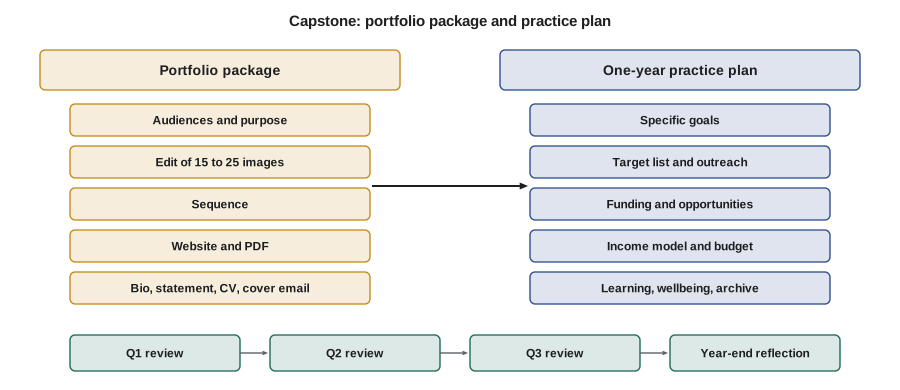
The capstone has two parts. The portfolio package is what you show to the world; the practice plan is what you use to run your first year.
- Part 1, portfolio package: a purpose statement for each audience, a final edit of 15 to 25 images per audience, a sequence, at least two formats (for example a website gallery and a tailored PDF), a bio or artist statement, a CV or client list and a short cover email.
- Part 2, practice plan: three to five goals for the year, a target list of clients or venues, an outreach and visibility calendar, a funding and opportunities calendar, an income model and budget, a professional development plan and an archive and backup plan.
- Part 3, reflection: a short written review of what you learned, how your work changed over the program and what you will do differently.
Step 1: define your audiences and goals
Choose one or two audiences that matter most for the year ahead (lesson 1). Write a purpose sentence for each portfolio. Then write three to five goals that are specific, measurable and realistic. "Get more work" is not a goal; "secure four paid editorial commissions from food or travel magazines by December" is. Include at least one goal for income, one for your body of work and one for your professional development.
| Vague hope | Specific goal | How you will measure it |
|---|---|---|
| Get gallery attention | Exhibit the community project in one artist-run centre or festival program | Acceptance letter and exhibition dates |
| Make more money | Reach $48,000 in photography income | Monthly income tracking against target |
| Get better clients | Land three commissions from brands with budgets over $5,000 | Signed estimates |
| Be more visible | Grow the newsletter from 150 to 500 subscribers who opted in | Email service reports |
| Keep learning | Complete a lighting-for-video workshop and add motion work to the portfolio | Certificate and three new motion pieces |
Step 2: edit, sequence and format
Use the staged edit from lesson 2 to reach your final selection, scoring images against criteria that match each purpose sentence. Seek feedback from at least two people who understand your audience and record the changes you made in response. Sequence the work using the principles from lesson 3 and test it with small prints. Produce at least two formats, following the specifications in lessons 3 and 4: a website gallery with alt text and metadata, and a PDF sized for screens and kept under common email limits.
Worked problem
Checking the edit
Your final commercial edit has 22 images. Two reviewers independently suggest removing images 7 and 15, and one reviewer suggests removing image 19. Your own weighted scores for those images are 3.4, 3.2 and 4.1 out of 5, against a portfolio average of 4.2. What should you do?
Show solution
- Images 7 and 15 are flagged by both reviewers and score well below average, so remove them.
- Image 19 is flagged by one reviewer but scores close to average; keep it unless you have a stronger replacement.
- The edit becomes 20 images, and the average score rises.
Answer: Remove images 7 and 15, keep 19 for now, and finish with 20 images, a stronger and more consistent set.
Step 3: write the supporting texts
Write a bio of about 100 to 150 words in the third person for websites and press, an artist statement of about 200 to 300 words in the first person for art audiences, and a CV or client list in a clean, consistent format. Draft a short cover email for each audience, under 150 words, following the outreach advice in lesson 6. Ask someone outside photography to read your texts; if they stumble over jargon, simplify.
Step 4: build your target list and outreach calendar
List 20 to 40 specific targets: named clients, art buyers, editors, galleries, artist-run centres, festivals or schools that fit your work (lesson 6). Record why each is a good fit and how you will approach them. Turn the list into a calendar: how many new contacts per week, when you will follow up, when you will send newsletters and how often you will post on social media (lesson 5). Make the plan modest enough to sustain while doing paid work.
Worked problem
Outreach targets for the year
Your goal is four new commissions this year. Based on lesson 6, you estimate that about 25 per cent of personalized contacts reply, half of replies lead to a meeting and one in five meetings leads to a commission. How many contacts do you need, and how many per week over 46 working weeks?
Show solution
- Conversion from contact to commission: \( 0.25 \times 0.5 \times 0.2 = 0.025 \).
- Contacts needed: \( 4 / 0.025 = 160 \).
- Per week: \( 160 / 46 \approx 3.5 \), so plan on three or four new contacts a week.
Answer: About 160 contacts, or three to four personalized contacts per week, plus follow-ups.
Step 5: plan funding and opportunities
Using lessons 8 and 9, list the grants, residencies, open calls, competitions and portfolio reviews that fit your goals, with deadlines, fees and expected benefits. Work backward from each deadline to set preparation dates. Set a yearly budget for entry fees and review events and choose opportunities that fit it. Include at least one grant or residency application if you have an art practice, and one opportunity that would stretch you.
| Month | Opportunity | Preparation starts | Cost |
|---|---|---|---|
| February | Municipal creation grant | December | Free |
| March | Festival open call | January | $35 |
| May | Portfolio review event | February | $1,900 with travel |
| September | Federal or national project grant (rolling or fixed deadline) | June | Free |
| October | Residency application | August | $30 |
| November | Selective competition with credible jurors | October | $60 |
Step 6: build your income model and budget
Apply the model from lesson 11 to your own numbers: annual costs, target income, tax reserve and realistic billable days, giving your minimum day rate. List expected income by stream (commissions, licensing, prints, teaching, grants) and by month, including slow seasons. Plan your cash buffer and how you will build it. Add a capital budget for equipment you truly need this year, and decide whether to buy, rent or wait.
Worked problem
Testing the income plan
Your plan has annual costs of $16,000, a target personal income of $46,000 and a tax reserve of $12,000. You expect $6,000 profit from print sales and teaching, and you estimate 70 billable days of commissioned work. What minimum day rate must your commissions earn?
Show solution
- Total needed: \( 16{,}000 + 46{,}000 + 12{,}000 = 74{,}000 \) dollars.
- Subtract other profit: \( 74{,}000 - 6{,}000 = 68{,}000 \) dollars from commissions.
- Minimum day rate: \( 68{,}000 / 70 \approx 971 \) dollars.
Answer: About $971 per billable day. If your market will not support this rate, adjust the plan: more billable days, lower costs, more income from other streams or a more modest income target for the first year.
Step 7: professional development, wellbeing and archive
Plan one or two learning goals for the year (lesson 11), a professional association or community you will join (lesson 10) and the habits that will keep you healthy and working: time off, working hours, a peer group and a plan for slow months. Write a short archive plan: folder and naming structure, metadata, 3-2-1 backups with an off-site copy and a yearly check that backups can be restored.
Step 8: quarterly reviews
A plan only works if you check it. Schedule a short review every quarter: compare income and enquiries with the plan, update your target list, refresh the portfolio with new work, check upcoming deadlines and adjust goals if circumstances change. At the end of the year, write a one-page review and a plan for the next year.
How the capstone is assessed
The capstone is assessed against a rubric that reflects what real decision makers look for. A strong submission is focused, consistent and realistic; it shows that you understand your audience, your market and your own capacity.
| Criterion | What strong work shows | Weight |
|---|---|---|
| Purpose and audience | Clear purpose sentences and audience-specific selections | 15 % |
| Edit and consistency | A tight edit with no weak images and a consistent standard | 20 % |
| Sequence and formats | Intentional sequence, professional website and PDF to specification | 15 % |
| Supporting texts | Clear bio, statement, CV or client list and cover emails | 15 % |
| Practice plan | Specific goals, realistic outreach, funding and income plans | 25 % |
| Reflection | Honest assessment of growth and lessons learned | 10 % |
Worked problem
Calculating a rubric score
A student scores 4, 5, 4, 3, 4 and 5 out of 5 on the six criteria in the order listed, with weights of 15, 20, 15, 15, 25 and 10 per cent. What is the final score out of 5 and as a percentage?
Show solution
- Weighted sum: \( 0.15 \times 4 + 0.20 \times 5 + 0.15 \times 4 + 0.15 \times 3 + 0.25 \times 4 + 0.10 \times 5 \).
- \( = 0.60 + 1.00 + 0.60 + 0.45 + 1.00 + 0.50 = 4.15 \).
- As a percentage: \( 4.15 / 5 = 0.83 \), or 83 per cent.
Answer: 4.15 out of 5, or 83 per cent; improving the supporting texts would raise the score most efficiently.
Looking ahead
Finishing the program is a beginning. The photographers who build lasting careers keep making new work, keep editing hard, keep in touch with the people who support them and keep checking their numbers. Your portfolio package will change many times; your plan will be revised every quarter. What stays constant is the professional approach this course has built: clear purpose, honest editing, generous relationships and a sustainable way of working.
Common mistakes
MistakeWriting goals such as "get more work"
InsteadWrite specific, measurable goals with dates and a way to check progress.
MistakeBuilding one portfolio for every possible audience
InsteadBuild a focused package for one or two priority audiences.
MistakePlanning more outreach than you can sustain alongside paid work
InsteadSet a modest weekly routine, such as three or four contacts a week, and keep it.
MistakeUsing a day rate that ignores costs and taxes
InsteadBase your minimum rate on costs, income target, tax reserve and billable days.
MistakeWriting a plan and never looking at it again
InsteadSchedule quarterly reviews and a yearly reflection.
Summary and key terms
- The capstone combines a portfolio package, a one-year practice plan and a reflection.
- Start with one or two audiences, purpose sentences and specific, measurable goals.
- Edit, sequence and format the work using the methods from earlier lessons and outside feedback.
- Write clear supporting texts: a bio, a statement, a CV or client list and short cover emails.
- Turn a target list into a sustainable outreach calendar based on realistic conversion rates.
- Plan funding, opportunities and income with deadlines, budgets and a minimum day rate.
- Review the plan every quarter and adjust as your practice develops.
- Portfolio package
- The complete set of images, formats and texts sent to a particular audience
- Practice plan
- A written plan for a year of professional activity, goals, income and development
- SMART goal
- A goal that is specific, measurable, achievable, relevant and time-bound
- Target list
- A researched list of specific clients, venues or funders to approach
- Outreach calendar
- A schedule for contacts, follow-ups, newsletters and posts
- Opportunities calendar
- A schedule of grant, residency, competition and review deadlines with preparation dates
- Capital budget
- Planned spending on long-lasting equipment or assets
- Quarterly review
- A check every three months of progress against the plan
- Rubric
- A scoring guide listing criteria, standards and weights
- Reflection
- A written review of what was learned and how practice will change
Practice problems
Work each problem on paper first, then reveal the answer to check.
List the three parts of the capstone.
Show answer
A portfolio package, a one-year practice plan and a written reflection.
Rewrite "be more visible" as a specific goal.
Show answer
For example: "Grow my newsletter from 200 to 500 opted-in subscribers by December."
Two reviewers flag an image that scores 3.0 against an average of 4.3. What should you do?
Show answer
Remove it, because independent feedback and a low score agree.
A goal of 3 commissions with a 2.5 % contact-to-commission rate needs how many contacts?
Show answer
\( 3 / 0.025 = 120 \) contacts.
120 contacts over 40 weeks is how many per week?
Show answer
\( 120 / 40 = 3 \) per week.
Costs $14,000, income $40,000, tax $10,000, other profit $4,000 and 60 billable days. What is the minimum day rate?
Show answer
\( 60{,}000 / 60 = 1{,}000 \) dollars.
Scores 5, 4, 4, 4, 3, 4 with weights 15, 20, 15, 15, 25, 10 give what total?
Show answer
\( 0.75 + 0.8 + 0.6 + 0.6 + 0.75 + 0.4 = 3.9 \) out of 5.
What should a quarterly review check?
Show answer
Income and enquiries against plan, target list, portfolio updates and upcoming deadlines.
How long should a cover email be?
Show answer
Under about 150 words.
What should an archive plan include?
Show answer
Folder and naming structure, metadata, 3-2-1 backups and yearly restore checks.
Lesson quiz · 5 questions
Score 60% or more to complete this lesson.
Create a free account to save your progress, take quizzes and earn a certificate.