
VIS-410 · Lesson 7 of 12 · 29 min
Pricing, licensing and contracts for creative work
Pricing is where many talented photographers struggle most. Charge too little and you cannot sustain a practice; charge too much without the work to back it up and you lose opportunities. This lesson builds on the licensing and pricing basics in PHOT-302 and focuses on three areas that matter as you turn a portfolio into a practice: pricing commissioned work with usage in mind, pricing and editioning prints for sale, and the agreements that govern exhibitions, consignment and fees. It also explains a real legal difference between Canada and the United States: Canadian artists have an exhibition right; American artists do not.
The three parts of a commercial price
A commercial photography price usually has three parts. The creative fee pays for your time, skill and creative contribution. The usage or licence fee pays for the client's right to use the images in specific ways, for a specific time and place. Expenses and production costs cover crew, studio, props, travel, retouching and other direct costs, often with a handling markup. Separating them in estimates helps clients understand what they are paying for and protects the value of your images when usage expands later. PHOT-302 explains licensing terms such as media, territory, duration and exclusivity.
Knowing your minimum
Before you negotiate, know the minimum price at which a job is worth doing. That figure comes from your annual costs, your income target and the number of days you can realistically bill (lesson 11 builds this model in detail). Many new photographers set prices by looking at what others charge, without checking whether those prices would cover their own costs. Price comparisons are useful for understanding the market, but your minimum must come from your own numbers.
Pricing prints and editions
Fine art photographers often sell prints in limited editions. An edition is a fixed number of prints of an image at a given size, each numbered and signed, often with a small number of artist's proofs (APs) kept outside the edition. Limiting supply supports value, and editions usually rise in price as they sell. Once you announce an edition size, keep it: printing more than you declared breaks trust with collectors and, in some places, can breach consumer or art-sales laws.
- Common edition sizes range from very small (3 to 5 prints at large sizes) to 25 or more for smaller prints.
- Price usually rises with size, rarity and the artist's exhibition and sales history.
- Many artists use stepped pricing: the first prints in an edition sell at a base price, and the price increases as the edition sells out.
- Keep a certificate of authenticity and a record of every print: number, size, paper, date, buyer and price.
Worked problem
Pricing an edition sold through a gallery
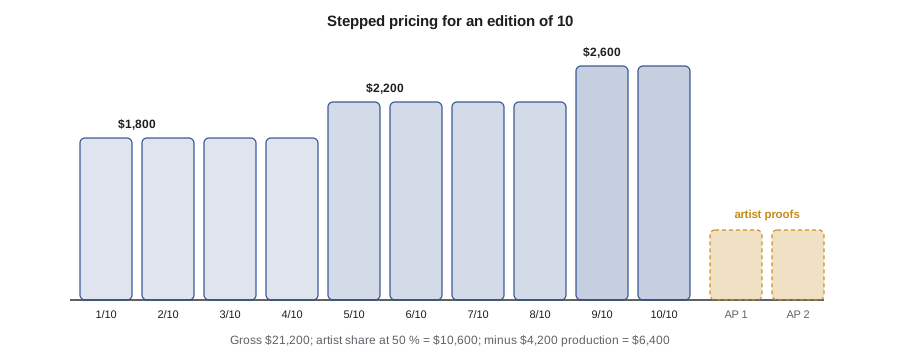
A photographer releases an edition of 10 prints at about 60 by 75 cm. The gallery takes a 50 per cent commission. Printing, mounting and framing cost the artist $420 per print. The first 4 prints sell at $1,800, the next 4 at $2,200 and the last 2 at $2,600. What does the artist net if the whole edition sells?
Show solution
- Gross sales: \( 4 \times 1{,}800 + 4 \times 2{,}200 + 2 \times 2{,}600 = 7{,}200 + 8{,}800 + 5{,}200 = 21{,}200 \) dollars.
- Artist's share after a 50 per cent commission: \( 21{,}200 \times 0.5 = 10{,}600 \) dollars.
- Production cost: \( 10 \times 420 = 4{,}200 \) dollars.
- Artist net: \( 10{,}600 - 4{,}200 = 6{,}400 \) dollars, or $640 a print on average.
Answer: About $6,400 if the whole edition sells, before taxes and other overheads. Who pays for framing is negotiable; some galleries share production costs or deduct them before splitting.
The example shows why the split and production costs matter so much. If the gallery agreed to share framing costs 50/50, the artist would save \( 4{,}200 / 2 = 2{,}100 \) dollars. Always clarify who pays for production, shipping, insurance and installation before an exhibition.
Selling prints directly
Selling directly through your website, studio sales or markets avoids gallery commission but adds work: payment processing, packing, shipping, returns, sales tax and customer service. Direct sales can also undercut a gallery that represents you; most representation agreements require consistent pricing, so that collectors do not find the same print cheaper on your website. Decide on a single retail price for each edition and size, and stick to it across all channels.
Worked problem
Direct sale or gallery sale?
A print retails at $900. Through a gallery the artist receives 50 per cent and the gallery handles everything. Selling directly, the artist pays 3 per cent in payment fees, $45 for packing and shipping, and spends about 2 hours on the sale, which she values at $40 an hour. Production costs $150 either way. Which channel nets more for this one sale?
Show solution
- Gallery: \( 900 \times 0.5 - 150 = 300 \) dollars.
- Direct: \( 900 - 0.03 \times 900 - 45 - 150 = 900 - 27 - 45 - 150 = 678 \) dollars, minus time worth \( 2 \times 40 = 80 \) dollars, giving 598 dollars.
Answer: Direct sale nets about $598 against $300 through the gallery for this sale. The gallery's value lies in reaching collectors and sales the artist would not make alone, so many artists use both channels with consistent prices.
Exhibition fees and the CARFAC-RAAV schedule
In Canada, CARFAC (Canadian Artists' Representation / Le Front des artistes canadiens) and RAAV (Regroupement des artistes en arts visuels du Québec) publish the CARFAC-RAAV Minimum Recommended Fee Schedule. It sets minimum fees for exhibitions, reproductions, presentations, professional services and other uses, scaled by the type and size of the institution. The schedule is updated yearly through negotiation and to reflect the cost of living, so always check the current version before quoting. Many public galleries and artist-run centres, especially those funded by the Canada Council for the Arts, are expected to pay fees at or above the schedule. Fees for copyright uses are subject to GST/HST, which is not included in the listed amounts.
The exhibition right
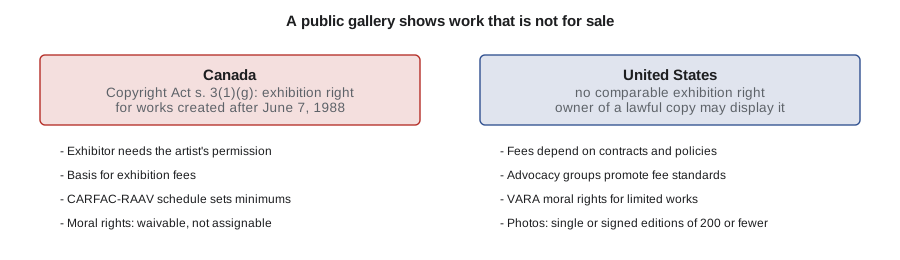
Canada's Copyright Act gives artists an exhibition right: the sole right to present an artistic work at a public exhibition, for a purpose other than sale or hire, for works created after June 7, 1988 (section 3(1)(g)). In practice this means that a public gallery or other exhibitor showing your work, other than to sell it, needs your permission, and artists' organizations use this right as the legal basis for exhibition fees. The right does not apply to work shown in a commercial gallery for the purpose of selling it. Canadian artists also have moral rights: the right to be credited, to remain anonymous or use a pseudonym, and to protect the integrity of the work and its association with products or causes. Moral rights cannot be assigned, though they can be waived in writing.
US copyright law does not include an exhibition right comparable to Canada's. The owner of a lawful copy of a work, such as a collector who bought a print, may generally display that copy publicly where it is located, so exhibition fees in the United States depend on contracts and institutional policies rather than on copyright. Advocacy groups promote fee standards, and some non-profit spaces and museums pay artist fees, but practice varies widely. Moral rights are limited: the Visual Artists Rights Act of 1990 protects attribution and integrity for a narrow category of works of visual art, which includes still photographs produced for exhibition only, in single copies or signed and numbered editions of 200 or fewer.
Consignment agreements
Galleries and shops usually sell artwork on consignment: you keep ownership of the work until it sells, the gallery displays and sells it, and you are paid your share after the sale. A written consignment agreement protects both sides. It should list each work with its retail price and the commission, state when you will be paid (for example within 30 days of the sale), who pays for framing, shipping and insurance, whether the gallery can offer discounts and who absorbs them, how long the gallery holds the work and how you get it back.
- Insurance: confirm that the gallery insures consigned work against loss and damage while it is in their care, and at what value.
- Discounts: galleries sometimes give collectors 10 per cent or more; agree in writing whether discounts come from the gallery's share, the artist's share or both.
- Payment: specify the payment deadline and the information you will receive about each sale, such as the buyer's name for your records where privacy rules allow.
- Ownership: some jurisdictions protect consigned art from a dealer's creditors if the gallery fails financially, but protection varies, so a clear agreement and prompt payment terms matter everywhere.
Worked problem
Who pays for a discount?
A gallery sells a $3,000 print with a 10 per cent collector discount. The agreement says the artist and gallery split 50/50 after discounts, and the gallery must pay within 30 days. What does the artist receive, and what would she receive if the gallery absorbed the discount alone?
Show solution
- Sale price after discount: \( 3{,}000 \times 0.9 = 2{,}700 \) dollars.
- Shared discount: artist receives \( 2{,}700 \times 0.5 = 1{,}350 \) dollars.
- Gallery absorbs the discount: artist receives 50 per cent of the full retail price, \( 3{,}000 \times 0.5 = 1{,}500 \) dollars, and the gallery receives \( 2{,}700 - 1{,}500 = 1{,}200 \) dollars.
Answer: $1,350 if the discount is shared, or $1,500 if the gallery absorbs it. The difference of $150 shows why discount terms belong in writing.
Contracts for commissions and licensing
Every commissioned job and every licence should be documented, even with a short email that both sides confirm. Key terms include the scope of work, deliverables and deadlines, fees and payment schedule, licensed uses (media, territory, duration, exclusivity), credit requirements, approvals and revisions, cancellation and rescheduling, who owns copyright (normally the photographer unless assigned in writing), model and property releases, and limits on liability. PHOT-302 and PHOT-340 give examples of photography contracts; CRE-330 covers contract clauses in more detail for creators.
In Quebec, the law on the professional status of artists sets requirements for written contracts with artists in the visual arts and allows recognized artists' associations to negotiate collective terms; Quebec photographers should check how it applies to their work. Elsewhere in Canada, contracts follow provincial contract law, and copyright assignments must be in writing and signed by the owner.
Negotiating with confidence
Negotiation is easier when you know your minimum, understand what the client values and can offer options. Instead of lowering your price, change the scope: fewer images, a narrower licence, a shorter duration or a simpler production. Ask questions before quoting: how the images will be used, where, for how long and how important the campaign is to the client. Put every agreement in writing and confirm changes by email.
Common mistakes
MistakePricing by copying other photographers' rates
InsteadCalculate your own minimum from costs, income target and billable days, then compare with the market.
MistakePrinting more copies than the edition size you announced
InsteadKeep every edition to its declared size and record every print.
MistakeSelling the same print cheaper on your own website than through your gallery
InsteadUse one retail price across all channels.
MistakeLeaving discounts, insurance and payment dates out of consignment agreements
InsteadPut every term in a written agreement before delivering work.
MistakeAssuming exhibition fees work the same in Canada and the United States
InsteadCanada has a statutory exhibition right and a fee schedule; US fees depend on contracts and policies.
Summary and key terms
- Commercial prices combine a creative fee, a licence fee and expenses with a markup.
- Know your minimum price from your own costs before negotiating.
- Limited editions support value; keep edition sizes fixed and price prints consistently across channels.
- Gallery commissions of around 50 per cent, production costs and discounts strongly affect what artists net.
- The CARFAC-RAAV schedule sets minimum recommended fees in Canada and is updated yearly.
- Canada's Copyright Act gives an exhibition right for works created after June 7, 1988; US law does not.
- Written consignment, commission and licensing agreements protect both sides.
- Creative fee
- The part of a price that pays for the photographer's time, skill and creative input
- Licence fee
- The part of a price that pays for the right to use images in defined ways
- Edition
- A fixed number of numbered, signed prints of an image at a given size
- Artist's proof (AP)
- A print kept outside the numbered edition, usually by the artist
- Certificate of authenticity
- A document recording an artwork's details, edition number and authenticity
- Consignment
- An arrangement in which a gallery sells work it does not own and pays the artist after sale
- CARFAC-RAAV fee schedule
- Canada's minimum recommended fees for artists' exhibitions, reproductions and services
- Exhibition right
- In Canada, the artist's right to control public exhibition of works not shown for sale or hire
- Moral rights
- Rights to attribution and to the integrity of a work, separate from copyright ownership
- Work made for hire
- In US law, work owned by an employer or commissioning party only in narrow, defined cases
Practice problems
Work each problem on paper first, then reveal the answer to check.
Name the three parts of a commercial photography price.
Show answer
Creative fee, licence fee and expenses (often with a markup).
An edition of 8 sells 4 at $1,000 and 4 at $1,300 with a 50 % commission and $250 production per print. What is the artist's net?
Show answer
Gross \( 9{,}200 \); half is \( 4{,}600 \); minus \( 2{,}000 \) gives \( 2{,}600 \) dollars.
What is an artist's proof?
Show answer
A print outside the numbered edition, usually kept by the artist.
Why should prices be consistent across channels?
Show answer
So collectors and galleries trust that the same work is not sold more cheaply elsewhere.
A $600 print sold directly has 3 % fees, $35 shipping and $120 production. What does the artist net before time?
Show answer
\( 600 - 18 - 35 - 120 = 427 \) dollars.
What does section 3(1)(g) of Canada's Copyright Act provide?
Show answer
An exhibition right for artistic works created after June 7, 1988 shown publicly other than for sale or hire.
Does US copyright law include an exhibition right like Canada's?
Show answer
No; exhibition fees in the US depend on contracts and institutional policies.
List four terms a consignment agreement should cover.
Show answer
Retail price and commission, payment deadline, insurance, discounts (also costs and return of work).
A $2,000 print sells with a 15 % discount shared 50/50. What does the artist receive?
Show answer
\( 2{,}000 \times 0.85 \times 0.5 = 850 \) dollars.
Instead of lowering a price, how can you adjust a quote?
Show answer
Reduce the scope: fewer images, a narrower or shorter licence, or simpler production.
Lesson quiz · 5 questions
Score 60% or more to complete this lesson.
Create a free account to save your progress, take quizzes and earn a certificate.