
BAR-207 · Lesson 10 of 12 · 16 min
The Connecticut Rules of Professional Conduct and attorney regulation
▶ Video coming soon A video version of this lesson is on the way.
Graham scored 88 on the MPRE, and he knows the ABA Model Rules well. What he does not yet know is how Connecticut's own rules differ from them. 'That gap catches new lawyers in every state,' Hollis Marchetti says. 'You study the Model Rules for the MPRE, and then you practice under your state's rules, which are mostly the same and sometimes very different. Connecticut has a few differences that matter a great deal, starting with the one that tells you when you must break a client confidence.'
This lesson covers the Connecticut Rules of Professional Conduct, which the judges of the Superior Court adopt as part of the Practice Book, the main ways they differ from the Model Rules, and the system of attorney registration and discipline that begins on the day of admission. The MPRE tests the Model Rules, so these differences are for practice, not for the exam.
Where the rules come from
Connecticut adopted rules based on the ABA Model Rules in 1986 and has amended them many times, generally following the ABA's revisions with its own changes. The Rules of Professional Conduct are published in the front of the Connecticut Practice Book with official commentary. They govern every lawyer admitted in Connecticut and every lawyer who practices here, including lawyers admitted elsewhere who provide legal services in Connecticut. The Superior Court judges adopt and amend them on recommendation from the Rules Committee of the Superior Court, after public comment.
Confidentiality: a mandatory disclosure duty
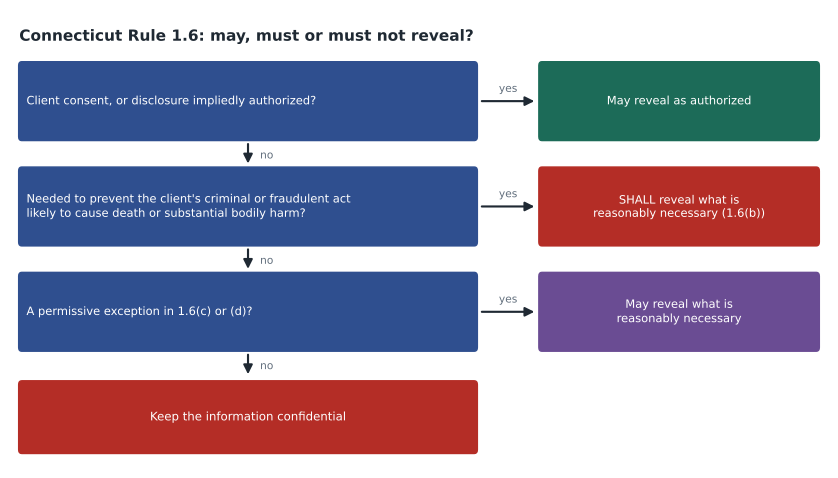
The most important difference is in Rule 1.6. Like the Model Rule, Connecticut's rule forbids a lawyer to reveal information relating to the representation of a client unless the client gives informed consent, the disclosure is impliedly authorized, or an exception applies. But Connecticut's first exception is mandatory, not permissive. Rule 1.6(b) provides that a lawyer shall reveal such information to the extent the lawyer reasonably believes necessary to prevent the client from committing a criminal or fraudulent act that the lawyer believes is likely to result in death or substantial bodily harm. Under Model Rule 1.6(b)(1), disclosure to prevent reasonably certain death or substantial bodily harm is permitted but not required.
The rest of Connecticut's exceptions are permissive. Rule 1.6(c) allows a lawyer to reveal information to the extent reasonably necessary to prevent a client's criminal or fraudulent act likely to cause substantial injury to the financial interest or property of another, to prevent, mitigate or rectify the consequences of a client's crime or fraud in which the lawyer's services were used, to secure legal advice about the lawyer's own compliance with the rules, to comply with other law or a court order, or to detect and resolve conflicts arising from a change of employment or of a firm's composition. Rule 1.6(d) allows disclosure to establish a claim or defense in a controversy between the lawyer and the client and to respond to allegations about the lawyer's representation.
| Situation | ABA Model Rule 1.6 | Connecticut Rule 1.6 |
|---|---|---|
| Client's criminal or fraudulent act likely to cause death or substantial bodily harm | May reveal (reasonably certain death or bodily harm, from any cause) | Shall reveal, to the extent reasonably necessary |
| Client's crime or fraud likely to cause substantial financial injury | May reveal if the lawyer's services were used | May reveal |
| Rectifying a crime or fraud in which the lawyer's services were used | May reveal | May reveal |
| Lawyer's own legal advice; claims and defenses; court orders | May reveal | May reveal |
The mandatory duty is narrow. It applies to a client's criminal or fraudulent act, not to every risk of harm, and it requires disclosure only to the extent the lawyer reasonably believes necessary. But a Connecticut lawyer who knows a client is about to commit a violent crime has no choice to make. A lawyer who has absorbed the Model Rule's word may could make a serious mistake.
Other differences worth knowing
Connecticut's fee rule, Rule 1.5, requires that the scope of the representation and the basis or rate of the fee and expenses be communicated to the client in writing before or within a reasonable time after the representation begins, with limited exceptions such as regularly represented clients charged on the same basis. That is stricter than the Model Rule, which only prefers a writing. Contingent fee agreements must be in writing and signed by the client, and Connecticut statutes cap contingent fees in personal injury, wrongful death and property damage cases arising from negligence, on a sliding scale, unless the client waives the cap in writing under statutory conditions. A new lawyer in a personal injury firm should read the statutory schedule before drafting a fee agreement.
Connecticut's rules on advertising and solicitation also differ in detail from the Model Rules, including filing requirements for some advertisements with the Statewide Grievance Committee and rules on targeted written communications, and Connecticut has its own rules on trust accounts and the Interest on Lawyers' Trust Accounts program, which every lawyer handling client funds must follow. These details change more often than the core rules, so a new lawyer should read the current text rather than rely on memory.
Registration and the juris number
Admission is followed immediately by registration. Every attorney admitted in Connecticut is registered with the Statewide Grievance Committee and receives a juris number, which the committee's guidance says usually arrives about fifteen days after the Statewide Grievance Committee is notified of the swearing-in. A lawyer needs the juris number to file an appearance in court. Practice Book section 2-27(d) requires every attorney to register each year, online, between January and early March, updating addresses, practice information and the certification of continuing education. Lawyers must also notify the Statewide Bar Counsel within thirty days of admission in another jurisdiction, and must report any discipline imposed by another jurisdiction.
Discipline
Discipline in Connecticut is a court function carried out through several bodies. A grievance against a lawyer is filed with the Statewide Bar Counsel and usually referred to a local grievance panel, which investigates and decides whether there is probable cause of misconduct. If there is, the matter goes to a reviewing committee of the Statewide Grievance Committee, which may dismiss it, impose discipline such as a reprimand, or direct the Office of Chief Disciplinary Counsel to present the matter to the Superior Court for more serious sanctions. Only the court can suspend or disbar a lawyer. Lawyers who fail to register or to meet continuing education requirements can be administratively suspended until they cure the failure.
| Body | Role |
|---|---|
| Statewide Bar Counsel | Receives grievances and assigns them |
| Grievance panels | Investigate and decide probable cause |
| Statewide Grievance Committee | Reviews findings, imposes lesser discipline, keeps the register |
| Office of Chief Disciplinary Counsel | Prosecutes serious matters in the Superior Court |
| Superior Court | Imposes suspension or disbarment |
| Client Security Fund | Reimburses clients harmed by a lawyer's dishonest conduct |
The Client Security Fund
Practice Book section 2-70 establishes the Client Security Fund, financed by an annual fee assessed on Connecticut attorneys. The fund reimburses clients who lose money or property because of a lawyer's dishonest conduct, such as theft from a trust account, when no other source of recovery is available. Paying the fee is a condition of active status, and lawyers are reminded of it with their annual registration.
Worked problem
A client's threat
During a meeting about a custody dispute, Graham's firm's client says that if the court rules against him next week, he will go to his former partner's house and hurt her, and describes the weapon he owns. The lawyer reasonably believes he means it.
Show solution
- The information relates to the representation and is confidential under Rule 1.6(a).
- The client is threatening a criminal act likely to cause death or substantial bodily harm.
- Connecticut Rule 1.6(b) says the lawyer shall reveal the information to the extent reasonably necessary to prevent it.
- Under the Model Rule the lawyer would be permitted, not required, to disclose.
Answer: The lawyer must disclose enough to prevent the harm, for example by warning the former partner or the police, and should limit disclosure to what is necessary. The lawyer should also consider whether withdrawal is required.
Marchetti ends the session with a habit she wants Graham to form. 'Keep the Model Rules in your head for the MPRE and your February exam,' she says, 'and keep the Connecticut rulebook on your desk at work. When a question about ethics comes up in practice, the first move is to read the Connecticut rule and its commentary, not to remember the Model Rule. And when you are unsure, the Connecticut Bar Association has an ethics committee that issues informal opinions you can read.'
Common mistakes
MistakeConnecticut lawyers may choose whether to disclose a client's planned violent crime.
InsteadRule 1.6(b) requires disclosure to the extent reasonably necessary.
MistakeThe MPRE tests Connecticut's rules.
InsteadThe MPRE tests the ABA Model Rules.
MistakeA juris number is optional.
InsteadA lawyer needs a juris number to file an appearance.
MistakeThe Statewide Grievance Committee can disbar a lawyer.
InsteadOnly the Superior Court can suspend or disbar.
Conflicts and the duty to the court
Most of Connecticut's conflict of interest rules, Rules 1.7 to 1.11, follow the Model Rules closely: a lawyer may not represent a client whose interests are directly adverse to another current client, or where there is a significant risk the representation will be materially limited, unless the lawyer reasonably believes the representation will be competent and diligent and each affected client gives informed consent, confirmed in writing. Former client conflicts, imputation within a firm, screening of lateral lawyers and the special rules for former government lawyers follow the familiar structure. A new lawyer moving between firms should know that Connecticut's Rule 1.6(c) permits limited disclosure of information to detect and resolve conflicts arising from a change of employment, as the Model Rule does.
The duties to the court in Rules 3.1 to 3.9 also track the Model Rules: a lawyer may not bring frivolous claims, must be candid with the tribunal, must disclose directly adverse controlling authority the other side has not cited, and may not offer evidence the lawyer knows is false. Connecticut courts have also addressed the use of generative artificial intelligence in court filings through orders and guidance, and the core rule remains the same: a lawyer who signs a filing is responsible for every citation and quotation in it, however it was prepared.
Trust accounts
Connecticut lawyers who hold client funds must keep them in a separate trust account, maintain records of every deposit and disbursement, and reconcile the account regularly. Practice Book provisions on trust accounts include an overdraft notification program: banks that hold lawyers' trust accounts agree to report any overdraft to the Statewide Grievance Committee or disciplinary counsel, which may lead to an inquiry or a random audit. Funds that are nominal in amount or held for a short time go into an IOLTA account, whose interest funds legal services for low-income people through the Connecticut Bar Foundation. Misuse of client funds is the most common cause of disbarment in Connecticut, as in most states, and also the most common source of Client Security Fund claims.
Pro bono and practice after hours
Connecticut's Rule 6.1 encourages lawyers to provide legal services to people of limited means, as the Model Rule does, but does not make pro bono service mandatory. The Judicial Branch and bar groups run volunteer programs, including attorney of the day programs in housing and family courts, where new lawyers can gain experience under the guidance of experienced practitioners. Marchetti suggests that Graham sign up once he is admitted. 'The fastest way to learn Connecticut practice,' she says, 'is to stand next to someone who has done it for twenty years, on a morning when forty people need help.'
The MPRE versus Connecticut, side by side
To help Graham keep the two sets of rules apart, Marchetti builds a short list of points where the MPRE answer and the Connecticut answer can differ. The confidentiality rule is first: on the MPRE, disclosure to prevent death or substantial bodily harm is permitted; in Connecticut, disclosure to prevent a client's criminal or fraudulent act likely to cause it is required. Fees are second: on the MPRE, a writing is preferred for ordinary fees; in Connecticut, the scope and basis must be communicated in writing, subject to limited exceptions, and contingent fees in negligence cases are subject to a statutory cap. Third, advertising details and filing requirements vary; the MPRE tests the Model Rules' general principles. Fourth, discipline: the MPRE does not test any state's disciplinary procedure, but Connecticut lawyers must know theirs.
| Point | MPRE answer (Model Rules) | Connecticut practice |
|---|---|---|
| Preventing death or substantial bodily harm | May disclose | Shall disclose (client's criminal or fraudulent act) |
| Ordinary fee agreement | Writing preferred | Writing required, with limited exceptions |
| Contingent fees in negligence cases | Must be reasonable, in writing | Also capped by statute unless properly waived |
| Discipline process | Not tested | Grievance panels, Statewide Grievance Committee, Superior Court |
Ethics help
Connecticut lawyers facing an ethics question have several sources of help. The Connecticut Bar Association's Professional Ethics Committee issues informal opinions on questions members submit, and its opinions are published. The official commentary to each rule explains its purpose and application. And the Connecticut courts' disciplinary decisions show how the rules are applied in practice. Graham adds a line to his notebook: when in doubt, read the Connecticut rule and its commentary, check the bar association's opinions, and ask a senior lawyer before acting.
Marchetti's final reminder is that rules and commentary are amended from time to time, so the version to rely on is the one currently published in the Practice Book, not a printout from law school.
Summary and key terms
- Connecticut's Rules of Professional Conduct are adopted by the Superior Court judges and follow the Model Rules with differences.
- Rule 1.6(b) makes disclosure mandatory to prevent a client's criminal or fraudulent act likely to cause death or substantial bodily harm.
- Rule 1.5 requires the fee basis in writing; contingent fees are capped by statute in negligence cases unless waived.
- Lawyers register annually, receive a juris number and pay the Client Security Fund fee.
- Grievance panels, the Statewide Grievance Committee and Chief Disciplinary Counsel handle discipline; only the court suspends or disbars.
- Rule 1.6(b)
- Connecticut's mandatory confidentiality exception for preventing death or substantial bodily harm.
- Statewide Bar Counsel
- The officer who receives grievances and handles out-of-state admission notices.
- Grievance panel
- A local body that investigates grievances for probable cause.
- Chief Disciplinary Counsel
- The office that prosecutes serious misconduct in the Superior Court.
- Client Security Fund
- A fund financed by lawyers that reimburses clients for lawyer dishonesty.
Lesson quiz · 5 questions
Score 60% or more to complete this lesson.
Create a free account to save your progress, take quizzes and earn a certificate.