
BAR-207 · Lesson 6 of 12 · 16 min
What the exam tests and how Connecticut law appears
▶ Video coming soon A video version of this lesson is on the way.
Halfway through their sessions, Graham asks the question every Connecticut candidate eventually asks. 'If the exam tests no Connecticut law, why should I learn any before I pass?' Hollis Marchetti does not answer directly. Instead she asks him what he did at work that morning. He drafted a motion to strike, checked a return date, and calculated the interest on an offer of compromise for a partner who was deciding whether to file one. 'Every one of those is Connecticut law,' she says. 'None of them will be on your exam. All of them will be on your desk the week you are sworn in. So we do both: we pass the national exam, and we make sure Connecticut law never trips you on it.'
This lesson explains what NextGen tests, why Connecticut adds no state-law component, how Connecticut law can mislead a candidate on a national exam, and how to build a short Connecticut notebook that serves both the exam and the first months of practice.
What NextGen tests
NCBE's content scope for NextGen sets out two kinds of content. The first is foundational concepts and principles in eight subjects: civil procedure, contract law, evidence, torts, business associations, constitutional law, criminal law and constitutional protections of the accused, and real property. The second is seven foundational lawyering skills: legal research, legal writing, issue spotting and analysis, investigation and evaluation, client counseling and advising, negotiation and dispute resolution, and client relationship and management. NCBE marks certain topics within the subjects as tested only through the skills, with the law provided, rather than from memory. A candidate should read the current content scope and the official examinees' guide for the exact list, because NCBE has updated both since 2023.
Professional responsibility appears in a limited way. NCBE has said a short list of Model Rules of Professional Conduct may be tested within integrated question sets that involve client-facing skills. The MPRE remains the main test of ethics, and Connecticut still requires it.
| Area | What NextGen does with it |
|---|---|
| Eight foundational subjects | Tested from memory, with some topics marked as tested only with law supplied |
| Seven lawyering skills | Tested through integrated sets and performance tasks |
| Family law | Added to the foundational subjects from July 2028 |
| Trusts and estates | May appear with the law supplied |
| Selected Model Rules | May appear in client-facing integrated sets |
| State law | Not tested; answers follow general principles or supplied law |
No Connecticut component
Connecticut does not add any jurisdiction-specific component to the exam. NCBE's jurisdiction information lists no Connecticut-specific requirement for either the legacy UBE or NextGen, and the committee's regulations describe the exam entirely in terms of the NCBE components. That puts Connecticut among the jurisdictions that rely wholly on the national exam, unlike neighbors that add a state-law course or test. The practical effect is that a Connecticut candidate's preparation is the same as a candidate's anywhere else on NextGen, and that nothing in the admission process requires the candidate to study the Practice Book or the General Statutes.
How Connecticut law can mislead
The danger for a candidate who already works in Connecticut is not ignorance of Connecticut law. It is the opposite: answering a national question with a Connecticut rule. NextGen multiple-choice questions follow generally accepted principles, the Federal Rules of Civil Procedure and Evidence, and uniform acts where the question indicates them. Integrated sets and performance tasks supply the law that governs. A candidate who reaches for local practice can choose an answer that would be right in a Hartford courtroom and wrong on the exam.
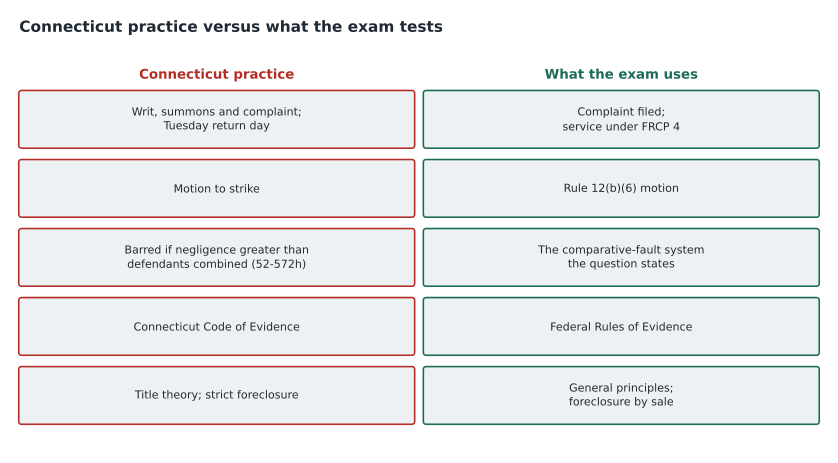
Several Connecticut rules are classic traps. Connecticut's procedure begins with a writ, summons and complaint served by a state marshal and returned to court before a fixed return day; the exam's civil procedure is federal, with a complaint filed first and service under Federal Rule 4. Connecticut tests the legal sufficiency of a pleading with a motion to strike; the exam uses a Rule 12(b)(6) motion to dismiss for failure to state a claim. Connecticut's comparative negligence statute bars a plaintiff whose negligence is greater than the combined negligence of the defendants; the exam usually tells the candidate which system to apply or assumes pure comparative negligence. Connecticut has its own Code of Evidence, adopted by the judges, which differs from the Federal Rules in places; the exam tests the Federal Rules. Connecticut is a title theory state for mortgages and uses strict foreclosure; the exam's real property questions follow general principles unless they say otherwise.
Reading what the question supplies
Integrated question sets and performance tasks often place the facts in a fictional jurisdiction and supply statutes and cases in a library. Graham's July experience shows why that matters: in one task, the library contained a statute on recreational land use that looked like Connecticut's but differed on a key exception. Candidates who knew the real statute had to set that knowledge aside and work only from the library. The rule for every supplied-law question is simple. The library is the law. If the task memo says the facts arise in a fictional state, Connecticut law is irrelevant, however familiar the facts may feel.
Building a Connecticut notebook
Marchetti does not want Graham to stop learning Connecticut law. She wants him to put it in the right place. She asks him to keep a short notebook with two columns. On the left he writes the national rule the exam tests; on the right, the Connecticut rule he uses at work, with its source. When he sees a Connecticut rule in practice, he adds it. When he studies a national topic, he checks whether Connecticut differs and notes it. The notebook does three jobs at once. It trains him to notice the difference between local and national rules, which protects him on the exam. It becomes a starting outline for the Connecticut practice he will need after admission. And it helps him answer questions from clients and colleagues who assume a new lawyer already knows Connecticut practice.
| Topic | Exam rule | Connecticut rule (source) |
|---|---|---|
| Starting a civil action | Complaint filed; service under FRCP 4 | Writ, summons and complaint served before a Tuesday return day (General Statutes chapter 896) |
| Testing legal sufficiency | Rule 12(b)(6) motion | Motion to strike (Practice Book section 10-39) |
| Comparative negligence | As the question states | Barred if greater than combined negligence of defendants (General Statutes section 52-572h) |
| Evidence code | Federal Rules of Evidence | Connecticut Code of Evidence |
| Mortgage foreclosure | General principles | Strict foreclosure or foreclosure by sale |
Where Connecticut law does appear
Although the exam tests no Connecticut law, Connecticut law shapes the rest of the admission process. The character and fitness review applies Connecticut's standards. The Practice Book governs admission, registration and continuing education. After admission, the Connecticut Rules of Professional Conduct, not the Model Rules tested on the MPRE, govern a lawyer's conduct. And the first weeks of practice involve the Connecticut courts, procedure and statutes covered in the next four lessons. For a candidate who already works in a Connecticut firm, as Graham does, those lessons also explain much of what he has been doing by instinct.
Worked problem
Choosing the answer the exam wants
A multiple-choice question describes a plaintiff injured in a collision who was 55 percent at fault, suing a single defendant who was 45 percent at fault. It states that the jurisdiction follows pure comparative negligence and asks how much of 100,000 dollars in damages the plaintiff recovers.
Show solution
- Under Connecticut's statute, a plaintiff more at fault than the defendants recovers nothing.
- The question says the jurisdiction follows pure comparative negligence.
- Under pure comparative negligence, damages are reduced by the plaintiff's share of fault.
- The plaintiff recovers 45 percent of 100,000 dollars.
Answer: The answer is 45,000 dollars. A candidate who applied Connecticut's rule would choose zero and lose the point.
A study plan that fits
For Graham's February plan, Marchetti divides his weekly time three ways. About half goes to written work: one full performance task, timed, and four integrated question sets, each reviewed against a model answer. About a third goes to multiple-choice practice in the eight subjects, with his miss log reviewed every Sunday. The rest goes to reading NCBE's content scope and official materials, so that he knows which topics are tested from memory and which come with law supplied. Connecticut law gets no exam time. It gets ten minutes a day at work, in the notebook.
Common mistakes
MistakeConnecticut adds a state-law essay to NextGen.
InsteadConnecticut has no jurisdiction-specific component.
MistakeA Connecticut rule is a safe answer on the exam.
InsteadUse general principles, federal rules or the law the question supplies.
MistakeIf the facts feel familiar, real Connecticut law governs a performance task.
InsteadThe library is the law; a fictional jurisdiction means Connecticut law is irrelevant.
MistakeProfessional responsibility is no longer tested anywhere.
InsteadThe MPRE still applies, and NextGen may test selected Model Rules in integrated sets.
Subject by subject: where the traps are
Marchetti and Graham go through the eight subjects one at a time, asking the same question for each: where does Connecticut practice differ from what the exam tests, and where would a Connecticut lawyer's instinct lead to a wrong answer?
Civil procedure is the most dangerous subject for a Connecticut clerk, because the exam tests federal procedure and Connecticut state practice differs at almost every step. Service, pleading, the order of motions, the timing of jurisdictional objections and the deadline to appeal are all different. Graham's rule for the exam is simple: if the question does not say otherwise, think Federal Rules and Title 28.
Evidence is the second. Connecticut has its own Code of Evidence, adopted by the judges in 2000, which tracks the Federal Rules in structure but differs in places, including on some hearsay exceptions and on how certain prior statements may be used. The exam tests the Federal Rules of Evidence as currently in effect. Graham, who reads Connecticut evidence rulings at work, makes a list of the differences he has noticed and studies the federal rule for each.
Torts is the third. The exam tests general principles: duty, breach, causation, damages, the intentional torts, strict liability and products liability. Where comparative fault matters, the question usually says which system applies. Connecticut's statutory modified system, several liability and product liability act are practice knowledge, not exam knowledge.
Real property is the fourth. Connecticut's title theory, strict foreclosure, forty-year marketable title act and fifteen-year adverse possession period are local. The exam's real property questions follow general principles, and where a recording act matters, the question tells the candidate whether the jurisdiction is race, notice or race-notice.
Contracts, constitutional law, criminal law and procedure, and business associations are less dangerous, because Connecticut law there is closer to general principles or is federal in any event. The main risk in criminal law is the Model Penal Code versus common law distinction, which the exam signals in the question. In business associations, the exam tests general agency, partnership, corporate and limited liability company principles; a Connecticut lawyer's familiarity with the state's own business entity statutes rarely misleads.
| Subject | Risk for a Connecticut clerk | Rule for the exam |
|---|---|---|
| Civil procedure | High | Federal Rules and Title 28 |
| Evidence | High | Federal Rules of Evidence |
| Torts | Medium | General principles; follow the stated fault system |
| Real property | Medium | General principles; follow the stated recording act |
| Contracts | Low | Common law and UCC Article 2 |
| Constitutional law | Low | Federal constitutional law |
| Criminal law and procedure | Low | Common law or Model Penal Code as signaled |
| Business associations | Low | General principles |
Skills that travel
Some things Graham does at work help him directly on the exam. Drafting short client emails is practice for integrated set answers. Reading a supervising lawyer's instructions carefully before starting is exactly what a performance task demands. Pulling the relevant facts from a messy file is the core of every task. Marchetti asks him to notice those moments at work and to treat them as exam practice. 'Your job is a bar course you are being paid to take,' she says, 'as long as you remember which rules belong to which world.'
When the exam supplies Connecticut-like law
Occasionally a task library will contain statutes or cases that resemble Connecticut's, because the drafters build fictional jurisdictions from real models. Graham's July task with a recreational use statute was an example. The temptation is to fill gaps in the library with what one knows about the real law. The graders cannot reward that, because their grading materials are built from the library alone. Where the library is silent, the right answer usually notes the gap and reasons from what is provided.
A short self-test
Marchetti ends with three quick questions, which Graham answers aloud. A question asks how a defendant raises lack of personal jurisdiction; he answers with Rule 12(b)(2) and the waiver rule in Rule 12(h), not a Connecticut motion to dismiss within thirty days. A question asks about the admissibility of a prior inconsistent statement; he answers under the Federal Rules. A question gives a race-notice recording act; he applies it as written, even though he has never seen one used in a Connecticut closing. Three right answers, and three Connecticut rules left in the notebook where they belong.
Building the trap list
Graham turns the session into a working document: a two-column list he keeps at the front of his notebook. On the left, the Connecticut rule he uses at work; on the right, the rule the exam tests. He adds to it whenever a practice question catches him using the wrong one. By the end of the first week it has eleven entries, most of them in civil procedure and evidence. Marchetti tells him the list is useful for two reasons. It shows him where his instincts are unreliable, and it gives him a short, targeted review for the night before each exam day, when there is no time to reread whole outlines. She also tells him to stop adding entries two weeks before the exam and to spend the last days rehearsing the right column only.
Summary and key terms
- NextGen tests eight foundational subjects and seven lawyering skills; family law joins in July 2028.
- Connecticut adds no state-law component and requires no Connecticut law course.
- Connecticut practice rules can mislead on a national exam: use general principles, federal rules or supplied law.
- In supplied-law tasks, the library is the law.
- A two-column Connecticut notebook protects exam answers and builds a practice outline.
- Content scope
- NCBE's published list of NextGen subjects, topics and skills.
- Supplied law
- Statutes and cases provided in a task library, which govern the answer.
- Motion to strike
- Connecticut's motion testing the legal sufficiency of a pleading.
- Connecticut Code of Evidence
- The evidence code adopted by the Connecticut judges.
- Strict foreclosure
- A Connecticut foreclosure method in which title vests in the lender after the law day passes.
Lesson quiz · 5 questions
Score 60% or more to complete this lesson.
Create a free account to save your progress, take quizzes and earn a certificate.