
BAR-207 · Lesson 4 of 12 · 16 min
The Connecticut bar exam: NextGen, scoring and the 616 passing score
▶ Video coming soon A video version of this lesson is on the way.
For their fourth session, Hollis Marchetti asks Graham to describe the July exam from the moment he walked into the Connecticut Convention Center in Hartford. He remembers the long hall of tables, the check-in line, the rule that no one could leave for the first hour, and the strange calm of the second morning, when the room was half the size and everyone seemed to know what was coming. 'Good,' she says. 'Now let's make sure you know exactly how that day and a half is built and scored, because the structure tells you how to spend your time.'
Since July 2026, Connecticut has given the NextGen Uniform Bar Examination, prepared by the National Conference of Bar Examiners. This lesson explains how the exam is organized, how Connecticut runs it, how it is scored and what the passing score of 616 means.
The schedule
Under the committee's 2026 regulations, the exam is given on the last two consecutive Tuesdays and Wednesdays of February and July. It lasts a day and a half: two three-hour sessions on the first day and one on the morning of the second. The July 2026 exam was held on July 28 and 29 at the Connecticut Convention Center in Hartford, with a third day, July 30, for some candidates with extended-time accommodations. The February exam follows the same pattern. The committee publishes the location and the reporting times in its notice for each exam.
Applicants must attend all three sessions, in Connecticut, during the same administration. An applicant who misses any session is deemed to have withdrawn and receives no result. The regulations also set conduct rules for the room: applicants generally may not leave during the first hour except in extraordinary circumstances; late arrivals are not admitted once the verbal instructions begin; missing one session bars entry to later ones; and missing both first-day sessions bars entry on the second day. Cheating provisions were expanded in 2026 to cover looking at exam material before the official start, using unauthorized materials and writing or marking answers outside session times.
What is in each session
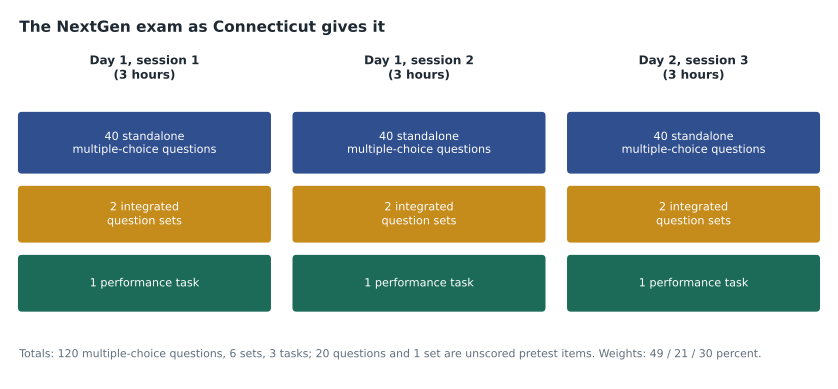
Each of the three sessions has the same mix: forty standalone multiple-choice questions, two integrated question sets and one performance task. NCBE's published guidance for the exam suggests a pace of roughly 1.8 minutes per multiple-choice question, about 24 minutes per integrated set and about 60 minutes for the performance task. Across the exam, twenty of the multiple-choice questions and one integrated set are unscored pretest items. Candidates cannot tell which items are unscored, so every item deserves full effort.
Standalone multiple-choice questions test the eight foundational subjects the exam covers: civil procedure, contract law, evidence, torts, business associations, constitutional law, criminal law and procedure, and real property. Some are select-one questions; others ask the candidate to select two answers and give partial credit. Integrated question sets build several questions around one fact pattern and a small file, mixing multiple-choice items with short written answers and drafting tasks. They test the skills of practice, such as client counseling, negotiation, legal research and drafting, alongside doctrine. Performance tasks give the candidate a file and a library and ask for a document a new lawyer might write, such as a memorandum, a letter or a short brief, and some include legal research.
| Component | Per session | Scored share of total | Who scores it in Connecticut |
|---|---|---|---|
| Standalone multiple choice | 40 questions | 49 percent | NCBE |
| Integrated question sets | 2 sets | 21 percent | Connecticut graders |
| Performance task | 1 task | 30 percent | Connecticut graders |
How Connecticut scores it
The committee's 2026 regulations set out the division of labor. NCBE scores the multiple-choice questions and handles all scaling and equating. The committee's own graders score the integrated question sets and the performance tasks, using NCBE's grading materials. Scores are weighted 49 percent for the standalone questions, 21 percent for the integrated sets and 30 percent for the performance tasks, and the result is a single scaled score reported as a whole number on NCBE's scale, which runs from 500 to 750.
Two features of NextGen scoring matter for strategy. First, there is no separate MBE score or written score. The whole exam produces one number, so a candidate cannot pass one part and transfer it, and Connecticut does not accept transferred MBE scores for any purpose. Second, the score is equated, not curved. NCBE adjusts for differences in difficulty between administrations so that a score of 616 represents the same level of performance on any NextGen exam, regardless of how other candidates did. A candidate is competing with the standard, not with the room.
The passing score
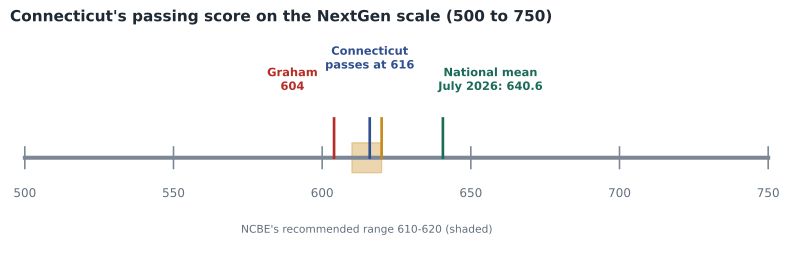
The committee's notice states that a total scaled NextGen score of 616 is the minimum passing score in Connecticut. That figure sits at the low end of the range NCBE recommended to jurisdictions in November 2025, which was 610 to 620, and below the scores some other NextGen jurisdictions have set. The committee's July 10, 2026 minutes record a motion to revisit the passing score and consider raising it; the chair put the item on a future agenda after the July 2026 results. Candidates should treat 616 as the current standard and watch the committee's notices for any change before their exam.
How hard is 616? NCBE's figures for the July 2026 exam give some context. Nationally, across ten jurisdictions, 2,630 candidates earned an official score; the mean was 640.6 and the median 640. In Connecticut, 436 candidates sat, and 63 percent passed: 71 percent of first-time takers and 38 percent of repeaters. Connecticut's results were released on October 9, 2026. Those numbers describe one exam, the first of a new kind, and the committee cautions, as NCBE does, against reading too much into a single administration.
Results and review
Failing applicants receive their scaled score and whatever other information the committee specifies. Under the legacy UBE, Connecticut reread essays for scores just below passing; the committee's older guidance described a reread band of 256 to 265. The 2026 regulations do not describe a reread band for NextGen, and NCBE's own score verification service checks only that a score was correctly computed, for a fee; it is not a regrade. A candidate who fails should use the diagnostic information NCBE provides to plan the next attempt rather than hope for a review.
Technology and accommodations
Connecticut gives the NextGen exam on candidates' own laptops, using exam software. Laptop registration is due at least seven days before the exam, and the committee's notice lists the technical requirements. Candidates should install the software early, run every practice exam it offers on the same machine and bring the power cord. Applicants who need testing accommodations apply to the committee with documentation. For July 2026, the minutes record forty-two applicants receiving non-standard accommodations, some of whom tested on a third day.
Worked problem
Reading Graham's numbers
Graham scored 604 in July 2026. Connecticut's passing score is 616. His diagnostic information shows his multiple-choice work near the passing range, weaker integrated sets and one unfinished performance task.
Show solution
- The gap is 12 scaled points on a single equated score.
- Performance tasks carry 30 percent of the score and integrated sets 21 percent: together, more than half.
- An unfinished task loses the points for every part he did not write.
- Finishing all three tasks and tightening his integrated answers is the most efficient way to gain the 12 points.
Answer: Graham's plan puts written work first: timed performance tasks weekly, integrated sets twice a week, and multiple-choice drills to hold his level.
Marchetti draws the lesson in one sentence. 'NextGen rewards the candidate who finishes,' she says. 'A complete, organized answer that gets the main points beats a brilliant half-answer every time.'
Common mistakes
MistakeConnecticut still gives the MBE, MEE and MPT.
InsteadSince July 2026 Connecticut gives the NextGen exam; the last legacy UBE was February 2026.
MistakeThe passing score is a percentage of correct answers.
InsteadIt is a scaled, equated score of 616 on a 500 to 750 scale.
MistakeA candidate can carry a strong multiple-choice score into the next exam.
InsteadNextGen produces one score; Connecticut does not accept separate MBE scores.
MistakeNCBE will regrade a failing paper on request.
InsteadScore verification checks the computation only; it is not a regrade.
How the sessions feel
Graham's memory of July helps explain the structure in practice. Each session contained all three components, and the clock ran for the whole three hours. He had planned to finish the multiple-choice questions in about seventy minutes, leave twenty-four minutes for each integrated set and an hour for the performance task. In the first session he kept to it. In the second, a long integrated set on a business formation problem took him almost forty minutes, and he started the performance task with too little time. By the third session, he was tired, and he read the task library twice before writing anything.
'That is the classic NextGen failure,' Marchetti says. 'Not a lack of law, but a lack of time discipline in the written work. The fix is practice under the same conditions: three-hour blocks, all three components, a clock you can see. By February, the pacing should feel boring.' She asks him to do at least four full simulated sessions before the exam, two of them back to back on a Saturday to rebuild the stamina the second day demands.
Inside an integrated question set
An integrated set gives the candidate a short fact pattern and sometimes a small file of documents, then asks several questions about it. Some are multiple choice; some ask for a short written answer, often a few sentences; some ask the candidate to draft a short provision or a paragraph of advice. NCBE's published scoring scheme gives short answers a small number of points and drafting answers more. The questions may move across subjects and skills: a single set on a small business dispute might ask about the formation of an LLC, a contract term, what the candidate should ask the client next and how to respond to an opposing offer.
The skills tested in integrated sets reward clarity. A short answer should answer the question asked, cite the rule or fact that supports the answer, and stop. A drafting answer should do what the instruction says, in plain language. Graham's July answers ran long. His February plan is to write each short answer in no more than four sentences, and to reread each drafting instruction before starting.
Inside a performance task
A NextGen performance task gives the candidate a task memo from a supervising lawyer, a file of facts and a library of law, and asks for a document, such as an objective memorandum, a persuasive brief, a client letter or a set of contract provisions. Some tasks include research: the library is larger, and the candidate must find the relevant authority and decide which controls. NCBE's scoring scheme for a standard task uses a point scale that rewards organization, correct use of the law and facts, and responsiveness to the task memo.
Marchetti teaches a three-step method. First, read the task memo twice and write down exactly what document is wanted, for whom and in what format. Second, read the library before the file, briefly, noting the rules and their elements, then read the file looking for the facts that matter to those elements. Third, outline the document using the elements as headings and start writing no later than about a third of the way through the hour. 'A finished, organized answer with every heading filled is worth more than a perfect half,' she says. 'Graders can only give points for what you wrote.'
What Connecticut graders look for
Because Connecticut's own graders score the written components, candidates sometimes ask whether Connecticut grades differently from other jurisdictions. The committee's graders use NCBE's grading materials and calibration, and the final score is scaled and equated by NCBE, which is what makes a Connecticut score portable. Candidates should therefore prepare for NextGen as NCBE describes it, not for a local style. The committee's minutes do show that it trains graders for the new format and has considered how much the new grading work should be paid, a sign that it takes the written grading seriously.
Practice materials
NCBE publishes official study aids for NextGen, including sample questions, practice sets and full simulated exams. Commercial bar review courses have built NextGen programs around them. Marchetti recommends that every candidate use at least one full official simulation under timed conditions, because official items match the exam's style most closely. She also warns against overusing unofficial question banks written for the old MBE, whose style and level of detail differ from NextGen's standalone questions.
Reading a score report
Graham's score report from July gave him a single scaled score of 604 and a pass or fail decision. What matters most for planning is the total, because the pass decision depends on it alone. Marchetti explains why. Because the score is a single total produced by NCBE's scaling, a candidate cannot simply decide to give up one component and make it up in another without knowing how much each is worth. The published weights are the best guide: standalone multiple choice carries roughly half of the total, the integrated sets about a fifth and the performance tasks the remaining 30 percent.
Twelve points, the gap between 604 and 616, sounds small, and in one sense it is. On a scale that runs from 500 to 750, it represents a modest improvement spread across the whole exam. Marchetti estimates for Graham that a steady gain in multiple-choice accuracy, combined with finishing every performance task, would close it. She is careful not to promise a number, because no one outside NCBE can convert raw performance into scaled scores precisely, and the scale is designed so that the same performance earns the same score whatever the difficulty of a particular exam.
What the committee publishes
After each administration, the committee publishes pass lists and summary statistics, and NCBE publishes national figures. Candidates should treat these numbers as context rather than prediction. A pass rate describes a whole group, including first-time takers from accredited schools, repeaters and foreign-educated applicants; it says little about any one candidate's chance.
Summary and key terms
- Connecticut gives the NextGen exam on the last consecutive Tuesday and Wednesday of February and July, over a day and a half.
- Each session has 40 multiple-choice questions, 2 integrated sets and 1 performance task.
- Weights are 49, 21 and 30 percent; NCBE scores multiple choice and Connecticut graders score the written work.
- The passing score is 616; the committee has agreed to revisit it.
- In July 2026, 63 percent of 436 Connecticut candidates passed.
- NextGen UBE
- NCBE's bar exam that replaced the MBE, MEE and MPT from July 2026 in Connecticut.
- Integrated question set
- A group of questions built on one fact pattern, mixing multiple choice and short written answers.
- Performance task
- A task requiring a lawyer's document from a file and library.
- Equating
- Adjusting scores so the same score means the same performance across exams.
- Pretest item
- An unscored question used to test future items.
Lesson quiz · 5 questions
Score 60% or more to complete this lesson.
Create a free account to save your progress, take quizzes and earn a certificate.