
BAR-207 · Lesson 7 of 12 · 16 min
Connecticut courts and civil procedure under the Practice Book
▶ Video coming soon A video version of this lesson is on the way.
The partner Graham works for, Ruth Abernathy, has a rule for new clerks: before you draft anything, find the return day. On Graham's first week she handed him a file in which a writ had been served correctly but returned to court a day late, and asked him what that meant. He did not know. He does now. 'Connecticut procedure is not hard,' Hollis Marchetti says when he tells her the story, 'but it is different, and the differences are exactly the ones that cause malpractice claims. Let's walk through the courts and a civil case from the first paper to the appeal.'
This lesson covers Connecticut's court system and the main features of civil procedure under the General Statutes and the Practice Book. None of it is tested on NextGen, which uses federal procedure. All of it matters in the first months of practice.
The courts
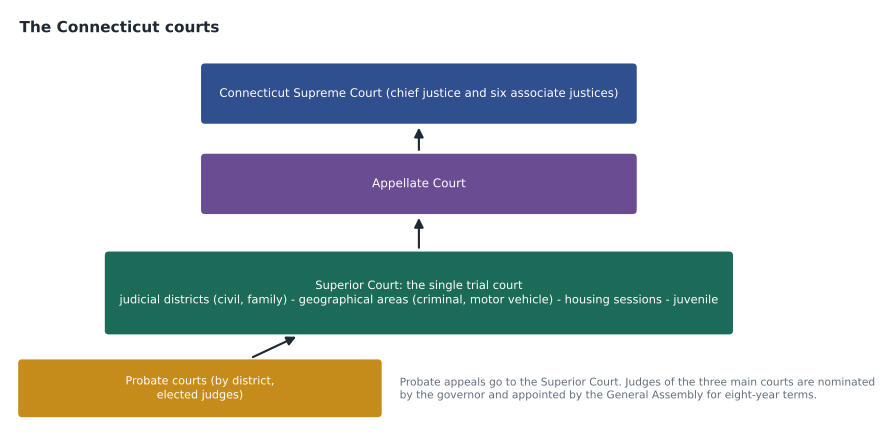
Connecticut has a unified state court system with three levels. The Superior Court is the single trial court of general jurisdiction. It hears civil, criminal, family, juvenile and housing matters, organized into judicial districts for most civil and family cases and into geographical areas for many criminal and motor vehicle matters, with dedicated housing sessions in the larger cities. There are no separate county courts or municipal courts; county government was abolished in Connecticut in 1960. The Appellate Court hears most appeals from the Superior Court. The Supreme Court, with a chief justice and six associate justices, is the highest court; it hears appeals transferred or certified to it and certain appeals directly.
Judges of all three courts are nominated by the governor, usually from candidates screened by the Judicial Selection Commission, and appointed by the General Assembly for eight-year terms. Probate courts stand outside this structure. They are courts of limited jurisdiction organized by probate district, each with an elected judge, and they handle decedents' estates, trusts, guardianships, conservatorships and some adoptions and name changes. Lesson 9 covers them.
Starting a civil action
A Connecticut civil action begins not with filing but with service. The plaintiff prepares a writ, summons and complaint. The summons states a return day, which must be a Tuesday and no more than two months after the date of the process. A state marshal, or another proper officer, serves the defendant. Service must be made at least twelve days before the return day, and the original process with the marshal's return must be filed in court at least six days before the return day. Only then is the case entered on the court's docket. The action is commenced, for limitation purposes, when the defendant is served, not when the papers are filed, although a savings statute gives a short extension where process was delivered to the marshal within the limitation period and served within thirty days.
Graham's late-return file shows why the deadlines matter. A complaint returned to court fewer than six days before the return day is defective, and a defendant may move to dismiss. Connecticut courts have often allowed the defect to be cured by amending the return day where the statute permits, but a lawyer who relies on the cure has taken a needless risk. Abernathy's rule exists because the cheapest malpractice claim to avoid is the one that starts with a calendar mistake.
| Step | Deadline or rule |
|---|---|
| Return day | A Tuesday, no more than two months after the date of process |
| Service | At least twelve days before the return day, by a state marshal or proper officer |
| Return to court | At least six days before the return day |
| Appearance | Defendant files an appearance; pleadings follow the Practice Book order |
| Commencement for limitations | Service on the defendant, subject to the savings statute |
The order of pleadings
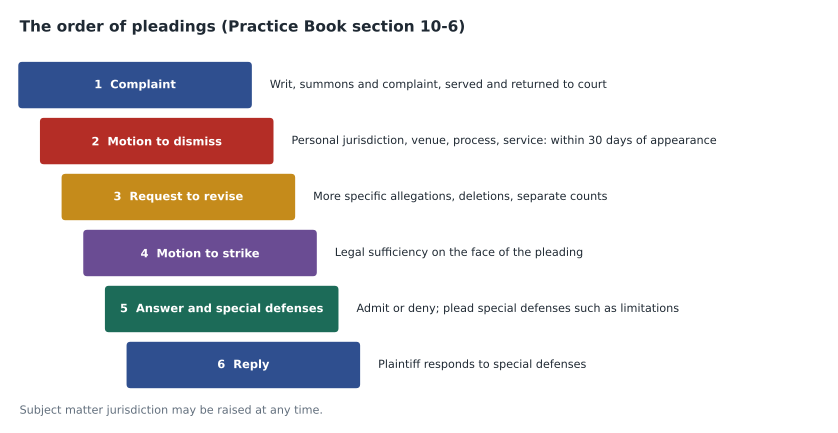
Practice Book section 10-6 sets a fixed order of pleadings: the plaintiff's complaint, then the defendant's motion to dismiss, request to revise, motion to strike, answer and special defenses, and the plaintiff's reply. Each step waives the right to earlier ones in many respects. Most important, a defendant who wants to challenge personal jurisdiction, venue, the sufficiency of process or the sufficiency of service must file a motion to dismiss within thirty days of filing an appearance. A defendant who misses that window waives those defenses. Subject matter jurisdiction is different: it can be raised at any time.
A request to revise asks the plaintiff to make the complaint more specific, delete improper allegations or separate claims into counts. A motion to strike tests legal sufficiency: assuming every well-pleaded fact is true, does the complaint state a claim on which relief can be granted? It is the Connecticut counterpart to the federal Rule 12(b)(6) motion, and it is decided on the face of the pleading. If a motion to strike is granted, the plaintiff usually has fifteen days to plead over. Special defenses, such as contributory negligence, the statute of limitations or payment, must be pleaded specially in the answer; a defendant who does not plead them may lose them.
Parties and apportionment
Connecticut allows a defendant in a negligence action to bring in other parties whose negligence may have caused the plaintiff's injury. Under the apportionment statute, a defendant may serve an apportionment complaint on a person not already a party within 120 days after the return day of the original complaint. The plaintiff then has sixty days to assert a direct claim against the new party. Apportionment matters because Connecticut's comparative negligence statute generally makes defendants severally liable for their own share of damages, so the share assigned to each person who caused the harm affects what each pays. Lesson 8 returns to the substantive rule.
Prejudgment remedies
Connecticut has an unusual set of prejudgment remedies: attachment of real or personal property, garnishment and replevin, available before judgment to secure a plaintiff's claim. Because they take property before any judgment, the statutes require notice and a hearing in most cases, at which the plaintiff must show probable cause that a judgment will be rendered in the plaintiff's favor in the amount sought. Ex parte remedies without a hearing are available only in narrow circumstances, such as a showing that the defendant is about to remove or hide assets. Commercial lenders and contractors use prejudgment remedies often, and a new lawyer in a litigation firm will see applications for them early.
Offers of compromise
General Statutes section 52-192a gives plaintiffs a powerful settlement tool. In an action seeking money damages, a plaintiff may file an offer of compromise stating an amount for which the plaintiff will settle. If the defendant does not accept it within the statutory time and the plaintiff then recovers at least that amount at trial, the court must add interest at 8 percent a year on the amount recovered, generally running from the date the complaint was filed, together with a modest attorney's fee. In a large personal injury case that has taken years to reach trial, the interest can be very large. Defendants have a counterpart offer of compromise under section 52-193 and following. Graham's morning calculation for Abernathy was exactly this: estimating what the 8 percent interest might add if the firm's client beat its own offer.
Worked problem
The cost of ignoring an offer
A plaintiff files an offer of compromise for 150,000 dollars eighteen months after filing the complaint. The defendant lets it lapse. At trial, three years after filing, the jury awards 200,000 dollars.
Show solution
- The verdict exceeds the offer, so section 52-192a interest applies.
- Interest runs at 8 percent a year, generally from the date the complaint was filed.
- Three years at 8 percent on 200,000 dollars is about 48,000 dollars, before any adjustment.
- The court also awards a reasonable attorney's fee capped by statute.
Answer: The defendant faces roughly 48,000 dollars in additional interest because it did not accept an offer below the verdict.
Discovery, summary judgment and trial
Discovery in Connecticut resembles federal practice in its tools: interrogatories, requests for production, requests for admission and depositions, governed by Chapter 13 of the Practice Book. Connecticut has standard form interrogatories and requests for production for certain kinds of cases, including personal injury actions, and lawyers use them routinely. Summary judgment is available under Practice Book section 17-44 and following when there is no genuine issue of material fact and the moving party is entitled to judgment as a matter of law. Civil jury trials are common, and a party must claim a jury in time to preserve the right. Appeals generally must be filed within twenty days of notice of the judgment, a short period that catches lawyers who are used to the federal thirty days.
Graham's procedure page
Marchetti has Graham add a procedure page to his notebook with the deadlines that matter most: the Tuesday return day, twelve days for service, six days for return, thirty days to move to dismiss for personal jurisdiction, 120 days for apportionment, fifteen days to replead after a motion to strike, and twenty days to appeal. 'None of these will be on your February exam,' she says. 'All of them will be on your first calendar.'
Common mistakes
MistakeA Connecticut action begins when the complaint is filed.
InsteadIt begins with service of the writ, summons and complaint; the papers are returned to court afterward.
MistakePersonal jurisdiction can be challenged at any time.
InsteadA motion to dismiss on that ground must be filed within thirty days of the appearance.
MistakeConnecticut uses a Rule 12(b)(6) motion.
InsteadConnecticut uses a motion to strike.
MistakeAn appeal can be filed within thirty days.
InsteadThe general Connecticut deadline is twenty days from notice of the judgment.
Housing and small claims
Two specialized parts of the Superior Court deserve mention because new lawyers meet them early. Housing sessions in the larger cities hear summary process evictions, housing code cases and landlord and tenant disputes, with housing mediators who help many cases settle. Small claims, handled through a centralized small claims process, allows parties to bring limited money claims with simplified procedures, and many people appear without lawyers. The dollar limit for small claims is set by statute and has been raised over time, so a lawyer should check the current figure before advising a client whether to file there.
Electronic filing and practice
Most Superior Court civil and family filings are made through the Judicial Branch's electronic filing system, and lawyers must use it. A new lawyer needs a juris number to register for e-filing, which is another reason the number matters on the first day of practice. Court calendars, short calendar lists for motions and many decisions are published online. Connecticut motion practice runs largely through short calendars, on which motions are listed for argument or for decision on the papers; a lawyer who wants oral argument on many motions must mark the motion ready and request argument under the Practice Book.
Jury trials and the trial list
A party who wants a jury in a civil case must file a jury claim within the time the Practice Book and statutes allow, and pay the fee; otherwise the case is tried to the court. Cases are assigned to trial lists by judicial district, and pretrial conferences and court-annexed mediation are common. Connecticut's civil juries are usually six members in civil cases, with alternates. Graham notices that the partners at his firm think about the jury claim from the first day of a case, because the decision affects strategy for the whole litigation.
Appeals in more detail
Most appeals from the Superior Court go to the Appellate Court. The Supreme Court may transfer appeals to itself and hears appeals on certification from the Appellate Court. An appeal is generally commenced by filing within twenty days of notice of the judgment or decision, a period that can be extended in limited circumstances or restarted by certain post-judgment motions. The appellant must order transcripts, file a docketing statement and follow detailed rules on the record and briefs in the Practice Book's appellate rules. Because the window is short and the rules on what restarts it are technical, Connecticut appellate practice is a specialty, and many firms refer appeals to lawyers who handle them regularly.
Comparing the systems
For a candidate studying federal procedure, a side-by-side comparison helps keep the two systems apart.
| Step | Federal (tested on the exam) | Connecticut (practice) |
|---|---|---|
| Commencement | Filing the complaint | Service of writ, summons and complaint |
| Personal jurisdiction objection | Rule 12(b)(2); waived if omitted from first response | Motion to dismiss within thirty days of appearance |
| Testing legal sufficiency | Rule 12(b)(6) | Motion to strike |
| More definite pleading | Rule 12(e) | Request to revise |
| Bringing in others | Rule 14 impleader | Apportionment complaint within 120 days |
| Settlement pressure | Rule 68 offer of judgment (costs) | Offer of compromise (8 percent interest) |
| Time to appeal | 30 days in most civil cases | 20 days in most cases |
Graham's file
Back at work, Graham checks the late-return file again. The writ was served fourteen days before the return day, which was timely, but returned to court only five days before it, which was not. The defendant's lawyer filed a motion to dismiss. Abernathy's response relied on the statutory procedure for amending a return day and on case law treating a late return as a curable defect in some circumstances, and the court allowed the amendment. 'We won,' she tells Graham, 'and it cost the client three months and a hearing. That is why we find the return day before we do anything else.'
Summary and key terms
- The Superior Court is the single trial court; above it are the Appellate Court and the Supreme Court; probate courts are separate.
- An action begins with service before a Tuesday return day: twelve days for service, six days to return to court.
- Practice Book section 10-6 sets the order of pleadings; jurisdictional motions to dismiss are due within thirty days of appearance.
- Apportionment complaints are due within 120 days of the return day.
- Prejudgment remedies need probable cause and usually a hearing; offers of compromise carry 8 percent interest.
- Return day
- The Tuesday stated in the summons on which the case is returnable to court.
- State marshal
- The officer who serves civil process in Connecticut.
- Apportionment complaint
- A defendant's pleading bringing in another person whose negligence may have caused the harm.
- Prejudgment remedy
- Attachment, garnishment or replevin before judgment, on a showing of probable cause.
- Offer of compromise
- A settlement offer under section 52-192a that can carry 8 percent interest if beaten at trial.
Lesson quiz · 5 questions
Score 60% or more to complete this lesson.
Create a free account to save your progress, take quizzes and earn a certificate.