
BAR-207 · Lesson 3 of 12 · 17 min
Character and fitness and the MPRE
▶ Video coming soon A video version of this lesson is on the way.
Graham arrives at his third session with a question he has been carrying since September. In August, between the exam and results, he received a parking ticket in New Haven, paid it online and forgot about it. Then he remembered the application's instruction to keep his answers current. 'It is a parking ticket,' he says. 'Do they really want to know?' Marchetti smiles. 'Read me the question,' she says, 'and then we will talk about why the committee asks so much, and why the safest answer is almost always to tell them.'
This lesson covers the two requirements that test a candidate's fitness for the profession rather than knowledge of the law: the character and fitness review run by the Connecticut Bar Examining Committee, and the Multistate Professional Responsibility Examination (MPRE). Both apply to every applicant, by examination or without it.
The standard
The Practice Book requires every applicant to show good moral character and fitness to practice law. The burden is on the applicant. The committee's question is forward-looking: whether the applicant can be trusted to handle clients' money and confidences, meet deadlines, deal honestly with courts and opponents, and follow the rules of the profession. Past conduct matters because it is the best evidence of future conduct, but the review is not a search for perfect people. Most applicants with minor issues are admitted. What causes delay and denial is usually serious misconduct, a pattern of irresponsibility, or a lack of candor in the application itself.
Connecticut does not use NCBE's character and fitness service. The committee runs its own review, and its application doubles as the character questionnaire. Every applicant undergoes an extensive background check, and the committee may require fingerprints. The committee's guidance is clear that it does not accept background checks an applicant arranges independently; it gathers the information itself.
What the application asks
The questionnaire covers the usual ground: education and any academic discipline; employment, including terminations; addresses; military service; criminal matters, including arrests and charges that did not lead to conviction; civil litigation in which the applicant was a party; financial matters, including defaults and bankruptcies; driving history; admission applications filed in other jurisdictions; and professional licensing. In July 2026 the committee amended two questions. Question 21 was rewritten to capture more fully the types of applications to other bars that must be disclosed. Question 41 was amended to follow ABA Resolution 800 and NCBE's updated character and fitness questionnaire, creating an exception to disclosure for certain civil and administrative matters. Applicants should answer the version of the questionnaire in front of them and read each question's exceptions carefully, because the exceptions are narrow.
| Area | Typical issues | What helps |
|---|---|---|
| Candor | Omissions, inconsistent answers | Full, accurate disclosure with documents |
| Criminal history | Arrests, charges, convictions | Court records and a clear account of what happened |
| Finances | Defaults, collections, unpaid taxes | Payment plans and proof of current responsibility |
| Academic record | Probation, discipline, honor code matters | School records and evidence of change |
| Mental health and substance use | Conduct, not diagnosis, is the focus | Evidence of treatment and stability where conduct raised concern |
Candor above all
Candidates sometimes treat the questionnaire as a place to minimize. That instinct is backwards. The committee checks what applicants say against law school records, court databases, credit reports, employers and other jurisdictions. An old, minor matter that an applicant disclosed and explained rarely causes trouble. The same matter discovered after the applicant left it out becomes a question about honesty, and honesty is the core of the inquiry. Courts across the country have treated false or misleading answers on bar applications as serious misconduct in their own right, sometimes more serious than the underlying conduct. When in doubt, disclose, explain briefly and attach the document.
The duty to disclose is continuing. An applicant must update the application if anything changes or new information arises before admission. Graham's parking ticket is a small example. Whether a particular question reaches parking tickets depends on its wording and exceptions, so Marchetti has him read the driving question line by line. If the question covers it, he reports it with the receipt. If it plainly does not, he keeps the receipt in his file in case the committee asks. Either way he has made a reasoned choice rather than a guess.
How the review runs
Review begins when the application is filed and continues while the exam is graded. The committee's staff gather records and contact references. If an issue needs explanation, staff may write to the applicant for more information. Applications with unresolved issues are held until the issues are resolved, which is one reason candidates who file late or answer vaguely can pass the exam and still wait for admission. When an applicant's file raises a concern the staff cannot clear, the matter goes to a hearing before the committee or a panel under Article VI of the regulations. The committee's April 2026 minutes illustrate the process: of the sixty applicants who passed the February 2026 exam, eight had disclosed character or fitness concerns and were sent for further review under Article VI, while the rest were recommended for admission.
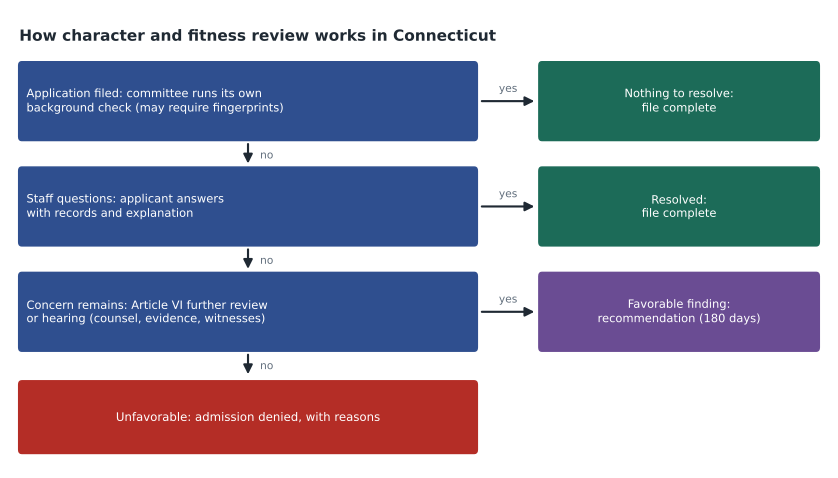
At a hearing the applicant can present evidence, documents and witnesses and may be represented by counsel. The questions are what happened, what it shows about the applicant now, and what has changed. Evidence of rehabilitation carries real weight: time since the conduct, restitution, treatment where relevant, steady employment, community service and the candor with which the applicant discusses the past.
Mental health and the questionnaire
National bar admission practice has moved away from asking about mental health diagnoses and toward asking about conduct. ABA policy urges jurisdictions to focus on conduct and behavior that would call fitness into question, not on diagnosis or treatment, and the 2026 change to Connecticut's question 41 follows the updated national questionnaire. A candidate who has sought counseling or treatment should not avoid it out of fear of the bar application. If past conduct, whatever its cause, raised concerns, evidence of treatment and stability is usually the most persuasive thing an applicant can offer.
The MPRE
The MPRE is a two-hour multiple-choice examination on the law governing lawyers, written by NCBE. It has sixty questions, fifty scored and ten unscored, on the ABA Model Rules of Professional Conduct, the ABA Model Code of Judicial Conduct and controlling constitutional and procedural law. It is given at computer-based test centers several times a year. Scores run from 50 to 150. Connecticut's passing score is 80, which sits in the middle of the range that jurisdictions use; some accept 75 and California requires 86.
Connecticut requires NCBE to send the MPRE score directly to the committee. A score report that the applicant downloads and submits is not accepted. Applicants should order the score transfer through their NCBE account when they file, so that the committee's file is complete. Candidates who are unsure how old a score may be should check the committee's current instructions; the age limit for MPRE scores is a jurisdiction-by-jurisdiction rule, and NCBE's published information for Connecticut refers applicants to the committee for it.
The MPRE tests the Model Rules, not Connecticut's version of them. Lesson 10 covers the places where Connecticut's Rules of Professional Conduct differ from the Model Rules. A candidate preparing for the MPRE should learn the Model Rules as written, then learn Connecticut's differences separately for practice.
Worked problem
Two applicants, two outcomes
Applicant A disclosed a 2021 arrest for disorderly conduct after a college party, attached the dismissal order and explained it in three sentences. Applicant B did not disclose a 2022 small claims judgment for unpaid rent, which the committee found in a records search; B paid it in full in 2024.
Show solution
- A disclosed fully, with records, and the matter is old, minor and resolved.
- B's underlying problem is also minor and resolved, but B left it out.
- The committee will ask B to explain the omission, and the omission itself becomes the main concern.
- B should promptly amend the application, attach proof of payment and explain why it was missed.
Answer: A's file is likely to clear without delay. B's file will probably be held for questions and may go to further review, not because of the debt but because of the omission.
Marchetti's rule
Graham reads the driving question aloud. It asks about moving violations, and it says nothing about parking. He makes a note in his file anyway, with the receipt and the date, and moves on. Marchetti sums up her rule for every candidate: 'The committee is not looking for saints. It is looking for people who tell the truth when the truth is inconvenient. Show them that on the application, and the rest usually takes care of itself.'
Common mistakes
MistakeMinor matters can be left off the application.
InsteadIf a question covers a matter, disclose it with records; omissions raise questions about honesty.
MistakeAn applicant can submit their own MPRE score report.
InsteadNCBE must send the score directly to the committee.
MistakeConnecticut uses NCBE's character investigation.
InsteadConnecticut runs its own review and may require fingerprints.
MistakeOnce the application is filed, nothing more needs reporting.
InsteadThe duty to update continues until admission.
References and employers
The application asks for references and for a complete employment history, and the committee contacts some of the people listed. Applicants should tell their references in advance that the committee may write to them, and should give accurate contact information. An applicant who left a job on bad terms should not leave it off; the committee will usually learn about it anyway, and a short, honest explanation is far better than a discovered gap. Graham lists every job since college, including two summers working at a hardware store in Waterbury and a semester as a research assistant, and gives the dates as precisely as his records allow.
Financial responsibility
Debt alone does not disqualify anyone. Most law graduates carry student loans, and the committee is not looking for applicants without debt. What it looks at is how applicants handle their obligations: whether loans are in good standing or in an approved repayment or deferment plan, whether accounts in collection have been addressed, whether taxes have been filed and paid, and whether there is a pattern of ignoring creditors or court orders. An applicant with a past default who has entered a payment plan and kept to it can show exactly the responsibility the committee wants to see. Applicants should collect current statements and correspondence before filing so that they can answer questions quickly.
Law school records
The committee asks law schools to certify each applicant's record, including any academic or disciplinary action. Discrepancies between what an applicant reports and what the school reports are among the most common causes of delay. A candidate who was placed on academic probation in the first year, or who was found to have violated an honor code, should disclose it, explain what happened and what changed, and make sure the explanation matches the school's file. Many candidates disclosed these matters on their law school applications as well; the committee may compare the two.
Timing and the 180-day window
Character review runs alongside grading, but it does not always finish when results come out. An applicant whose file is complete and clear when results are released can be recommended for admission and attend the next ceremony. An applicant whose file still has open questions waits until they are resolved. The recommendation, once made, is valid for 180 days, so an applicant who is recommended but delays the oath for too long may have to update the file and seek a new recommendation. The safest course is the one Marchetti gives every candidate: file early, answer fully, respond to every letter from the committee within days, and keep a copy of everything.
Graham's update
Graham's own file is uncomplicated, and his July application cleared review before July results were released. For February he files an update listing his new address, the job change from summer associate to law clerk and, after reading the driving question, nothing about the parking ticket, which the question does not cover. He keeps the receipt in a folder with the rest of his records. Marchetti approves. 'You read the question, you made a decision, and you kept the paper,' she says. 'That is what the committee hopes every lawyer will do with a hard question for the rest of their career.'
The MPRE in your calendar
For candidates who have not yet taken the MPRE, the timing deserves thought. NCBE offers it several times a year at computer-based test centers, with registration deadlines well before each date and no late registration. Many candidates take it during the second or third year of law school, when the professional responsibility course is fresh, so that it never competes with bar preparation. A candidate who waits until after the bar exam may find that the next available MPRE date pushes admission back by months. Because Connecticut requires 80, a candidate who scores in the high seventies elsewhere should plan to retake it, even if another jurisdiction accepted the score.
Keeping the file current
Filing the application is not the end of the character and fitness process. The committee expects applicants to report material changes until they are admitted, and the duty is easy to forget during months of study. A new traffic citation, a civil lawsuit, a change of address, a new job, a disciplinary matter in another field or a change in a reported debt can all require an update. The safest habit is to treat the application as a living document and to send an amendment promptly whenever something changes, with a short explanation and any supporting papers.
Graham's own file shows how small the updates can be. Since filing for February, he has moved from his parents' home in Waterbury to an apartment in Hartford closer to the firm, and his job title has changed from intern to law clerk. Neither fact is troubling, but both are facts the committee asked for, so he sends both. Marchetti tells him that the applicants who run into trouble are rarely the ones with something serious to report; they are the ones whose later disclosures do not match what the committee already learned from somewhere else.
Interviews and hearings
Most applicants are recommended for admission on the written record. Where the record raises a question, a member of the committee or its staff may ask for more information, a meeting or an interview, and a small number of applicants are referred for a formal hearing. Applicants have the right to counsel in that process, and many retain a lawyer who regularly handles admission matters. Preparation for an interview looks like preparation for any serious conversation about one's past: know the record exactly, bring documents, take responsibility without minimizing, and explain what has changed since the conduct in question. The committee's question is not whether the applicant has a perfect past but whether the applicant can be trusted with clients, money and the courts now.
Summary and key terms
- Applicants must prove good moral character and fitness; the burden is on them.
- Connecticut runs its own background review and may require fingerprints.
- Question 21 and question 41 were amended in July 2026; question 41 follows ABA Resolution 800.
- Candor matters most; the duty to update continues until admission.
- The MPRE passing score in Connecticut is 80, and NCBE must report it directly.
- Character and fitness
- The review of whether an applicant can be trusted to practice law.
- Article VI
- The CBEC regulation governing further review and hearings on character and fitness.
- Duty to update
- The obligation to report new information until admission.
- MPRE
- NCBE's professional responsibility exam, scored from 50 to 150.
- Rehabilitation
- Evidence that an applicant has addressed past problems.
Lesson quiz · 5 questions
Score 60% or more to complete this lesson.
Create a free account to save your progress, take quizzes and earn a certificate.