
BAR-207 · Lesson 9 of 12 · 17 min
Connecticut family law, property and probate
▶ Video coming soon A video version of this lesson is on the way.
Ruth Abernathy's firm does not handle divorces or estates, but its clients have them. In a single month Graham fields a call from a client whose divorce decree divided a house the firm is now selling, a question about whether a client's late mother left a valid will, and a landlord who wants to know how long a tenant's eviction will take. 'Every Connecticut lawyer gets these calls,' Hollis Marchetti says, 'even the ones who swear they will never practice family law. You do not need to be an expert. You need to know enough to spot the problem and know where the rules are.'
This lesson covers the Connecticut rules on dissolution of marriage and support, a few distinctive features of Connecticut real property and landlord and tenant law, and the probate courts, wills and estates. Family law joins the NextGen exam in July 2028, and trusts and estates may appear with the law supplied, but the exam will test general principles, not Connecticut's versions.
Dissolution of marriage
Connecticut calls divorce dissolution of marriage, governed by Chapter 815j of the General Statutes. A court may dissolve a marriage on a no-fault ground, that the marriage has broken down irretrievably, or on one of several fault grounds that remain in the statute, such as adultery, desertion or intolerable cruelty. Almost all dissolutions proceed on the no-fault ground, though fault can still affect property division and alimony. A residency rule applies: in general, one of the parties must have been a Connecticut resident for at least twelve months before the complaint is filed or before the decree enters, with exceptions, for example where the cause arose after a party moved to Connecticut. Connecticut also has a simplified procedure, nonadversarial dissolution, for short marriages without children or significant assets, and a ninety-day waiting period applies to most contested and uncontested cases.
Property division
Connecticut divides property at dissolution by equitable distribution under section 46b-81. It is often called an all-property state, because the court may assign to either spouse all or any part of the property of the other, regardless of how or when it was acquired or whose name is on the title. There is no automatic category of separate property that is off limits, as there is in many states. Instead, the court considers statutory factors: the length of the marriage, the causes of its breakdown, each party's age, health, station, occupation, income, vocational skills, employability, estate, liabilities and needs, the opportunity of each for future acquisition of assets and income, and each party's contribution to the acquisition, preservation or appreciation of the property. A premarital inheritance can therefore be divided, though the source of an asset is a factor the court may weigh heavily.
| Issue | Connecticut rule | Statute |
|---|---|---|
| Grounds | Irretrievable breakdown, or a listed fault ground | Section 46b-40 |
| Residency | Generally twelve months before filing or decree, with exceptions | Section 46b-44 |
| Property | Equitable distribution of all property, whenever and however acquired | Section 46b-81 |
| Alimony | Statutory factors; modification on a substantial change of circumstances | Sections 46b-82 and 46b-86 |
| Custody | Best interests of the child | Section 46b-56 |
Alimony and support
Alimony under section 46b-82 may be awarded to either spouse, periodic or lump sum, for a fixed term or an indefinite one, based on factors similar to those for property: the length of the marriage, the causes of the breakdown, the parties' ages, health, income, earning capacity, needs and the property each receives. Alimony orders may generally be modified under section 46b-86 on a substantial change in circumstances unless the decree precludes modification. Section 46b-86(b) adds a Connecticut rule on cohabitation: a court may modify, suspend or terminate alimony if the recipient is living with another person under circumstances that the court finds alter the recipient's financial needs. A separate provision bars a court from ordering alimony to a spouse convicted of certain serious crimes against the other spouse.
Child support follows Connecticut's child support guidelines, an income shares model under which both parents' incomes are combined and the support obligation is divided in proportion to income. Custody and parenting decisions turn on the best interests of the child under section 46b-56, with a presumption that joint custody is in the child's best interests when the parents have agreed to it. Parents in dissolution cases with minor children generally must attend a parenting education program.
Real property: titles, closings and foreclosure
Connecticut real estate practice has several features that surprise lawyers from other states. Residential closings are commonly handled by attorneys, who search title, prepare documents and conduct the closing, so many new lawyers meet real estate early. The Connecticut Marketable Title Act provides that a person with an unbroken record chain of title for forty years or more holds a marketable record title, free of most interests that predate the root of title unless they have been preserved by recorded notice. Adverse possession requires open, visible, exclusive, continuous and hostile possession for fifteen years, proved by clear and convincing evidence.
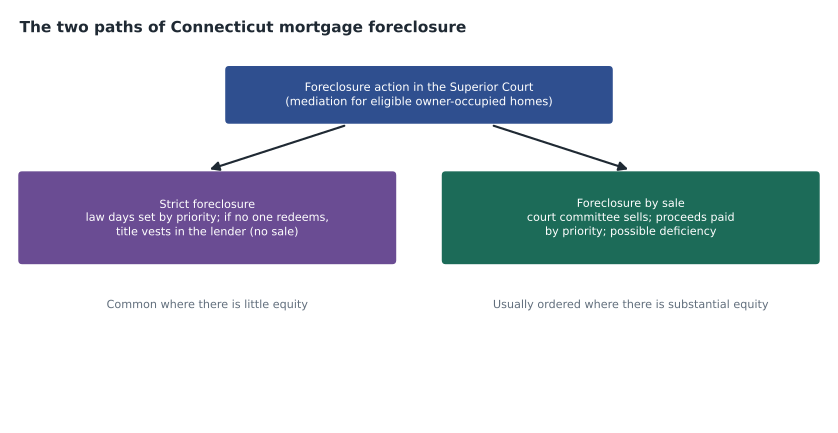
Mortgage foreclosure is especially distinctive. Connecticut is a title theory state, in which the mortgage conveys legal title to the lender subject to the borrower's equity of redemption. Foreclosure is judicial, and the court may order either strict foreclosure or foreclosure by sale. In a strict foreclosure, the court sets law days; if the borrower does not redeem by paying the debt on the borrower's law day, title vests absolutely in the lender, or in a junior encumbrancer who redeems, without any sale. Strict foreclosure is common where there is little or no equity in the property; a court will usually order a sale where there is substantial equity. Connecticut also runs a foreclosure mediation program for many owner-occupied residential properties.
Landlord and tenant
Residential evictions in Connecticut are summary process actions under Chapter 832, heard in the housing sessions in the larger cities and in the Superior Court elsewhere. A landlord must first serve a notice to quit, and Connecticut has added requirements in recent years, including notices about rental assistance and protections for certain tenants, so a lawyer should check the current statutes before advising. Landlords owe tenants a statutory duty to keep the premises fit and habitable, and tenants have a statutory payment-into-court remedy when the landlord fails to make required repairs. Security deposits are capped by statute, must be held in escrow and must earn interest, and must be returned with any interest, less lawful deductions, within a short period after the tenancy ends.
Probate courts
Connecticut's probate courts are separate from the Superior Court. Each probate district has its own court and an elected probate judge who serves a four-year term, and the probate system is overseen by the Probate Court Administrator. In 2011 the legislature consolidated what had been more than a hundred small courts into far fewer, larger districts, and regional children's probate courts handle many matters involving minors. Probate courts settle decedents' estates, oversee testamentary and some living trusts, appoint guardians and conservators, and handle adoptions, name changes and other matters. Appeals from probate generally go to the Superior Court.
Wills and intestacy
A Connecticut will must be in writing, signed by the testator or by someone at the testator's direction, and subscribed by two witnesses in the testator's presence. Connecticut does not recognize holographic wills executed in Connecticut, so a handwritten, unwitnessed will is not valid here unless it was valid under the law of the place where it was executed. A self-proving affidavit lets the will be admitted without the witnesses' testimony. When a person dies without a will, the intestacy statute divides the estate among the surviving spouse, descendants, parents and more distant relatives according to fixed shares that depend on who survives.
Connecticut's protection for a surviving spouse is unusual. Instead of an elective share of a fraction of the estate outright, as in most states, a surviving spouse who elects against the will takes a statutory share: the use for life of one third of the property passing under the will. Because the share is a life interest, not ownership, it is often worth less than an elective share elsewhere, and estate planners in Connecticut account for that difference. Connecticut adopted a version of the Uniform Trust Code, the Connecticut Uniform Trust Code, which took effect in 2020 and governs most express trusts.
Worked problem
Is Mom's will valid?
A client's late mother, a lifelong Connecticut resident, wrote her wishes by hand on a single page, dated and signed it at her kitchen table in Hartford, and showed it to no one. She had an earlier typed will, signed and witnessed by two people in her lawyer's office.
Show solution
- The handwritten page was executed in Connecticut.
- Connecticut requires two subscribing witnesses and does not recognize holographic wills executed here.
- The handwritten page is therefore not a valid will and does not revoke the earlier will by a later instrument.
- The earlier typed will, properly executed with two witnesses, is offered for probate in the probate court for her district.
Answer: The typed will governs unless it was revoked in another valid way. The handwritten page may still be evidence of her intentions, but it does not control.
Where these rules fit
Marchetti reminds Graham that none of this is on his February exam. 'From July 2028, family law will be,' she says, 'and it will be general principles: equitable distribution, best interests, the uniform acts on custody jurisdiction and support enforcement. Connecticut's all-property rule, its cohabitation statute and its life-estate spousal share are things you learn for clients, not for graders.' Graham adds a family and probate page to his notebook, with a reminder to refer clients to colleagues who practice in those areas when the questions go beyond spotting the issue.
Common mistakes
MistakeProperty owned before marriage is always separate in a Connecticut divorce.
InsteadConnecticut may divide all property, however and whenever acquired.
MistakeA signed handwritten will is valid in Connecticut.
InsteadA will executed in Connecticut needs two subscribing witnesses.
MistakeA surviving spouse takes one third of the estate outright.
InsteadThe statutory share is the use for life of one third.
MistakeEvery Connecticut foreclosure ends in a sale.
InsteadStrict foreclosure vests title in the lender after the law days pass, without a sale.
Prenuptial agreements and the process of a case
Connecticut enforces premarital agreements under the Connecticut Premarital Agreement Act, which generally requires a written agreement signed by both parties, fair and reasonable financial disclosure and an opportunity to consult independent counsel, and allows a court to refuse enforcement if the agreement was unconscionable when signed or when enforcement is sought. Postnuptial agreements are enforceable under standards the Connecticut Supreme Court has set, which require that the agreement be fair and equitable when signed and not unconscionable when enforced. Many dissolution cases resolve by agreement, often through mediation or collaborative practice, and the court must find any agreement fair and equitable before incorporating it in the decree.
Contested dissolution cases follow the family part of the Practice Book. Parties exchange sworn financial affidavits, which are central to every alimony, support and property decision, and courts treat inaccurate affidavits seriously; a judgment obtained on a fraudulent affidavit can be reopened. Automatic orders take effect when the complaint is served, restricting the parties from selling or hiding assets, changing insurance beneficiaries or removing children from the state without consent or a court order. A lawyer who handles any part of a divorce, even a real estate sale incident to it, should know the automatic orders exist.
Real estate closing practice
Graham's sale of the house divided in the client's divorce decree illustrates how family and property law meet. Before the closing, the firm checks the decree to confirm who owns the property and on what terms it must be sold, records any necessary quitclaim deed or certified copy of the decree, pays off the mortgage and any liens, and calculates the state and municipal real estate conveyance taxes the seller owes. Title insurance is standard, and title searches typically trace the record back to a root of title under the Marketable Title Act. Connecticut lawyers who close real estate must also follow rules on handling client funds through trust accounts, and the closing attorney's escrow obligations are a frequent source of grievance complaints.
Landlord and tenant in practice
Summary process cases move quickly by design. After the notice to quit expires, the landlord serves a summary process summons and complaint with a short return day; the tenant files an appearance and an answer; and the case may be referred to a housing mediator. Many cases end in a stipulated judgment that gives the tenant time to move or to pay arrears. Statutes protect certain tenants, including elderly and disabled tenants in larger buildings, against eviction except for cause, and tenants may raise defenses such as the landlord's failure to repair or retaliation for a complaint to a housing code official. Graham's client who asked how long an eviction would take got the honest answer: it depends on whether the tenant contests it, and on the current statutory notices, which the legislature has changed several times since 2020.
Estates in practice
When a Connecticut resident dies, the estate is administered in the probate court for the district where the decedent was domiciled. If there is a will, the named executor applies to admit it; if not, the court appoints an administrator, usually a close relative. Small estates below a statutory threshold may use a simplified affidavit procedure. Larger estates go through full administration: notice to creditors, an inventory, payment of debts and taxes, and a final accounting or financial report. Connecticut imposes its own estate tax on large estates, with an exemption that the legislature tied to the federal exemption amount, and the estate files a Connecticut return with the probate court and the Department of Revenue Services. Probate fees are based on the size of the estate.
Trusts created during life are generally administered without court supervision, under the Connecticut Uniform Trust Code, unless a party asks the probate court to act. Testamentary trusts, created by a will, are more often supervised by the probate court. Guardianships of minors and conservatorships of adults who cannot manage their affairs are also probate matters, and Connecticut's conservatorship statutes require the court to choose the least restrictive means of intervention.
Spotting the issue
Marchetti's goal for this lesson is modest. 'You will not be a family or probate lawyer next year,' she says. 'But you will be the lawyer a client trusts, and clients bring every problem to the lawyer they trust. Know that Connecticut divides all property, that a cohabiting ex-spouse may lose alimony, that a handwritten will is usually worthless here, that a spouse who elects against a will gets only a life interest, and that strict foreclosure means no sale. Then know whom to call.'
Summary and key terms
- Dissolution may be no-fault or fault-based; residency is generally twelve months.
- Connecticut divides all property equitably under section 46b-81.
- Alimony can be modified on a substantial change, and cohabitation can justify modification under section 46b-86(b).
- Foreclosure may be strict or by sale; residential evictions are summary process actions.
- Probate courts are separate, with elected judges; wills need two witnesses; the spousal share is a life estate in one third.
- Dissolution of marriage
- Connecticut's term for divorce.
- All-property state
- A state in which all marital and separate property may be divided at divorce.
- Strict foreclosure
- Foreclosure in which title vests in the lender if the owner does not redeem by the law day.
- Summary process
- Connecticut's eviction procedure.
- Statutory share
- A surviving spouse's life use of one third of the property passing under the will.
Lesson quiz · 5 questions
Score 60% or more to complete this lesson.
Create a free account to save your progress, take quizzes and earn a certificate.