
BAR-209 · Lesson 1 of 12 · 16 min
Becoming a lawyer in the District of Columbia
▶ Video coming soon A video version of this lesson is on the way.
Jasper Nwosu joins Hollis Marchetti's study group in the fall of 2026 with a job he loves and a deadline he almost missed. He grew up in Prince George's County, Maryland, finished law school in Washington in May 2026, and now works as a law clerk at a nonprofit that represents tenants in the Landlord and Tenant Branch of the Superior Court. His supervising attorney wants him admitted as soon as possible so he can stand up in court on his own. Jasper registered for the February 2027 District of Columbia bar exam in the first days of the October registration window, and he was glad he did: the Committee on Admissions later announced that every seat for that exam had been taken and that there would be no waitlist. A classmate who waited until the last week of the window did not get a seat.
'Washington is different from every other place you could take a bar exam,' Marchetti tells him at their first session. 'It is not a state, its highest court was created by Congress, and the same city that has one of the largest bars in the country has some of the tightest seat limits on its exam. It also has one of the most open doors for experienced lawyers who were admitted somewhere else. If you understand who makes the rules and why the rules look the way they do, the rest of the process makes sense.'
This lesson maps the whole process: the bodies involved, the routes to admission, the requirements on the examination route, and the order in which most candidates meet them. Later lessons take each step in detail and then turn to the District of Columbia law that matters most for new lawyers who will practice there.
Who controls admission
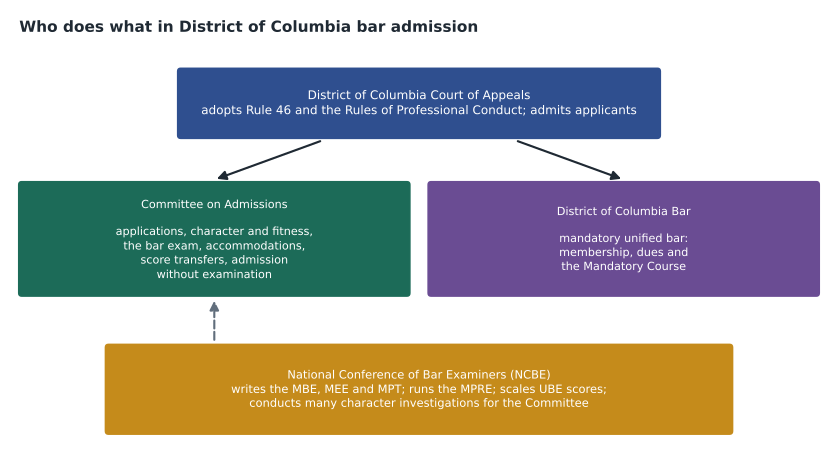
Admission to the bar of the District of Columbia is controlled by the District of Columbia Court of Appeals, the highest court of the District. The court is a local court, not a federal one, even though Congress created it. It sits at the top of the District's own court system, above the Superior Court, and it decides questions of District law in the way a state supreme court decides questions of state law. Among its powers is the regulation of the legal profession. The court adopts the rule that governs admission, Rule 46 of the District of Columbia Court of Appeals Rules, and it changes that rule by order after public notice and comment.
The court does its admissions work through the Committee on Admissions, a body the court appoints. The Committee receives applications through an online portal, runs the character and fitness review, gives the bar exam twice a year, decides accommodation requests, processes transferred scores and handles applications for admission without examination. When the Committee finds an applicant qualified, it certifies the applicant to the court, and the court admits the applicant. The Committee's office is in the Historic Courthouse complex at 430 E Street, N.W., and its public announcements, including seat counts, registration windows and results dates, appear on the admissions portal. Those announcements are where the current rules become concrete, and Marchetti tells every DC candidate to read them as carefully as the rule itself.
The court also sets the standards that apply after admission. It adopted the District of Columbia Rules of Professional Conduct, it oversees the disciplinary system through the Board on Professional Responsibility and the Office of Disciplinary Counsel, and it decides what counts as the unauthorized practice of law under its Rule 49, with guidance from a Committee on Unauthorized Practice of Law. Lesson 10 covers the professional conduct rules and Rule 49.
The District of Columbia Bar
The second body every DC lawyer deals with is the District of Columbia Bar. The DC Bar is a unified, or integrated, bar: membership is mandatory for anyone who wants to practice law in the District as a member of its bar. The court created it by rule in the early 1970s, and the court's Rules Governing the District of Columbia Bar set out its classes of membership, dues and duties. Admission and membership are linked but separate steps. The court admits you, and you then become a member of the DC Bar and must keep that membership in good standing by paying dues and meeting its requirements.
The DC Bar also administers the one educational requirement that follows admission: the Mandatory Course on the District of Columbia Rules of Professional Conduct and District of Columbia Practice. New admittees must complete it within twelve months after the month in which they are sworn in. Lesson 11 explains the course, the consequences of missing the deadline and the fact that, unlike most states, the District does not require ongoing continuing legal education after that.
The role of NCBE
The National Conference of Bar Examiners, a national nonprofit, plays a large supporting role. NCBE writes the three tests that make up the Uniform Bar Examination (UBE), which is the District's bar exam, and it scales and equates the scores. It runs the Multistate Professional Responsibility Examination (MPRE), which every applicant must pass. It maintains the score transfer system that lets UBE scores move between jurisdictions. And for many applications, NCBE also carries out the character and fitness investigation on the Committee's behalf, gathering records and verifying the applicant's history. NCBE does not admit anyone. It reports to the Committee, and the Committee makes the decisions.
Why the District is different
Three features of the District shape its admission system. The first is its status. The District is the seat of the federal government and is not part of any state. The Constitution gives Congress the power to legislate for it, and Congress created its local courts in their modern form in 1970. Since the Home Rule Act of 1973, an elected mayor and council make most local law, subject to review by Congress. Lesson 7 explains how that works and why it occasionally makes national news.
The second feature is the size and makeup of the bar. Washington is home to the federal government, many national and international organizations, and a large number of law firms whose practices center on federal law. A great many lawyers who work in the District practice federal law, appear before federal agencies, or work for the federal government itself. Many of them were first admitted in another jurisdiction. That is one reason the District has long offered a relatively open route for experienced lawyers admitted elsewhere, and why it accepts UBE scores earned in other jurisdictions.
The third feature is capacity. Even with a large bar, the District gives the bar exam in a limited number of rooms, and the Committee announces a fixed number of seats for each administration. For the July 2026 exam it announced 2,550 seats; for the February 2027 exam it announced 750. Seats are assigned on a first-come, first-served basis during a short registration window, and when they are gone, they are gone. 'In some states the danger is missing a deadline,' Marchetti says. 'In DC, the danger is being on time and still being too late.'
The routes to admission
The District offers three main routes, all set out in Rule 46. The first is admission by examination: you register for the District's UBE, pass it with a score of at least 266, pass the MPRE with at least 75 and satisfy the character and fitness requirements. The second is admission by transferred UBE score: if you sat the UBE in another jurisdiction and earned a score that meets the District's standard within five years, you can apply to transfer that score instead of sitting again. The third is admission without examination for lawyers who are members in good standing of the bar of another United States jurisdiction and who meet the experience requirement. Since April 24, 2026, that requirement is three years of active practice of law within the five years before the application, replacing an older rule that looked only at three years of bar membership.
Rule 46 also provides narrower paths, including a license to practice as a special legal consultant for lawyers admitted in a foreign country, and the court's separate rules allow temporary practice in specific settings, such as Rule 46-B for military spouse attorneys and admission for a particular case through pro hac vice. These paths are outside the main focus of this course, but Lesson 11 mentions the ones a new lawyer is most likely to meet.
| Route | Where it is in the rules | Who uses it | Key requirement |
|---|---|---|---|
| Admission by examination | Rule 46, examination provisions | Recent graduates and others without a qualifying score | Pass the DC UBE with 266 or more; MPRE 75 |
| Transferred UBE score | Rule 46(d) | Applicants who sat the UBE elsewhere | 266 on the legacy UBE, or the NextGen passing score set by the court (616), earned within five years |
| Admission without examination | Rule 46(e) | Lawyers in good standing in another US jurisdiction | Active practice of law for three of the five years before applying (since April 24, 2026) |
| Special legal consultant | Rule 46 | Lawyers admitted in a foreign country | A limited license to advise on foreign law |
The requirements on the examination route
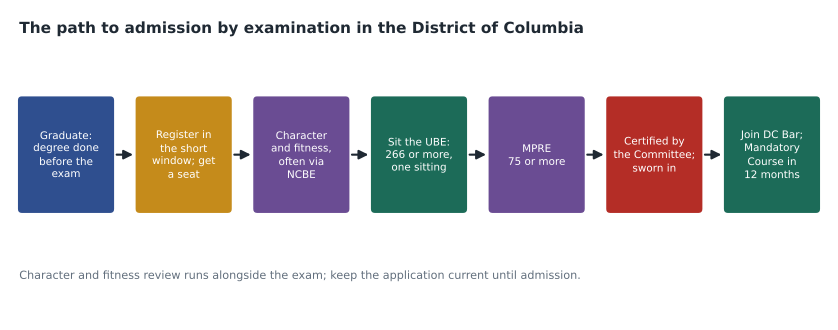
For an applicant seeking admission by examination, the requirements come down to five. You must be eligible, which usually means holding a J.D. from a law school approved by the American Bar Association (ABA), with the degree requirements completed before the first day of the exam; Lesson 2 explains the alternative routes for graduates of other law schools, which require additional study at an ABA-approved school. You must register during the announced window, secure a seat and pay the fees. You must pass the UBE in a single administration with a total scaled score of at least 266. You must pass the MPRE with a scaled score of at least 75. And you must satisfy the Committee that you have the character and fitness to practice law.
Look at what is not on the list. The District does not add a separate test of District law to the UBE, and it does not require a separate course on District law before admission. NCBE's information for the District lists no jurisdiction-specific component for the current exam. The one District-specific educational requirement, the Mandatory Course, comes after admission. Whether the NextGen exam will carry a District component is listed as to be announced; Lesson 5 explains what that means.
Two numbers to remember: 266 and 75
The District's passing score of 266 sits in the middle of the range among UBE jurisdictions, where passing scores run from 260 to 270. Its MPRE requirement of 75 is at the bottom of the national range, which runs from 75 to 86. Both numbers matter for portability. A score of 266 earned in the District transfers to any jurisdiction that requires 266 or less, but not to one that requires 270. A score earned elsewhere transfers into the District if it is at least 266. Marchetti makes a point she will repeat often: 'Passing scores are policy choices made by courts. Always check the number that applies to the exam you are actually taking and the jurisdiction you want your score to reach.'
The District sets no time limit on when the MPRE score must be earned, according to NCBE's jurisdiction information. That is unusual: many jurisdictions require the MPRE score to be no more than a few years old. Lesson 3 explains how the MPRE fits into the character and fitness process and why candidates should still take it early.
The order of events
Most District applicants move through the process in a predictable order. During law school they take the MPRE. In the final year they gather what the application asks for, including employment and residence histories and records for anything that requires a yes answer on the character questions. When the Committee announces the registration window for their exam, they register at once. They file the character and fitness materials and respond promptly to NCBE's requests. They sit the exam on the last Tuesday and Wednesday of February or July. Results follow some weeks later: the July 2026 results were posted on October 23, 2026, and the February 2026 results on April 17, 2026. A successful candidate who has met every other requirement is certified, admitted and sworn in, joins the DC Bar and then completes the Mandatory Course within a year.
Worked problem
Planning Jasper's path
Jasper graduated in May 2026 from an ABA-approved law school in the District and scored 96 on the MPRE in his third year. He holds a seat for the February 2027 exam. What must he still do before he can be admitted, and what must he do after?
Show solution
- Eligibility: his J.D. is from an ABA-approved school and was completed before the exam, so he is eligible.
- Character and fitness: he must complete his application and respond to NCBE and the Committee promptly.
- MPRE: his 96 exceeds the District's 75, and the District sets no time limit, so the score works.
- Exam: he must score 266 or more on the February 2027 UBE in that single administration.
- After admission: he joins the DC Bar and must finish the Mandatory Course within twelve months of the month he is sworn in.
Answer: Jasper needs a passing exam score and character and fitness approval; his MPRE is done; the Mandatory Course follows admission.
Common mistakes
MistakeThe District's courts are federal courts because Congress created them.
InsteadThe DC Court of Appeals and Superior Court are local courts of the District, created by Congress under its power over the District; federal cases go to separate federal courts.
MistakeRegistering on time guarantees a seat.
InsteadSeats are limited and assigned first-come, first-served; the February 2027 exam filled with no waitlist.
MistakeThe DC Bar admits new lawyers.
InsteadThe Court of Appeals admits lawyers on the Committee on Admissions' certification; the DC Bar is the mandatory membership organization new lawyers then join.
MistakeThe District requires a course on District law before admission.
InsteadThere is no pre-admission District law component; the Mandatory Course on DC rules and practice comes within twelve months after admission.
Summary and key terms
- The District of Columbia Court of Appeals controls admission through Rule 46 and acts on certification by its Committee on Admissions.
- The DC Bar is a mandatory unified bar that new lawyers join after admission; it runs the Mandatory Course.
- NCBE writes the UBE, runs the MPRE and conducts many character investigations, but does not admit anyone.
- The main routes are examination (UBE 266), transferred UBE score and admission without examination after three of the last five years in active practice.
- Exam seats are limited and assigned first-come, first-served during short registration windows.
- District of Columbia Court of Appeals
- The highest court of the District, which adopts Rule 46 and admits lawyers to the DC bar.
- Committee on Admissions
- The court-appointed body that administers the bar exam and reviews applications for admission.
- DC Bar
- The mandatory, unified bar of the District, whose membership is required to practice as a DC lawyer.
- Rule 46
- The DC Court of Appeals rule governing admission by examination, transferred score and admission without examination.
- Unified bar
- A bar association that every licensed lawyer in the jurisdiction must join.
Lesson quiz · 5 questions
Score 60% or more to complete this lesson.
Create a free account to save your progress, take quizzes and earn a certificate.