
BAR-209 · Lesson 6 of 12 · 18 min
What the exam tests and how District of Columbia law appears
▶ Video coming soon A video version of this lesson is on the way.
Jasper's supervising attorney, Constance, has practiced in the Landlord and Tenant Branch for twenty years. When Jasper mentions that the bar exam will not test District law, she laughs. 'Then you will learn it the way the rest of us did,' she says. 'From the judges, from the clerk's office and from the statute book. Start now.'
This lesson explains what the District's bar exam tests, why District law is not on it, where District law will matter instead, and how to find and cite the sources of District law. It also sets up the four lessons that follow, which cover the District law a new lawyer is most likely to need.
The exam tests general law
The UBE, which the District gives through July 2027, tests general principles of law. NCBE writes its questions on the basis of widely accepted rules: the Federal Rules of Civil Procedure and federal jurisdiction statutes for civil procedure, the Federal Rules of Evidence for evidence, the Uniform Commercial Code and general common law for contracts, and majority rules for torts, property and criminal law. Where the law is unsettled, NCBE either avoids the question or states the governing rule in the question. The MPT supplies all the law the examinee needs, often from a fictional jurisdiction. The MEE asks examinees to apply general principles unless a question states otherwise. NextGen, from February 2028, follows the same approach.
This has a practical consequence that every District candidate should absorb. On the exam, answer by the general rule that NCBE tests, even if District law differs. A torts question on the MBE that does not state a rule will usually call for comparative negligence and joint and several liability under NCBE's default assumptions. The District, as Lesson 8 explains, is one of the few jurisdictions that still applies contributory negligence in most cases. If you answer an MBE question using the District's rule, you may choose the wrong answer.
No District component
The District does not add a District law test or course to the UBE. NCBE's information lists no jurisdiction-specific component for the District's legacy exam and no component required for admission by transferred score. Some jurisdictions take a different approach. Neighboring Maryland, for example, has used a Maryland law component, and Virginia gives its own state law essay exam. A candidate who sits in the District and later seeks admission in a jurisdiction with its own component will need to satisfy that jurisdiction's requirement at that time.
Whether the District's NextGen exam will carry a District component is listed as to be announced. If the court adopts one, candidates who sit in February 2028 and later will need to complete it, and candidates transferring NextGen scores may be required to complete it too. For now, District law enters the picture after admission, in the Mandatory Course and in practice.
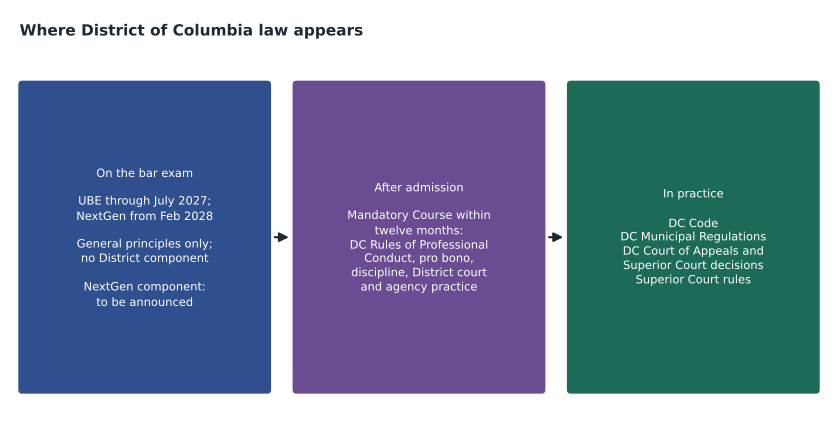
Why District law still matters
Even though the exam does not test it, District law matters for three reasons. First, new lawyers practice it. Jasper will appear in the Superior Court's Landlord and Tenant Branch, where the District's Rental Housing Act, eviction procedures and local court rules decide cases. A new associate at a litigation firm will handle cases under the District's tort law, limitation periods and Superior Court Civil Rules. Second, the Mandatory Course that every new admittee must complete covers the District's Rules of Professional Conduct and District court and administrative practice. Third, District lawyers owe ethical duties under the District's rules, not the ABA Model Rules that the MPRE tests, and Lesson 10 explains several important differences.
The sources of District law
District law has an unusual structure because the District is not a state. At the top is federal law: the Constitution gives Congress exclusive legislative power over the seat of government, and Congress can legislate directly for the District at any time. Below that is the District of Columbia Home Rule Act of 1973, a federal statute that delegated most local legislative power to an elected Council and executive power to an elected Mayor. The Home Rule Act functions somewhat like a charter, and it limits what the Council may do. For example, the Council cannot change the structure or jurisdiction of the District's courts or enact certain kinds of taxes on nonresidents, and Congress keeps the power to review District legislation.
The Council enacts laws, which are codified in the District of Columbia Official Code, usually called the DC Code. The Council publishes the official code online through the Council's legal information site, and the DC Code is organized into titles by subject: Title 12 for the right to remedy, including limitation periods; Title 16 for particular actions and proceedings; Title 42 for real property, including the Rental Housing Act; Title 2 for government administration, including the District of Columbia Human Rights Act; and many others. District agencies issue regulations, which appear in the District of Columbia Municipal Regulations, the DCMR, and are published in the District of Columbia Register.
The courts supply the rest. The District of Columbia Court of Appeals is the highest court on questions of District law, and its decisions bind the Superior Court. Decisions of the United States Court of Appeals for the District of Columbia Circuit issued before February 1, 1971, when Congress's court reorganization took effect, are binding on the District's local courts as precedent under the Court of Appeals' own decision in M.A.P. v. Ryan, 285 A.2d 310 (D.C. 1971), unless the Court of Appeals sitting together as a full court has overruled them. Later D.C. Circuit decisions on District law are persuasive but not binding. The Superior Court has its own rules of procedure, including the Superior Court Rules of Civil Procedure, which are modeled closely on the Federal Rules.
| Source | What it is | Where to find it |
|---|---|---|
| US Constitution and Acts of Congress | Congress's exclusive power over the District; laws Congress passes for it | United States Code; Statutes at Large |
| Home Rule Act (1973) | Federal statute delegating local power to the Council and Mayor, with limits | DC Code, charter provisions |
| Acts of the Council | Local legislation, subject to congressional review | DC Official Code (Council legal site) |
| Regulations | Rules adopted by District agencies | DC Municipal Regulations; DC Register |
| Court decisions | DC Court of Appeals (binding); pre-1971 D.C. Circuit decisions (binding under M.A.P. v. Ryan) | Atlantic Reporter; court websites |
| Court rules | Superior Court and Court of Appeals rules | DC Courts website |
Finding District law
The official DC Code, with annotations and links to session laws, is available free on the Council's legal information site. The District of Columbia Courts publish their rules, opinions of the Court of Appeals and forms on their website. The DCMR and DC Register are published online by the District government. Commercial databases carry all of these with citators and secondary sources. For landlord and tenant practice, the Superior Court's Landlord and Tenant Branch publishes forms and information, and the District's Office of the Tenant Advocate and Rental Housing Commission publish guidance and decisions.
Marchetti recommends that Jasper spend an hour finding five things on the official sites before he needs them: the Rental Housing Act, the Superior Court Landlord and Tenant rules, the District's limitation periods in DC Code section 12-301, the Human Rights Act and the DC Rules of Professional Conduct. 'If you can find them calmly on a quiet afternoon,' she says, 'you can find them quickly when a judge is waiting.'
Citing District law
District court opinions are reported in the Atlantic Reporter, and citations follow the usual form, such as 285 A.2d 310 (D.C. 1971) for a Court of Appeals decision. DC Code sections are cited by title and section, such as D.C. Code section 12-301. The District's courts have their own citation practices in local rules and in their opinions, and new lawyers should follow them in filings. Lesson 12's practice questions use these forms.
How the next four lessons are organized
Lessons 7 through 10 cover the District law a new lawyer is most likely to need, chosen because each area differs from what the bar exam tests or is unusual to the District. Lesson 7 covers the District's courts, its relationship with Congress and its civil procedure. Lesson 8 covers District tort law, which still applies contributory negligence with important statutory exceptions. Lesson 9 covers District housing and civil rights law, including the Rental Housing Act, the Tenant Opportunity to Purchase Act and the District of Columbia Human Rights Act. Lesson 10 covers the District's Rules of Professional Conduct, including its long-standing exception allowing nonlawyer partners, and the District's rule on the unauthorized practice of law.
Worked problem
Exam answer or practice answer?
An MBE question describes a pedestrian struck by a car; the pedestrian was 10 percent at fault. The question does not say which rule applies. In practice in the District, a different statute might govern. Which rule should Jasper use on the exam?
Show solution
- NCBE tests general principles and, absent a stated rule, assumes comparative negligence.
- The District's own rules, including its contributory negligence doctrine and its statute for pedestrians and other vulnerable road users, are not tested.
- On the exam he should apply the general rule NCBE states or assumes.
- In practice he would apply District law, which Lesson 8 explains.
Answer: On the exam, use NCBE's general rule; in District practice, use District law.
Common mistakes
MistakeAnswer MBE questions using District law when you know it.
InsteadThe exam tests general principles; apply NCBE's stated or default rules.
MistakeAll D.C. Circuit decisions bind the District's local courts.
InsteadPre-1971 D.C. Circuit decisions bind under M.A.P. v. Ryan; later ones on District law are persuasive only.
MistakeThe Council can restructure the District's courts.
InsteadThe Home Rule Act bars the Council from changing the courts' structure and jurisdiction.
MistakeDistrict regulations are in the DC Code.
InsteadRegulations appear in the DC Municipal Regulations and the DC Register.
Reading a District statute
District statutes are organized in the DC Code by title and section, and a citation such as DC Code 12-309 points to title 12, section 309. Many District statutes include a definitions section near the beginning of the chapter, and those definitions often decide whether the statute applies at all. The vulnerable user statute in lesson eight is a good example: whether a scooter rider is protected depends on how section 50-2204.51 defines a vulnerable user. Before relying on any District statute, a new lawyer should read the definitions, check the effective date of the current version and look for amendments that have been enacted but are not yet in force.
Because District laws must pass a congressional review period before they take effect, the date a law was passed by the Council and the date it takes effect can be months apart. The Council's official code website shows the current text and notes recent changes, and the Council's legislative information system shows the status of pending bills and acts.
Reading a District opinion
Opinions of the DC Court of Appeals are binding on the Superior Court and on the Court of Appeals' own later panels, and the court can overrule its own precedent only when sitting en banc. A new lawyer researching District law should therefore look for en banc decisions on the point and should check whether a panel decision has been reconsidered. Older decisions of federal courts on District law, from before the 1970 court reorganization, can also matter, because the Court of Appeals has treated certain earlier decisions as binding unless it has overruled them en banc.
Why the general law still comes first
None of this changes what the exam tests. On the exam, candidates apply general principles, and on most questions the District's rule and the general rule are the same. The District-specific material in this course is for two purposes: understanding the jurisdiction in which a candidate will practice, and recognizing the handful of areas, such as contributory negligence, where the District's rule is different enough that a new lawyer must know it from the first day.
Worked problem
Spotting the right rule
A practice MEE question asks about a negligence claim and says the jurisdiction follows pure comparative negligence. A candidate who has studied District law wonders whether to discuss contributory negligence instead. What should she do?
Show solution
- The question states the rule to apply, so she should apply pure comparative negligence.
- Discussing the District's rule would not earn credit and would use time.
- If a question states no rule, she should apply the general rule NCBE tests.
- She should save District law for practice, not the exam.
Answer: Apply the rule the question gives; District law is for practice, not the UBE.
A useful habit for new lawyers is to keep a short list of the places where District law differs from what they learned for the exam. The list can start with the topics in the next four lessons: contributory negligence and its statutory exception, the notice rule for claims against the District, the protections of the Rental Housing Act and TOPA, the reach of the Human Rights Act, and the DC Rules on nonlawyer partners and client confidences and secrets. Each time a lawyer meets another difference in practice, it goes on the list.
Summary and key terms
- The District's bar exam tests general principles; there is no District component on the legacy UBE, and any NextGen component is to be announced.
- District law matters in practice and in the Mandatory Course.
- District law flows from Congress, the Home Rule Act, Council acts, agency regulations and decisions of the DC Court of Appeals.
- Pre-February 1971 D.C. Circuit decisions bind the local courts under M.A.P. v. Ryan.
- The DC Code, DCMR and court rules are available free on official sites.
- Home Rule Act
- The 1973 federal statute delegating local legislative and executive power to the District's Council and Mayor.
- DC Official Code
- The codified statutes of the District, published by the Council.
- DCMR
- The District of Columbia Municipal Regulations, containing agency rules.
- M.A.P. v. Ryan
- A 1971 DC Court of Appeals decision holding that pre-February 1971 D.C. Circuit decisions bind the local courts.
- Atlantic Reporter
- The regional reporter that publishes DC Court of Appeals decisions.
Lesson quiz · 5 questions
Score 60% or more to complete this lesson.
Create a free account to save your progress, take quizzes and earn a certificate.