
BAR-209 · Lesson 12 of 12 · 26 min
Capstone: District of Columbia practice questions and an exam-day plan
▶ Video coming soon A video version of this lesson is on the way.
Three months before the February 2027 exam, Marchetti gives Jasper the same assignment she gives every candidate at this stage. 'Two things,' she says. 'First, prove to me you understand how DC works, because you will need it the week after you are sworn in. Second, write down exactly what you will do from now until the second afternoon of the exam. If it is not written down, it is not a plan.'
This capstone has three parts. The first is a set of original practice questions on the District's admission rules and the District law in this course, each with an explanation. The second is an original essay on District law with a model answer. The third is an exam-week plan for the District's February 2027 UBE. None of the questions is drawn from a released bar exam; all were written for this course.
Part one: practice questions
Work through each question before reading the explanation. Treat it the way you would treat an MBE question: identify the issue, recall the rule, apply it and choose.
Practice problems
Work each problem on paper first, then reveal the answer to check.
Rhea graduates from an ABA-approved law school in December 2027 and wants to be admitted in the District as soon as possible by sitting the District's own exam. Which exam will she take, and what score must she reach?
Show answer
The District's last legacy UBE is July 2027, before her graduation. Her first District exam is the NextGen UBE in February 2028, and she must reach the District's NextGen passing score of 616, set by the court's administrative order.
Teodor earned a legacy UBE score of 268 in another UBE jurisdiction in February 2025. That jurisdiction requires 270, so he did not pass there. Can he transfer the 268 to the District in 2027?
Show answer
Yes, if he meets the District's other requirements. The District accepts legacy UBE scores of 266 or more earned in other jurisdictions during any administration, if no more than five years old when the transfer is requested. A 268 from February 2025 qualifies until early 2030. Whether he passed in Alaska does not matter; what matters is the District's standard.
Benedikt holds a German law degree and an LL.M. from an ABA-approved law school, in which he took 18 credits of tax and international law courses. Is he eligible to sit the District's exam?
Show answer
Not yet, on these facts. The District requires foreign graduates to complete 26 semester credit hours at an ABA-approved school in qualifying bar subjects, and to have the foreign education evaluated. An LL.M. title alone does not establish eligibility, and 18 credits in largely non-bar subjects falls short.
A lawyer admitted in Virginia in 2015 has spent the last five years as a full-time stay-at-home parent and has not practiced. She applies for admission without examination in December 2026. Does she qualify under the three-year provision?
Show answer
No. Since April 24, 2026, the provision requires active practice of law for three of the five years before the application. Bar membership alone, which satisfied the former rule, is no longer enough. She could sit the exam or wait until she has accumulated qualifying practice.
On an MBE question, a pedestrian who was looking at her phone is struck by a speeding car. The question states no rule on comparative or contributory negligence. Which rule should a District candidate apply?
Show answer
NCBE's default: pure comparative negligence. The exam tests general principles, not District law. In actual District practice, DC Code 50-2204.52 would govern a pedestrian in a collision with a motor vehicle.
A car driver in the District is struck by another car that ran a red light. The injured driver was going five miles per hour over the speed limit, which contributed slightly to the collision. Under District law, what is the main obstacle to recovery, and what doctrine might help?
Show answer
Contributory negligence: the District applies it as the general rule outside the statute for pedestrians and vulnerable users, and a driver is not covered by that statute. If the injured driver's negligence was a proximate cause, it may bar recovery, unless the last clear chance doctrine applies because the other driver had the last clear opportunity to avoid the collision.
A cyclist is injured on March 1, 2026 when a District government truck backs into her. She contacts a lawyer on October 15, 2026. What deadline may already have passed?
Show answer
The six-month written notice to the Mayor required by DC Code 12-309 for unliquidated damages claims against the District. Six months from March 1, 2026 is early September 2026. Unless a qualifying police report or other notice satisfied the statute, the claim may be barred regardless of the three-year limitation period.
A building owner bought a District apartment building in 2022 and wants to sell it in 2027. The owner disclosed the RENTAL Act exemption in new leases and gave existing tenants written notice by March 31, 2026. Must the owner give the tenants an offer of sale under TOPA?
Show answer
Generally no, under the RENTAL Act's fifteen-year exemption: a sale within fifteen years after a prior sale or transfer is not a sale for offer-of-sale purposes when the disclosure and notice conditions are met. The owner must still give the tenants a notice of transfer, and counsel should confirm the details under the statute and any implementing regulations.
A DC law firm that provides only legal services wants to make its chief operating officer, a nonlawyer, a partner with a profit share. Is that permitted under the DC Rules, and did the October 2026 court decision change the answer?
Show answer
Yes, under DC Rule 5.4(b), if the firm's sole purpose is providing legal services, the nonlawyer undertakes to abide by the Rules, the lawyer partners take responsibility for her, and the conditions are in writing. The October 15, 2026 decision rejected a broader proposal for firms offering other law-related services, but it left Rule 5.4(b) in place, so the answer does not change.
Suppose Jasper is sworn in on June 10, 2027. By what date must he complete the Mandatory Course, and what happens if he does not?
Show answer
By June 30, 2028, twelve months after the month of swearing in. If he does not comply after the notice and grace period, he will be suspended from practicing law in the District, must notify clients and withdraw from District court cases, and must pay a reinstatement fee; the DC Bar cannot grant extensions.
Part two: an essay on District law
Allow yourself thirty minutes, the time allotted for an MEE question. Write an organized answer before you read the model.
The facts: Nora Price, a District resident, was riding a shared electric scooter in a marked bike lane on a District street at 7 p.m. on April 2, 2026. A delivery van owned by Fairway Logistics, LLC and driven by its employee turned right across the bike lane without signaling and struck her. Price was riding somewhat faster than the posted guidance for scooters in bike lanes and was wearing headphones. She suffered a broken leg. Two weeks later, while she was using crutches, she fell on a section of District-owned sidewalk that the District had marked for repair months earlier but had not fixed, injuring her wrist. Price consulted a lawyer on November 20, 2026. She asks what claims she has, against whom, and what deadlines matter.
The call: Discuss Price's claims under District law against Fairway Logistics and the District of Columbia, including any defenses and deadlines.
Model answer. Claim against Fairway Logistics. Price can sue the driver for negligence and Fairway Logistics as his employer under respondeat superior, since he was driving a company van in the course of his employment. The driver owed a duty of reasonable care to others on the road and likely breached it by turning across a marked bike lane without signaling or yielding. His breach was a cause in fact and proximate cause of the collision and of her broken leg.
The main defense is Price's own negligence: she was riding fast and wearing headphones. In general, the District applies contributory negligence, which would bar a negligent plaintiff entirely. But DC Code 50-2204.52, as expanded in 2021, applies when a pedestrian or vulnerable user is involved in a collision with a motor vehicle. A person riding an electric scooter likely qualifies as a vulnerable user under the definitions in section 50-2204.51, which include electric mobility devices, personal mobility devices, scooters and similar devices; counsel should confirm how the specific shared scooter is classified. If the statute applies, Price's negligence bars recovery only if it was a proximate cause of her injury and was greater than the combined negligence of all defendants. On these facts, a jury could reasonably find that the driver's unsignaled turn across a marked bike lane was the greater fault, in which case her claim is not barred. The statute does not, on its face, reduce her damages by her share of fault, and it preserves joint and several liability and the last clear chance doctrine. Fairway may argue that her speed and headphones were the greater cause, which is a jury question.
Deadline for the van claim: the general limitation period for personal injury under DC Code 12-301 is three years, so she has until April 2029. She is well within time.
Claim against the District. Her sidewalk fall raises a negligence claim against the District for failing to repair a known defect in a public sidewalk. Maintenance of sidewalks the District has already identified for repair is generally treated as a ministerial function rather than a discretionary policy choice, which supports the claim, though the District may argue otherwise. The public duty doctrine of Warren v. District of Columbia concerns duties to provide public services such as police protection to the public at large, and is less likely to bar a claim based on the District's maintenance of its own property, but counsel should research how it has been applied to sidewalk claims.
The critical issue is notice. DC Code 12-309 requires written notice to the Mayor within six months after the injury for unliquidated damages claims against the District. Her fall was around April 16, 2026, so the six-month period ended around mid-October 2026. She consulted a lawyer on November 20, 2026, after the period had run. Unless a qualifying notice was given, such as a police report prepared in the regular course of duty that recorded the time, place, cause and circumstances, her claim against the District is likely barred, even though the three-year limitation period has not expired. The District will also raise contributory negligence: as a pedestrian on crutches she is not in a collision with a motor vehicle or vulnerable user, so section 50-2204.52 does not apply, and any negligence by her in watching her step could bar recovery unless an exception applies.
Advice: pursue the claim against the driver and Fairway Logistics promptly, preserving evidence of the turn, the van's route and any camera footage. Investigate at once whether any qualifying notice of the sidewalk fall exists; if not, advise her that the District claim is likely barred.
Part three: an exam-week plan
The District's February 2027 UBE is given on Tuesday, February 23 and Wednesday, February 24, 2027, at venues the Committee will announce. Only clear bags are permitted. Marchetti has Jasper write his plan in four stages.
| When | What to do |
|---|---|
| Now to late January | Finish substantive review; take at least two full timed practice exams; read the Committee's exam-day instructions as soon as they are posted |
| Two weeks before | Confirm the venue and travel route; install and test any required exam software; check identification and admission documents |
| The weekend before | Light review of outlines and MPT approach; pack a clear bag with permitted items only; plan meals and sleep |
| Exam days | Arrive early; MPT and MEE on day one, MBE on day two; do not discuss answers between sessions; rest the evening of day one |
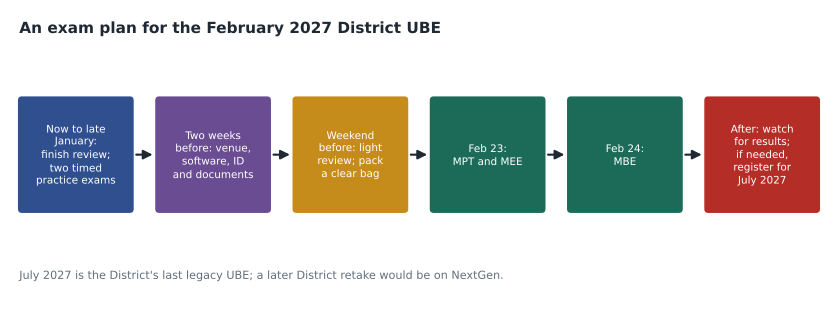
His plan also covers what comes after the exam. He will keep his application current, respond promptly to any Committee or NCBE requests, and check the admissions portal for the results date, which for the February 2026 exam was April 17. If he passes, he will be certified, sworn in, join the DC Bar and calendar the Mandatory Course deadline. If he does not pass, he will register for the July 2027 exam the day its window opens, knowing it is the District's last legacy UBE.
Marchetti reads his plan and adds one line at the bottom: 'Register on day one.' She has seen too many candidates prepare well and still lose a seat.
Worked problem
Checking the plan
Jasper's plan says he will register for July 2027 if he does not pass in February. What else should his backup plan include, given the District's calendar?
Show solution
- July 2027 is the District's last legacy UBE; a later District retake would be NextGen in February 2028.
- He should consider whether sitting the legacy UBE elsewhere in February 2028 and transferring a 266 score would be better than switching to NextGen.
- He should watch for the District's July 2027 registration window and register at once.
- He should keep his MPRE score on file; the District sets no time limit on it.
Answer: His backup plan should account for July 2027 being the last District legacy UBE and the transfer option.
Common mistakes
MistakeA score below the passing score where it was earned cannot be transferred.
InsteadWhat matters is the receiving jurisdiction's standard; a 268 meets the District's 266.
MistakeMeeting the three-year limitation period preserves a claim against the District.
InsteadThe separate six-month notice under DC Code 12-309 must also be satisfied.
MistakeThe vulnerable user statute protects any injured pedestrian.
InsteadIt applies to collisions with motor vehicles or vulnerable users; a sidewalk fall is not covered.
MistakeExam-week plans can wait until the week of the exam.
InsteadVenue, software and identification should be checked at least two weeks before.
Summary and key terms
- The capstone reviews the District's admission routes, scores and deadlines and the District law in this course.
- The essay shows how DC Code 50-2204.52, contributory negligence, respondeat superior, section 12-309 notice and section 12-301 limitation periods interact.
- The February 2027 District UBE is on February 23 and 24, 2027; only clear bags are allowed.
- A good plan covers preparation, logistics, the exam days and what happens after results.
- If a candidate does not pass in February 2027, July 2027 is the last District legacy UBE.
- IRAC
- Issue, rule, application, conclusion: a structure for organizing an essay answer.
- Respondeat superior
- The doctrine making an employer liable for an employee's torts committed in the scope of employment.
- Ministerial function
- A governmental act involving little discretion, for which the District may be liable.
- Exam-week plan
- A written schedule for the final weeks before the bar exam and the exam days.
- Backup plan
- A decided course of action if a seat is lost or the exam is not passed.
Lesson quiz · 5 questions
Score 60% or more to complete this lesson.
Create a free account to save your progress, take quizzes and earn a certificate.