
BAR-209 · Lesson 11 of 12 · 15 min
Score transfer, admission without examination and practice after admission
▶ Video coming soon A video version of this lesson is on the way.
Three people in Jasper's world are trying to get into the DC Bar by three different doors. Aaliyah, his classmate, missed a February 2027 seat and is thinking about sitting elsewhere and transferring her score. Priyanka, a lawyer at his nonprofit, was admitted in Maryland in 2019, practiced there for four years, then took two years off to care for a parent and now works in the District. And Jasper himself will soon be admitted and must learn what the DC Bar expects of its new members. Marchetti spends this session on all three.
This lesson covers admission by transferred UBE score, admission without examination under the amended three-year provision, and the obligations that begin after admission: DC Bar membership, the Mandatory Course and the District's approach to continuing legal education.
Admission by transferred UBE score
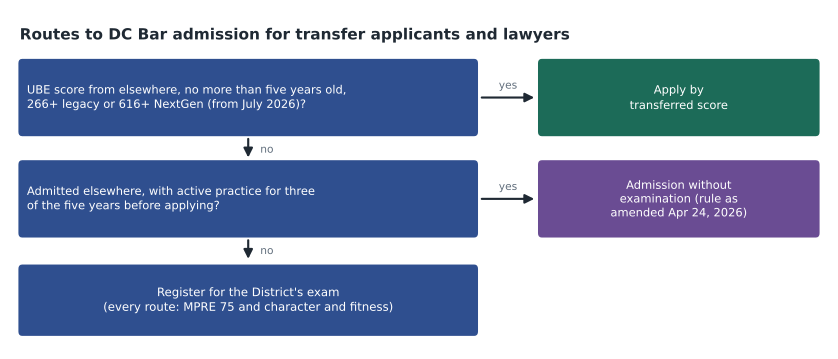
The District accepts UBE scores earned in other jurisdictions. Under Rule 46(d)(1) as amended, an applicant may transfer a legacy UBE score of 266 or more, earned in another jurisdiction during any administration, if the score is not more than five years old when the transfer is requested. An applicant may also transfer a NextGen UBE score earned in another jurisdiction during any administration in or after July 2026, if the score is at or above the District's NextGen passing score, which the Committee has announced as 616, and is not more than five years old. In each case, all components must have been taken in a single administration, and the four-attempt limit applies. The District does not accept transferred MBE scores standing alone.
A transfer applicant must meet the District's other requirements: an eligible law degree, a passing MPRE score of 75, and character and fitness. NCBE lists the application fee for admission by transferred score as 405 dollars plus the character and fitness fee. Unlike admission without examination, admission by transferred score is available to recent graduates who have never practiced, which makes it the natural route for a candidate like Aaliyah who sits the UBE somewhere else.
Concurrent transfer applications
The Committee has also offered concurrent transfer applications for candidates who are sitting the UBE in another jurisdiction and want to transfer the score to the District as soon as it is available. For the February 2027 exam cycle, the concurrent transfer window runs from December 1 to December 30, 2026; applicants need a UBE score of 266 or a NextGen score of 616, and the score must reach the District by June 15, 2027, or the application is terminated. For the July 2026 cycle, the window ran in May 2026 and scores were due by January 15, 2027. The fees are not refundable or transferable. A candidate in Aaliyah's position who sits in another UBE jurisdiction in February 2027 could file a concurrent application in December 2026, take the exam elsewhere, and have the score sent to the District when it is released.
Admission without examination: the three-year provision
The District has long allowed lawyers admitted in other United States jurisdictions to join the DC Bar without taking an exam. For years, the requirement under Rule 46(e)(3) was simply that the applicant had been a member in good standing of the bar of a court of general jurisdiction in the United States for at least three years immediately before applying. Membership alone was enough, whether or not the lawyer had practiced.
In February 2026, the court proposed to change that. Its notice in matter M-295-26 explained that membership without practice does not clearly show competence and proposed to require actual practice instead, measured over a five-year window so that applicants who had stepped away from work for reasons such as illness or caregiving would not be penalized. The court adopted the change, and the Committee announced that, effective April 24, 2026, applicants under the three-year provision must show that they engaged in the active practice of law for three of the five years before they apply. The Committee has issued guidance defining the active practice of law for this purpose.
NCBE's jurisdiction information lists the kinds of practice that count, including private practice, work as in-house corporate counsel, work for a government agency, military legal service, law teaching and a judicial clerkship in a court of record. The District does not require reciprocity, so a lawyer from a jurisdiction that would not admit a District lawyer on motion can still be admitted in the District. NCBE also notes that the District sets no time limit on the MPRE score and that lawyers first admitted by diploma privilege are eligible. NCBE lists the fee as 595 dollars plus the character and fitness fee, effective April 1, 2024.
Priyanka's case shows why the five-year window matters. She was admitted in Maryland in 2019 and practiced full time from 2019 to 2023, then spent 2023 to 2025 caring for her father, and in 2025 returned to Maryland practice for a District-based nonprofit while she prepared her DC application. If she applies in late 2026, the five years before her application run from late 2021 to late 2026. Within that period, she practiced from late 2021 to 2023, roughly two years, and since 2025, roughly one more year. Whether she reaches three full years of active practice depends on the exact dates and on whether all of her work qualifies under the Committee's guidance. If she falls short, she can wait a few more months or use another route.
| Route | Score or experience | Time limit | Fee listed by NCBE |
|---|---|---|---|
| Transferred legacy UBE | 266 or more, single administration | No more than five years old | 405 dollars plus character and fitness |
| Transferred NextGen UBE | 616 or more, from July 2026 on | No more than five years old | 405 dollars plus character and fitness |
| Admission without examination | Active practice for three of the five years before applying (since April 24, 2026) | Measured over the five-year window | 595 dollars plus character and fitness |
| All routes | MPRE 75; character and fitness | No MPRE time limit | NCBE character report fee by category |
After admission: joining the DC Bar
Once admitted, a lawyer becomes a member of the District of Columbia Bar, which is mandatory for anyone who wants to practice as a District lawyer. The Rules Governing the District of Columbia Bar set out classes of membership, including active, inactive and judicial members, and require members to pay annual dues and keep their contact information current. Members who do not pay dues are suspended administratively. The DC Bar also issues certificates of good standing on the court's behalf, which lawyers need when applying for admission elsewhere or before federal courts.
The Mandatory Course
Every new admittee must complete the Mandatory Course on the District of Columbia Rules of Professional Conduct and District of Columbia Practice within twelve months after the month in which he or she is sworn in. The DC Bar's example makes the deadline concrete: a lawyer sworn in on September 15, 2025 must complete the course by September 30, 2026. The course is a four-hour, on-demand online video with closed captions, which a lawyer can pause and resume. As of November 2026 it cost 229 dollars. It covers the DC Rules of Professional Conduct, pro bono obligations and how to fulfill them, the District's disciplinary system, the DC Bar's nondisciplinary regulatory programs, and District court and administrative practice. To receive a certificate, the lawyer must watch the entire presentation and submit codes that appear during it.
The consequences of missing the deadline are serious. The DC Bar sends a notice of noncompliance with a grace period, and a lawyer who still does not comply is suspended from practicing law in the District. The suspension is reported to the District's courts, the lawyer must notify clients and withdraw from cases in District courts, a reinstatement fee applies, and the suspension becomes a permanent part of the lawyer's membership record. The DC Bar states that it does not have authority to grant extensions or exceptions. The course is also required for some members returning to active status after long periods in other statuses, such as five or more years as inactive.
The course carries continuing legal education credit in other jurisdictions: it is accredited for four total hours, including three hours of legal ethics, in jurisdictions that require continuing education, which helps lawyers admitted in more than one place.
No ongoing mandatory CLE
Unlike most states, the District does not require its lawyers to complete a set number of continuing legal education hours each year or reporting period. The Mandatory Course is a one-time requirement for new admittees and certain returning members. DC lawyers who are also admitted elsewhere must meet those jurisdictions' requirements, and the DC Bar offers a large program of continuing education that many members take voluntarily. Marchetti warns Jasper not to read the absence of a requirement as permission to stop learning. 'DC law changes fast,' she says, pointing to the RENTAL Act and the 2026 amendments to Rule 46. 'The lawyers who keep up are the ones who choose to.'
Pro bono and support
The District has a strong pro bono culture, supported by the DC Bar Pro Bono Center, legal services organizations and the courts. The DC Rules describe an aspirational duty to provide pro bono services, and the Mandatory Course explains how to meet it. The DC Bar's Lawyer Assistance Program offers confidential help to lawyers dealing with stress, mental health concerns or substance use, and the Committee on Admissions has promoted its support groups for applicants.
Worked problem
Jasper's first year as a lawyer
Suppose Jasper passes the February 2027 exam and is sworn in on June 10, 2027. What must he do in his first year?
Show solution
- Join the DC Bar as an active member and pay dues.
- Complete the Mandatory Course within twelve months after June 2027, that is, by June 30, 2028.
- Keep his DC Bar contact information current.
- There is no other District CLE requirement, but if he is later admitted elsewhere he must meet that jurisdiction's rules.
Answer: He must join the DC Bar and complete the Mandatory Course by June 30, 2028.
Common mistakes
MistakeThe District accepts transferred MBE scores.
InsteadNCBE's information states that the District does not accept transferred MBE scores standing alone.
MistakeThree years of bar membership elsewhere is enough for admission without examination.
InsteadSince April 24, 2026, applicants must show active practice of law for three of the five years before applying.
MistakeThe District requires reciprocity for admission without examination.
InsteadThere is no reciprocity requirement.
MistakeThe DC Bar can extend the Mandatory Course deadline.
InsteadThe DC Bar states it has no authority to grant extensions or exceptions; noncompliance leads to suspension.
Choosing a route
For candidates who have a choice of routes, the decision usually turns on timing and cost. A candidate with a qualifying UBE score from another jurisdiction may find a transfer the quickest path. A lawyer with several years of active practice in another jurisdiction may qualify under the three-year provision without any exam. A candidate with neither must sit the District's exam. Marchetti asks every candidate who has more than one option to write down three things for each route: the earliest realistic admission date, the cost, and the risk that something will go wrong, such as a score expiring or a practice period falling short.
Keeping admission current
Admission is not the last step. Once admitted, a lawyer must pay DC Bar dues each year, keep contact information current with the DC Bar, complete the Mandatory Course on time and comply with the DC Rules. A lawyer who moves out of the District can choose inactive status, which typically carries lower dues but restricts practice. A lawyer who plans to stop practicing should consider the rules for resigning or taking inactive status, since leaving dues unpaid can lead to administrative suspension.
Admission in more than one jurisdiction
Many District lawyers are also admitted in Maryland, Virginia or another state, and each jurisdiction has its own rules on dues, continuing legal education and professional conduct. The District has no ongoing mandatory CLE beyond the Mandatory Course, but a lawyer admitted elsewhere may need to meet that jurisdiction's CLE requirements. Keeping a single calendar of every jurisdiction's deadlines is the simplest way to avoid missing one.
Finally, a newly admitted lawyer should keep the paperwork from the admission process: the certification, the date of swearing in and the DC Bar membership number. These details are needed for the Mandatory Course, for admission to the federal courts in the District, and for any later application to another jurisdiction, which will usually ask for proof of good standing and the date of admission in the District.
Summary and key terms
- Transferred scores must be 266 on the legacy UBE or 616 on NextGen (from July 2026), no more than five years old, from a single administration.
- Concurrent transfer windows let candidates sitting elsewhere apply early; for February 2027 the window is December 1 to 30, 2026.
- Since April 24, 2026, admission without examination requires active practice for three of the five years before applying; there is no reciprocity requirement.
- New lawyers must join the DC Bar and complete the four-hour Mandatory Course within twelve months after the month of swearing in.
- The District has no ongoing mandatory CLE requirement.
- Transferred UBE score
- A UBE score earned in another jurisdiction and used for admission in the District.
- Three-year provision
- Rule 46(e)(3), allowing admission without examination after three of the last five years of active practice.
- Active practice of law
- Practice that counts toward the three-year provision under the Committee's guidance.
- Mandatory Course
- The DC Bar's four-hour course on the DC rules and practice, required within twelve months of admission.
- Certificate of good standing
- A document confirming a lawyer's membership in good standing, issued by the DC Bar for the court.
Lesson quiz · 5 questions
Score 60% or more to complete this lesson.
Create a free account to save your progress, take quizzes and earn a certificate.