
BAR-209 · Lesson 3 of 12 · 18 min
Character and fitness and the MPRE
▶ Video coming soon A video version of this lesson is on the way.
Jasper has one item on his record that worries him. In his first year of college, he and two friends were cited for possessing an open container of alcohol in a park in Maryland. He paid a small fine and never thought about it again until the character and fitness questions asked about every citation, arrest and charge. His instinct is to leave it off. 'It was nothing,' he says. Marchetti stops him. 'It was nothing when it happened,' she says. 'It becomes something if you hide it. The Committee does not expect perfect people. It expects honest ones.'
This lesson explains how the District's character and fitness review works, what the Committee looks for, how NCBE fits in, and how the MPRE requirement works. It ends with the habits that keep applications moving.
The standard
Every jurisdiction requires applicants to show that they have the good moral character and fitness needed to practice law. The District's Rule 46 places that burden on the applicant: it is the applicant who must satisfy the Committee on Admissions that he or she has the character and fitness to be admitted. The Committee does not have to prove that an applicant is unfit. If the record leaves real doubt, the Committee can decline to certify the applicant until the doubt is resolved.
The purpose of the review is protection of clients, courts and the public. Lawyers hold other people's money and confidential information, make promises to courts, and act for clients who often cannot check their work. The review asks whether an applicant's past conduct suggests that he or she can be trusted to do these things honestly, competently and within the rules. Courts across the country have long recognized that bar admission standards must be rationally connected to fitness to practice. In the 1957 Supreme Court decisions in Schware v. Board of Bar Examiners and Konigsberg v. State Bar of California, the Court held that a state cannot exclude an applicant on grounds that have no rational connection to fitness to practice law. Those decisions frame the review everywhere, including in the District.
What the application asks
The application asks for a detailed personal history. Applicants report their education, employment, residences, financial matters, criminal history, civil litigation in which they were a party, academic or professional discipline, licenses, and other matters. Most questions ask whether something has ever happened, not whether it happened recently. Many applicants are surprised by how far back the questions reach and how broadly they are worded. A question about criminal matters typically covers citations, arrests, charges and convictions, including matters that were dismissed, expunged or sealed, unless the question says otherwise.
The governing principle is complete candor. An applicant who discloses a past problem, explains it and shows what has changed since is usually in a far better position than one whose problem the investigation discovers on its own. Nondisclosure is often treated as more serious than the underlying conduct, because it is itself evidence of dishonesty, and it is happening during the admission process, when the applicant knows the stakes. Jasper's open container citation, honestly disclosed, is a minor matter. Concealed and then discovered, it could delay his admission and require him to explain why he left it off.
How NCBE fits in
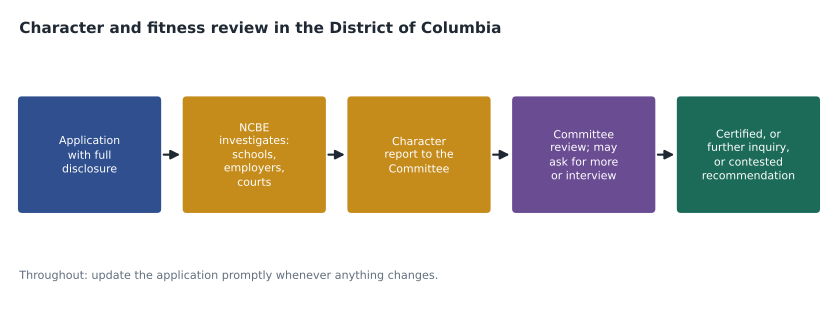
For many District applications, NCBE conducts the character investigation on the Committee's behalf. NCBE's information for the District explains that it may contact schools, employers, courts and others to verify what the applicant reported and to collect records, and that applicants must respond to NCBE's requests promptly. NCBE then prepares a character report for the Committee. NCBE does not decide whether the applicant is fit. The Committee on Admissions makes that decision and may request more information or an interview with the applicant.
The character report carries a separate fee paid to NCBE, which depends on the applicant's category. As Lesson 2 explained, NCBE's fees rose on October 1, 2026, to 435, 625 or 975 dollars depending on whether the applicant is a recent graduate, an applicant with an older United States degree or United States admission, or an applicant with foreign education or foreign admission. Reduced fees apply when NCBE has completed a report within the past four years.
What concerns the Committee
Character and fitness reviews across the country focus on a familiar set of concerns. Conduct involving dishonesty, such as fraud, forgery, false statements or academic misconduct, raises the most direct questions because honesty is central to a lawyer's work. Criminal conduct, particularly recent or repeated conduct, matters. Financial irresponsibility, such as unpaid debts that the applicant has ignored, defaulted student loans not in a repayment plan, or unpaid court judgments, can raise concerns because lawyers handle client money. Violations of court orders, including child support orders, matter. So do neglect of professional obligations, discipline in another profession, and unauthorized practice of law.
Reviews also consider the circumstances. Factors that bodies such as the Committee commonly weigh include how old the applicant was when the conduct occurred, how long ago it was, how serious it was, whether it was isolated or part of a pattern, whether the applicant has been candid about it, and what evidence of rehabilitation exists. A single minor incident many years ago, honestly disclosed, rarely stands in the way of admission. A recent pattern of dishonesty, especially one the applicant tried to hide, can.
Mental health and substance use
Admission authorities across the country have moved away from broad questions about mental health diagnoses and toward questions about conduct. The concern is whether an applicant's behavior shows a risk to clients, not whether the applicant has sought treatment. Applicants who are uncertain about how a question applies to them should read it exactly as written and answer what it asks. Seeking help for mental health or substance use is not a sign of unfitness, and the profession's lawyer assistance programs, including the DC Bar's Lawyer Assistance Program, exist precisely to support lawyers who need it. The Committee's announcements have even promoted the DC Bar program's support groups.
The MPRE requirement
Every applicant for admission must also pass the Multistate Professional Responsibility Examination. The MPRE is a two-hour, sixty-question multiple-choice test of the rules governing lawyers' conduct, based mainly on the ABA Model Rules of Professional Conduct and the ABA Model Code of Judicial Conduct, with some questions on constitutional and procedural rules that govern lawyers. NCBE gives it several times a year at test centers. BAR-140 in this program covers it in depth.
The District requires a scaled score of at least 75, the lowest requirement among jurisdictions that use the MPRE. NCBE's information for the District states that there is no time limit on when the score must be earned. That means a score earned years ago can still satisfy the requirement, which is helpful for experienced lawyers seeking admission without examination. It also means law students can take the MPRE early, such as in the second or third year of law school, without worrying that the score will expire before the bar exam.
Marchetti adds two cautions. First, a 75 satisfies the District, but an applicant who might later seek admission in a jurisdiction with a higher requirement, such as 85 or 86, should aim higher. Second, the MPRE tests the ABA Model Rules, which differ in important ways from the District's own Rules of Professional Conduct. Passing the MPRE does not mean an applicant knows the District's rules, and Lesson 10 explains several of the differences.
| Requirement | District of Columbia | Typical range elsewhere |
|---|---|---|
| MPRE passing score | 75 | 75 to 86 |
| MPRE score age limit | None | Often two to five years in some jurisdictions |
| Character investigation | NCBE for many application types; Committee decides | Varies: board staff or NCBE |
| Character report fee (recent graduate) | 435 dollars to NCBE (from Oct 1, 2026) | Varies |
Habits that keep an application moving
Most delays in character and fitness reviews come from incomplete answers and slow responses. Marchetti gives the group four habits. Answer every question fully, and when in doubt, disclose and explain. Respond to NCBE and the Committee quickly, ideally within days, because a stalled request stalls the whole file. Keep the application current: report new addresses, jobs, citations or other changes as they happen, because the duty to update continues until admission. And keep copies of everything submitted, including explanations, so that later answers are consistent with earlier ones.
A fifth habit applies to applicants with something serious in their history. Such applicants should gather documents that show what has happened since, such as court records showing completion of a sentence, letters from employers, evidence of treatment or repayment, and statements from people who know them now. Some applicants choose to consult a lawyer experienced in bar admission matters. The goal is not to argue that the past did not happen but to show the Committee the person the applicant has become.
Worked problem
Jasper's citation
Jasper's application asks whether he has ever been cited, arrested or charged with any violation of law other than minor traffic violations. He received an open container citation in Maryland at nineteen and paid the fine. How should he handle it?
Show solution
- Read the question: it covers citations other than minor traffic violations, so the open container citation falls within it.
- Disclose it, with the date, place, charge and outcome.
- Add a short, factual explanation and attach any record he can obtain.
- Expect it to be treated as a minor, isolated matter from years ago; candor is what matters.
Answer: He should disclose the citation fully and briefly explain it; hiding it would create a far larger problem.
Common mistakes
MistakeThe Committee must prove an applicant is unfit.
InsteadThe applicant bears the burden of satisfying the Committee of good character and fitness.
MistakeNCBE decides whether an applicant is fit.
InsteadNCBE investigates and reports; the Committee on Admissions decides.
MistakeAn MPRE score expires after a few years in the District.
InsteadNCBE's information states that the District sets no time limit on the MPRE score.
MistakePassing the MPRE shows knowledge of the DC Rules of Professional Conduct.
InsteadThe MPRE tests the ABA Model Rules; the DC rules differ in important ways.
Disclosure versus explanation
Candidates often confuse two different tasks on the application: disclosing a fact and explaining it. Disclosure is simple and absolute. If a question asks whether you have ever been cited, charged, sued, disciplined or terminated, the answer must include every matter that falls within the question, however minor, however old and however sure you are that it was expunged or dismissed. Explanation is where judgment comes in. A short, factual account of what happened, what you did about it and what has changed since then is far more persuasive than a long defense or a list of reasons it was not your fault.
Marchetti gives her candidates a simple test for an explanation. Could a reader who knows nothing about you understand what happened from the explanation alone? Does it accept responsibility where responsibility is due? Does it show what you did afterward, such as paying a debt, completing a program or simply going years without a repeat? If the answer to all three is yes, the explanation is probably ready. If the explanation blames a professor, an employer or a police officer, it probably needs another draft, even if the blame is partly deserved.
Financial responsibility
Debt itself rarely prevents admission. Most law graduates carry large student loans, and character committees understand that. What draws attention is a pattern of ignoring obligations: accounts sent to collection without any response, unpaid court judgments, failures to file tax returns, or loans in default with no attempt to arrange repayment. A candidate in that position should act before applying. Contacting creditors, entering a repayment plan or resolving a judgment, and keeping records of each step, turns a concern into evidence of responsibility.
Time and the MPRE together
Because the District sets no time limit on the MPRE score, a candidate can sit the MPRE during law school and rely on that score years later. That flexibility helps candidates who want to clear the MPRE early, while ethics coursework is fresh. NCBE offers the MPRE several times a year, and candidates register through their NCBE account. A candidate who plans to transfer a score into the District, or to apply under the three-year provision, should confirm that the score is reported to the District, since NCBE sends scores only to the jurisdictions the candidate designates.
Worked problem
A late change to the application
Rhea filed her District application in October and listed her address and employer. In December she moves to a new apartment and changes jobs, and in January she receives a speeding ticket. What should she do?
Show solution
- Her duty to keep the application current continues until admission.
- She should report the new address and the new employer promptly, as the application instructions require.
- She should check whether the ticket falls within a question; a minor traffic offense may be excluded, but she should read the wording rather than assume.
- She should keep copies of each update in her application folder.
Answer: Report the changes promptly and read each question's wording; late or missing updates cause delay.
Summary and key terms
- Applicants bear the burden of showing good character and fitness; complete candor is the governing principle.
- NCBE conducts many District character investigations, but the Committee on Admissions decides.
- Concerns center on dishonesty, criminal conduct, financial irresponsibility and violations of court orders, weighed with age, recency, pattern, candor and rehabilitation.
- The District requires an MPRE scaled score of 75 with no time limit on when it was earned.
- Prompt responses and continuous updating keep applications moving.
- Character and fitness
- The requirement that an applicant show the honesty and reliability needed to practice law.
- MPRE
- The Multistate Professional Responsibility Examination, a sixty-question test of lawyer conduct rules.
- Duty to update
- The continuing obligation to report changes to the application until admission.
- Rehabilitation
- Evidence that an applicant has addressed past conduct and changed since it occurred.
- Schware v. Board of Bar Examiners
- A 1957 Supreme Court decision holding that bar exclusion must rest on grounds rationally connected to fitness to practice.
Lesson quiz · 5 questions
Score 60% or more to complete this lesson.
Create a free account to save your progress, take quizzes and earn a certificate.