
BAR-209 · Lesson 2 of 12 · 16 min
Eligibility, education, registration windows and fees
▶ Video coming soon A video version of this lesson is on the way.
Two of the people in Jasper's circle illustrate the most common eligibility questions in the District. His classmate Aaliyah graduated from the same ABA-approved law school but waited until the third week of the October 2026 registration window to register for February, and found the exam full. His colleague at the tenants' rights nonprofit, Benedikt, earned his law degree in Germany, practiced there for four years, and wants to know whether he can sit the District's exam at all. Marchetti answers both questions in the same session, because both come down to reading Rule 46 and the Committee's announcements closely.
'Eligibility is the first gate,' she says. 'If you are not eligible, nothing else matters. And in DC, eligibility has a cousin: availability. You can be perfectly eligible and still have to wait for the next exam because the seats are gone.'
The basic rule: an ABA-approved law degree
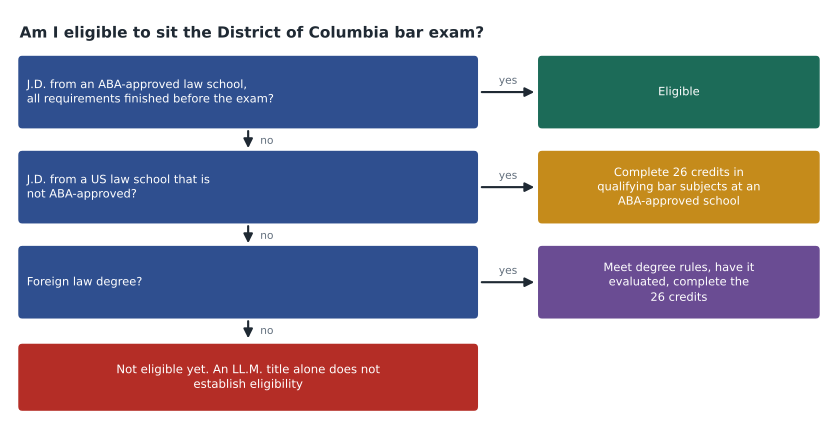
The standard route to the District's bar exam is a Juris Doctor degree from a law school approved by the American Bar Association. An applicant with an ABA-approved J.D. meets the education requirement without anything more. The Committee has stressed one timing point in its announcements: under Rule 46(c)(3), an applicant must have completed all of the requirements for the law degree before the first day of the bar exam. A student who will finish a final course or a graduation requirement after the exam begins cannot sit that exam, even if the diploma would be conferred shortly afterward. Students who graduate in December should check their school's completion date carefully against the February exam dates, and May graduates should confirm that every requirement will be finished well before late July.
Graduation from an ABA-approved school is common to almost every jurisdiction, but the District goes further than many in welcoming applicants who did not follow that path, provided they make up the difference with study at an ABA-approved school. NCBE's jurisdiction information states that eligibility in the District is not limited to graduates of ABA-approved schools, and that graduates of other schools must complete additional coursework at an ABA-approved law school.
Graduates of other United States law schools and of foreign law schools
An applicant who graduated from a law school in the United States that is not ABA-approved, or who earned a law degree outside the United States, can become eligible by completing additional study at an ABA-approved law school. The Committee's guidance describes this as the 26-credit requirement: the applicant must complete 26 semester credit hours of study at an ABA-approved law school, in courses that cover subjects tested on the bar exam, and the Committee publishes guidance on which courses qualify. In January 2026, the Committee updated its list of qualifying courses to reflect the content of the NextGen exam starting in July 2026, so applicants who plan their coursework now should check the current list rather than an older one.
For foreign-trained applicants, NCBE's information adds two further conditions: the foreign degree must meet the Committee's requirements, and the applicant must have the foreign education evaluated as the Committee directs. NCBE's information also notes that an LL.M. or other graduate law degree from an ABA-approved school does not, on its own, make a foreign graduate eligible. What matters is whether the applicant's study at the ABA-approved school satisfies the credit and subject requirements. An LL.M. program can be designed to do that, but the degree title alone does not.
Benedikt's situation shows how this works in practice. His German law degree does not make him eligible by itself. To sit the District's exam, he must complete the required credit hours at an ABA-approved law school in qualifying subjects and have his foreign education reviewed. Because he has practiced in Germany, he may also want to compare this path with the special legal consultant license, which allows a foreign lawyer to advise on the law of the country where he is admitted without becoming a full member of the DC bar. The two routes serve different goals: the bar exam leads to full admission, while the consultant license does not permit practicing District or federal law.
Registration windows and seat limits
Here the District differs sharply from most jurisdictions. In many states, an applicant files an application by a deadline and is automatically allowed to sit if eligible. In the District, an applicant must register during a window the Committee announces for each exam, and the number of seats is capped. Registration is first-come, first-served, and once the seats are filled, the exam is closed.
The Committee's announcements for the 2026 and 2027 exams show the pattern. For the February 2026 exam, registration ran from November 25 to December 5, 2025, with 450 seats, after a federal government shutdown delayed the Committee's work in the fall of 2025. For the July 2026 exam, registration ran from March 2 to March 31, 2026, with 2,550 seats spread across several venues in the District, and some seats were reserved for applicants who had not passed in February, with a short window for them in late April. For the February 2027 exam, registration ran from October 1 to October 21, 2026, with 750 seats and no late registration; a special window from October 30 to November 6, 2026 was opened for applicants who had not passed the July 2026 exam. The Committee then announced that the February 2027 exam was full and that there was no waitlist, and it advised applicants without a seat to explore other testing arrangements.
'Treat the window like a ticket sale,' Marchetti says. 'Know the opening date, have your account set up before it opens, and register on the first day. Do not assume the window will last until its closing date.'
What can an applicant like Aaliyah do? She has three realistic options. She can wait for the July 2027 exam and register the day that window opens. She can sit the UBE in another jurisdiction that has seats available and then transfer the score to the District, an option Lesson 11 covers in detail. Or she can do both in sequence, sitting elsewhere in February and holding the District as a backup for July. For the July 2026 and February 2027 exams, the Committee also offered concurrent transfer applications, which let a candidate who sits the UBE elsewhere apply to transfer the score to the District in a set window, with the score due by a stated date.
| Exam | Registration window | Seats | Notes |
|---|---|---|---|
| February 2026 | Nov 25 to Dec 5, 2025 | 450 | Delayed after the fall 2025 federal shutdown |
| July 2026 | Mar 2 to Mar 31, 2026 | 2,550 | Several DC venues; late-April window for February non-passers |
| February 2027 | Oct 1 to Oct 21, 2026 | 750 | No late registration; Oct 30 to Nov 6 window for July 2026 non-passers; full with no waitlist |
Fees
An applicant pays two kinds of fees. The first is the bar exam application fee paid to the District. NCBE's jurisdiction information lists the exam application fee as 405 dollars for first-time applicants, attorneys and repeaters, plus the character and fitness fee. It lists the same 405 dollars plus the character and fitness fee for admission by transferred UBE score, and 595 dollars plus the character and fitness fee for admission on motion, effective April 1, 2024. A laptop fee may also apply. Fees are generally not refundable once paid, and the Committee's announcements for concurrent transfers state that those fees are neither refundable nor transferable.
The second fee is the character report fee paid to NCBE, which conducts many of the District's character investigations. NCBE raised its fees on October 1, 2026. NCBE's information for the District lists 435 dollars for an applicant whose first law degree is expected within a year and who is not yet authorized to practice; 625 dollars for an applicant whose United States law degree was awarded more than a year earlier or who is authorized to practice only in the United States; and 975 dollars for an applicant with a non-United States law degree or authorization to practice in a foreign country. Reduced fees apply when NCBE has completed a report within the past four years and a new application is filed. NCBE keeps an administrative fee if an application is withdrawn and does not refund the fee once it has begun correspondence on the file.
Marchetti reminds the group that fees change, and that the amounts in this lesson were current in November 2026. 'Pull the fee from the application you are actually filing,' she says. 'Then budget for the bar review course, travel and time off, which will cost you far more than the fees.'
Testing accommodations
Applicants with disabilities may request testing accommodations, such as extra time, a separate room or assistive technology. The Committee uses a Request for Testing Accommodations form, available as a fillable document in the admissions portal, and it sets a deadline for each exam that falls before the exam itself. For the February 2026 exam, accommodation requests were due on November 10, 2025. Because seat registration and accommodations interact, an applicant who needs accommodations should prepare the documentation early, register for a seat as soon as the window opens, and submit the accommodation request well before the deadline. The Committee's decision is separate from the seat registration, and a late request may not be considered for the exam the applicant registered for.
Keeping the application current
Once an applicant registers, the application is a continuing statement. Changes in address, employment, criminal matters, discipline or anything else the application asked about must be reported promptly. The duty continues until admission. Lesson 3 explains why candor and prompt updating matter so much in the character and fitness review.
Worked problem
Aaliyah after the February window closes
Aaliyah, an ABA-approved J.D. graduate of May 2026, missed a seat for the February 2027 District exam. She wants to be admitted in the District as soon as possible. What are her options?
Show solution
- Option one: register on the first day of the July 2027 window and sit in the District, the last legacy UBE there.
- Option two: sit the February 2027 UBE in another jurisdiction with seats available, score 266 or more, and transfer the score to the District within five years.
- If she chooses option two, she should watch for the District's concurrent transfer window and the date by which the score must arrive.
- Either way, she must also pass the MPRE with 75 or more and satisfy character and fitness.
Answer: She can wait for July 2027 in the District or sit elsewhere and transfer a qualifying UBE score.
Common mistakes
MistakeA student may sit the exam if the degree will be conferred shortly after the exam.
InsteadAll requirements for the law degree must be completed before the first day of the exam (Rule 46(c)(3)).
MistakeOnly ABA-approved graduates can ever sit the District exam.
InsteadGraduates of other US schools and foreign graduates can qualify by completing 26 credit hours in qualifying subjects at an ABA-approved school.
MistakeAn LL.M. from an ABA-approved school automatically qualifies a foreign lawyer.
InsteadThe credits and subjects must meet the requirement; the degree title alone does not.
MistakeThe registration window stays open until its closing date.
InsteadSeats can fill before the window closes, and the February 2027 exam filled with no waitlist.
Planning around the calendar
Because the District's windows are short and its seats limited, the calendar deserves its own plan. Marchetti asks each District candidate to write down four dates for the exam they want: the day the registration window is expected to open, the day it is expected to close, the accommodation deadline and the exam itself. She then asks them to add a fifth date, the day they will check the admissions portal for the announcement, because the Committee announces each window shortly before it opens. The February 2027 window, for example, opened on October 1, 2026, and a candidate who checked the portal for the first time in mid-October would have found the exam nearly or entirely full.
Candidates who work full time, as Jasper does, should also plan their study time around the exam they actually hold a seat for. A candidate who loses a February seat and switches to July gains five months but loses the momentum of a fall study plan. A candidate who switches to another jurisdiction's February exam keeps the momentum but must learn that jurisdiction's registration rules and deadlines, which may already have passed. Many jurisdictions close their February filing well before the end of the year. Marchetti's advice is to decide in advance what you will do if you do not get a District seat, so that you can act on the same day rather than spend a week deciding.
Records to gather early
Whatever the route, every applicant needs the same basic records, and gathering them early saves time later. These include the law school's certification that the degree requirements are complete, transcripts showing any credits taken to satisfy the 26-credit requirement, proof of identity, an employment history with addresses and supervisors, a residence history, and documents for any matter that requires a yes answer on the character questions, such as court records or a letter explaining a past academic issue. Foreign-trained applicants also need the evaluation of their foreign education. Keeping a single folder with every document submitted and every message received makes later follow-up questions much easier to answer.
Summary and key terms
- An ABA-approved J.D. is the standard route; all degree requirements must be completed before the first day of the exam.
- Other US graduates and foreign graduates can qualify through 26 credit hours of qualifying study at an ABA-approved school; foreign degrees must also be evaluated.
- The District caps exam seats and assigns them first-come, first-served in short registration windows.
- Fees include the District exam application fee (listed by NCBE as 405 dollars plus character and fitness) and NCBE's character report fee, which rose on October 1, 2026.
- Accommodation requests have their own deadline before each exam.
- 26-credit requirement
- The District's rule that graduates of non-ABA US schools and foreign graduates complete 26 semester credit hours of qualifying study at an ABA-approved school.
- Registration window
- The announced period during which applicants may register for a seat at a District exam.
- Concurrent transfer application
- An application to transfer a UBE score being earned elsewhere, filed in a window the Committee announces.
- Special legal consultant
- A foreign lawyer licensed to advise on the law of the country where he or she is admitted.
- Character report
- NCBE's investigation of an applicant's background, prepared for the Committee on Admissions.
Lesson quiz · 5 questions
Score 60% or more to complete this lesson.
Create a free account to save your progress, take quizzes and earn a certificate.