
BAR-213 · Lesson 1 of 12 · 16 min
Becoming a lawyer in Idaho
▶ Video coming soon A video version of this lesson is on the way.
Wes Achterberg joins Hollis Marchetti's study group in the fall of 2026 with a job waiting and a clock running. He grew up on a family farm outside Twin Falls, finished law school at an ABA-approved school in Idaho in May 2026, and now works as a law clerk for a small firm in Twin Falls that handles farm leases, water right transfers, family law and the occasional car wreck. He planned to sit the July 2026 exam, but a family illness kept him home for most of the summer, so he filed instead for the February 2027 exam. He submitted his application in late October, after the regular October 1 deadline but before the November 15 late deadline, and paid the late fee. His supervising attorney, Delia Ruffing, has told him she wants him admitted by spring so he can take over the firm's water right transfer filings.
'You picked an interesting year to become an Idaho lawyer,' Marchetti tells him at their first session. 'Idaho was one of the first jurisdictions to give the new NextGen bar exam, in July 2026. Your February exam will be only the second NextGen administration in the state. That means fewer old questions to practice with and more reading of the official materials. But it also means the rules are fresh, recently written and easy to find. If you know who makes them, you know where to look.'
This lesson maps the whole path to an Idaho license: the bodies involved, the routes to admission, the requirements on the examination route and the order in which most applicants meet them. Later lessons take each step in detail and then turn to the Idaho law that matters most to new lawyers, from community property to the priority system that governs water.
Who controls admission
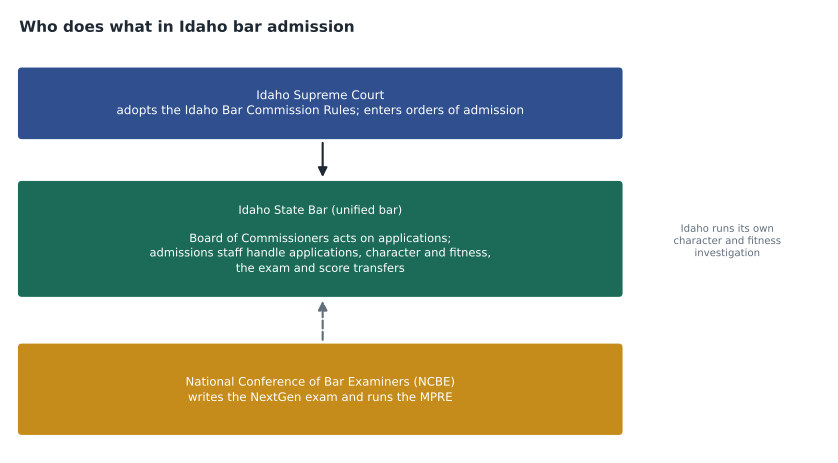
Admission to practice law in Idaho is controlled by the Idaho Supreme Court. The court has inherent power to regulate the practice of law, and it exercises that power through the Idaho Bar Commission Rules, which it adopts and amends by order. Section II of those rules governs admissions. When the court changes the rules, it usually acts on a resolution approved by the membership of the Idaho State Bar or on a proposal from the Bar's Board of Commissioners, and it publishes the change on the Bar's website and in its weekly email to members, with a summary in The Advocate, the Bar's magazine.
The Idaho State Bar does the day-to-day work. It is a unified bar, created by statute and governed by the court's rules, which means every lawyer licensed in Idaho must be a member. Unlike in some states, where admissions are run by a separate board, in Idaho the Bar's own licensing and admissions staff receive applications, run the character and fitness investigation, give the bar exam, process transferred scores and handle applications from experienced attorneys. The Board of Commissioners acts on applications, and when it finds an applicant qualified it recommends admission to the Supreme Court, which enters the order of admission.
The National Conference of Bar Examiners (NCBE) also plays a part, but it does not admit anyone. NCBE writes the NextGen bar exam that Idaho now gives, wrote the Uniform Bar Examination (UBE) components that Idaho gave through February 2026, runs the Multistate Professional Responsibility Examination (MPRE) and scales scores. Unlike many jurisdictions, Idaho does not use NCBE's character and fitness investigation service; NCBE's jurisdiction information tells applicants to file their character materials directly with Idaho.
The routes to admission
The Idaho Bar Commission Rules offer three main routes. The first is admission by examination: you file an application, pass the Idaho bar exam, pass the MPRE with a scaled score of at least 85 and satisfy the character and fitness requirements. The second is admission by transferred score: if you earned a qualifying score on an NCBE exam in another jurisdiction recently enough, you can transfer it instead of sitting again. The third is experienced attorney admission under Rule 206, for lawyers admitted elsewhere who have practiced actively for at least three of the five years before applying.
The rules also provide narrower licenses: a house counsel license for lawyers working in-house for an Idaho employer, an emeritus license for retired lawyers doing pro bono work, provisional admission for military spouses stationed in Idaho, pro hac vice admission for a single case and a legal intern license for law students. Lesson 11 returns to the transfer and experienced attorney routes. This course focuses on the examination route, because that is the one Wes is on.
| Route | Where it is in the rules | Who uses it | Key requirement |
|---|---|---|---|
| Admission by examination | Rules 202 to 204 and 217 | Recent graduates and others without a qualifying score | Pass the Idaho NextGen exam with 616 or more; MPRE 85 |
| Transferred score | Rule 217 | Applicants who sat an NCBE exam elsewhere | A qualifying UBE or NextGen score earned within the last 37 months |
| Experienced attorney admission | Rule 206 | Lawyers admitted in another US jurisdiction | Active practice for three of the five years before applying; no bar exam failure in the last five years |
| House counsel license | Rule 225 | In-house lawyers for an Idaho employer | Admission elsewhere; practice limited to the employer |
The requirements on the examination route
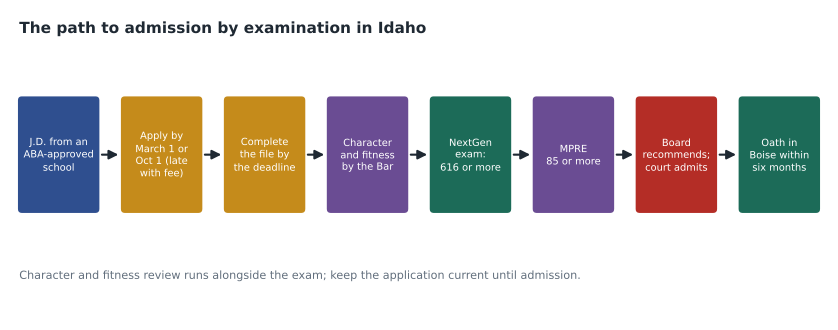
For an applicant seeking admission by examination, the requirements come down to five. You must be at least eighteen and hold a J.D. from an ABA-approved law school; NCBE's information for Idaho states that foreign law graduates are not eligible to sit, and Lesson 2 explains the details. You must file a complete application on time and pay the fee. You must pass the character and fitness review run by the Idaho State Bar. You must pass the Idaho bar exam, which since July 2026 is the NextGen exam, with a scaled score of at least 616. And you must earn a scaled score of at least 85 on the MPRE, within the time the rules allow. Once the Board recommends you and the court orders your admission, you take the attorney's oath in person before the Idaho Supreme Court in Boise.
Look at what is not on the list. Idaho does not add a separate test of Idaho law to the NextGen exam, and it does not require a separate course on Idaho law before admission. NCBE's information for Idaho lists no jurisdiction-specific requirement for either the legacy UBE or the NextGen exam. Idaho's attention to local law comes after admission, through a new admittee continuing legal education requirement that includes courses on Idaho substantive law. Lesson 6 explains how that works and why it matters for your exam preparation.
Two numbers to remember: 616 and 85
Idaho's passing score on the NextGen exam is 616. The Idaho State Bar's Board of Commissioners set it on November 4, 2025, and the Supreme Court adopted it in the Bar Examination Grading Standards and Procedures by an order effective May 1, 2026. The Board chose 616 because it is treated as equivalent to 266 on the legacy UBE, and at the same time it lowered Idaho's UBE passing score from 270 to 266 for the February 2026 exam, Idaho's last UBE, so that the last UBE group and the first NextGen group faced the same standard. NCBE has recommended NextGen passing scores in the range of 610 to 620, so Idaho sits in the middle of the range.
The MPRE requirement of 85 is near the top of the national range, which runs from 75 to 86. Wes scored 93 on the MPRE in his third year of law school, so he is clear, but Marchetti warns the group that an 85 requirement trips up more candidates than people expect. Lesson 3 explains the timing rule, which is unusual: the MPRE score must be earned before the bar exam or within the next two MPRE administrations after it.
The order of events
Most Idaho applicants move through the process in a predictable order. During law school they take the MPRE. In the final year they gather what the application asks for: residence and employment histories, a fingerprint card requested from the Idaho State Bar, release forms and records for anything that requires a yes answer on the character questions. They file by March 1 for the July exam or by October 1 for the February exam, or by the late deadlines of April 15 and November 15 with a late fee, and they complete their files by June 15 or January 15. They sit the exam, wait for results, and if they pass and have been found to have the required character and fitness, they are recommended for admission, sworn in and enrolled as members of the Idaho State Bar.
After admission the obligations continue. A new Idaho lawyer must complete the new admittee education requirement within twelve months, report thirty hours of continuing legal education every three years, keep a trust account under the Idaho Rules of Professional Conduct when handling client funds and pay the Bar's annual license fee. Lesson 11 covers those duties.
Worked problem
Planning Wes's path
Wes graduated in May 2026 from an ABA-approved law school in Idaho and scored 93 on the MPRE in his third year. He filed for the February 2027 exam in late October 2026 and paid the late fee. What must he still do before he can be admitted, and what must he do after?
Show solution
- Eligibility: his J.D. is from an ABA-approved school, so he is eligible to sit.
- File completion: his application was timely under the late deadline, but every required document must be in by January 15, 2027, or he faces an additional fee for further consideration.
- Character and fitness: he must respond promptly to the Bar's investigation and keep his answers current.
- MPRE: his 93 exceeds Idaho's 85 and was earned before the exam, so the timing rule is satisfied.
- Exam: he must score 616 or more on the February 2027 NextGen exam.
- After admission: he takes the oath in person in Boise within six months of notice and completes the new admittee education requirement within twelve months.
Answer: Wes needs a complete file, character and fitness approval and a passing NextGen score; his MPRE is done; the oath and new admittee education follow.
Common mistakes
MistakeIdaho admissions are run by a separate board of bar examiners.
InsteadThe Idaho State Bar's admissions staff and Board of Commissioners run admissions under rules adopted by the Idaho Supreme Court, which enters the order of admission.
MistakeIdaho still gives the UBE.
InsteadIdaho gave its last UBE in February 2026 and its first NextGen exam in July 2026.
MistakeAn MPRE score of 80 is enough everywhere.
InsteadIdaho requires 85, near the top of the national range.
MistakeIdaho requires a course on Idaho law before admission.
InsteadThere is no pre-admission Idaho law component; new admittees complete Idaho substantive law CLE courses within twelve months after admission.
What Idaho's size means for applicants
Idaho is a large state with a small bar. The Idaho State Bar's admissions department reported 395 applications of all kinds in 2025: 184 bar exam applicants, 62 applicants transferring a UBE score, 143 experienced attorney applicants, five house counsel applicants and one emeritus applicant. Those numbers are tiny compared with the thousands who sit in California, New York or the District of Columbia, and the small scale shapes the experience. The admissions staff is small, the exam is given at a handful of sites, and an applicant who calls or writes with a question can usually reach someone who knows the file. Marchetti tells Wes to use that advantage: ask questions early and in writing, keep a copy of every message and do not guess.
The numbers also show how many lawyers come to Idaho from elsewhere. Nearly as many experienced attorneys applied in 2025 as bar exam takers, after a large jump in 2024 that followed a Supreme Court order broadening experienced attorney admission. Idaho's growing cities, especially in the Treasure Valley around Boise and in the Coeur d'Alene area, have drawn lawyers from Washington, Oregon, California and Utah. A new Idaho lawyer is likely to work alongside, and against, lawyers who learned their law somewhere else, which is one reason Idaho cares about local-law education after admission.
Where the rules live
Three sources hold almost everything an Idaho applicant needs. The first is Section II of the Idaho Bar Commission Rules, which covers qualifications, applications, character and fitness, the exam, score transfer, reexamination, experienced attorney admission, the oath and the limited licenses. The second is the Bar Examination Grading Standards and Procedures, a separate document adopted by the court, which sets the passing scores; since May 1, 2026, the rules point to that document rather than stating a number themselves. The third is the set of orders the court issues when it changes either one. Each order is posted on the Idaho State Bar's website, and it is worth reading the orders themselves, because a summary written months earlier may describe a rule that has since changed.
Wes keeps a short file with the current version of each. When he read NCBE's jurisdiction page in October, it still showed the NextGen passing score as to be announced and the legacy UBE score as 270. The court's orders, dated January 2026, showed 616 and 266. The orders control. Marchetti's rule of thumb is simple: when two sources disagree, find the most recent official order and follow it.
A note on vocabulary
Idaho's rules use some terms that differ from other jurisdictions. What many states call admission on motion, Idaho calls experienced attorney admission. What some states call a board of law examiners, Idaho handles through the Board of Commissioners of the Idaho State Bar. And Idaho speaks of an applicant's license rather than a membership card: an admitted lawyer holds an active license, which must be renewed each year with the Bar. Using the Idaho terms when writing to the Bar avoids confusion and signals that the applicant has read the rules.
Summary and key terms
- The Idaho Supreme Court controls admission through the Idaho Bar Commission Rules and enters orders of admission.
- The Idaho State Bar is a unified bar; its admissions staff and Board of Commissioners handle applications, character and fitness and the exam.
- Idaho gave its last UBE in February 2026 and its first NextGen exam in July 2026; the NextGen passing score is 616.
- The MPRE requirement is a scaled score of 85.
- The main routes are examination, transferred score and experienced attorney admission after three of the last five years in active practice.
- Idaho Bar Commission Rules
- The rules, adopted by the Idaho Supreme Court, that govern admission, licensing, discipline and continuing education for Idaho lawyers.
- Idaho State Bar
- The unified bar of Idaho, whose membership is required to practice law in the state and which administers admissions.
- Board of Commissioners
- The governing board of the Idaho State Bar, which acts on applications and recommends admission to the Supreme Court.
- Unified bar
- A bar association that every licensed lawyer in the jurisdiction must join.
- NextGen bar exam
- The bar exam written by NCBE and first given in July 2026, which replaced the UBE in Idaho.
Lesson quiz · 5 questions
Score 60% or more to complete this lesson.
Create a free account to save your progress, take quizzes and earn a certificate.