
BAR-213 · Lesson 5 of 12 · 16 min
From the UBE to NextGen: Idaho's transition and first results
▶ Video coming soon A video version of this lesson is on the way.
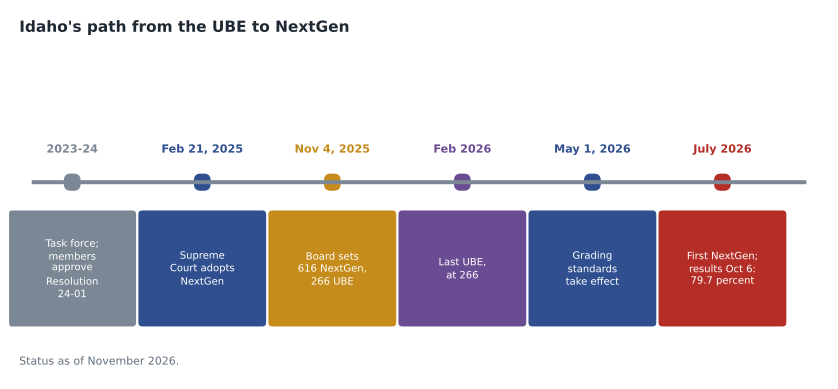
Idaho's move to the NextGen bar exam took about three years from start to finish, and it involved the whole profession. The Idaho State Bar's Board of Commissioners created a NextGen task force in 2023. The Bar's membership approved a resolution in 2024 asking the Supreme Court to adopt the new exam. The court adopted it in February 2025, effective with the July 2026 exam. Along the way, Idaho lowered its UBE passing score, set a NextGen passing score and rewrote the rule that tells applicants how passing scores are set. This lesson tells that story, because understanding it helps an applicant read the current rules and answer questions about scores earned before and after the change.
Wes's interest is practical. Two members of his study group, Tessa from Washington and Marcus from Missouri, also sat or are sitting NextGen exams, and several of his law school classmates passed the February 2026 Idaho exam, the last UBE. Two of his friends failed it. 'Everybody you know is on one side or the other of this change,' Marchetti says. 'You need to know what applies to each of them, because the questions you get from friends and future clients will start the day you are admitted.'
Why Idaho moved early
NCBE announced the NextGen exam after a multi-year study of what new lawyers do, and offered it to jurisdictions beginning in July 2026. Most jurisdictions chose to wait until 2027 or 2028. Idaho chose to go in the first group, with Connecticut, Maryland, Missouri, Oregon and Washington among the states and with several territories. In a September 2025 update, the Idaho State Bar's licensing director described the new exam as entirely online and explained that NCBE and the Bar would provide content scope outlines, sample questions and a preview of the exam software. Supporters of early adoption pointed to the exam's focus on the skills new lawyers use and to the chance to prepare alongside NCBE rather than follow other states. The University of Idaho College of Law, the primary testing site for the July exam, was part of the planning.
Going early had costs. Early candidates had fewer practice materials and no older Idaho results to compare against, and the Bar had to set a passing score before any real results existed. The Bar addressed the first problem by working with NCBE on content outlines, sample questions and a software preview, and the second by setting a score in line with NCBE's recommendation.
The rule changes
The legal change happened in three steps. First, on February 21, 2025, the Supreme Court approved the membership's resolution and amended Section II of the Idaho Bar Commission Rules so that the Idaho bar exam became the current version of NCBE's updated exam, effective May 1, 2026. Second, in an order dated January 2026, the court lowered the passing score for the February 2026 UBE from 270 to 266, effective February 2, 2026, explaining that the change was in the interest of fairness to applicants because 266 matched the standard approved for the first NextGen exam. Third, in orders effective May 1, 2026, the court amended Rule 217 and the Bar Examination Grading Standards and Procedures so that both passing scores, for the UBE and for NextGen, are approved by the Board and the court and stated in the grading standards rather than in the rule itself.
The result is a set of numbers that every Idaho applicant should know. The NextGen passing score is 616. The minimum score for transferring a NextGen score into Idaho is also 616. The legacy UBE passing score was 266 for Idaho's last UBE in February 2026, and the grading standards set 266 as the minimum for transferring a UBE score earned in another jurisdiction.
| Exam or transfer | Score required | Source |
|---|---|---|
| Idaho UBE through July 2025 | 270 | Earlier Rule 217 |
| Idaho UBE, February 2026 (the last one) | 266 | January 2026 order, effective February 2, 2026 |
| Idaho NextGen, from July 2026 | 616 | Grading standards, effective May 1, 2026 |
| Transferred NextGen score | 616 | Grading standards, effective May 1, 2026 |
| Transferred UBE score | 266 under the grading standards (see the caution below) | Grading standards; older Rule 217 text says 270 |
A caution about the transfer score
Not every published source has caught up with these changes. NCBE's jurisdiction page for Idaho, as read in late 2026, still listed the legacy UBE minimum as 270 and the NextGen score as to be announced. The text of Rule 217 that remains in the published rules also still refers to a UBE scaled score of 270, earned in July 2023 or later, as transferable, while the May 2026 amendment added a separate provision allowing transfer of any NCBE exam score that meets the passing scores in the grading standards. The grading standards adopted by the court state 266 as the minimum for transferring a UBE score.
An applicant whose transferred UBE score falls between 266 and 269 is the one affected by this mismatch. Marchetti's advice is to rely on the most recent court order and the grading standards, and to confirm the applicant's own situation in writing with the Idaho State Bar's admissions staff before relying on a score in that range. The safest reading is that the grading standards, which the amended rule now points to, control.
The last UBE
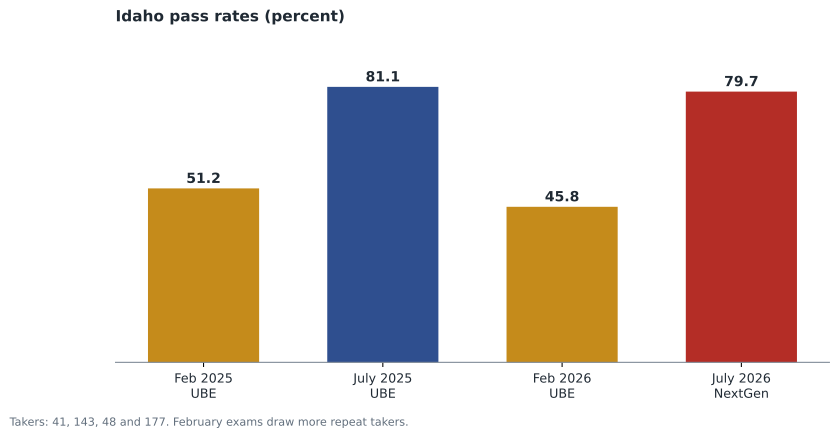
The February 2026 exam was Idaho's last UBE. Forty-eight candidates sat it and 45.8 percent passed, according to the admissions department's May 2026 report, using the newly lowered 266 standard. A candidate who failed that exam and wants to try again in Idaho now has only one choice: the NextGen exam. Idaho no longer gives the UBE, and Idaho candidates cannot sit a legacy UBE in Idaho after February 2026.
Candidates who failed the February 2026 UBE face a real adjustment. The NextGen exam covers fewer subjects but tests skills in new formats, and preparation built around the MEE and MPT does not transfer neatly to integrated question sets and research tasks. Two of Wes's friends are in that position. One is sitting NextGen in February 2027 with Wes; the other passed the MBE comfortably and is weighing whether to transfer an MBE score to another jurisdiction instead. Lesson 11 explains why that second path is narrow.
The first NextGen results
Idaho's first NextGen exam was given in July 2026. The Idaho State Bar released results on October 6, 2026, posting the list of successful applicants after three in the afternoon Mountain Time and emailing every applicant. One hundred seventy-seven candidates were tested and the pass rate was 79.7 percent. Nationally, NCBE reported 2,630 scored candidates in the first administration, with a mean scaled score of 640.6 and an overall pass rate of 72.7 percent.
Comparisons with earlier Idaho results need care, because the exams differ and so do the groups who sit them. But the numbers give context. The July 2025 UBE in Idaho had 143 takers and an 81.1 percent pass rate; the February 2025 UBE had 41 takers and a 51.2 percent pass rate. February exams have lower pass rates almost everywhere, because they draw more repeat takers. Wes reads that as a warning rather than a comfort: the February 2027 group will include many candidates retaking after a failed UBE or a failed first NextGen, and the results will reflect it.
Scores earned before the change
Applicants often ask what happens to scores earned before the change. The answer depends on what the applicant wants to do with them. A passing Idaho UBE score that led to admission needs nothing more. An Idaho UBE score from a failed attempt does not carry forward into a NextGen attempt; the NextGen exam is scored on its own. A UBE score earned in another jurisdiction may be transferred into Idaho if it meets the transfer minimum and is no more than 37 months old when the application is filed. A NextGen score earned in another jurisdiction may be transferred if it is at least 616 and recent enough.
Worked problem
What applies to whom?
Three friends ask Wes about their situations in November 2026. Lena failed the February 2026 Idaho UBE with a 262. Omar earned a 268 on the July 2025 UBE in Washington and now wants to move to Boise. Priya passed the July 2026 NextGen exam in Oregon with a 631. What should each know?
Show solution
- Lena: Idaho no longer gives the UBE, so her next Idaho attempt is the NextGen exam, scored on its own; she needs 616.
- Omar: his 268 meets the 266 transfer minimum in the grading standards, but older rule text refers to 270, so he should confirm in writing before relying on it; his score is within 37 months.
- Priya: Idaho has accepted transferred NextGen scores since July 2026; 631 exceeds 616, so she can apply to transfer.
Answer: Lena sits NextGen; Omar likely transfers but should confirm; Priya can transfer her NextGen score.
Common mistakes
MistakeIdaho still gives a UBE option alongside NextGen.
InsteadIdaho's last UBE was February 2026; only NextGen is given now.
MistakeIdaho's UBE passing score was always 270.
InsteadThe court lowered it to 266 for the February 2026 exam, the last Idaho UBE.
MistakeA failed UBE score carries into a NextGen attempt.
InsteadEach NextGen exam is scored on its own.
MistakeNCBE's jurisdiction page is always current.
InsteadIn late 2026 it still showed outdated Idaho scores; the court's orders and grading standards control.
How the profession was involved
Idaho's decision was unusual in one respect: the Bar's own members voted on it. The Idaho State Bar uses a resolution process in which proposed changes to the Bar Commission Rules go to the membership for approval before the Board of Commissioners sends them to the Supreme Court. Resolution 24-01, which asked the court to adopt the NextGen exam beginning in July 2026, went through that process in 2024 and was approved. The court then adopted it in February 2025. Later changes, including Resolution 25-04, which moved the passing scores into the grading standards, followed the same path.
That process has a practical consequence for applicants. Changes to Idaho's admission rules are usually discussed publicly months before they take effect, in The Advocate, in the Bar's weekly emails and at district bar meetings. An applicant who reads those sources will rarely be surprised. Wes signs up for the Bar's public announcements and reads the Advocate articles on admissions, which in 2025 and 2026 covered the task force's work, the passing score decisions and the first exam.
What the task force had to decide
Adopting a new exam involves more decisions than choosing it. The task force and the Board had to decide when the last UBE would be given, what passing score to set for the new exam, whether to add an Idaho law component, how to handle transferred scores from both kinds of exams and how to prepare applicants and law schools. Idaho chose to end the UBE immediately after February 2026, to set a NextGen score equivalent to 266, to add no Idaho law component to the exam and to accept transferred NextGen scores from July 2026.
Each choice had alternatives. Some jurisdictions are adding a local component to the NextGen exam, and some, such as Florida and New York, will not accept transferred NextGen scores from exams given before July 2028. Idaho's choices reflect its small size and its existing approach: Idaho added no Idaho law component to the UBE either, and it relies on post-admission education to teach Idaho law. Lesson 6 explains that approach.
Lessons from the first exam
Candidates Marchetti coached through the first NextGen exam, including Marcus, offered advice that she passes on to the group. They said the integrated question sets took longer than expected because the scenarios rewarded careful reading, and that candidates who skimmed lost points on later questions in a set. They said the research performance task was the part most unlike anything in law school, because it required deciding which authority mattered before writing anything. And they said the computer interface, once practiced, was not a problem, but that candidates who had not used the official tutorial lost time in the first section learning where things were.
Several also said that the exam felt less like a memory test than the old one. Starred topics still had to be known cold, but many questions supplied enough law to work with, and the challenge was applying it under time pressure. That matches NCBE's description of the exam and Marchetti's advice: know the core rules, practice applying them, and spend a large share of study time on written tasks.
Reading results notices
When the Idaho State Bar posts results, it publishes the names of successful applicants, emails every applicant and reports the overall numbers. Individual score reports follow. An applicant who passes and has been cleared on character and fitness moves on to the admission ceremony; an applicant who passes but has an open character matter waits for that matter to finish. An applicant who fails receives a score that shows how far from 616 the result was, and should use it to plan the next attempt.
What the transition means for repeat takers
Candidates who failed the February 2026 UBE in Idaho had no option to retake the UBE in Idaho, because Idaho gave its last UBE that month. Their next Idaho attempt was the July 2026 NextGen exam. Much of what they had studied still applied, because the NextGen exam tests many of the same subjects, but the formats and skills emphasis were new. Marchetti's advice to those candidates was to treat the change as a fresh start, not as a reason for anxiety: rebuild the plan around the NextGen content scope and question types, and keep the knowledge already gained.
Summary and key terms
- The Bar created a NextGen task force in 2023, members approved adoption in 2024 and the court adopted NextGen on February 21, 2025.
- Idaho's last UBE, in February 2026, used a lowered passing score of 266.
- Idaho's first NextGen exam was in July 2026: 177 tested, 79.7 percent passed, results on October 6, 2026.
- Since May 1, 2026, passing scores are set in the grading standards: 616 for NextGen and its transfers, 266 for UBE transfers.
- Where sources conflict, follow the most recent court order and confirm in writing with the Bar.
- Legacy UBE
- The Uniform Bar Examination as given before the NextGen exam, made up of the MBE, MEE and MPT.
- Grading standards
- The Bar Examination Grading Standards and Procedures, adopted by the court, which state Idaho's passing scores.
- Score transfer
- Using a qualifying score earned in another jurisdiction to seek admission without sitting again.
- Task force
- The Idaho State Bar group created in 2023 to plan the move to the NextGen exam.
- Pass rate
- The share of candidates who reach the passing score in an administration.
Lesson quiz · 5 questions
Score 60% or more to complete this lesson.
Create a free account to save your progress, take quizzes and earn a certificate.