
BAR-213 · Lesson 9 of 12 · 17 min
Idaho community property, family law and probate
▶ Video coming soon A video version of this lesson is on the way.
The first family law consultation Wes sat in on began with a simple question from the client: 'The house is in my name, so it is mine, right?' Ruffing's answer took twenty minutes. The house had been bought during the marriage with wages earned during the marriage, so it was presumed to be community property regardless of whose name was on the deed. The down payment, however, had come partly from an inheritance the client received before the wedding, which raised the question of whether part of the house was his separate property. And the couple had refinanced twice. By the end of the meeting the client understood that in Idaho, title tells you much less than it does in most of the country.
Idaho is one of nine community property states, along with Arizona, California, Louisiana, Nevada, New Mexico, Texas, Washington and Wisconsin. That makes marital property one of the areas where Idaho practice differs most from the general law tested on the bar exam. This lesson introduces the Idaho community property system, the main features of Idaho divorce and custody law and Idaho probate under the Uniform Probate Code. As with the other Idaho law lessons, it is written for practice and for the Idaho substantive law courses, not for the exam.
Community and separate property
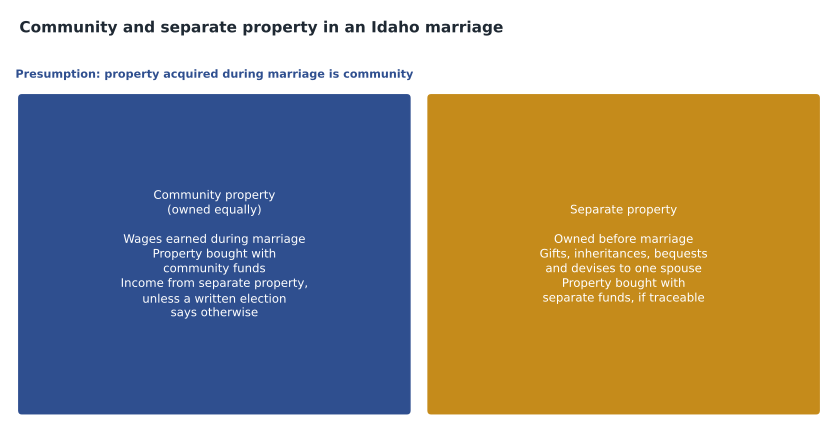
Idaho's community property rules are in Title 32 of the Idaho Code. The basic idea is that a marriage is an economic partnership. Property acquired by either spouse during the marriage is presumed to be community property, owned equally by both spouses, no matter which spouse earned it or whose name appears on the title. Separate property is the exception. It includes property a spouse owned before the marriage and property a spouse acquired during the marriage by gift, bequest, devise or descent, along with property acquired with the proceeds of separate property.
Because the presumption favors community property, a spouse who claims that an asset is separate generally bears the burden of proving it. The proof often requires tracing: showing, through records, that the asset was bought with separate funds or is the product of separate property. Tracing can be straightforward, as when an inheritance was deposited into an account in one spouse's name and never mixed with other funds, or very difficult, as when separate and community funds were commingled in a joint account over many years. When tracing fails, the presumption usually wins.
Income from separate property
Idaho takes a distinctive position on the income that separate property produces. Rents from a separately owned rental house, dividends from separately owned stock and interest on a separate savings account are, under Idaho law, community property unless the owning spouse has signed a written instrument, served on or acknowledged by the other spouse, providing that the income will be his or her separate property. Community property states do not all agree on this point; some treat income from separate property as separate. A new Idaho lawyer advising a client who brings significant separate property into a marriage should explain this rule and consider whether a written election, or a premarital agreement, is appropriate.
Increases in the value of separate property raise related questions. Appreciation that results from market forces generally stays with the separate property, while increases attributable to community effort or community funds, such as a spouse's labor in a separately owned business or mortgage payments made with community wages on a separate house, may give the community a claim for reimbursement or a share. Idaho cases develop these rules in detail, and they are among the most litigated issues in Idaho divorces.
Changing the character of property
Spouses can change the character of property by agreement, a process often called transmutation. A spouse may give separate property to the community, for example by deeding a separately owned house to both spouses, and spouses may agree to treat community property as the separate property of one of them. Because agreements between spouses about real property and other significant assets raise questions of proof and fairness, Idaho requires certain formalities, and agreements affecting real property generally must be in writing and acknowledged. Premarital agreements are governed by Idaho's adoption of the Uniform Premarital Agreement Act, which allows couples to set their own property rules if the agreement is in writing and signed by both parties.
| Question | Idaho approach | Contrast with general common-law approach |
|---|---|---|
| Wages earned during marriage | Community property owned equally | Owned by the earning spouse, subject to division or elective share rights |
| Gifts and inheritances to one spouse | Separate property | Owned by the recipient |
| Income from separate property | Community unless a written election makes it separate | Owned by the owner of the underlying property |
| Name on title | Does not control; the presumption of community property applies to property acquired during marriage | Often strong evidence of ownership |
| Division at divorce | Community property divided substantially equally unless compelling reasons justify otherwise | Equitable distribution in most common-law states |
Management of community property
Both spouses generally have the power to manage and control community property, but Idaho law limits that power for some transactions. In particular, the sale, conveyance or encumbrance of community real property generally requires both spouses to join in the instrument. A buyer, lender or title company that deals with only one spouse in a transaction involving community real property takes a serious risk, which is why title companies in Idaho routinely require both spouses to sign. For a new lawyer, this rule matters as much in real estate practice as in family law.
Debts raise separate questions. Whether a debt incurred by one spouse can be collected from community property, from the other spouse's separate property or only from the debtor spouse's separate property depends on when the debt was incurred and for what purpose. Creditors' rights in community property states are a specialized subject, and a lawyer advising a client about a debt should research the Idaho rules rather than rely on general principles.
Divorce in Idaho
Idaho permits divorce on fault and no-fault grounds. The no-fault ground, irreconcilable differences, is used in most cases. Idaho has a residency requirement: the plaintiff generally must have been a resident of Idaho for at least six full weeks before filing, one of the shortest residency periods in the country. Divorce cases are usually heard in the magistrate division of the district court and follow the Idaho Rules of Family Law Procedure, which Lesson 7 introduced.
At divorce, Idaho law requires the court to divide community property substantially equally between the spouses, unless there are compelling reasons for an unequal division. The statute lists factors the court may consider, such as the duration of the marriage, the parties' health and earning abilities, and their needs. Separate property is not divided; it is confirmed to the spouse who owns it. In practice, then, the most important questions in many Idaho divorces are which assets are community and which are separate, and how to value them. Spousal maintenance, the Idaho term for alimony, may be awarded under statutory standards that consider whether the spouse seeking it lacks sufficient property and is unable to support himself or herself through employment.
Children: custody and support
Idaho courts decide custody according to the best interests of the child, applying statutory factors that include the wishes of the parents and the child, the child's relationships, adjustment to home and school, the character and circumstances of the people involved and any history of domestic violence. Idaho law expresses a policy favoring frequent and continuing contact with both parents, and joint custody is presumed to be in the child's best interests absent a preponderance of evidence to the contrary, subject to exceptions such as domestic violence. Courts commonly order parenting classes and mediation in contested cases.
Child support is calculated under the Idaho Child Support Guidelines, which are part of the Idaho Rules of Family Law Procedure. The guidelines use an income shares model: the parents' combined income determines a basic support obligation, which is divided between them in proportion to their incomes, with adjustments for custody arrangements, health insurance and child care. Courts may deviate from the guidelines only on findings that the result would be inequitable. A new lawyer should use the current guidelines and worksheets for every calculation, because the figures are updated periodically.
Probate and the Uniform Probate Code
Idaho was the first state to adopt the Uniform Probate Code, enacting it in 1971, and its probate law remains organized on the UPC's model in Title 15 of the Idaho Code. The UPC was designed to make the administration of estates simpler and less expensive, with informal procedures that allow most estates to be settled without close court supervision. Probate cases are heard in the magistrate division of the district court.
Under the UPC structure, a personal representative may be appointed in an informal proceeding before a registrar or in a formal proceeding before a judge. Informal probate works well for uncontested estates with a valid will or clear intestate heirs; formal proceedings are used when there is a dispute or when a court order is needed. Idaho also provides simplified procedures for small estates, including collection of personal property by affidavit when the estate's value is below a statutory limit. A new lawyer should check the current limit, which has been raised over time.
Community property shapes Idaho probate in important ways. At a married person's death, the surviving spouse already owns half of the community property, and only the decedent's half passes through the estate. If the decedent dies without a will, Idaho's intestacy statute gives the decedent's half of the community property to the surviving spouse, and divides the decedent's separate property between the surviving spouse and other heirs according to the statute. Idaho also recognizes quasi-community property, which treats property acquired by a spouse while domiciled elsewhere, that would have been community property if acquired in Idaho, in a similar way at death. Because many Idaho residents moved from common-law states, quasi-community property questions arise more often than new lawyers expect.
Worked problem
Characterizing assets
Ana and Ben married in Idaho in 2015. Before the marriage, Ana owned a rental duplex. During the marriage, Ben earned wages that the couple used to buy a house titled in Ben's name alone, and Ana received a 50,000-dollar inheritance that she deposited in an account in her name and never added to. The duplex produced rent throughout the marriage, which went into a joint account. Ana never signed a written election about the rent. They are now divorcing. How are the assets characterized?
Show solution
- The house: bought during the marriage with community wages, so it is presumed to be community property, despite title in Ben's name.
- The duplex: owned by Ana before marriage, so it is her separate property, though the community may have a claim if community funds or effort increased its value.
- The rent from the duplex: income from separate property is community property in Idaho absent a written election, and none was made, so the rent was community.
- The inheritance: received by gift or descent and kept separate, so it is Ana's separate property and is traceable.
- At divorce, the house and the remaining rent are divided substantially equally; the duplex and inheritance are confirmed to Ana, subject to any community claims.
Answer: House and rent are community; the duplex and the inheritance are Ana's separate property.
Common mistakes
MistakeProperty belongs to the spouse whose name is on the title.
InsteadProperty acquired during marriage is presumed community regardless of title.
MistakeRent from separate property stays separate.
InsteadIn Idaho, income from separate property is community unless a written election makes it separate.
MistakeIdaho courts divide marital property equitably as they see fit.
InsteadIdaho requires a substantially equal division of community property unless compelling reasons exist.
MistakeThe whole community estate passes through a deceased spouse's probate.
InsteadThe surviving spouse already owns half; only the decedent's half passes through the estate.
Premarital and marital agreements in practice
Many Idaho clients who marry later in life, or who bring a business, a farm or significant savings into a marriage, want an agreement that changes the default community property rules. A premarital agreement can provide, for example, that income from each spouse's separate property will remain separate, that a family ranch will stay in one spouse's family or that certain earnings will be separate. Because these agreements displace rules that otherwise protect both spouses, careful lawyers make sure each party has independent counsel, full disclosure of assets and enough time to consider the agreement before the wedding. An agreement signed under pressure the night before the ceremony invites a later challenge.
Spouses can also make agreements during the marriage. A written election that income from separate property will be separate, an agreement converting community property to separate property or the reverse, and estate planning documents that depend on the character of property all fall into this category. A lawyer drafting such an agreement for a married couple must consider whether representing both spouses creates a conflict of interest and, if so, whether it can be managed with informed consent or requires separate counsel.
Moving into and out of Idaho
Idaho's population has grown quickly, and many new residents arrived from common-law states. Their property questions can be complicated. Property acquired while a couple lived in a common-law state is not community property, but at death Idaho may treat some of it as quasi-community property, and at divorce courts in community property states may apply related principles. The reverse also happens: Idahoans who move to a common-law state take community property with them, and the new state's courts may have to decide how to treat it. A new lawyer meeting a couple who moved to Idaho during the marriage should ask early where they lived and when each major asset was acquired.
Family law for the exam
Family law is not among the NextGen subjects tested on the February 2027 exam, though it is scheduled to be added beginning in July 2028, and family law and trusts and estates may appear in performance tasks with the governing law supplied. For Idaho candidates, that means the material in this lesson serves practice, not the exam, but the habit of characterizing property and tracing its source is exactly the kind of fact-sorting a performance task rewards.
Summary and key terms
- Idaho is a community property state; property acquired during marriage is presumed to be owned equally.
- Separate property includes premarital property and gifts and inheritances; tracing is often required to prove it.
- Income from separate property is community unless a written election makes it separate.
- At divorce, community property is divided substantially equally unless compelling reasons justify otherwise.
- Idaho was the first state to adopt the Uniform Probate Code, in 1971, and probate is handled in the magistrate division.
- Community property
- Property acquired during marriage that is owned equally by both spouses.
- Separate property
- Property owned before marriage or acquired by one spouse by gift, bequest, devise or descent, and its traceable proceeds.
- Tracing
- Proving through records that an asset came from a separate or community source.
- Transmutation
- A change in the character of property by agreement between the spouses.
- Quasi-community property
- Property acquired while domiciled elsewhere that would have been community property if acquired in Idaho.
Lesson quiz · 5 questions
Score 60% or more to complete this lesson.
Create a free account to save your progress, take quizzes and earn a certificate.