
BAR-213 · Lesson 7 of 12 · 16 min
Idaho courts and civil procedure
▶ Video coming soon A video version of this lesson is on the way.
On his second day at the Twin Falls firm, Wes was handed a small claims file and a district court complaint and asked which court each belonged in and why. He knew the federal answer to every jurisdiction question from law school. He did not know the Idaho answer to either. 'That is normal,' Delia Ruffing told him. 'Law school teaches you the federal system because that is what the bar exam tests. Idaho practice starts with knowing our own courts.'
This lesson is a practical guide to the Idaho court system and Idaho civil procedure. Like the other Idaho law lessons in this course, it is written for practice and for the Idaho substantive law courses new admittees take after admission. The NextGen exam tests the Federal Rules of Civil Procedure, not Idaho's rules. But Idaho's rules are modeled closely on the federal rules, so understanding the differences reinforces the federal rules too, and a candidate who knows where the two systems diverge is less likely to confuse them on the exam.
The structure of the courts
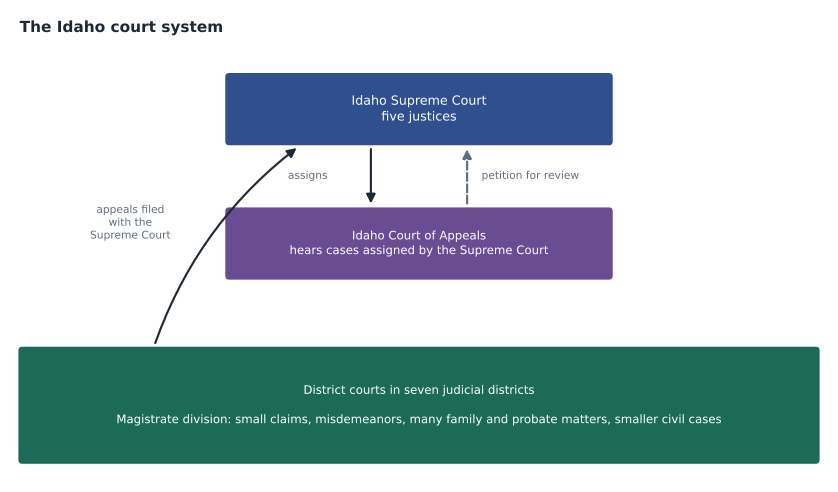
Idaho has a unified court system with three levels. At the top is the Idaho Supreme Court, which has five justices and is the court of last resort on questions of Idaho law. It also supervises the courts and regulates the practice of law, which is why it controls bar admission. Below it is the Idaho Court of Appeals, which hears cases the Supreme Court assigns to it. Idaho uses an unusual assignment system: appeals are filed with the Supreme Court, which keeps some and sends others to the Court of Appeals. A party who loses in the Court of Appeals may petition the Supreme Court for review.
The trial courts are the district courts, organized into seven judicial districts across the state, each covering several counties. Within each district court is a magistrate division, staffed by magistrate judges, which handles many of the cases ordinary people bring to court: small claims, misdemeanors and infractions, many family law matters, probate, juvenile cases and civil cases below a set amount. District judges hear felonies, larger civil cases and appeals from the magistrate division in many matters.
Idaho's judges are chosen by a mixed system. When a vacancy arises between elections, the Idaho Judicial Council screens applicants and sends names to the governor, who appoints. Justices and judges then stand for election in nonpartisan races, though contested judicial elections are uncommon. Magistrate judges are selected through a separate process involving magistrate commissions in each district and are subject to retention votes.
Small claims
The small claims department of the magistrate division is designed for people without lawyers. Claims up to a dollar limit set by statute may be filed there with simple forms, and the hearings are informal. Lawyers generally may not represent parties at the hearing, and the rules of evidence are relaxed. A party who loses may appeal to a magistrate judge for a new hearing. The limit has been raised over the years, so check the current figure in the Idaho Code before advising a client. For a new lawyer, small claims matters arise mostly as advice: helping a client prepare, or deciding whether a claim is better brought in the regular civil courts where fee-shifting statutes may make a lawyer worthwhile.
The Idaho Rules of Civil Procedure
Idaho's civil cases are governed by the Idaho Rules of Civil Procedure, which the Supreme Court restyled and renumbered effective July 1, 2016, to follow the structure of the federal rules more closely. A lawyer who knows the federal rules will find the Idaho rules familiar: notice pleading, liberal joinder, broad discovery with depositions, interrogatories, requests for production and requests for admission, motions to dismiss for failure to state a claim, summary judgment when there is no genuine dispute of material fact, and jury trials.
There are differences in the details. Idaho's pleading standard is a matter of Idaho's own rules and cases, and a lawyer should not assume that the federal plausibility standard of Bell Atlantic v. Twombly and Ashcroft v. Iqbal applies in state court without checking current Idaho decisions. Idaho's discovery rules have their own limits and timing, and Idaho's summary judgment practice uses its own deadlines for filing and responding. A new lawyer should read the Idaho rule, not assume the federal rule, every time a deadline or limit matters.
| Topic | Federal rule (tested on the exam) | Idaho practice |
|---|---|---|
| Pleading standard | Plausibility under Twombly and Iqbal | Governed by Idaho's own rules and cases; check current Idaho decisions |
| Rule structure | Federal Rules of Civil Procedure | Idaho Rules of Civil Procedure, restyled in 2016 to track the federal numbering |
| Trial courts | United States District Court for the District of Idaho | District courts in seven judicial districts, with magistrate divisions |
| Civil jury verdict | Unanimous unless the parties stipulate otherwise | The Idaho Constitution permits a less-than-unanimous verdict in civil cases (check the current rule) |
| Appeals | Courts of appeals; notice usually within 30 days | Appeal to the Idaho Supreme Court, which may assign the case to the Court of Appeals; check the Idaho Appellate Rules for the deadline |
Attorney fees
Idaho is unusual among American jurisdictions in how often its statutes allow the winning party to recover attorney fees. The general American rule is that each side pays its own lawyer. Idaho has several important exceptions in the Idaho Code. One statute allows fees to the prevailing party in actions on certain commercial transactions, accounts and smaller claims; another allows fees when a case was brought, pursued or defended frivolously, unreasonably or without foundation. The Idaho Rules of Civil Procedure set the procedure for claiming fees and costs after judgment.
These statutes change the economics of litigation. A client with a modest commercial claim may find a lawyer willing to take it because fees can be shifted to the losing side, and a client facing a weak lawsuit may have leverage in settlement because the plaintiff risks paying the defendant's fees. A new Idaho lawyer should check the fee statutes at the start of every case, plead the basis for fees in the complaint or answer and keep careful time records from the first day.
Limitation periods and notice requirements
Idaho's statutes of limitation are in Title 5 of the Idaho Code. The periods most often met in a general practice are two years for personal injury and most professional malpractice claims, four years for claims on oral contracts and five years for claims on written contracts. Special rules apply to particular claims, and discovery and tolling rules vary, so the statute itself must be checked for every case.
Claims against Idaho governmental entities carry an additional requirement. Under the Idaho Tort Claims Act, a claim against a political subdivision, such as a city, county or school district, must be presented to and filed with its clerk or secretary within 180 days from the date the claim arose or reasonably should have been discovered, whichever is later. Claims against the state have a parallel requirement. Missing the notice deadline is fatal to the claim even if the limitation period has not run. Lesson 8 covers the Tort Claims Act in more detail.
Family law procedure
Family cases in Idaho follow their own procedural rules, the Idaho Rules of Family Law Procedure, rather than the general civil rules. Those rules govern divorce, custody, child support and related matters, and they contain forms, disclosure requirements and procedures designed for parties who often represent themselves. Courts commonly require parents in custody disputes to attend parenting education and to try mediation before trial. Lesson 9 turns to the substance of Idaho family law.
Federal court in Idaho
Federal cases in Idaho are heard in the United States District Court for the District of Idaho, which sits in Boise, Coeur d'Alene and Pocatello, among other places, with appeals to the Ninth Circuit. Admission to the federal court follows admission by the Idaho Supreme Court; it is a separate application. Federal practice in Idaho follows the Federal Rules of Civil Procedure and the district's local rules, which is where the exam's federal focus becomes directly useful in practice.
Worked problem
Which court, which rules?
Two files land on Wes's desk. In the first, a client wants to recover a 3,000-dollar deposit from a contractor who never started work. In the second, a client wants to sue a feed supplier for 80,000 dollars in damages after a contaminated shipment sickened his cattle. Where should each case be filed, and what should Wes check first?
Show solution
- First file: a small claim of this size can usually be brought in the small claims department of the magistrate division; Wes should confirm the current dollar limit and explain that lawyers generally do not appear at small claims hearings.
- He should also consider whether a regular civil filing would allow attorney fees under an Idaho fee statute, which could make representation worthwhile.
- Second file: an 80,000-dollar claim belongs in district court under the Idaho Rules of Civil Procedure, unless federal jurisdiction exists and the client prefers federal court.
- For both, Wes should calendar the limitation period at once, check whether the claim sounds in contract, tort or both, and plead any basis for attorney fees.
Answer: The deposit claim fits small claims; the cattle claim belongs in district court; in both, check limitations and fee statutes first.
Common mistakes
MistakeEvery federal procedure decision applies in Idaho state court.
InsteadIdaho courts apply the Idaho Rules of Civil Procedure and Idaho decisions; check them before relying on a federal case.
MistakeThe Idaho Court of Appeals hears every appeal first.
InsteadAppeals are filed with the Supreme Court, which assigns some cases to the Court of Appeals.
MistakeEach side always pays its own lawyer in Idaho.
InsteadSeveral Idaho statutes allow the prevailing party to recover attorney fees.
MistakeThe limitation period is the only deadline for claims against a city.
InsteadThe Idaho Tort Claims Act also requires notice within 180 days.
Appeals in practice
Most new Idaho lawyers do not handle appeals in their first year, but they make decisions that shape appeals from the first day of a case. An issue that was not raised in the trial court is usually not considered on appeal, so objections, motions and offers of proof must be made on the record when they arise. A lawyer who wants a ruling reviewed later should make sure the trial court actually ruled, in writing or on the record, and that the ruling and the reasons for it can be found in the transcript or the file.
The Idaho Appellate Rules govern appeals to the Supreme Court and set the deadlines for the notice of appeal, the record and the briefs. Appeals from the magistrate division in many kinds of cases go first to a district judge rather than directly to the Supreme Court, so the path of an appeal depends on where the case began. Because appellate deadlines are jurisdictional or close to it, Ruffing's firm puts the appeal deadline on the calendar the day a final judgment is entered, before anyone has decided whether to appeal. Wes adopts the same habit for every case he touches.
Discovery and motion practice
Discovery in Idaho state court looks familiar to anyone who learned the federal rules: interrogatories, requests for production, requests for admission and depositions, with protective orders and motions to compel when the parties disagree. The differences that matter in daily practice are in the details, such as numerical limits, response times, the form of objections and the requirement to confer before filing a discovery motion. Each judicial district may also have its own practices and standing orders, and individual judges often publish their preferences for scheduling and hearings.
Motion practice has its own timing rules. Idaho's rules set how far in advance a motion and its supporting papers must be served before a hearing, and summary judgment motions have their own longer schedule for the motion, the response and the reply. A new lawyer who calendars only the hearing date, and not the deadlines that count backward from it, risks filing a response too late to be considered. Ruffing gives every new associate the same advice: count the days from the rule, not from memory, and count them twice.
Courtroom customs
Some of what makes Idaho practice distinctive is not written in any rule. The bar is small, and lawyers on opposite sides of a case are likely to meet again, often many times. Courtesy with opposing counsel, accurate representations to the court and prompt return of calls are expected and remembered. Judges in rural districts may travel between county courthouses on a regular schedule, so hearings in a small county may be set only on certain days of the month. Many courts allow or require remote appearances for some hearings, and the rules for those appearances vary by district and by judge.
Electronic filing is now standard in Idaho's state courts through the judiciary's e-filing system, and lawyers must register to use it. Court records are searchable through the judiciary's online repository, which is useful for checking a party's litigation history or finding a sample pleading in a similar case. A new lawyer should learn both systems early, because they make it far easier to find the local forms and practices that no rule book records.
Keeping federal and Idaho procedure apart for the exam
For the February exam, Wes treats Idaho procedure the way he treats Idaho tort law: useful at work, set aside during study hours. When a practice question asks about joinder, supplemental jurisdiction, summary judgment or the preclusive effect of a judgment, he answers under the Federal Rules of Civil Procedure and federal case law. The overlap between the two systems is large, which is a benefit, but the places where they differ are exactly where a tired candidate is most likely to slip, so he adds each one he notices to his contrasts list.
Summary and key terms
- Idaho's courts are the Supreme Court, the Court of Appeals and district courts in seven judicial districts with magistrate divisions.
- The Supreme Court assigns some appeals to the Court of Appeals.
- The Idaho Rules of Civil Procedure, restyled in 2016, track the federal rules but differ in details, including pleading.
- Idaho fee statutes often allow the prevailing party to recover attorney fees.
- Common limitation periods are two years for personal injury, four for oral contracts and five for written contracts; tort claims against governments need notice within 180 days.
- Magistrate division
- The part of each Idaho district court, staffed by magistrate judges, that handles small claims, misdemeanors and many family, probate and smaller civil matters.
- Idaho Rules of Civil Procedure
- The rules governing civil cases in Idaho's courts, restyled in 2016 to follow the federal structure.
- Notice pleading
- A pleading standard requiring a short statement of the claim sufficient to give fair notice.
- Fee-shifting statute
- A statute allowing the winning party to recover attorney fees from the losing party.
- Idaho Judicial Council
- The body that screens applicants for judicial vacancies and recommends names to the governor.
Lesson quiz · 5 questions
Score 60% or more to complete this lesson.
Create a free account to save your progress, take quizzes and earn a certificate.