
BAR-213 · Lesson 3 of 12 · 16 min
Character and fitness and the MPRE
▶ Video coming soon A video version of this lesson is on the way.
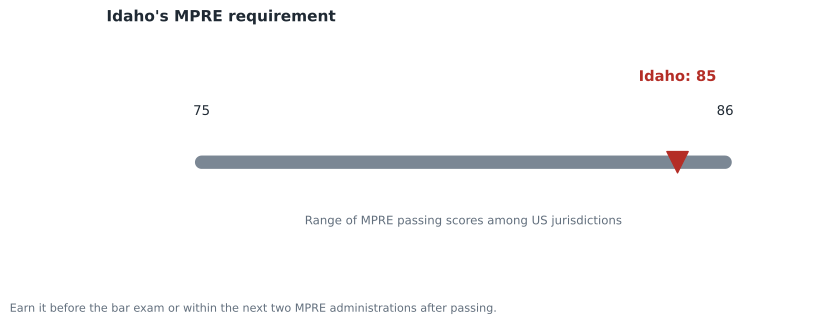
Two requirements stand beside the bar exam in Idaho, and both can stop an applicant who passes it. The first is character and fitness: the Idaho State Bar must be satisfied that the applicant has the honesty, judgment and responsibility to be trusted with clients' affairs. The second is the Multistate Professional Responsibility Examination (MPRE), the national ethics exam, on which Idaho requires a scaled score of 85. This lesson takes them in turn.
Wes has nothing alarming in his history, but he has two things to explain. When he was nineteen he received a citation for possessing alcohol as a minor at a river campsite, which was resolved by a diversion program and dismissed. And during his second year of law school he fell four months behind on a credit card after a medical bill, which went to collections before he paid it in full. 'Neither of those will keep you out,' Marchetti tells him. 'What could hurt you is leaving one of them off the application, or describing it in a way that does not match the records.'
Who investigates and how
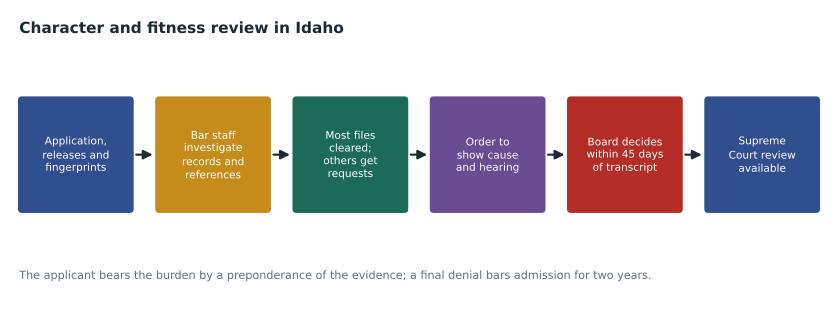
Idaho runs its own character and fitness investigation. Many jurisdictions hire NCBE to gather an applicant's records and prepare a report, but NCBE's information for Idaho states that Idaho does not use that service and that applicants file their character materials directly with the Idaho State Bar. The Bar's admissions staff review the application, obtain records using the applicant's signed release forms, run a criminal history check from the fingerprint card, contact references, schools and employers, and follow up on anything that needs explanation.
Most applications raise no concerns, and those applicants never hear about character and fitness again until they are recommended for admission. When something does need attention, the staff may ask for more information or documents, and the matter may go to the Bar's character and fitness review. If concerns remain, the Board of Commissioners may issue an order to show cause, which gives the applicant notice of the concerns and a hearing at which to respond. Under an amendment to Rule 215 effective February 2, 2026, the Board must enter its decision within forty-five days after it receives the transcript of the show cause hearing; before the amendment the period was fourteen days. An applicant who disagrees with the Board's decision may seek review by the Idaho Supreme Court.
The burden is on the applicant
The most important rule in the character process is easy to miss. Under Rule 224, the applicant bears the burden of proving good moral character and fitness, and the facts must be proven by a preponderance of the evidence. That is the reverse of a criminal case or a disciplinary case against an admitted lawyer, where the Bar must prove the charge. An applicant is asking for a license, and it is up to the applicant to show that he or she should have one. In practice this means that silence, vague answers and missing records count against the applicant, not the Bar.
The burden also shapes how an applicant should present a problem. A good disclosure does four things: it states the facts accurately and completely, it attaches the official records, it explains what the applicant has learned or changed, and it shows evidence of that change, such as completed treatment, payment plans kept, letters from supervisors or a clean record since. An applicant who does those things usually turns a potential problem into a demonstration of the very candor the Bar is looking for.
What the Bar looks for
Character and fitness review asks whether an applicant's past conduct suggests a risk to clients, courts or the public. The kinds of conduct that most often draw attention are familiar from every jurisdiction: dishonesty, including lack of candor on the bar application itself; criminal conduct, especially conduct involving dishonesty, violence or drugs; academic misconduct such as plagiarism or cheating; financial irresponsibility, such as unpaid debts, defaulted loans or unfiled taxes; neglect of professional obligations in another licensed occupation; and conduct suggesting that a current condition, such as untreated substance use, impairs the ability to practice.
Context matters. The Bar weighs how long ago the conduct happened, how old the applicant was, how serious it was, whether it was repeated, whether the applicant has been candid about it and what the applicant has done since. A single youthful citation resolved years ago weighs very differently from a pattern of recent conduct. Financial trouble caused by medical bills and then cured weighs very differently from debts ignored. Candor weighs heaviest of all, because a lawyer who will not tell the truth on a sworn application raises the very concern the process exists to address.
| Issue | What usually helps | What usually hurts |
|---|---|---|
| Old minor offense | Full disclosure with court records; time elapsed; clean record since | Omitting it because it was dismissed or expunged |
| Debts or collections | Documented payment or a payment plan kept over time | Unexplained defaults; debts still ignored |
| Academic discipline | The school's records; an honest account; evidence of lessons learned | Minimizing or contradicting the school's findings |
| Substance use or mental health treatment | Focus on current fitness; documentation of treatment and stability | Treating past treatment as something to hide |
| Inconsistent answers | Checking every answer against records before filing | Answers that differ from law school or employer records |
The two-year rule
Since February 2, 2026, the stakes of a denial are higher. Rule 202(a)(6) now provides that an applicant whose application has been denied on character and fitness grounds by a final order of the Board or the Supreme Court may not be admitted for two years after the denial. The rule does not change what the Bar looks for, but it means that an applicant with a serious problem should think carefully about timing. An applicant who is not ready to show rehabilitation may be better off waiting to apply, or withdrawing an application on advice of counsel, than pressing forward to a final denial that starts a two-year clock.
Applicants facing a show cause order should consider getting advice from a lawyer who knows Idaho admissions practice. Representation is not required, but a lawyer can help gather evidence, prepare witnesses and present rehabilitation in the way the Board finds most useful.
Wes's disclosures
Wes disclosed both matters. For the alcohol citation he attached the citation, the diversion agreement and the dismissal order, and he wrote three sentences describing what happened. For the credit card, he attached the collection notice, the payoff letter and a short explanation of the medical bill, and he noted that he had not missed a payment since. He also made sure the facts matched his law school application, which had asked about criminal matters and on which he had disclosed the citation. Marchetti read the disclosures and changed one word: Wes had written that the citation was 'minor,' and Marchetti suggested letting the records speak for themselves.
The MPRE
The MPRE is NCBE's exam on the law governing lawyers. It has sixty multiple-choice questions, fifty scored and ten unscored pretest questions, answered in two hours. It is given at Pearson VUE test centers several times a year, and NCBE does not offer a remote option. The registration fee for 2026 and 2027 is 185 dollars. The exam is based on the ABA Model Rules of Professional Conduct, the ABA Model Code of Judicial Conduct and controlling constitutional and procedural law, not on any one state's rules, so Idaho candidates prepare from the national materials. Scores are reported on a scale from 50 to 150.
Idaho requires a scaled score of at least 85. That is near the top of the national range, which runs from 75 to 86. Candidates who would comfortably pass in a jurisdiction requiring 75 or 80 can fall short in Idaho, so Marchetti recommends that Idaho candidates treat the MPRE as a real exam: about three or four weeks of study, a full timed practice test and review of every wrong answer.
When the MPRE score must be earned
Idaho's timing rule is unusual. Under Rule 202(b), the qualifying MPRE score must be earned either before the applicant sits the Idaho bar exam or within the next two MPRE administrations after the applicant passes it. Many jurisdictions instead require the score to fall within a set number of years before or after the bar exam. Idaho's rule lets an applicant take the bar exam first and the MPRE shortly after, but not much after: an applicant who passes the February bar exam and misses the next two MPRE administrations, or takes them and scores below 85, has a problem that can delay admission.
Because the window after the bar exam is short and MPRE dates fill, most Idaho applicants take the MPRE in law school. Wes took it in March of his third year and scored 93, so the timing rule is satisfied. His study group partner from Montana, who passed the MPRE with an 82, learned the hard way that her score would not have qualified in Idaho.
Worked problem
Will the MPRE score work?
Three applicants plan to sit the February 2027 Idaho exam. Ana scored 88 on the MPRE in August 2025. Ben has not taken it and plans to take it after the bar exam. Cara scored 83 in November 2025. Who satisfies Idaho's MPRE requirement, and what should the others do?
Show solution
- Ana: 88 is at least 85 and was earned before the bar exam, so it qualifies.
- Ben: he may take the MPRE after the exam, but only within the next two administrations after he passes the bar exam, and he needs 85 or more. He should register early.
- Cara: 83 is below 85, so it does not qualify in Idaho even though it would in many jurisdictions. She must retake and score 85 within the window.
Answer: Only Ana is done; Ben and Cara must earn 85 within the time Rule 202(b) allows.
Common mistakes
MistakeA dismissed or diverted offense need not be disclosed.
InsteadDisclose what the question asks; a dismissed matter that the question covers must be listed, with records.
MistakeThe Bar must prove an applicant lacks good character.
InsteadUnder Rule 224, the applicant bears the burden by a preponderance of the evidence.
MistakeAn MPRE score of 80 qualifies in Idaho.
InsteadIdaho requires 85.
MistakeThe MPRE can be taken any time after the bar exam.
InsteadThe score must be earned before the exam or within the next two MPRE administrations after passing it.
Keeping the application current
The duty of candor does not end when the application is filed. An applicant must update the application when something changes or when an earlier answer turns out to be incomplete, and that duty runs until admission. A new traffic citation, a lawsuit, a change of job, a new address or a debt that goes to collections after filing should all be reported promptly. Marchetti tells the group that the safest course is to report anything the application's questions would have covered if it had happened before filing, and to report it in writing with records attached.
Updates matter because the Bar compares the application with what it learns from other sources. An event that the Bar discovers on its own, after the applicant failed to report it, raises a candor question that the event itself might never have raised. An event the applicant reports promptly, with records, usually raises no question at all.
Mental health questions
Applicants often worry about questions concerning mental health and treatment. Over the past decade, NCBE, the ABA and many jurisdictions have revised character questions to focus on current conduct and current impairment rather than on diagnosis or treatment history, and ABA policy urges jurisdictions not to ask about mental health history as such. Applicants should read the current Idaho questions carefully and answer exactly what they ask. Seeking treatment is a sign of responsibility, not a mark against an applicant, and the Bar's interest is whether the applicant can practice competently and ethically now.
An applicant who is unsure how to answer a question should not guess. The admissions staff can explain what a question covers, and the Idaho State Bar's lawyer assistance resources and confidential counseling options are available to applicants and lawyers who want help. Applicants with a significant issue may also want independent legal advice before filing.
Preparing for the MPRE efficiently
The MPRE tests a body of law that every lawyer needs, and studying it pays off twice: once on the exam and again in practice. The heaviest areas on NCBE's outline are conflicts of interest, the client-lawyer relationship, client confidentiality and the regulation of the profession, followed by litigation duties, communications about legal services and the duties of judges. A sensible plan for an Idaho candidate is to read a short outline of the Model Rules, work several hundred practice questions spread over three weeks, take one full timed practice test under realistic conditions and review every miss by finding the rule that answers it.
Two habits help on test day. The first is to read the call of the question before the facts, because many MPRE questions ask a narrow thing, such as whether a lawyer is subject to discipline, rather than whether the conduct was wise. The second is to remember that the MPRE tests the Model Rules and generally accepted law, not Idaho's rules. Where the Idaho Rules of Professional Conduct differ from the Model Rules, the MPRE answer follows the Model Rules. Lesson 10 explains where Idaho differs and why that matters after admission.
Candidates who score just below 85 should look closely at their score report before retaking. NCBE reports a scaled score, and small differences in the number of correct answers can move it a few points. A candidate who scored 82 or 83 usually needs only a few more correct answers, which a focused review of the weakest areas can supply.
Summary and key terms
- Idaho runs its own character and fitness investigation; it does not use NCBE's service.
- The applicant bears the burden of proving good character and fitness by a preponderance of the evidence.
- Concerns can lead to a show cause hearing; the Board decides within 45 days after receiving the transcript.
- Since February 2, 2026, a final character and fitness denial bars admission for two years.
- Idaho requires an MPRE score of 85, earned before the bar exam or within the next two administrations after passing it.
- Character and fitness
- The review of whether an applicant has the honesty, judgment and responsibility required to practice law.
- Order to show cause
- An order giving an applicant notice of character concerns and a hearing at which to respond.
- Preponderance of the evidence
- The standard of proof under which a fact must be shown to be more likely true than not.
- MPRE
- The Multistate Professional Responsibility Examination, NCBE's national exam on the law governing lawyers.
- Rehabilitation
- Evidence that an applicant has addressed past conduct and is now fit to practice.
Lesson quiz · 5 questions
Score 60% or more to complete this lesson.
Create a free account to save your progress, take quizzes and earn a certificate.