
BAR-213 · Lesson 4 of 12 · 16 min
The Idaho bar exam: NextGen format, scoring and the 616 passing score
▶ Video coming soon A video version of this lesson is on the way.
When Wes opened NCBE's NextGen materials for the first time, his first reaction was relief: the exam was shorter than the old one. His second reaction, after working a practice set, was concern: it asked him to do things the old exam never asked, like decide which of several research sources answered a client's question or draft two sentences for a client letter. 'That is exactly the point,' Marchetti tells him. 'The NextGen exam tests whether you can do the first year of a lawyer's job. It still tests the law, but it tests it in the way a new lawyer uses it.'
This lesson describes the exam Idaho has given since July 2026: its structure, its question types, what it covers, how it is scored and what Idaho's passing score of 616 means. Lesson 5 explains how Idaho got here from the UBE, and Lesson 6 explains how Idaho law fits in.
The structure of the exam
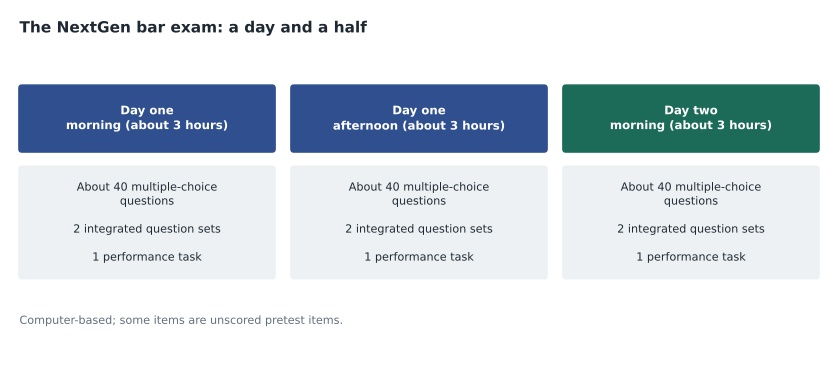
The NextGen bar exam is given over a day and a half, in three sections of about three hours each: two on the first day and one on the morning of the second. It is given entirely on computer, at sites the jurisdiction arranges, on national dates set by NCBE. For the coming year those dates are February 23 and 24, 2027, and July 27 and 28, 2027.
Each section contains the same three kinds of material. There are about forty multiple-choice questions, two integrated question sets and one performance task. NCBE's guidance budgets about one minute and forty-eight seconds per multiple-choice question, about twenty-four minutes per integrated question set and about an hour for the performance task, which together fill the section. Across the whole exam, some of the multiple-choice questions and one integrated set are unscored pretest items that NCBE is trying out for future exams; candidates cannot tell which ones they are, so every question deserves full effort.
The question types
The multiple-choice questions look familiar to anyone who has studied for the old MBE, but they are shorter and they come in two forms. Most are select-one questions, worth up to one point. Some are select-two questions, which ask the candidate to choose the two best answers from a longer list; they are worth up to two points, with partial credit for one correct choice. Multiple-choice questions test both doctrine and skills: a question may ask what rule applies, or it may ask what a lawyer should do next.
Integrated question sets are the most distinctive part of the exam. Each set begins with a shared scenario, often with documents such as an email, a contract clause or a short transcript, and then asks several questions about it. Some questions are multiple choice and some require short written answers, scored from zero to two points, or brief drafting, scored on a larger scale. A set might follow a client from an initial interview through a negotiation, or ask the candidate to revise a paragraph of a complaint and then predict a ruling on a motion. Because the questions build on one another, careful reading of the scenario at the start pays off across the whole set.
The performance tasks are the successors to the old Multistate Performance Test, but they are shorter, about an hour each, and some of them are research tasks. In a standard performance task, the candidate receives a file of facts and a library of legal authorities and must produce a document such as a memo, a letter or a section of a brief. A legal research performance task asks the candidate to find and evaluate the right authority before using it, and in those tasks the research questions carry extra weight. Standard performance tasks are scored on a scale from zero to twenty-four.
| Question type | What it looks like | How it is scored |
|---|---|---|
| Select-one multiple choice | A short fact pattern with four options | Up to 1 point |
| Select-two multiple choice | Choose the two best answers from a longer list | Up to 2 points, with partial credit |
| Integrated question set | A shared scenario with documents and several linked questions | Short answers 0 to 2; drafting on a larger scale |
| Performance task | A file and library; produce a document in about an hour | 0 to 24 for a standard task |
| Legal research performance task | Find and evaluate authority, then use it | Research questions weighted more heavily |
What the exam covers
NCBE describes the exam's content in two parts. The first is foundational concepts and principles: the legal knowledge a new lawyer needs, drawn from eight subjects. They are business associations, civil procedure, constitutional law, contracts, criminal law and constitutional protections of people accused of crimes, evidence, real property and torts. Family law joins the tested subjects in July 2028. Within each subject, NCBE's content scope marks some topics with a star, meaning candidates must know them from memory; for other topics, the exam may supply the law in the question.
The second part is foundational skills: legal research, legal writing, issue spotting and analysis, investigation and evaluation, client counseling and advising, negotiation and dispute resolution, and client relationship and management. A small set of professional responsibility rules, drawn from the ABA Model Rules, is tested where it naturally arises in client-facing skills questions. The MPRE remains the separate test of professional responsibility as a subject.
Two subjects that many candidates expect are handled differently. Family law and trusts and estates are not tested from memory before July 2028, but either may appear in a performance task on any exam, with the law supplied in the library. Candidates do not need to memorize those subjects, but they should be comfortable working with unfamiliar statutes and cases under time pressure.
How the exam is scored
The NextGen exam produces a single scaled score on a range from 500 to 750. Raw points from the multiple-choice questions, the integrated sets and the performance tasks are combined using weights of about 49 percent for multiple choice, 21 percent for integrated question sets and 30 percent for performance tasks. NCBE then scales and equates the result so that a given score means the same thing from one administration to the next, regardless of whether a particular exam was slightly easier or harder. The score is not curved against other candidates: a candidate's result does not depend on how well anyone else did.
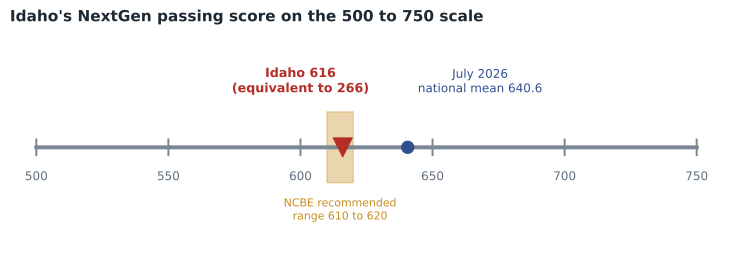
Each jurisdiction sets its own passing score. NCBE recommended a range of 610 to 620. Idaho chose 616, which the Board of Commissioners approved on November 4, 2025, and which the Idaho Supreme Court adopted in the Bar Examination Grading Standards and Procedures by an order effective May 1, 2026. The Board described 616 as equivalent to 266 on the legacy UBE. The same order sets 616 as the minimum for transferring a NextGen score into Idaho from another jurisdiction.
What 616 means in practice
A passing score is easier to understand next to real results. For the July 2026 exam, NCBE reported that 2,630 candidates were scored nationally, with a mean of 640.6 and a pass rate of 72.7 percent against the passing scores the jurisdictions had set. First-time takers passed at 85.2 percent and repeat takers at 41.0 percent. Those numbers suggest that a well-prepared first-time candidate who reaches the national average will clear Idaho's standard with room to spare, and that the real danger lies with candidates who are underprepared in one part of the exam.
Because the score combines all three kinds of material, a candidate cannot pass on multiple choice alone. The performance tasks carry about 30 percent of the weight, and the integrated sets another 21 percent. Marchetti tells the group to spend at least a third of their practice time on written work: performance tasks, short answers and drafting. Wes, who is stronger on multiple choice, schedules a performance task every other day from December on.
Worked problem
Reading a score report
A candidate who sat the July 2026 Idaho exam received a scaled score of 609. Did the candidate pass, and what does the score suggest about next steps?
Show solution
- Idaho's passing score is 616, so 609 does not pass.
- The score is seven points below the line, which is close; targeted work can close that gap.
- The candidate should look at the performance on each component, if reported, and find the weakest area.
- A candidate close to the line who was weak on performance tasks should prioritize timed written practice.
Answer: The candidate did not pass; the gap is small, and the next exam is a realistic target with focused work.
Common mistakes
MistakeThe NextGen exam is two full days, like the old UBE.
InsteadIt is a day and a half: three sections of about three hours each.
MistakeMultiple choice decides the result.
InsteadMultiple choice carries about 49 percent; integrated sets and performance tasks carry the rest.
MistakeNextGen scores are curved against other candidates.
InsteadScores are scaled and equated to a fixed standard; others' results do not affect yours.
MistakeFamily law and trusts and estates are not on the exam at all.
InsteadThey are not tested from memory before July 2028, but may appear in performance tasks with the law supplied.
Working on the computer
Because the NextGen exam is entirely computer-based, the testing interface becomes part of the skill being tested. NCBE publishes a tutorial and preview of the exam software, and Marchetti requires every member of the group to work through it at least twice before the exam: once early, to learn where things are, and once in the final week, to rehearse. The features worth practicing are the ones candidates use under pressure: moving between the questions of an integrated set, opening and searching the documents in a performance task's file and library, flagging questions to return to and keeping track of the time remaining in a section.
Typing matters too. Performance tasks and drafting questions reward clear, organized writing, and a candidate who types slowly or edits clumsily loses minutes that cannot be recovered. Wes practices performance tasks on a laptop with the same kind of keyboard he will use at the test site, and he times himself from the moment he opens the task memo to the moment he stops writing.
How the sections fit together
Each three-hour section is self-contained. A candidate who struggles with the performance task in the first section starts the second section fresh. That structure rewards a steady pace and a willingness to move on. Marchetti teaches a simple order for each section: read the performance task's instructions first, so its demands sit in the back of the mind; then work the multiple-choice questions at a steady pace; then the two integrated sets; then the performance task. Others prefer to start with the performance task while fresh. What matters is to choose an order in practice, test it on full timed sections and stick with it on exam day.
Studying the content scope
NCBE's content scope document is the single most useful study tool for the NextGen exam, because it lists every topic that may be tested and marks those that must be known from memory. Unlike the old MBE outlines, which were long lists of doctrine, the content scope is organized around what a new lawyer needs, and it has been revised as NCBE learned from field tests and the first administrations. Candidates should use the current version, not an older one copied from a commercial outline, and should check NCBE's site for updates before each administration.
The practical lesson from the content scope is that breadth matters more than depth. A candidate does not need to know the minority rules and historical curiosities that filled old outlines. A candidate does need a clear, usable command of the core rules in each subject and the ability to apply them to unfamiliar facts. Wes builds one-page summaries for each of the eight subjects from the content scope, marking the starred topics in red, and reviews two of them every morning.
Using NCBE's study aids
NCBE sells and provides study aids for the NextGen exam, including practice question sets, simulated full exams and sourcebooks for the performance tasks. Because Idaho candidates have only a few NextGen administrations behind them, these official materials are the best evidence of what the exam looks like. Marchetti recommends that each candidate take at least one full simulated exam under timed conditions, over a day and a half, about three weeks before the real one, then spend several days reviewing every item.
How scaled scores work
The scaled score is not a percentage of questions answered correctly. NCBE converts raw points to a common scale so that a score means the same thing on every administration, whether a particular exam turned out slightly easier or harder than another. That process, called equating, uses questions that have appeared on earlier exams to measure the difficulty of each new form. The practical result for a candidate is that there is no advantage in choosing a particular exam date in the hope of an easier form; the scale adjusts for difficulty.
Because the score is a total across the whole exam, a candidate does not need to pass each section separately. Strong performance on the multiple-choice questions can offset a weaker performance task, and the reverse. That is why Marchetti tells candidates never to abandon a section after a bad start: every point counts toward the same total, and a candidate who keeps working through a difficult hour often recovers more than expected.
Score reports for candidates who fail typically show how the total compared with the passing score. Idaho candidates should read those reports with care, because they are the best guide to how much improvement is needed and where to look for it.
Summary and key terms
- Idaho gives the NextGen exam: three sections over a day and a half, on computer.
- Each section has about 40 multiple-choice questions, two integrated question sets and one performance task.
- The exam covers eight subjects and seven skills; family law joins in July 2028.
- Scores run from 500 to 750, weighted about 49, 21 and 30 percent across the three kinds of material.
- Idaho's passing score is 616, equivalent to 266 on the legacy UBE.
- Integrated question set
- A NextGen item built on a shared scenario, with several linked multiple-choice and written questions.
- Performance task
- A NextGen item in which the candidate uses a file and library to produce a legal document.
- Select-two question
- A multiple-choice question asking for the two best answers, scored with partial credit.
- Scaled score
- A score adjusted so that results mean the same thing across administrations.
- Starred topic
- A topic in NCBE's content scope that candidates must know from memory.
Lesson quiz · 5 questions
Score 60% or more to complete this lesson.
Create a free account to save your progress, take quizzes and earn a certificate.