
BAR-215 · Lesson 11 of 12 · 21 min
Score transfer, admission without examination and practice after admission
▶ Video coming soon A video version of this lesson is on the way.
Two people in Marchetti's group had questions about Indiana that had nothing to do with sitting the exam there. Dana, who was sitting in Texas, wondered whether a UBE score from another state could get her into Indiana later, since her partner might take a job in Indianapolis. And Hannah's supervising lawyer had a friend, a lawyer in Ohio for a decade, who wanted to join the firm. This lesson covers the other routes into the Indiana bar and what every new Indiana lawyer must do after admission.
Admission on a transferred UBE score
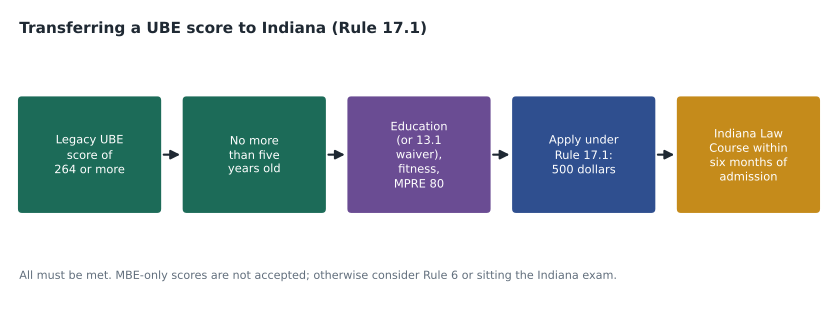
Rule 17.1 allows admission on a UBE score earned in another jurisdiction. NCBE's jurisdiction information sets out Indiana's main terms. The transferred legacy UBE score must be at least 264, the same as Indiana's own passing score, and it must be no more than five years old. The application fee for admission by transferred score is 500 dollars. Indiana does not accept transferred MBE scores standing alone, so a candidate cannot combine an MBE score from one state with written scores from another.
Transfer applicants still must satisfy the other requirements: the educational requirement, character and fitness review and the MPRE. Under the August 1, 2026 amendments, an applicant who graduated from a law school that is not ABA-approved may qualify for transfer if the Board grants a Rule 13.1 waiver. And like those admitted on an Indiana score, transfer admittees must complete the Indiana Law Course within six months after admission.
Indiana has also accepted transferred NextGen scores since the July 2026 administration, so a candidate who passes NextGen in another jurisdiction can apply on that score, subject to Indiana's NextGen standard and its other rules. A legacy UBE score and a NextGen score are different and are evaluated under their own requirements.
Admission without examination
Experienced lawyers admitted elsewhere can seek admission without taking the Indiana exam under Rule 6. According to NCBE, Indiana requires active practice in three of the past five years, and the rule describes the practice standard in terms of at least 1,000 hours a year. Qualifying practice can include law teaching, work for a government agency, military service as a lawyer, in-house corporate work and service as a judge of a court of record. Lawyers first admitted elsewhere by diploma privilege are eligible. The application fee is 875 dollars.
Some older bar-prep summaries describe a longer practice requirement of five of the past seven years, reflecting an earlier version of the rule. NCBE's current information and the text of the August 2026 order both describe three of five years, so candidates should rely on the current rule. The 2026 order also removed the separate requirement that an experienced attorney applying under Rule 6 hold a degree from an ABA-approved school, and allowed practice under an Indiana business counsel license or pro bono publico license to count toward the years of practice when the other requirements are met. The exhibit to the order was not entirely clear on every change, so applicants should read the official text and confirm with ACE.
Lawyers admitted under Rule 6 must also complete the Indiana Law Course. Because the August 2026 order's exhibit gives two different deadlines for these lawyers, they should confirm their exact deadline with ACE.
| Route | Main Indiana terms | Fee |
|---|---|---|
| Transferred legacy UBE score (Rule 17.1) | At least 264, no more than five years old; no MBE-only transfers | 500 dollars |
| Transferred NextGen score | Accepted since July 2026 scores, under Indiana's NextGen standard | Check with ACE |
| Admission without examination (Rule 6) | Active practice in 3 of the past 5 years, at least 1,000 hours a year | 875 dollars |
| All routes | Education (or Rule 13.1 waiver), character and fitness, MPRE 80; Indiana Law Course after admission | Varies |
Limited and temporary licenses
Indiana issues several limited forms of permission to practice. A business counsel license allows a lawyer admitted elsewhere to work as in-house counsel for an Indiana employer without full admission. A temporary license under Rule 6.1 lets some applicants work while their application is pending; the August 2026 amendments extended it to applicants for admission by examination, by transferred UBE score or without examination. Law students and recent graduates can serve as legal interns under Rule 2.1, and lawyers from other jurisdictions can seek temporary admission to appear in a particular Indiana case. Each has its own conditions and limits.
Continuing legal education
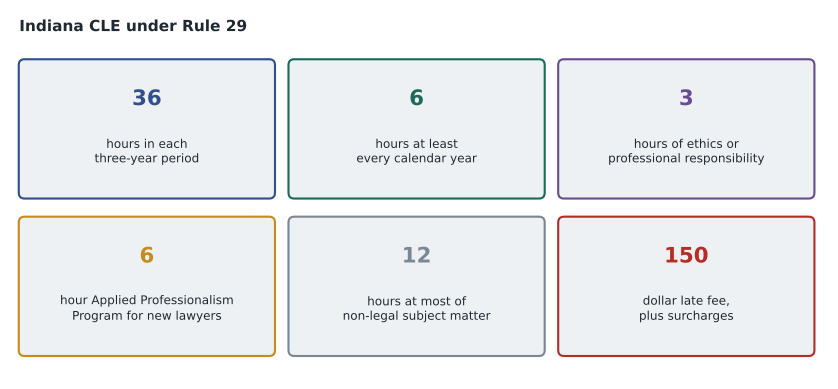
Once admitted, every Indiana lawyer must meet the continuing legal education requirements of Admission and Discipline Rule 29. Over each three-year educational period, a lawyer must complete at least 36 hours of approved courses, with at least 6 hours in each calendar year. At least 3 hours in each three-year period must cover legal ethics or professional responsibility. No more than 12 of the 36 hours may come from non-legal subject matter courses, and lawyers outside government and academia may count only a few hours of in-house programs.
New lawyers have one extra obligation. Attorneys admitted after 1998 must satisfy 6 of their 36 hours by attending an Applied Professionalism Program for Newly Admitted Attorneys accredited by the Commission for Continuing Legal Education. The rule gives newly admitted lawyers a grace period: their first educational period begins on January 1 after the year of admission. Late compliance brings a late fee of 150 dollars, plus additional surcharges for continued noncompliance.
The first year in practice
Marchetti closed with a checklist for Hannah's first year after admission: register as an active attorney and pay annual fees, set up a trust account correctly before taking any client money, complete the Indiana Law Course within six months, schedule the Applied Professionalism Program, start tracking CLE hours, and find a mentor. Indiana's Judges and Lawyers Assistance Program is there for confidential help if the transition gets hard.
Worked problem
Two transfer questions
Suppose Dana passes the February 2027 Texas UBE with a score of 268. Separately, the Ohio friend of Hannah's supervising lawyer has practiced full time in Ohio since 2015.
Show solution
- Dana's 268 exceeds Indiana's 264 minimum and would stay within the five-year limit until February 2032, so she can apply under Rule 17.1 with the 500 dollar fee, subject to the other requirements.
- After admission Dana must complete the Indiana Law Course within six months.
- The Ohio lawyer has more than three years of active practice in the past five, so he can apply without examination under Rule 6 with the 875 dollar fee.
- He must also meet character and fitness and MPRE requirements and complete the Indiana Law Course, confirming his deadline with ACE.
Answer: Dana can transfer her score; the Ohio lawyer can seek admission without examination. Both must complete the Indiana Law Course.
Common mistakes
MistakeAssuming an MBE score from another state can be combined with Indiana essays.
InsteadIndiana does not accept transferred MBE-only scores.
MistakeRelying on an older summary that requires five of seven years of practice.
InsteadCurrent information describes three of the past five years under Rule 6.
MistakeForgetting the Indiana Law Course after transferring a score.
InsteadTransfer admittees must complete it within six months of admission.
MistakeCounting the Indiana Law Course toward the 36 CLE hours.
InsteadIt does not count; the 6-hour Applied Professionalism Program does.
Practice problems
Work each problem on paper first, then reveal the answer to check.
What minimum score and age limit apply to a transferred legacy UBE score?
Show answer
At least 264 and no more than five years old.
What practice requirement applies to admission without examination?
Show answer
Active practice in three of the past five years.
How many CLE hours must an Indiana lawyer complete per three-year period?
Show answer
36, with at least 6 each year and 3 in ethics or professional responsibility.
What special CLE program must new lawyers complete?
Show answer
A 6-hour Applied Professionalism Program for Newly Admitted Attorneys.
Choosing among the routes
Lawyers moving to Indiana sometimes qualify for more than one route, and the choice depends on their history. Marchetti gave the group a short decision sequence. First, is there a legacy UBE score of at least 264 that is no more than five years old, or a NextGen score that meets Indiana's standard? If so, Rule 17.1 transfer is usually the simplest route. Second, if there is no qualifying score, does the lawyer have three years of active practice in the past five? If so, Rule 6 admission without examination is available. Third, if the lawyer will work only as in-house counsel for one employer, a business counsel license may be enough. Otherwise, the lawyer sits the Indiana exam.
Each route has the same core requirements underneath: education or a Rule 13.1 waiver, character and fitness review, and an MPRE score of 80. Each route also leads to the Indiana Law Course. A lawyer who chooses a route because it seems faster should check that none of the shared requirements will hold it up; a missing MPRE score, for example, will stop any application.
Character and fitness for experienced lawyers
Experienced lawyers sometimes assume that character and fitness review is a formality for them, since they are already admitted elsewhere. It is not. The application asks about their practice history, any discipline or malpractice claims, and their conduct since law school, and the Board may contact the bars where they are admitted. A lawyer with a past grievance, even one dismissed, should disclose it as the application asks. The same candor principles from Lesson 3 apply with more force to someone who has been practicing under rules that require honesty to tribunals.
Getting started as a new Indiana lawyer
Admission is followed by a series of practical steps. Every Indiana lawyer must register with the Clerk of the Indiana Supreme Court, keep contact information current, and pay the annual registration fee and related assessments. Lawyers must report trust account information. And they must comply with CLE. Missing these obligations can lead to suspension, often for reasons that have nothing to do with the quality of a lawyer's work.
Setting up a trust account correctly is the most important of these steps for a lawyer who will handle client money. The account must be at an eligible financial institution that has agreed to report overdrafts, and lawyers holding nominal or short-term funds use IOLTA accounts. The lawyer must keep records for each client, reconcile the account regularly, and never mix personal money with client funds beyond what the rules allow to cover bank charges. Hannah's supervising lawyer handles the firm's trust account, but Marchetti told Hannah to learn the process anyway, because a lawyer remains responsible for client money in her own matters.
Worked problem
CLE arithmetic for a new admittee
Suppose a lawyer is admitted in Indiana in May 2027 on an Indiana UBE score.
Show solution
- The Indiana Law Course is due within six months after admission, so by November 2027; it does not count toward CLE.
- Under Rule 29's grace period, the first educational period begins on January 1 after the year of admission, so on January 1, 2028.
- That three-year period runs from 2028 through 2030 and requires 36 hours, with at least 6 in each calendar year and at least 3 in ethics or professional responsibility.
- The 6-hour Applied Professionalism Program for Newly Admitted Attorneys counts toward the 36 hours, so the lawyer needs 30 more over the period, still meeting the 6-hour annual minimum.
Answer: Finish the Indiana Law Course by November 2027, then plan 36 CLE hours from 2028 through 2030, including the 6-hour professionalism program, at least 6 hours a year and 3 hours of ethics.
The example is hypothetical, but the pattern applies to any new admittee: the Indiana Law Course comes first, CLE begins in the following January, and the professionalism program should be scheduled early in the first period so it is not forgotten.
Finding support
New lawyers do better with support. The Indiana State Bar Association and local bar associations offer sections for practice areas, young lawyer divisions and mentoring programs, all voluntary. Legal aid organizations and pro bono plans provide training in return for volunteer work. And the Judges and Lawyers Assistance Program offers confidential help with stress, substance use and mental health. Marchetti told Hannah to join one section and one local bar group in her first year, attend a few meetings, and find at least one lawyer outside her firm she could call with a question.
Score transfer out of Indiana
The same rules work in reverse. A lawyer who passes the Indiana UBE may later want to transfer that score to another UBE jurisdiction. The receiving jurisdiction's passing score, score-age limit and other requirements control. A 264 earned in Indiana meets the passing score in some jurisdictions, such as Alabama at 260, but not in jurisdictions that require 266 or 270. A lawyer who might move should note the date of the exam and the score, and remember that score-age limits differ from state to state. After enough years of practice, admission without examination elsewhere may become the better route.
Summary and key terms
- A transferred legacy UBE score must be at least 264 and no more than five years old; the fee is 500 dollars and MBE-only scores are not accepted.
- Indiana has accepted transferred NextGen scores since July 2026.
- Rule 6 allows admission without examination after three of the past five years of active practice, for an 875 dollar fee.
- Business counsel, temporary and intern licenses provide limited authority to practice.
- Rule 29 requires 36 CLE hours per three years, 6 per year, 3 in ethics, and a 6-hour professionalism program for new lawyers.
- Rule 17.1
- Indiana's rule on admission by transferred UBE score.
- Rule 6
- Indiana's rule on admission without examination for experienced lawyers.
- Business counsel license
- A limited Indiana license for in-house lawyers admitted elsewhere.
- Educational period
- The three-year cycle for Indiana CLE compliance.
Lesson quiz · 5 questions
Score 60% or more to complete this lesson.
Create a free account to save your progress, take quizzes and earn a certificate.