
BAR-215 · Lesson 3 of 12 · 19 min
Character and fitness and the MPRE
▶ Video coming soon A video version of this lesson is on the way.
Hannah had one item on her application that worried her: a citation for underage drinking from her second year of college, resolved by a diversion program and later expunged. She had disclosed it, but she wanted to know whether it would sink her application. Marchetti had heard versions of the question every year. 'Disclosure almost never sinks an application,' she said. 'Hiding something almost always causes trouble. Let's talk about what the Board is actually looking for.' This lesson covers Indiana's character and fitness review and the Multistate Professional Responsibility Examination requirement.
Why character and fitness exists
Every US jurisdiction requires applicants to show the good moral character and fitness needed to practice law. The purpose is protecting the public, clients and the courts: a lawyer holds client money, keeps confidences and makes representations to courts that others rely on. The review asks whether the applicant's past conduct suggests they can be trusted with those duties. The US Supreme Court held in 1957, in Schware v. Board of Bar Examiners and Konigsberg v. State Bar, that a state may require good character but must base a denial on a rational connection to fitness to practice, with fair procedures.
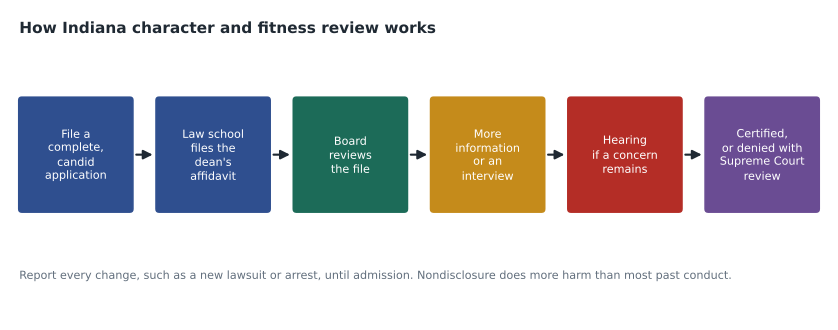
In Indiana, the Board of Law Examiners decides character and fitness. The application itself is the core of the review: it asks about criminal history, civil litigation, financial problems, academic discipline, employment history and other matters. The dean's affidavit required by Rule 15 adds the law school's view. Applicants may also be interviewed, and the Board can ask for more information, documents or a hearing when something in the file needs explaining. The details of the interview process are set by the Board's procedures, so applicants should follow the instructions they receive from ACE.
What the Board looks at
Boards across the country look at similar kinds of conduct: unlawful conduct, academic misconduct, false statements, neglect of financial obligations, violation of court orders, and evidence of mental or emotional conditions or substance use that currently impairs the ability to practice. They weigh how serious the conduct was, how recent, how old the applicant was, whether it was a pattern, and what the applicant has done since. Rehabilitation counts: completing a treatment program, paying debts, making restitution and a clean record since the incident all matter.
Candor matters most. The most damaging thing an applicant can do is fail to disclose something the application asks about. An omission, even of something minor, can be treated as a false statement, which goes directly to honesty, the trait the review exists to test. Hannah's expunged citation illustrates the point: many bar applications ask applicants to disclose matters even if they were expunged or sealed, so an applicant should read each question carefully and disclose what it asks for, with an explanation.
Keeping the file current
An application is not a snapshot. Applicants have a continuing duty to update their answers until they are admitted. A new traffic case, a lawsuit, a change of address, a job change or a financial problem that arises after filing must be reported. Marchetti made Hannah set a monthly reminder to reread her answers and report anything new.
Mental health questions
Bar admission authorities have moved away from broad questions about mental health diagnosis and treatment, toward questions about current conduct and current impairment. The concern is that broad questions discourage applicants from seeking help. Indiana also supports lawyers and law students through the Judges and Lawyers Assistance Program, which offers confidential help with substance use, mental health and stress. Marchetti told Hannah that getting help is a sign of the judgment the review is looking for, not a red flag.
Worked problem
Disclosing an old matter
Hannah's application asks whether she has ever been cited, arrested or charged with any offense, including matters expunged or dismissed. Her underage drinking citation was resolved by diversion and expunged.
Show solution
- Read the question literally: it asks about matters that were expunged or dismissed.
- Disclose the citation with the date, the court and the outcome.
- Explain briefly what happened and what she has done since, such as a clean record and her academic and employment history.
- Attach court records if available, and keep a copy of what she filed.
Answer: Hannah discloses the citation with records and a short explanation. A single minor matter years ago, fully disclosed, is unlikely to prevent certification; hiding it could.
The MPRE
Indiana, like almost every US jurisdiction, requires applicants to pass the Multistate Professional Responsibility Examination. The MPRE is written by NCBE and tests knowledge of the rules governing lawyers' conduct, mainly the ABA Model Rules of Professional Conduct and the ABA Model Code of Judicial Conduct, along with controlling law on topics like the attorney-client privilege. It is a two-hour, 60-question multiple-choice exam given at Pearson VUE test centers several times a year, separately from the bar exam.
Indiana's minimum scaled MPRE score is 80, on NCBE's scale of 50 to 150. The rules also set a time window within which the passing score must be earned relative to the bar exam; bar preparation providers describe it as within two years before or after passing the bar exam. Because the window matters and the rules can change, applicants should confirm it with the current Admission and Discipline Rules or ACE. Scores are reported to Indiana by NCBE when the applicant requests it.
| Item | Indiana requirement |
|---|---|
| Minimum MPRE scaled score | 80 |
| Score scale | 50 to 150 |
| Format | 60 questions, 2 hours, at Pearson VUE test centers |
| Timing | Earned within the window set by the rules; confirm with ACE |
| Where it is reported | NCBE sends the score to Indiana at the applicant's request |
Hannah took the MPRE in November 2026 and was waiting for her score. Marchetti's advice for anyone in that position was simple: plan to retake it in the spring if needed, because the score must be in before admission, and a February bar pass does not help without it. Lesson 10 covers how Indiana's Rules of Professional Conduct differ from the Model Rules the MPRE tests.
Common mistakes
MistakeLeaving out an expunged or dismissed matter because it no longer appears on a record.
InsteadRead each question literally. If it asks about expunged or dismissed matters, disclose them with an explanation.
MistakeTreating the application as finished once filed.
InsteadApplicants must update their answers until admission, including new legal, financial and employment matters.
MistakeAssuming the MPRE is part of the bar exam.
InsteadIt is a separate exam at Pearson VUE centers, and Indiana requires a scaled score of at least 80.
MistakeThinking that seeking treatment will count against you.
InsteadQuestions focus on current conduct and impairment, and getting help shows the judgment the review values.
Practice problems
Work each problem on paper first, then reveal the answer to check.
Who decides character and fitness in Indiana?
Show answer
The State Board of Law Examiners, with review by the Indiana Supreme Court.
What is Indiana's minimum MPRE score?
Show answer
A scaled score of 80.
What does the duty to update require?
Show answer
Reporting new matters, such as legal, financial or employment changes, until admission.
Which two 1957 Supreme Court cases limit how states may deny admission on character grounds?
Show answer
Schware v. Board of Bar Examiners and Konigsberg v. State Bar.
How the MPRE is built
The MPRE is a two-hour, computer-based exam of 60 multiple-choice questions, of which 50 are scored and 10 are unscored pretest questions mixed in with the rest. NCBE offers it three times a year, usually in March, August and November, at Pearson VUE test centers. Scores are reported on a scale of 50 to 150. Because each jurisdiction sets its own minimum, the same score can pass in one state and fail in another; Indiana's minimum is 80.
The questions are based on the ABA Model Rules of Professional Conduct, the ABA Model Code of Judicial Conduct, and generally accepted principles from leading cases and the law governing lawyers, such as the rules on malpractice and the attorney-client privilege. The largest areas are conflicts of interest and the client-lawyer relationship, followed by confidentiality, competence and fees, litigation and other forms of advocacy, the regulation of the profession, and communications about legal services. A small part of the exam covers judicial conduct.
A few habits help on the MPRE. Read the call of the question carefully, because the exam often asks whether conduct is proper, subject to discipline, or might expose the lawyer to civil liability, and those are different questions. Watch the verbs in the answer choices: must, may and may not have different meanings under the rules. And remember that the MPRE tests the Model Rules, not Indiana's version, so an Indiana variation should not change an MPRE answer.
| MPRE area | Typical issues |
|---|---|
| Client-lawyer relationship | Scope of representation, decision-making, terminating representation |
| Conflicts of interest | Current and former clients, business transactions with clients, imputation |
| Confidentiality | Rule 1.6 and its exceptions; the attorney-client privilege and work product |
| Competence, fees and malpractice | Reasonable fees, contingent fees, fee sharing, civil liability |
| Litigation and advocacy | Candor to the tribunal, fairness to opposing parties, trial publicity |
| Regulation of the profession | Admission, unauthorized practice, reporting misconduct, discipline |
| Communications about services | Advertising and solicitation |
| Judicial conduct | Impartiality, disqualification, gifts and political activity |
Preparing for the MPRE
Most candidates prepare in two to four weeks, often with a free or low-cost commercial course and NCBE's own practice exams. Marchetti suggests learning the conflicts rules first, because they are the largest area and because conflicts questions build on each other: once a candidate understands current-client conflicts under Rule 1.7, the rules on former clients, imputation and prospective clients make more sense. She also has candidates make a one-page chart of when Rule 1.6 permits disclosure, since confidentiality exceptions come up in many forms.
Timing matters as much as content. Indiana requires a passing MPRE score before admission, and scores are valid for a limited period under the Board's rules, so candidates should check the window that applies to them. A candidate who takes the MPRE in law school and passes is finished with it; a candidate who waits until after the bar exam can delay admission if the score comes in low. Hannah's November attempt left room for a March retake before any February pass could lead to admission.
Common character and fitness issues
Most applicants have nothing more than a traffic ticket or two to report. When more serious issues come up, they tend to fall into a few groups. Financial issues include unpaid debts in collection, defaulted student loans and tax problems. Conduct issues include criminal matters, including alcohol-related offenses, and academic discipline such as plagiarism. Candor issues arise when an applicant omits something or gives an answer that conflicts with records. And some applicants have prior professional discipline in another field, such as a revoked license.
For each type of issue, the Board looks at the same questions: what happened, how long ago, how the applicant has behaved since, and whether the applicant is open about it now. Evidence of rehabilitation can include completing a sentence or program, repaying debts or making a payment plan, steady employment, letters from people who know the applicant well, and treatment where relevant. An applicant who has a financial problem in progress should show a realistic plan and evidence of following it.
Writing an explanation
Many applications ask for a written explanation of any matter disclosed. Marchetti gave Hannah a simple structure. Start with the facts, plainly and without minimizing: what happened, when and where. State the outcome, with dates and documents. Then say briefly what the applicant learned or changed, without overstating it. Keep the tone factual rather than defensive, and attach the records the application requests. An explanation that matches the records and accepts responsibility reads very differently from one that blames others or leaves gaps for the reader to fill.
Hannah's explanation of her college citation ran to four sentences: the date and place, the diversion program she completed, the expungement order, and a sentence saying that she had not had any similar issue since. She attached the diversion completion letter and the expungement order. Marchetti said that was exactly the right length.
Help is available
Indiana's Judges and Lawyers Assistance Program offers confidential help to law students, bar applicants, lawyers and judges dealing with substance use, mental health or other stresses. Seeking help is not something the Board penalizes; the current trend in bar admission is to focus on present conduct and fitness rather than on whether someone has sought treatment. Marchetti mentioned the program to every group she taught, because bar study is stressful and the first years of practice can be harder.
Summary and key terms
- The Board of Law Examiners decides character and fitness, using the application, the dean's affidavit and any interview or hearing.
- Candor is the most important factor; omissions can be treated as false statements.
- Applicants must keep their answers current until admission.
- Indiana requires an MPRE scaled score of at least 80, earned within the window the rules set.
- The Judges and Lawyers Assistance Program offers confidential help to law students and lawyers.
- Character and fitness
- The review of whether an applicant's conduct shows they can be trusted to practice law.
- Duty to update
- The continuing obligation to report changes to application answers until admission.
- MPRE
- The Multistate Professional Responsibility Examination, written by NCBE.
- Rehabilitation
- Evidence that an applicant has addressed past conduct, such as treatment, restitution and a clean record.
Lesson quiz · 5 questions
Score 60% or more to complete this lesson.
Create a free account to save your progress, take quizzes and earn a certificate.