
BAR-215 · Lesson 9 of 12 · 19 min
Indiana family law, wills and estates
▶ Video coming soon A video version of this lesson is on the way.
Hannah's firm is a general practice, which means that between the injury cases come divorces, custody disputes, simple wills and the estates of clients who have died. Family law and wills, trusts and estates are both modules of the Indiana Law Course, and both left the MEE in July 2026, so a new Indiana lawyer may meet them for the first time in a client meeting. Marchetti used this lesson to give Hannah a working map. Section references are to the Indiana Code; check the current text before relying on a detail.
Ending a marriage
Indiana's Dissolution of Marriage Act, in Indiana Code article 31-15, provides for no-fault divorce. The most common ground is that the marriage has suffered an irretrievable breakdown; the statute lists a few other grounds, such as a felony conviction after the marriage, that are rarely used. A dissolution cannot be finalized until a statutory waiting period after filing has passed. Indiana also allows legal separation for a limited period when the parties want time apart without dissolving the marriage.
Indiana abolished common law marriage for marriages entered after 1958, so a couple who live together in Indiana without a license and ceremony are not married under Indiana law, however long they stay together. Indiana will, however, generally recognize a common law marriage validly formed in a state that allows it.
Dividing property
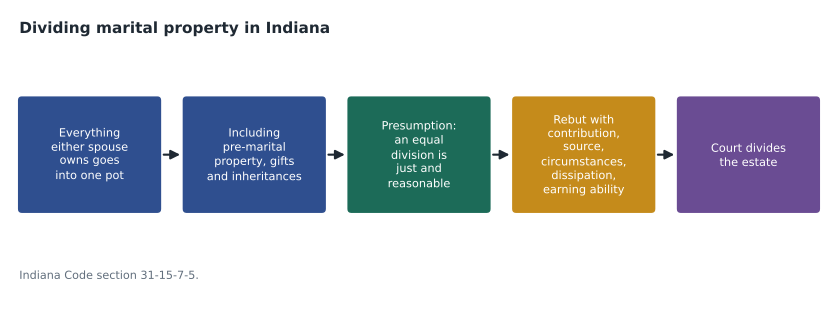
Indiana divides marital property under a one-pot approach. Everything either spouse owns, whether acquired before or during the marriage and however titled, generally goes into the marital estate. The court then starts from a statutory presumption that an equal division is just and reasonable, under section 31-15-7-5. A party can rebut the presumption with evidence about matters such as each spouse's contribution to acquiring property, whether property was acquired before the marriage or by gift or inheritance, the economic circumstances of each spouse, conduct related to the disposition or dissipation of property, and earning ability.
This differs from the approach of separate-property and community-property states that set aside property owned before marriage. In Indiana, pre-marital and inherited property start in the pot, and the source of the property becomes an argument for an unequal division rather than an automatic exclusion.
Children: custody, parenting time and support
Custody decisions follow the best interests of the child, using statutory factors that include the child's age and sex, the wishes of the parents and, depending on age, the child, the child's relationships with family members, adjustment to home, school and community, the mental and physical health of those involved, and evidence of family or domestic violence. Indiana courts can award joint legal custody, giving both parents a role in major decisions, separately from where the child primarily lives.
Indiana has two sets of statewide guidelines that a new family lawyer uses constantly. The Indiana Parenting Time Guidelines, adopted by the Indiana Supreme Court, set a default schedule for the parent who does not have primary physical custody, along with rules on communication, holidays and travel. The Indiana Child Support Guidelines use an income shares model: the court estimates what the parents would spend on the child if they lived together, based on their combined income, then divides that amount in proportion to each parent's income, with adjustments for parenting time and other costs. The guidelines produce a presumptive amount that a court can depart from only with written reasons.
Making a will
The Indiana Probate Code, in Indiana Code title 29, governs wills and estates. An Indiana will generally must be in writing, signed by the testator, and signed by two witnesses in the testator's presence. Indiana allows a self-proving clause, in which the testator and witnesses sign a statement that the will was properly executed, which makes probate simpler. Indiana was one of the early states to authorize electronic wills, signed and witnessed electronically, under statutes adopted in 2018. A handwritten will that is not witnessed does not meet Indiana's formal requirements, so an unwitnessed holographic will should not be relied on.
When there is no will
If a person dies without a valid will, Indiana's intestacy statute decides who inherits. A surviving spouse's share depends on who else survives: the spouse takes a larger share if the decedent left no descendants or parents, and a smaller share if there are children. Special rules reduce the share of a second or later spouse who had no children with the decedent, in some circumstances. Because the details turn on the family structure, a new lawyer should work through the statute for each estate rather than rely on a summary.
A surviving spouse who is unhappy with a will can usually elect to take against it instead, receiving a statutory share of the estate in place of what the will provides. The elective share is generally one half of the net estate, again with a reduction for a later spouse who had no children with the decedent when the decedent left children from an earlier marriage.
| Situation | Indiana rule in outline |
|---|---|
| Formal will | In writing, signed by the testator and two witnesses in the testator's presence; self-proving clause available |
| Electronic will | Authorized by statute since 2018 |
| Unwitnessed handwritten will | Does not meet the formal requirements |
| No will | Intestacy statute; spouse's share depends on surviving descendants and parents |
| Spouse disinherited | May elect against the will, generally for one half of the net estate, reduced for some later spouses |
Settling an estate
Most Indiana estates are opened in the probate division of the trial court in the county where the decedent lived. Indiana allows unsupervised administration, in which the personal representative settles the estate with less court involvement, when the estate is solvent, the heirs or beneficiaries consent and other conditions are met; otherwise the estate is administered under court supervision. Small estates below a statutory value can often be collected by affidavit without opening an estate at all, and Indiana's Transfer on Death Property Act lets owners name beneficiaries for many kinds of property, which then pass outside probate.
Worked problem
A client's first estate meeting
A widow comes to Hannah's firm after her husband's death. He had a will, typed and signed, but only one witness signed it. They have two adult children together. Their house was titled jointly with survivorship.
Show solution
- A will with only one witness does not meet Indiana's two-witness requirement, so its validity must be examined; if it fails, intestacy applies.
- The jointly titled house with survivorship passes to her outside probate.
- Under intestacy, with children of the marriage, she takes a spouse's share and the children take the rest; the statute must be checked for the exact fractions.
- Depending on the value of the probate estate, a small estate affidavit or an unsupervised administration may be available.
Answer: Hannah flags the defective will, confirms the house passes outside probate, and works through intestacy and the right administration route.
Common mistakes
MistakeExcluding a spouse's pre-marital property automatically.
InsteadIndiana puts all property in one pot and presumes an equal division; the source of property is an argument for deviation.
MistakeTreating a couple who have lived together for years in Indiana as married.
InsteadIndiana abolished common law marriage after 1958, though it may recognize one validly formed elsewhere.
MistakeRelying on an unwitnessed handwritten will.
InsteadIndiana requires two witnesses for a formal will.
MistakeCalculating child support from instinct.
InsteadUse the Indiana Child Support Guidelines, which produce a presumptive income shares amount.
Practice problems
Work each problem on paper first, then reveal the answer to check.
What presumption applies to dividing marital property in Indiana?
Show answer
That an equal division is just and reasonable, under section 31-15-7-5.
What model do the Indiana Child Support Guidelines use?
Show answer
An income shares model.
How many witnesses does a formal Indiana will require?
Show answer
Two.
Name one way property can pass outside probate in Indiana.
Show answer
A transfer on death designation, joint ownership with survivorship, or a payable-on-death account.
How a dissolution case moves
A dissolution case begins with a petition filed in the county where one of the spouses meets the statute's residence requirements. The other spouse is served and may respond, and the court can issue provisional orders while the case is pending, covering matters such as temporary custody, parenting time, child support, use of the home and payment of bills. Indiana requires a waiting period of 60 days after filing before a final decree can be entered, so even an agreed case takes at least two months.
Most dissolution cases settle. The parties, usually with lawyers and often with a mediator, reach a written settlement agreement covering property, debts, custody, parenting time and support, and the court reviews it and incorporates it into the decree. Cases that do not settle go to a final hearing, where the judge decides the contested issues. Many counties require mediation before a contested final hearing in cases involving children, and parents may be required to attend a co-parenting class.
Spousal maintenance
Indiana is relatively restrictive about spousal maintenance. The statute allows maintenance in limited situations: when a spouse is physically or mentally incapacitated to the extent that the ability to support himself or herself is materially affected; when a spouse lacks sufficient property to provide for his or her needs and is the custodian of a child whose incapacity requires the custodian to forgo employment; and as rehabilitative maintenance for a limited period, which the statute caps at three years, to help a spouse obtain education or training. Outside those situations, the parties can agree to maintenance in a settlement, but the court generally cannot order it. This often surprises clients who have heard about alimony in other states.
Modification
Orders about children can be modified as circumstances change. Custody modification requires a showing that modification is in the child's best interests and that there has been a substantial change in one or more of the statutory factors. Child support can be modified on a showing of a substantial and continuing change in circumstances, and the statute treats certain differences between the existing order and the guideline amount, after a period of time, as enough to support a request. Property divisions, by contrast, are generally final and cannot be modified later except in narrow circumstances such as fraud. A new lawyer should explain this difference to clients before they sign a settlement.
| Order | Can it be modified? |
|---|---|
| Custody | Yes, if in the child's best interests and there is a substantial change in a statutory factor |
| Parenting time | Yes, when modification would serve the child's best interests |
| Child support | Yes, on a substantial and continuing change, or as the statute otherwise provides |
| Property division | Generally no, except in narrow circumstances such as fraud |
| Maintenance | Court-ordered maintenance may be modified on changed circumstances; agreed maintenance depends on the agreement |
Probate deadlines
Once an estate is opened, the personal representative must give notice to creditors, including publication and notice to known or reasonably ascertainable creditors. Creditors generally must file claims within three months after the first publication of notice, and claims not filed within nine months after the decedent's death are generally barred regardless of notice. The personal representative also must prepare an inventory, manage estate property, pay valid claims and expenses, and eventually close the estate with an accounting or a closing statement, depending on the type of administration.
A will contest has its own short deadline. Under the Probate Code, a person who wants to contest the validity of a will generally must file within three months after the court admits the will to probate. A new lawyer who meets a family member upset about a will should check that deadline immediately.
Trusts
Indiana trusts are governed by the Indiana Trust Code, in Indiana Code article 30-4. Revocable living trusts are common estate planning tools in Indiana, because property in a funded trust passes to beneficiaries without probate. A lawyer who drafts a trust must also make sure it is funded, meaning that the client's property is actually retitled to the trust; an unfunded trust does little. Trustees owe fiduciary duties of loyalty and prudence, and beneficiaries can bring proceedings in the probate court to enforce them.
A first family law meeting
Marchetti closed with a checklist for a first meeting with a client considering dissolution. Confirm that the residence requirements are met and identify the county. Ask about safety and any history of domestic violence, which affects both custody and protective orders. List every asset and debt, however and whenever acquired, because all of it goes into the pot. Gather income information for both spouses for the child support guidelines. Explain the 60-day waiting period, the presumption of equal division and the limits on maintenance. And explain the cost and the process honestly, including mediation. Hannah noticed that every item on the list came from an Indiana statute or rule, which was exactly Marchetti's point.
Summary and key terms
- Indiana allows no-fault dissolution for irretrievable breakdown and abolished common law marriage after 1958.
- All property goes into one pot, and an equal division is presumed just and reasonable.
- Custody follows the best interests of the child; the Parenting Time and Child Support Guidelines set defaults.
- Formal wills need the testator's signature and two witnesses; electronic wills are authorized.
- Intestacy, the elective share and the choice between supervised and unsupervised administration shape most estates.
- One-pot approach
- Indiana's practice of putting all spousal property into the marital estate before dividing it.
- Income shares model
- A child support method dividing the child's estimated costs by the parents' incomes.
- Elective share
- A surviving spouse's right to take a statutory share instead of what the will provides.
- Unsupervised administration
- Settling an estate with limited court involvement when conditions are met.
Lesson quiz · 5 questions
Score 60% or more to complete this lesson.
Create a free account to save your progress, take quizzes and earn a certificate.