
BAR-215 · Lesson 12 of 12 · 20 min
Capstone: Indiana practice questions and an exam-day plan
▶ Video coming soon A video version of this lesson is on the way.
At the last session before the holidays, Marchetti gave Hannah the capstone: a set of original questions on Indiana admission and Indiana law, a short practice problem written in essay form, and a final task, an exam-day plan for February. 'The questions check that the Indiana side is solid,' Marchetti said. 'The plan checks that you will actually get through two days in February without a surprise.' This lesson works through the same capstone. The questions are original and do not come from any bar exam. Try each one before reading the answer.
Part one: admission questions
Question 1. A May 2026 graduate of an ABA-approved law school files for the February 2027 Indiana exam on November 28, 2026. What deadline and fee apply? Answer: November 28 falls after the November 15 regular deadline but within the late window ending November 30, so the application is timely if filed by November 30 with the 500 dollar late fee.
Question 2. A candidate scored 263 on the July 2026 Indiana UBE. Did she pass, and could the score transfer to Alabama? Answer: She did not pass in Indiana, which requires 264. Alabama's passing score is 260, so her 263 could support an Alabama application on a transferred score, subject to Alabama's rules and time limits.
Question 3. A lawyer admitted in Indiana on a transferred Illinois UBE score in March 2027 asks when she must finish the Indiana Law Course and whether it counts toward CLE. Answer: Within six months after admission, so by September 2027; it does not count toward annual CLE.
Question 4. A candidate plans to sit for the first time in February 2028 and asks what a failure would mean. Answer: February 2028 is the last legacy UBE in Indiana; a July 2028 retake would be the NextGen exam, with a 614 passing score on a 500 to 750 scale.
Question 5. An applicant who graduated from a California-accredited law school that is not ABA-approved, and who is eligible to sit in California, wants to sit in Indiana. Answer: She does not meet the standard ABA-approved requirement of Rule 13, but since August 1, 2026, she may petition for a Rule 13.1 waiver, paying the nonrefundable 250 dollar fee; the Board decides, subject to the Supreme Court's final approval, and the waiver applies only to that application.
Part two: Indiana law questions
Question 6. A defendant in an Indiana state court moves for summary judgment, arguing only that the plaintiff has produced no evidence of causation. Is that enough? Answer: Not under Hughley v. State. Indiana does not follow the federal Celotex approach; the movant must affirmatively negate an element of the claim or show that no genuine issue of material fact exists.
Question 7. A jury finds a plaintiff 52 percent at fault in a car crash with a private driver. What does she recover? Answer: Nothing. Under the Comparative Fault Act, a claimant whose fault exceeds 50 percent is barred.
Question 8. The same plaintiff, 10 percent at fault, was injured by a city snowplow. Does the Comparative Fault Act apply? Answer: No. The Act does not apply to governmental entities, so contributory negligence could bar her claim entirely. She also must have given written Tort Claims Act notice to the city within 180 days after the loss.
Question 9. A patient wants to sue a qualified health care provider for 400,000 dollars for malpractice in 2025. What must happen first, and what cap applies? Answer: Because the claim exceeds 15,000 dollars, a proposed complaint must first be filed with the Department of Insurance and reviewed by a medical review panel. For an act after June 30, 2019, total recovery is capped at 1.8 million dollars and the provider pays at most 500,000 dollars, so the cap is not a practical limit here.
Question 10. In a dissolution, a husband argues that a farm he inherited before the marriage should be excluded from the marital estate. Answer: In Indiana the farm goes into the marital pot. The presumption is an equal division, but he can argue that the inheritance justifies an unequal division in his favor.
Question 11. A will is signed by the testator and one witness. Is it valid in Indiana? Answer: Not as a formal will; Indiana requires two witnesses. Unless another statutory path saves it, the estate may pass by intestacy.
Question 12. Police in Indiana obtain consent to search from a suspect in custody without advising him of his right to counsel. What Indiana argument is available? Answer: The Pirtle doctrine, which generally requires that a person in custody be advised of the right to consult counsel before consenting to a search, along with an Article 1, Section 11 argument under Litchfield.
Part three: a practice problem
Facts. Rosalind Ashby, a delivery driver, slipped on ice in the parking lot of the Morgan County Highway Department garage on January 10, 2026, while dropping off a package. She broke her wrist and missed eight weeks of work. She was wearing ordinary sneakers rather than her employer-issued boots. She first consulted a lawyer on September 1, 2026, and no notice of any kind has been sent to the county. Discuss the issues a new Indiana lawyer should identify.
Model analysis. First, the defendant is a political subdivision, so the Indiana Tort Claims Act applies. Written notice was due within 180 days after the loss, which ran in early July 2026. Because no notice was sent, the claim faces a likely bar unless an exception to the notice requirement applies, and the lawyer must research whether any exception or doctrine of substantial compliance could help. Second, the Tort Claims Act lists immunities, and the lawyer must check whether any immunity applies to the condition of the lot or to snow and ice in these circumstances. Third, because the defendant is a governmental entity, the Comparative Fault Act does not apply, and contributory negligence could bar recovery if her choice of footwear is found to be negligent. Fourth, even a successful claim would be subject to the Act's damages caps and the bar on punitive damages. Finally, the ordinary two-year limitation period has not run, but it does not help if the notice requirement bars the claim. A careful lawyer would explain all of this to Ms. Ashby candidly, research the notice exceptions immediately, and document the advice.
What made the problem hard? None of the issues is a general bar exam issue. Every one is an Indiana rule. That is exactly why Indiana requires the Indiana Law Course after admission.
Part four: an exam-day plan
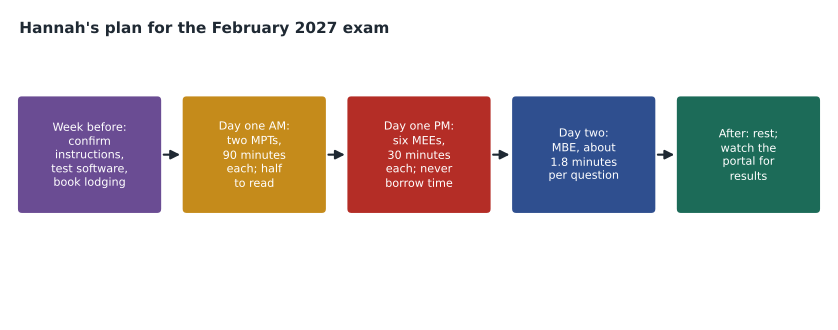
Marchetti's last assignment was a plan for February 2027. Hannah's version had five parts. Before the week: confirm the exam location and time from the Board's instructions, test her laptop software, review the allowed and prohibited items lists, and book a hotel near the site for both nights. Day one: arrive early, eat a real breakfast, take the two MPTs in the morning with half the time on reading and organizing, then the six MEEs in the afternoon at 30 minutes each, never borrowing time. Day two: the MBE, 100 questions per three-hour session, about 1.8 minutes per question, marking and moving on. Between sessions: no discussing answers. After the exam: rest, then return to work and check the Board's portal for results.
Worked problem
Pacing the MBE
Hannah wants a pacing check for each MBE session of 100 questions in three hours.
Show solution
- Three hours is 180 minutes.
- 180 minutes divided by 100 questions is 1.8 minutes per question.
- At the halfway point, 90 minutes, she should be near question 50.
- If she is behind, she marks hard questions, chooses her best answer and moves on, returning if time remains.
Answer: About 1.8 minutes per question, with a checkpoint at question 50 by 90 minutes.
Common mistakes
MistakeStudying the capstone's Indiana rules for the February exam.
InsteadThey are for practice and the Indiana Law Course; the exam tests the general rule.
MistakeSpending extra time on one MEE question.
InsteadKeep to 30 minutes per question; borrowed time comes out of the next answer.
MistakeIgnoring the Board's instructions until the night before.
InsteadRead the allowed and prohibited items lists and test software weeks ahead.
MistakeTreating a government defendant like any other.
InsteadCheck Tort Claims Act notice, immunities and contributory negligence on day one.
Practice problems
Work each problem on paper first, then reveal the answer to check.
What is the first issue in a slip on ice at a county garage?
Show answer
Tort Claims Act notice to the political subdivision within 180 days.
How many minutes per MBE question is the pace?
Show answer
About 1.8 minutes.
Why does contributory negligence matter in the Ashby problem?
Show answer
The Comparative Fault Act does not apply to governmental entities.
What is the last legacy UBE in Indiana?
Show answer
February 2028.
Scoring the capstone
Hannah worked through the twelve questions in about forty minutes and got ten right. She missed the question about a Rule 13.1 waiver, because she had forgotten that a waiver applies only to the application it is granted for, and the question about the Pirtle doctrine, because she had remembered Section 11 but not the separate rule for consent from a person in custody. Marchetti told her that ten of twelve was a good result for material that would not be on her exam, and that the two misses showed exactly what to review in the Indiana Law Course after admission.
For the exam itself, Marchetti uses a different measure. She wants candidates scoring consistently in a comfortable range on timed MBE practice in the final month, writing complete essays in 30 minutes, and finishing MPTs with the required format. A candidate who is short of those targets three weeks out should shift time from review to practice, because practice under time is what moves scores at that stage.
A second practice problem
Marchetti added a second, shorter problem for the group, again entirely original and based on Indiana law.
Facts. Thomas Greer had knee surgery at a Bloomington hospital in March 2024. The surgeon, a qualified health care provider under the Medical Malpractice Act, left a surgical sponge in the knee, which was discovered and removed in a second surgery in September 2024. Mr. Greer's medical bills and lost wages total about 60,000 dollars, and he wants to sue the surgeon and the hospital. He comes to Hannah's firm in November 2026. Identify the issues.
Model analysis. First, the claim is against qualified providers, so the Medical Malpractice Act applies. Because the claim seeks more than 15,000 dollars, a proposed complaint must be filed with the Department of Insurance and reviewed by a medical review panel before suit, unless the parties agree otherwise as the statute allows. Second, timing: the Act measures the limitation period from the date of the act of malpractice, generally two years, so a claim based on the March 2024 surgery faced a deadline around March 2026. The firm must research whether any doctrine, such as the rules Indiana courts apply when a patient could not reasonably have discovered the malpractice within the period, could save a claim filed now, and must not assume the claim is lost or alive without that research. Third, the cap: the act occurred after June 30, 2019, so the 1.8 million dollar total cap applies, with the provider liable for no more than 500,000 dollars, which is far above the likely damages here. Fourth, the Comparative Fault Act and its nonparty defense may matter if fault is shared among the surgeon, the hospital and others. A careful lawyer would act quickly, research the limitation issue that day, and document the advice given.
The point of the problem, Marchetti said, is that the most important issue is often a deadline. Hannah's sticky note with its two questions, who is the defendant and when did it happen, identified the key issues in under a minute.
The last week before the exam
The final week is about rest and confidence, not new material. Marchetti's plan for Hannah was light: a short set of MBE questions each morning to stay sharp, one essay early in the week, a review of her one-page rule summaries, and no studying the evening before the exam. Hannah would confirm her exam-day instructions, pack the approved items the night before, check her laptop software one last time, and plan her route to the site. Marchetti also told her to sleep and eat normally, because candidates who stay up late cramming tend to perform worse on the MBE the next day.
During the exam, Marchetti's advice was to treat each session as a fresh start. A hard MPT does not predict a bad essay session, and a difficult MBE morning does not predict the afternoon. Candidates who dwell on one section lose focus on the next. Between sessions and between days, Hannah planned to avoid talking about the questions with other candidates, eat something, and get outside for a few minutes.
After the exam
Results take time. While she waits, Hannah will keep her character and fitness information current, watch her MPRE score, and go back to work at the firm. If she passes, the Board will certify her for admission, and she will take the oath and begin the steps in Lesson 11: registration, the trust account, the Indiana Law Course within six months, and CLE from the following January. If she does not pass, she will read her score report closely, decide whether to sit in July 2027, and build a plan around the part of the exam that cost her the most, with two legacy retakes still available before the switch to NextGen.
Marchetti's last words to the group were about the profession rather than the exam. The bar exam measures minimum competence on one day; the Indiana Law Course, CLE and the first years of practice build the rest. Hannah left the session with a schedule for the next twelve weeks, a sticky note on her monitor, and a notebook of Indiana rules waiting for the day she would need them.
Summary and key terms
- The capstone tests Indiana admission rules: deadlines, scores, transfer, the Indiana Law Course, NextGen timing and waivers.
- It also tests the Indiana law a new lawyer meets first: Hughley, comparative fault, Tort Claims Act notice, malpractice, property division, wills and Section 11.
- Government defendants require immediate attention to notice, immunities and contributory negligence.
- An exam-day plan covers logistics, pacing of MPTs and MEEs, and MBE pacing of about 1.8 minutes per question.
- Indiana law is for practice; the exam tests general rules.
- Capstone
- A final exercise drawing on the whole course.
- Substantial compliance
- An argument that notice served its purpose despite a technical defect.
- Pacing checkpoint
- A planned point to compare progress with time used.
- Exam-day plan
- A written plan for logistics and timing on both days of the bar exam.
Lesson quiz · 5 questions
Score 60% or more to complete this lesson.
Create a free account to save your progress, take quizzes and earn a certificate.