
BAR-215 · Lesson 4 of 12 · 18 min
The Indiana bar exam: the UBE, scoring and the 264 passing score
▶ Video coming soon A video version of this lesson is on the way.
In early November, Marchetti gave Hannah a blank page and asked her to draw the exam: two days, what happens on each, how long each part takes, how each part counts. Hannah got most of it right, but she had the weights wrong and did not know how the written answers were scaled. 'Strategy starts with the scoring,' Marchetti said. 'If you don't know what counts, you can't decide where to spend your time.' This lesson explains the exam Indiana gives through February 2028, how it is scored and what it takes to pass.
Indiana and the Uniform Bar Examination
Indiana gives the Uniform Bar Examination. According to NCBE's jurisdiction information, Indiana first administered the UBE in July 2021, replacing its earlier exam with its own essay questions. The UBE is a set of three NCBE components given in the same way in every UBE jurisdiction, so a score earned in Indiana is a portable UBE score that other UBE jurisdictions can accept, subject to their own rules. Indiana will keep giving this legacy UBE through February 2028 and switch to the NextGen bar exam in July 2028, as Lesson 5 explains.
Day one: the written components
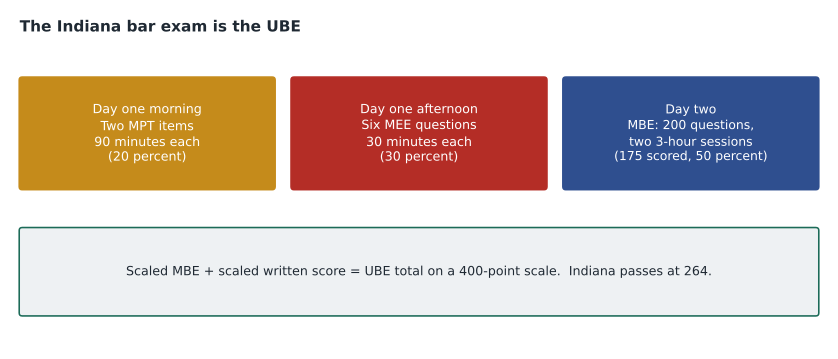
The first day holds the written parts. In the morning session, candidates answer two Multistate Performance Test items, 90 minutes each. An MPT gives the candidate a file of facts and a library of law and asks for a practical document, such as an objective memo, a persuasive brief or a client letter. In the afternoon, candidates answer six Multistate Essay Examination questions, 30 minutes each. MEE questions test the ability to identify issues and apply general legal principles to a set of facts.
Starting with the July 2026 exam, NCBE removed four subjects from the MEE: conflict of laws, family law, trusts and estates, and secured transactions. The Indiana Board posted this change for its candidates. Family law and trusts and estates may still appear on the MPT through February 2028, with the relevant law supplied in the library. So Hannah's February 2027 essays will draw on the remaining MEE subjects, mainly the MBE subjects plus business associations, while the MPT may give her a family or estates problem with the law provided.
Day two: the MBE
The second day is the Multistate Bar Examination: 200 multiple-choice questions in two three-hour sessions of 100 questions each. Of the 200, 175 are scored and 25 are unscored pretest questions that candidates cannot identify. The MBE covers seven subjects: civil procedure, constitutional law, contracts, criminal law and procedure, evidence, real property and torts.
How the score is built
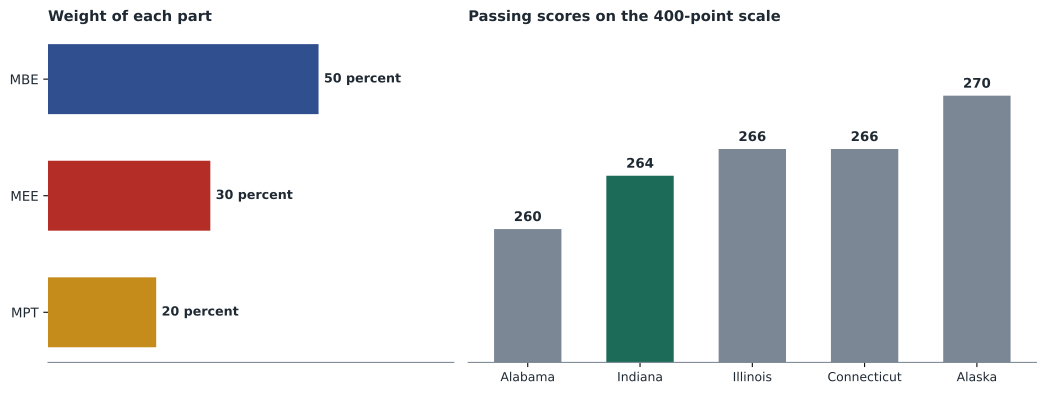
The UBE score is reported on a 400-point scale. The MBE counts for 50 percent of the total, the MEE for 30 percent and the MPT for 20 percent. Indiana describes its passing requirement as a total scaled score of 264 or higher.
Scaling explains how answers written by different graders at different administrations can be compared. The MBE is equated by NCBE so that a given scaled score means the same level of performance across administrations, even if one exam was slightly harder than another. Raw essay and MPT grades are then scaled to the MBE score distribution of the candidates in the jurisdiction. The written score is therefore anchored to MBE performance, which is why candidates who do well on the MBE tend to do well overall, and why a weak MBE score is hard to make up on the written portion alone.
| Component | Questions and time | Weight in the UBE score |
|---|---|---|
| MBE | 200 multiple-choice questions, 6 hours, 175 scored | 50 percent |
| MEE | 6 essays, 30 minutes each | 30 percent |
| MPT | 2 tasks, 90 minutes each | 20 percent |
| Total | Reported on a 400-point scale | Indiana passing score: 264 |
Where 264 sits
UBE jurisdictions set their own passing scores within a range from 260 to 270. Indiana's 264 is toward the lower middle of that range: Alabama passes at 260, Illinois and Connecticut at 266, and Alaska at 270. Because the score is portable, the passing score also matters when a candidate transfers a score: a 265 earned in Indiana passes in Indiana but would not transfer to Illinois, which requires 266. Lesson 11 returns to score transfer.
Worked problem
Reading a score report
A candidate in Hannah's group receives a total UBE score of 262 after the July 2026 Indiana exam.
Show solution
- Indiana requires a total scaled score of 264 or higher.
- A total of 262 is below 264, so the candidate did not pass in Indiana.
- The 262 is still a valid UBE score. It would pass in a jurisdiction with a 260 passing score, such as Alabama, if transferred within that jurisdiction's time limit.
- In Indiana the candidate must retake the exam, filing in the reexamination window: December 15, or December 30 with the late fee, for February 2027.
Answer: The candidate failed in Indiana with 262 and must reapply as a reexamination applicant, though the score could transfer to a 260 jurisdiction.
Exam logistics
The Board publishes instructions about allowed and prohibited items, laptop use for the written portion, check-in procedures and the exam location. Candidates should read them carefully and early, because the rules on what may be brought into the room are strict and the consequences of breaking them are serious. Candidates who need testing accommodations for a disability must request them through the Board's process, with documentation, well before the exam.
Marchetti's advice for exam logistics was practical: register any laptop requirement as soon as the Board allows, test your software, plan travel and lodging for both days, and do a full timed rehearsal of each day at least once before the exam.
Common mistakes
MistakeGiving equal study time to each part on the assumption they count equally.
InsteadThe MBE counts for 50 percent, the MEE 30 percent and the MPT 20 percent.
MistakeStudying conflict of laws and secured transactions for the MEE.
InsteadFrom July 2026, those subjects are no longer on the MEE; family law and trusts and estates may appear on the MPT with law supplied.
MistakeAssuming a passing Indiana score passes everywhere.
InsteadPassing scores differ: 264 passes in Indiana but not in a 266 or 270 jurisdiction.
MistakeTreating essay grades as independent of the MBE.
InsteadWritten scores are scaled to the MBE distribution, so MBE performance anchors the whole score.
Practice problems
Work each problem on paper first, then reveal the answer to check.
What is Indiana's UBE passing score?
Show answer
A total scaled score of 264 out of 400.
How is the UBE score weighted?
Show answer
MBE 50 percent, MEE 30 percent, MPT 20 percent.
When did Indiana first give the UBE, according to NCBE?
Show answer
July 2021.
Which subjects left the MEE starting July 2026?
Show answer
Conflict of laws, family law, trusts and estates, and secured transactions.
Working the MBE
Because the MBE is half of the score, Marchetti spends more time on it than on any other part. The pace is about 1.8 minutes per question, and the 25 pretest questions look exactly like the scored ones, so there is no point guessing which ones count. Every question deserves a real answer, and because there is no penalty for wrong answers, no question should be left blank.
Her method has four steps. Read the call of the question first, the last sentence that says what is being asked. Read the facts with that call in mind, marking the facts that trigger a rule. Predict the answer before looking at the options. Then read all four options and choose the one that matches the prediction, or the best of the four if none matches exactly. When two answers both look right, the better one usually states the rule more precisely or rests on the stronger reason.
Hannah tracks her practice results by subject and by the reason she missed each question: she did not know the rule, she knew the rule but misread the facts, or she ran out of time. Each reason has a different fix. Rule gaps call for review, misreading calls for slower reading of the call and the key facts, and timing calls for more timed sets. After two weeks, her log showed that most of her misses in evidence came from misreading whether a statement was offered for its truth, which told her exactly what to practice.
Writing an MEE answer
Each MEE answer gets about 30 minutes, and graders read many answers quickly. Marchetti teaches a plain structure. Give each issue its own heading that matches the question's call. State the rule in one or two sentences. Apply the rule to the specific facts, using them by name rather than restating the whole story. Close each issue with a one-line conclusion. An answer that reaches a different conclusion from the model answer can still earn strong credit if the analysis is sound and the rule is stated correctly.
She warns against two habits. The first is writing everything known about a subject in the hope that something matches; graders reward analysis of the issues raised, not volume. The second is skipping a question or running out of time on the sixth essay. A short answer with the right headings and rules earns points that a blank page cannot, so she tells candidates to stop at 30 minutes and move on, returning only if time remains.
Because the MEE no longer tests conflict of laws, family law, trusts and estates or secured transactions, Hannah's essay preparation focuses on the MBE subjects and business associations. Marchetti reminded her that the MBE subjects appear on the MEE in essay form, where the candidate has to state the rule rather than recognize it, so memorizing short rule statements for the core rules pays off twice.
Approaching the MPT
The MPT gives the candidate a file of facts and a library of law, and asks for a specific task, such as an objective memo, a persuasive brief, a client letter or a set of discovery requests. Everything needed is in the packet; outside knowledge is not required and can even get in the way if it contradicts the library. Marchetti's rule is to spend roughly half of the 90 minutes reading and organizing and half writing. She has candidates read the task memo first, because it says exactly what to produce and in what format, then the library, building an outline of rules, and then the file, slotting facts under each rule.
The most common MPT mistake is ignoring the instructions on format. If the supervising partner asks for a memo with a short statement of facts and no headings in the argument, that is what graders expect. Following the format is part of the skill being tested. A second mistake is spending too long on one task and rushing the other; each MPT counts the same, so each gets its full 90 minutes.
Reading a score report
Candidates who pass in Indiana generally receive a notice of passing, and candidates who fail receive score information that shows the scaled MBE score and the written scores. A failing candidate should look at which part pulled the total down. Because the MBE is half of the total, a weak MBE score usually has the largest effect, but a low written score can be fixed with practice and structure. The candidate should also compare her MPT and MEE results, since a candidate who writes well under time but misses rules needs a different plan from one who knows the rules but runs out of time.
Marchetti's group included two candidates retaking the exam. Both had failed by a few points. One had a solid MBE score and weak essays, and spent the next cycle writing two timed essays a week with feedback. The other had strong essays and a weak MBE, and spent the next cycle doing timed MBE sets and reviewing every wrong answer. Both plans came from reading the score report closely rather than simply studying harder.
A word on portability
Hannah's score will be a UBE score, and UBE scores are portable to other UBE jurisdictions within their time limits and passing scores. She does not plan to practice outside Indiana, but Marchetti pointed out that a score well above 264 gives a candidate options later, for example if a spouse takes a job in another state. A candidate who expects to transfer should check the receiving jurisdiction's passing score and score-age limit, as Lesson 11 explains.
Summary and key terms
- Indiana gives the UBE through February 2028: two MPTs and six MEEs on day one, and the MBE on day two.
- The UBE is weighted MBE 50, MEE 30 and MPT 20 percent and reported on a 400-point scale.
- Indiana requires a total scaled score of 264.
- Written scores are scaled to the MBE, which NCBE equates across administrations.
- From July 2026, four subjects left the MEE; family law and trusts and estates may still appear on the MPT with the law supplied.
- UBE
- The Uniform Bar Examination: the MBE, MEE and MPT, given uniformly and producing a portable score.
- Scaling
- Converting raw written grades to the MBE score distribution so scores are comparable.
- Equating
- NCBE's process for keeping MBE scaled scores consistent across administrations.
- Pretest questions
- The 25 unscored MBE questions used to test new items.
Lesson quiz · 5 questions
Score 60% or more to complete this lesson.
Create a free account to save your progress, take quizzes and earn a certificate.