
BAR-215 · Lesson 7 of 12 · 21 min
Indiana courts and civil procedure
▶ Video coming soon A video version of this lesson is on the way.
This lesson begins the part of the course aimed at practice rather than the exam. Marchetti put it here on purpose, after Hannah had finished her first pass through the MBE subjects. 'Nothing in the next four lessons is on your February exam,' she said. 'All of it is in the Indiana Law Course, and all of it will be on your desk.' Hannah's firm had just given her a small contract dispute to work up, so she brought real questions. This lesson covers the structure of Indiana's courts, the Indiana Rules of Trial Procedure and the procedural moments a new litigator meets first. Rule and statute numbers are given so readers can look them up; the current text always controls.
The courts
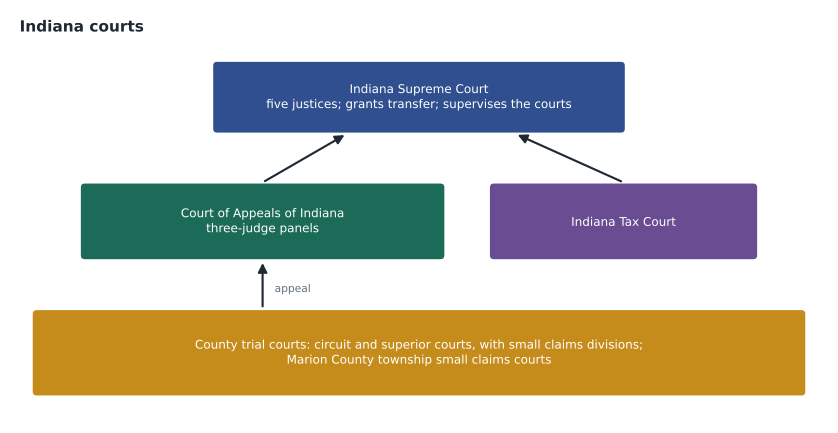
Indiana's courts are organized under Article 7 of the Indiana Constitution. The Indiana Supreme Court sits at the top, with five justices. It hears appeals in a limited set of cases directly, including certain criminal cases, and otherwise decides which cases to take by granting transfer from the Court of Appeals. It also supervises the state's courts, adopts the rules of procedure and practice, and regulates the legal profession, which is how it controls bar admission.
The Court of Appeals of Indiana hears most appeals from the trial courts. It sits in panels of three judges and is organized into geographic districts. A separate Indiana Tax Court hears appeals from final determinations of the state's tax agencies. Indiana's appellate judges are chosen through a merit selection process: a nominating commission recommends candidates, the governor appoints, and the judges then stand in retention elections.
Trial courts are organized county by county. Each county has a circuit court, and most also have one or more superior courts; both are courts of general jurisdiction, and many handle civil, criminal, family and probate matters. Some counties have specialized dockets, and small claims are handled either by small claims divisions of the trial courts or, in Marion County, by township small claims courts, each with a dollar limit set by statute. Indiana has also designated commercial courts in several counties to handle business disputes.
The Indiana Rules of Trial Procedure
Civil cases in Indiana's trial courts are governed by the Indiana Rules of Trial Procedure, usually called the Trial Rules. They were modeled on the Federal Rules of Civil Procedure, and their numbering often tracks the federal rules: Trial Rule 8 on pleading, Trial Rule 12 on defenses and motions, Trial Rule 26 through 37 on discovery, and Trial Rule 56 on summary judgment. Because of the shared structure, federal cases are sometimes persuasive, but Indiana courts interpret their own rules, and the details differ. A new lawyer should read the Indiana rule rather than assume the federal rule applies.
Pleading
Indiana is a notice pleading state. A complaint must give the defendant fair notice of the claim and the basis for it; it does not need to plead detailed facts or meet the federal plausibility standard from Bell Atlantic v. Twombly and Ashcroft v. Iqbal. A motion to dismiss for failure to state a claim under Trial Rule 12(B)(6) tests the legal sufficiency of the complaint, viewing it in the light most favorable to the plaintiff. Indiana courts generally dismiss only when the plaintiff could not recover under any set of facts consistent with the complaint.
This is one of the clearest exam-versus-practice differences in the course. On the MBE, a federal complaint must state a plausible claim. In an Indiana trial court, notice pleading applies.
Summary judgment
Summary judgment under Trial Rule 56 is available when there is no genuine issue of material fact and the moving party is entitled to judgment as a matter of law. Indiana's approach differs from federal practice in an important way. In Hughley v. State (2014), the Indiana Supreme Court explained that Indiana does not follow the federal approach from Celotex, under which a moving party can sometimes point to the absence of evidence in the other side's case. In Indiana, the moving party must affirmatively negate an element of the opponent's claim or show that no genuine issue exists, and the court described Indiana as consciously erring on the side of letting marginal cases proceed to trial. Summary judgment is therefore harder to win in Indiana state court than in federal court.
Discovery, limitation periods and appeals
Discovery under Trial Rules 26 through 37 looks familiar to anyone who studied the federal rules: interrogatories, requests for production, requests for admission and depositions. Local rules and individual courts' practices matter, so a new lawyer should check the county's local rules early in every case.
Limitation periods come from statute. Many personal injury and property damage claims carry a two-year limitation period under the Indiana Code, while contract claims carry longer periods that depend on whether the contract is written. Some claims have special rules, such as medical malpractice claims, which run from the date of the act under the Medical Malpractice Act, and claims against government entities, which require written notice within short deadlines under the Tort Claims Act. Lesson 8 covers both. Because limitation periods are unforgiving, a new lawyer should calculate the deadline for every claim on the first day a file arrives.
Appeals are governed by the Indiana Rules of Appellate Procedure. An appeal is started by filing a notice of appeal within a short period after the final judgment, generally 30 days. The deadline is strict and missing it can forfeit the appeal, so new lawyers should treat it like a limitation period.
Worked problem
A first file
Hannah's firm represents a landscaping company owed 18,000 dollars under a written contract. The client wants to sue in the county where the work was done.
Show solution
- The claim exceeds typical small claims limits, so it belongs in the circuit or superior court of the county.
- The complaint must give fair notice of the claim under Indiana notice pleading; it need not meet federal plausibility.
- Hannah should calculate the limitation period for a written contract claim from the date of breach and calendar it.
- If the defendant moves for summary judgment, it must affirmatively negate an element or show no genuine issue under Hughley.
Answer: Hannah files a notice-pleading complaint in the county trial court and calendars the limitation period and any later appeal deadline.
Common mistakes
MistakeDrafting an Indiana state complaint to meet Twombly and Iqbal.
InsteadIndiana uses notice pleading under Trial Rule 8; fair notice is enough.
MistakeAssuming summary judgment works as it does in federal court.
InsteadUnder Hughley, the Indiana movant must affirmatively negate an element or show no genuine issue.
MistakeApplying a federal rule because the Indiana rule has the same number.
InsteadThe Trial Rules track federal numbering but differ in details; read the Indiana text.
MistakeLeaving the notice of appeal to the end of the period.
InsteadThe deadline, generally 30 days, is strict; calendar it on the day of judgment.
Practice problems
Work each problem on paper first, then reveal the answer to check.
How many justices sit on the Indiana Supreme Court?
Show answer
Five.
What pleading standard applies in Indiana trial courts?
Show answer
Notice pleading.
What did Hughley v. State hold about summary judgment?
Show answer
Indiana does not follow Celotex; the movant must affirmatively negate an element or show no genuine issue.
Which courts are Indiana's trial courts of general jurisdiction?
Show answer
The circuit and superior courts in each county.
Trial Rules a new lawyer meets early
Beyond pleading and summary judgment, several Indiana Trial Rules come up so often in a general practice that Hannah's supervising lawyer made her read them in her first month at the firm. None of them is tested on the UBE, but each shapes daily practice.
Trial Rule 4 and the rules that follow it govern service of process. Service can be made by several methods, including certified mail and personal service by the sheriff, and the rules for serving organizations, the state and people outside Indiana have their own details. A complaint that is never properly served goes nowhere, so a new lawyer should confirm service in every case rather than assume it happened.
Trial Rule 41(E) allows a court to dismiss a case when no action has been taken for a period set in the rule, after notice and a hearing. Cases that sit idle are vulnerable, and a lawyer who inherits an old file should check its activity right away.
Trial Rule 53.1 is one of the more unusual Indiana rules. If a judge does not rule on a motion or decide a case within the time the rule allows, a party may ask that the matter be withdrawn from that judge, and the case can be reassigned. Lawyers use the rule carefully, because it can affect relationships with the court, but it reflects Indiana's concern that cases move forward.
Trial Rule 60(B) allows relief from a judgment for listed reasons, such as mistake, excusable neglect, newly discovered evidence or fraud, within time limits that depend on the ground. And Trial Rule 76 governs changes of judge and changes of venue, which Indiana allows in some civil cases on a timely request; the deadlines are short, so a lawyer who wants a change must act quickly after the case begins.
| Trial Rule | What it covers | Practice point |
|---|---|---|
| 4 and following | Service of process | Confirm service in every case |
| 8 and 12(B)(6) | Notice pleading; motion to dismiss | Indiana does not use the federal plausibility standard |
| 26 to 37 | Discovery | Check local rules and the judge's practices |
| 41(E) | Dismissal for failure to prosecute | Do not let a case sit idle |
| 53.1 | Withdrawing a matter from a judge who has not ruled in time | Use carefully and with attention to deadlines |
| 56 | Summary judgment | Hughley makes it harder to win than in federal court |
| 60(B) | Relief from judgment | Different time limits for different grounds |
| 76 | Change of judge or venue | Short deadlines after the case begins |
Filing and finding cases
Indiana courts use electronic filing, and lawyers generally must file electronically through the state's e-filing system in the courts where it is available, which now covers most Indiana courts. A new lawyer needs an account, must learn the system's filing codes and service features, and should keep copies of every filing confirmation. The courts also offer public online access to case information, which lawyers use to check dockets, hearing dates and the history of the parties in a case. Hannah's firm checks the online docket for every new client's name as part of its conflict and background review.
Mediation and other dispute resolution
Many Indiana civil cases go to mediation before trial, either by agreement or by court order under Indiana's rules for alternative dispute resolution. Family cases are frequently sent to mediation, and some counties have programs for particular kinds of disputes. Mediators must meet training and registration requirements. A new lawyer should learn how to prepare a client for mediation, including what the client wants, what the client can accept, and what information the other side will need to settle. Marchetti noted that mediation advocacy draws on the same skills NextGen tests under negotiation and dispute resolution.
Appeals in more detail
After the notice of appeal, the appellant must make sure the trial court clerk and court reporter prepare the record and transcript, then file briefs on the schedule the Appellate Rules set. Most appeals go to the Court of Appeals, and a party who loses there may petition the Supreme Court to grant transfer, which it does in a small share of cases. Interlocutory appeals, from orders before final judgment, are allowed only in limited situations, some as of right and others with permission of the trial court and the Court of Appeals. Because the deadlines are short and the requirements are technical, many general practice firms refer appeals to lawyers who handle them regularly.
Worked problem
An idle file
Hannah's supervising lawyer hands her a small contract case the firm took over from a retiring lawyer. The complaint was filed in a county superior court eighteen months ago. The docket shows service on the defendant, an answer, and nothing since.
Show solution
- The file has been idle for a long period, so the first risk is a Trial Rule 41(E) dismissal for failure to prosecute.
- Hannah should enter the firm's appearance, check the local rules, and take a step to move the case, such as serving discovery or requesting a case management conference.
- She should calculate any remaining deadlines and confirm that the claim was filed within the limitation period for the type of contract involved.
- If the defendant moves for summary judgment later, the firm will rely on the Hughley standard, which requires the movant to negate an element rather than point to gaps.
Answer: Move the case forward promptly to avoid a Trial Rule 41(E) dismissal, and calendar every deadline.
Summary and key terms
- Indiana has a five-justice Supreme Court, a Court of Appeals sitting in panels, a Tax Court, and county circuit and superior courts.
- The Indiana Rules of Trial Procedure track federal numbering but differ in details.
- Indiana uses notice pleading, not federal plausibility.
- Under Hughley, summary judgment is harder to win in Indiana than in federal court.
- Limitation periods and the notice of appeal deadline are strict; calendar them immediately.
- Trial Rules
- The Indiana Rules of Trial Procedure governing civil cases in state trial courts.
- Notice pleading
- A standard requiring a complaint to give fair notice of the claim and its basis.
- Transfer
- The Indiana Supreme Court's discretionary review of a Court of Appeals decision.
- Hughley v. State
- The 2014 Indiana Supreme Court decision on the summary judgment standard.
Lesson quiz · 5 questions
Score 60% or more to complete this lesson.
Create a free account to save your progress, take quizzes and earn a certificate.