
BAR-218 · Lesson 2 of 12 · 19 min
Eligibility, education, deadlines and fees
▶ Video coming soon A video version of this lesson is on the way.
Two members of Marchetti's group learned the hard way, in other jurisdictions, that eligibility questions are cheapest to answer early. One discovered three weeks before a filing deadline that her online law degree did not qualify her to sit where she had planned. Another had assumed a late filing would be accepted with a small fee and found that the late window had already closed. So when Sadie joined, Marchetti spent a full session on the rules that decide who may sit for the Kentucky exam, when the application is due and what it costs. This lesson covers the same ground.
The education requirement
Kentucky's education rule is SCR 2.014. The basic requirement is that the applicant has completed the requirements for a Juris Doctor or equivalent professional degree from a law school approved by the American Bar Association or by the Association of American Law Schools. Graduates of every ABA-approved school in Kentucky and elsewhere meet this requirement in the ordinary course.
The rule adds a requirement that many candidates overlook. Before or at the time of the exam, the applicant must certify that he or she completed a course in legal ethics in law school and will abide by the Supreme Court's code of professional responsibility. The Character and Fitness Committee may waive the ethics course only in exceptional circumstances. Nearly every ABA-approved school requires a professional responsibility course, so this rarely causes trouble, but a candidate whose degree is unusual should confirm that the ethics course is on the transcript.
Kentucky allows a candidate to sit before the degree is formally conferred if all degree requirements have been completed. That matters for candidates who finish coursework in December and want to sit in February before the spring ceremony. The law school must certify the completion and the expected date of graduation on the form the Office provides.
Graduates of other law schools
SCR 2.014 also opens two narrower doors.
Graduates of law schools in the United States that are not ABA- or AALS-approved may be considered if their degree was not earned through correspondence, online or distance study, if the program was the substantial equivalent of a three-year course at a Kentucky-approved school, and if they have practiced law as their principal occupation for at least three of the past five years. They pay for an evaluation of their education, which the Board of Bar Examiners reviews, considering factors such as admission in other jurisdictions and how closely the curriculum tracks an approved school's.
Foreign-educated applicants may be considered if their legal education is the substantial equivalent of the education provided by approved law schools in Kentucky. They too pay for an evaluation, must submit a certified copy of their license or admission record from the country where they practiced, and must have practiced actively for three of the past five years. The board considers proficiency in written and spoken English.
In both cases, full-time teaching of law at an ABA-accredited school counts as active practice for the three-year experience requirement.
NCBE's summary describes Kentucky as not requiring an ABA-approved degree and as accepting foreign graduates. That is accurate as far as it goes, but it compresses the conditions. A graduate of an unapproved school who has never practiced, or whose degree was earned online, does not qualify under the rule as it reads today.
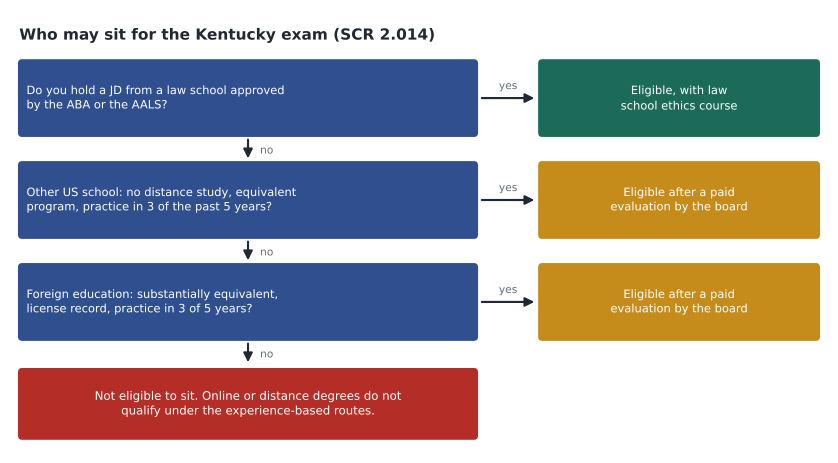
| Applicant | Requirement under SCR 2.014 | Extra steps |
|---|---|---|
| Graduate of an ABA- or AALS-approved school | JD or equivalent completed | Law school certification; ethics course |
| Graduate of an unapproved US school | No distance study; substantially equivalent program; practice in 3 of the past 5 years | Paid educational evaluation reviewed by the board |
| Foreign-educated lawyer | Substantially equivalent education; practice in 3 of the past 5 years | Paid evaluation; certified license record; English proficiency considered |
Prior refusals and pending discipline
SCR 2.022 adds two eligibility conditions that sit in the application rule rather than the education rule. An applicant whose application to the bar of another jurisdiction was refused is ineligible, unless the refusal was only for failing that jurisdiction's exam. And an applicant already admitted elsewhere must submit a certificate of good standing and a statement from the disciplinary authority listing any complaints and how they were resolved. Pending complaints, current discipline, suspension or disbarment elsewhere make the applicant ineligible.
Filing deadlines
Under SCR 2.022, the filing deadline is October 1 for the February exam and February 1 for the July exam. The application may not be filed more than 90 days before the deadline, so the window for the February exam opens in early July and the window for the July exam opens in early November.
Kentucky has also published late filing periods. NCBE's Kentucky page, for example, lists late deadlines of March 10 and May 10 for the July 2025 exam and December 10 for the February 2026 exam. Late filing costs more, and the late dates have varied from cycle to cycle, so a candidate who misses the regular deadline should check the Office of Bar Admissions immediately rather than assume a late window exists.
Marchetti's rule for the group is to treat the regular deadline as the real deadline and to file in the first half of the window. Early filing gives the Character and Fitness Committee time to ask follow-up questions and gives the candidate time to answer them without a looming exam.
Fees
SCR 2.022 sets the examination application fee at 875 dollars for applicants who have not been admitted to practice anywhere, and 1,200 dollars for attorneys admitted in another jurisdiction. If the Character and Fitness Committee requires a more intensive background investigation, the applicant pays the extra cost. No fees are refundable. If an applicant does not withdraw properly, the rule provides that the 175-dollar examination fee portion is forfeited; an applicant who wants to withdraw must notify the Office in writing at least five days before the exam, or present a verified excuse.
Other routes have their own fees. A transferred-score application under SCR 2.090 costs 875 dollars if the score was released within 12 months before the application and 1,200 dollars if it is older. Admission without examination under SCR 2.110 costs 1,500 dollars. These figures come from the rule text as amended by Orders 2025-06 and 2025-43; fees change, so the current figure on the Office's site controls on the day of filing.
| Application | Fee | Source |
|---|---|---|
| Examination, not previously admitted | 875 dollars | SCR 2.022 |
| Examination, admitted elsewhere | 1,200 dollars | SCR 2.022 |
| Transferred UBE score, released within 12 months | 875 dollars | SCR 2.090 |
| Transferred UBE score, older | 1,200 dollars | SCR 2.090 |
| Admission without examination | 1,500 dollars | SCR 2.110 |
Candidates should budget for more than the application fee. The MPRE has its own NCBE fee. Bar review courses, travel to the exam site, a hotel for two nights and time away from work add up. Sadie's firm agreed to cover her application fee and give her two weeks of unpaid leave before the exam; she budgeted the hotel and review course herself.
Worked problem
Can Priyanka sit in February?
Priyanka graduated in 2022 from a law school in India, practiced commercial litigation in Bengaluru until 2025, and then earned an LLM at an ABA-approved school in Kentucky. She wants to sit for the February 2027 Kentucky exam.
Show solution
- Her LLM is not a JD, so she does not qualify under the ordinary ABA-approved JD route.
- She may qualify as a foreign-educated applicant if her Indian education is the substantial equivalent of the education at an approved Kentucky school.
- She needs active practice in three of the five years before applying. Her practice from 2022 to 2025 is three years; the board will look at the dates closely.
- She must pay for an educational evaluation, submit a certified record of her admission in India, and expect the board to consider her English proficiency.
- Because the evaluation takes time, she should start well before the October 1 deadline.
Answer: Priyanka may be eligible under the foreign-education provision of SCR 2.014, but only after the board's evaluation; she should apply early and confirm her practice dates.
Common mistakes
MistakeAssuming any JD qualifies.
InsteadKentucky requires an ABA- or AALS-approved degree unless the narrow experience-based exceptions apply, and online or distance degrees do not qualify under those exceptions.
MistakeForgetting the ethics course certification.
InsteadSCR 2.014 requires certification that a law school ethics course was completed.
MistakeFiling the application too early.
InsteadAn application may not be filed more than 90 days before the deadline.
MistakeCounting on a late filing window.
InsteadLate windows and fees vary by cycle; treat October 1 and February 1 as the real deadlines.
MistakeExpecting a refund after withdrawing.
InsteadNo fees are refundable, and a withdrawal must be made in writing at least five days before the exam.
Practice problems
Work each problem on paper first, then reveal the answer to check.
What degree does SCR 2.014 ordinarily require?
Show answer
A JD or equivalent professional degree from a law school approved by the ABA or the AALS.
How much practice must a graduate of an unapproved US school or a foreign-educated applicant have?
Show answer
Active practice in at least three of the past five years.
When does the filing window open for the February exam?
Show answer
Ninety days before the October 1 deadline, in early July.
What is the examination fee for an applicant not previously admitted?
Show answer
875 dollars.
What makes an applicant who is admitted elsewhere ineligible to sit?
Show answer
Pending complaints, current discipline, suspension or disbarment in another jurisdiction.
Planning the application itself
The application is long, and most of the time it takes goes into gathering information rather than typing it. Marchetti gave Sadie a list of what to collect before opening the form: every address she had lived at for the period the form asks about, every employer with dates and a supervisor's contact details, every school attended, every traffic citation and court case in which she was a party, every bar or professional license application she had ever made, and her financial obligations, including student loans. She suggested building the list in a spreadsheet first and then copying from it, so the dates in the application match one another and match what references and employers will later confirm.
Inconsistent dates are the most common reason for follow-up questions. If an employer remembers a start date of June and the application says May, the committee will ask, and the applicant will spend time explaining a harmless mistake. Checking old pay stubs, offer letters and tax records before filing avoids that.
When the plan changes
Plans change. A candidate may need to move from the February exam to July because of illness, a family emergency or a job change. Kentucky's rules allow withdrawal with written notice at least five days before the exam, or later with a verified excuse, but they do not provide refunds, and a candidate who withdraws must file again for a later exam under that exam's rules. For a candidate in Sadie's position, this has an extra consequence: withdrawing from February 2027 means sitting for NextGen in July 2027, not for the legacy UBE. Marchetti tells candidates to make that decision with the format change in mind, not just the calendar.
A candidate who has failed should also keep the attempt limit in mind. Under SCR 2.080 as amended by Order 2025-43, an applicant who has not earned the required score within five attempts, counting UBE attempts in any jurisdiction since February 2021, may not sit for the Kentucky exam. Most candidates will never come near the limit, but someone who has already tried several times elsewhere should count before filing.
A note on law students
Some jurisdictions require law students to register with the bar early in law school, so a student planning to practice in Kentucky should check the Office of Bar Admissions for any current student registration rule. Kentucky law students often meet the Supreme Court's rules earlier in another way: a student who wants to appear in court under a law school clinic or externship needs a limited practice license under the court's student practice rule, and the University of Louisville law school publishes tips for students completing that application. Students who plan to practice in Kentucky should treat that first filing as practice for the bar application to come.
Summary and key terms
- SCR 2.014 requires a JD or equivalent from an ABA- or AALS-approved school, plus certification of a law school ethics course.
- Graduates of unapproved US schools and foreign-educated lawyers may qualify only with substantial equivalence, three of five years of practice and a paid evaluation; distance degrees do not qualify.
- Filing deadlines are October 1 for February and February 1 for July, with a 90-day window before each.
- The exam fee is 875 dollars for first-time applicants and 1,200 dollars for attorneys admitted elsewhere; nothing is refundable.
- A prior refusal elsewhere (other than for failing an exam) or pending discipline makes an applicant ineligible.
- AALS
- The Association of American Law Schools, whose member schools also satisfy SCR 2.014.
- Substantial equivalence
- The standard the board applies when evaluating education from an unapproved or foreign school.
- Filing window
- The 90-day period before each deadline during which an application may be filed.
- Certificate of good standing
- A statement from another jurisdiction that an applicant is admitted and not under suspension.
Lesson quiz · 5 questions
Score 60% or more to complete this lesson.
Create a free account to save your progress, take quizzes and earn a certificate.