
BAR-218 · Lesson 3 of 12 · 19 min
Character and fitness and the MPRE
▶ Video coming soon A video version of this lesson is on the way.
Halfway through October, Sadie received an email from the Office of Bar Admissions asking her to explain a 2019 citation for possession of alcohol by a minor that she had disclosed on her application. She had paid the fine and completed a diversion program at nineteen, and she had nearly left it off the form because the record had been expunged. Marchetti's reaction was relief. 'The email is the system working,' she said. 'They asked because you told them. The candidates who get into real trouble are the ones who decide for themselves what the committee doesn't need to know.' This lesson covers the two professional responsibility screens every Kentucky applicant passes through: character and fitness review and the Multistate Professional Responsibility Examination.
The standard
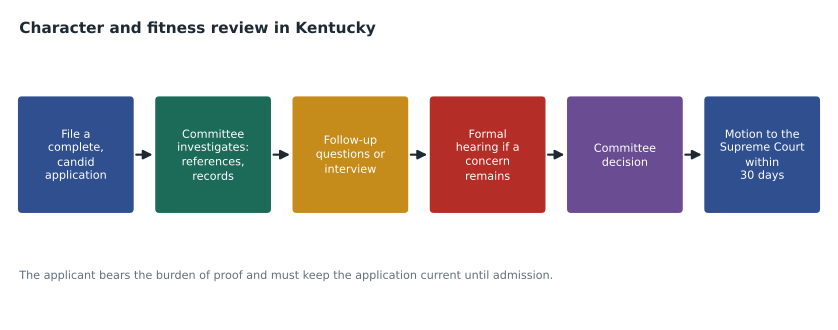
Under the Kentucky rules, an applicant must be of good moral character and generally fit to practice law, and the applicant bears the burden of proving it. The burden matters. The committee does not have to prove that an applicant is unfit; the applicant has to satisfy the committee that he or she is fit. In practice, that means producing information, explaining it candidly and supplying documents when asked.
The rules frame fitness in terms of present ability. Mental health and substance use matters are relevant only where they affect the applicant's current ability to practice law competently and ethically. That approach tracks a national shift away from asking applicants broad questions about any history of treatment and toward conduct and present functioning. An applicant who sought counseling during law school, for example, is not presumed unfit; the questions focus on whether there is conduct or a current condition that bears on the ability to meet a lawyer's obligations.
What triggers further inquiry
Kentucky's rules identify kinds of conduct that call for further investigation, including unlawful conduct, dishonesty and disciplinary history in any jurisdiction. Bar examiners generally treat academic misconduct, neglect of financial obligations and violation of court orders the same way. None of these automatically disqualifies an applicant. They prompt the committee to look more closely, and the committee weighs factors such as the applicant's age at the time, how recent and how serious the conduct was, whether it was an isolated event or a pattern, and what the applicant has done since.
Rehabilitation counts. Applicants who can show that they acknowledged a problem, took responsibility and changed their conduct are in a strong position. An applicant with old debt in collection who has a payment plan and has kept to it for two years presents very differently from one who ignores the debt. Sadie's citation at nineteen, disclosed, followed by years without incident, is the kind of matter that ordinarily needs only an explanation.
Candor above all
The single most important rule about character and fitness is candor. The application asks broad questions, and it is the applicant's job to answer them fully. Where a question is ambiguous, the safe course is to disclose and explain. The reason is simple: a lack of candor is itself evidence of unfitness, and often more serious evidence than the underlying conduct. A minor traffic matter disclosed is a footnote; the same matter concealed and later discovered raises a question about honesty that the committee must take seriously.
Expunged and sealed records are a common source of confusion. A state expungement law may allow a person to deny an expunged record in many settings, but bar applications often ask about records regardless of expungement, and courts and bar examiners frequently can see them. The safest approach is to read each question literally and, if it asks about expunged matters, disclose them. Sadie's question was whether her diversion counted; she disclosed it, and the committee's follow-up was routine.
The duty of candor continues after filing. Applicants must keep their applications current until admission. A new citation, a lawsuit, a change of job or a new financial problem that arises after filing should be reported promptly. The duty does not end at the exam; it runs until the oath.
Costs and hearings
The committee investigates using the application, references, records checks and, where needed, interviews. If the committee requires a more intensive background investigation, the applicant pays the cost, and under SCR 2.022 the applicant must pay any hearing-related record costs before exam results are released. The committee may refer an applicant to a formal hearing. An applicant who receives an adverse decision may seek review in the Supreme Court by filing a motion within 30 days.
Formal hearings are uncommon and usually involve serious or repeated conduct, or a credibility problem created by an incomplete application. Applicants facing a hearing should consider consulting a lawyer who practices in this area. The process is designed to be fair, but it is still a legal proceeding about the applicant's future.
The MPRE requirement
The MPRE is NCBE's two-hour, 60-question multiple-choice exam on the law governing lawyers, built mainly on the ABA Model Rules of Professional Conduct and the Model Code of Judicial Conduct. Fifty questions are scored and ten are unscored pretest questions. Scores are reported on a scale from 50 to 150.
Kentucky requires a scaled score of at least 80. Two features of Kentucky's rule matter for planning. First, under SCR 2.015 the MPRE must be passed before the candidate sits for the bar exam, not just before admission. A candidate who plans to sit in February must have a passing MPRE score in hand by then. Second, a candidate transferring a score from another UBE jurisdiction must also meet Kentucky's MPRE requirement, which is one of the conditions in SCR 2.090.
Because of the timing rule, Marchetti recommends that Kentucky candidates take the MPRE during the second or early third year of law school. NCBE offers the exam several times a year at test centers. A candidate who scores below 80 has time to retake it before the bar exam only if the first attempt was early enough.
| Item | Kentucky rule |
|---|---|
| Standard | Good moral character and fitness; applicant bears the burden |
| Fitness questions | Limited to conditions affecting present ability to practice |
| Investigation costs | Paid by the applicant when the committee requires more investigation |
| Review of adverse decision | Motion to the Supreme Court within 30 days |
| MPRE score | At least 80 |
| MPRE timing | Must be passed before sitting for the bar exam |
Preparing for the MPRE
The MPRE rewards precise knowledge of the Model Rules. The subject areas include the regulation of the legal profession, the client-lawyer relationship, client confidentiality, conflicts of interest, competence and malpractice, litigation and advocacy, transactions and communications with third parties, the different roles of the lawyer, safekeeping funds, communications about legal services, lawyers' duties to the public and the legal system, and judicial conduct. Conflicts of interest and confidentiality together make up a large share of the exam.
Two traps catch Kentucky candidates. The MPRE tests the ABA Model Rules, not Kentucky's version. Kentucky's Rules of Professional Conduct, SCR 3.130, follow the Model Rules closely, but where they differ the MPRE answer follows the ABA. And the MPRE uses specific words with specific meanings. 'Must' and 'may' are not interchangeable, and 'subject to discipline' is a narrower question than 'acted unwisely.' Reading the call of each question carefully matters as much as knowing the rules.
Sadie used two months of light study before her March MPRE: a short review course, the official practice questions and one timed practice test a week. Marchetti's advice to the group is to treat the MPRE as a real exam but not a second bar exam: steady review, attention to the question wording and enough practice to be comfortable with the format.
Worked problem
Should Jordan disclose?
Jordan is applying for the July Kentucky exam. In college he was briefly suspended for submitting a paper that copied a classmate's work. The school later reinstated him, and his transcript does not show the suspension. The application asks whether he has ever been disciplined by an educational institution.
Show solution
- The question asks about discipline, not about what appears on the transcript.
- A suspension for plagiarism is academic misconduct, one of the categories that prompts further inquiry.
- Leaving it out would be a lack of candor, which is itself evidence of unfitness and could be far more damaging than the incident.
- Jordan should disclose the suspension, explain what happened, describe what he learned and point to his record since.
Answer: Jordan should disclose; the conduct is old and he can show rehabilitation, while concealment would create a serious candor problem.
Common mistakes
MistakeLeaving off old or expunged matters.
InsteadRead each question literally; if it asks about expunged or sealed matters, disclose them and explain.
MistakeThinking the committee must prove unfitness.
InsteadThe applicant bears the burden of proving good character and fitness.
MistakeStopping updates after the exam.
InsteadThe duty to keep the application current runs until admission.
MistakeTaking the MPRE after the bar exam.
InsteadKentucky requires a passing MPRE score before the candidate sits.
MistakeStudying Kentucky's rules for the MPRE.
InsteadThe MPRE tests the ABA Model Rules, which Kentucky's SCR 3.130 follows closely but not exactly.
Practice problems
Work each problem on paper first, then reveal the answer to check.
Who bears the burden in a Kentucky character and fitness review?
Show answer
The applicant.
When are mental health or substance use matters relevant?
Show answer
Only where they affect the applicant's present ability to practice.
How long does an applicant have to seek Supreme Court review of an adverse decision?
Show answer
Thirty days, by motion.
What MPRE score does Kentucky require, and by when?
Show answer
A scaled score of 80, earned before sitting for the bar exam.
Answering a follow-up request
Most applicants receive at least one follow-up request, and the way they answer it matters. Marchetti gave Sadie a short method. Answer the question that was asked, completely, in plain sentences. Attach the documents that support the answer, such as a court disposition, a payment record or a letter from a school. Explain the circumstances without minimizing them and without dramatizing them. Say what has happened since. And reply by the date requested, or ask for more time before that date if a document will take longer to obtain.
Sadie's reply about her citation ran to four short paragraphs. She described what happened, attached the diversion completion record, noted that the record had later been expunged and explained that she had disclosed it because the question asked about expunged matters. She ended with a sentence on her record since. The committee closed the inquiry two weeks later. Marchetti pointed out that the reply did not argue that the matter was unimportant. It simply gave the committee what it needed to decide that for itself.
References and records
The application asks for references, and the committee may contact them. Good references know the applicant well and can speak to honesty and reliability; a famous name who barely knows the applicant adds little. Applicants should tell their references to expect contact and should make sure the contact details are current. Employers listed on the application may also be asked to confirm dates and to say whether the applicant left in good standing.
Records requests can take longer than applicants expect. A court in another state may need several weeks to produce a certified disposition, and a school's records office may be slow during the summer. Starting those requests when the application is filed, rather than when the committee asks, shortens the review.
Financial responsibility
Debt alone does not make an applicant unfit. Many applicants carry large student loans, and the committee knows it. What draws attention is neglect: accounts ignored until they go to collection, judgments left unpaid, taxes not filed. The concern is practical. A lawyer handles other people's money and deadlines, and a pattern of ignored obligations can suggest the same habits will carry into practice. An applicant with a troubled financial history should be ready to show a current plan and a record of keeping to it.
MPRE logistics
Candidates register for the MPRE through their NCBE account, choose a test date and a test center, and request any testing accommodations through NCBE's own process, which has its own deadlines separate from the bar application. NCBE reports scores to the jurisdictions a candidate designates, so a Kentucky candidate should make sure Kentucky receives the score. A candidate who took the MPRE years earlier should confirm that the score is still accepted; jurisdictions set their own rules on how old an MPRE score may be, and the Office of Bar Admissions can say how Kentucky treats an older score.
On test day, the MPRE is a timed, closed-book exam. Marchetti's practical advice is modest: arrive early, bring the identification NCBE requires, and pace for roughly two minutes a question. A candidate who knows the rules but reads carelessly will lose more points than one who reads carefully but is unsure of a few rules.
Summary and key terms
- Applicants must prove good moral character and fitness; the burden is on them.
- Fitness inquiries focus on present ability to practice, not on past treatment as such.
- Conduct such as dishonesty, unlawful acts and neglected debts triggers inquiry, weighed against age, time, seriousness and rehabilitation.
- Candor is essential, the application must be kept current until admission, and adverse decisions may be taken to the Supreme Court within 30 days.
- Kentucky requires an MPRE score of 80, earned before the bar exam; the MPRE tests the ABA Model Rules.
- Character and Fitness Committee
- The Kentucky body that investigates applicants and decides whether they have proven good moral character and fitness.
- Rehabilitation
- Evidence that an applicant has acknowledged past misconduct and changed.
- MPRE
- The Multistate Professional Responsibility Examination, scored from 50 to 150.
- Candor
- Complete and truthful disclosure on the application and in all dealings with the committee.
Lesson quiz · 5 questions
Score 60% or more to complete this lesson.
Create a free account to save your progress, take quizzes and earn a certificate.