
BAR-218 · Lesson 7 of 12 · 19 min
Kentucky courts and civil procedure
▶ Video coming soon A video version of this lesson is on the way.
Sadie's firm files most of its cases in Warren County, and by her third year of clerking she could find her way around the Justice Center without a map. What she could not do, Marchetti discovered, was explain why one of the firm's cases was in district court and another in circuit court, or why a summary judgment motion that would have been routine in federal court had been denied in state court. 'You'll learn the building in a week,' Marchetti said. 'The system takes longer.' This lesson describes the Kentucky court system and the features of Kentucky civil procedure that differ most from the federal rules the bar exam tests.
A unified court system
Kentucky's courts form a single, unified system called the Kentucky Court of Justice, created by the judicial article of the Kentucky Constitution adopted in 1975. The Chief Justice of the Supreme Court is the system's administrative head, and the Administrative Office of the Courts handles its day-to-day administration. There are four levels of court.
The Supreme Court of Kentucky is the court of last resort. It has seven justices, each elected from one of seven appellate districts, and it hears appeals by right in the most serious criminal cases and discretionary review in most other cases. It also governs the practice of law, as earlier lessons explained.
The Court of Appeals is the intermediate appellate court. Its judges are also elected from the appellate districts, and it usually sits in panels of three. Most appeals from circuit court go to the Court of Appeals first.
The circuit court is the trial court of general jurisdiction. It hears civil cases above the district court's dollar limit, felony prosecutions, cases involving title to land and equitable matters, and appeals from district court. In many circuits, a family court division of the circuit court handles divorce, custody, adoption, domestic violence and related matters, an arrangement added to the Constitution in 2002.
The district court is the trial court of limited jurisdiction. It hears civil cases below a statutory dollar limit, misdemeanors and violations, preliminary hearings in felony cases, juvenile matters and probate. Its small claims division handles the smallest civil disputes in a simplified procedure. The jurisdictional limits are set by statute, in KRS 24A.120 and KRS 24A.230, and the General Assembly has considered raising them, so a lawyer should check the current figures before choosing a court.
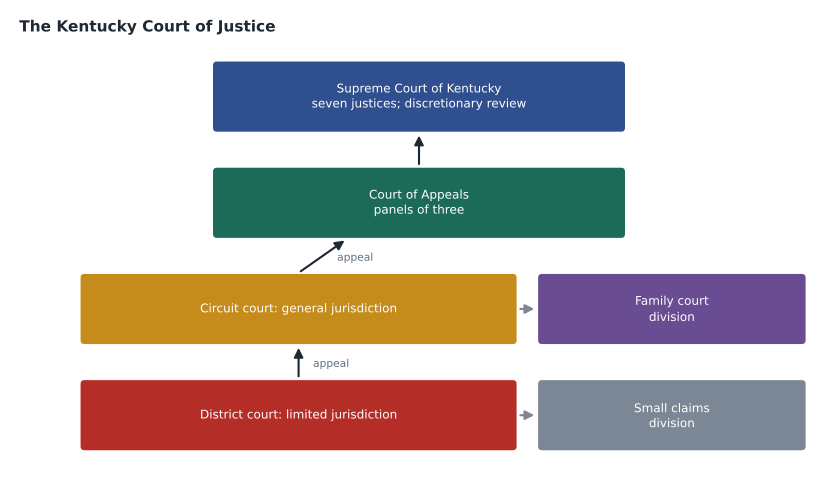
| Court | Role | Typical matters |
|---|---|---|
| Supreme Court | Court of last resort | Discretionary review; appeals by right in the most serious criminal cases; rules and bar governance |
| Court of Appeals | Intermediate appellate court | Most appeals from circuit court, in panels of three |
| Circuit court | General jurisdiction trial court | Larger civil claims, felonies, land title, equity; family court division in many circuits |
| District court | Limited jurisdiction trial court | Smaller civil claims, misdemeanors, juvenile, probate, small claims |
The Kentucky Rules of Civil Procedure
Kentucky's Rules of Civil Procedure, cited as CR, were modeled on the federal rules, and their numbering largely tracks the federal rules. A lawyer who knows the federal rules will recognize most of the structure: a complaint and answer, motions to dismiss under CR 12, discovery under CR 26 through 37, summary judgment under CR 56. But the familiar numbering can hide real differences.
Pleading
Kentucky follows notice pleading. A complaint must give the defendant fair notice of the claim and the grounds on which it rests. The federal courts moved to a plausibility standard after the Supreme Court's decisions in Twombly and Iqbal, and the MBE tests that federal standard. In Russell v. Johnson & Johnson, Inc., decided in 2020, the Kentucky Supreme Court expressly declined to adopt the plausibility test and kept Kentucky's traditional notice pleading standard, so a motion to dismiss built on federal plausibility arguments is a weaker motion in state court.
Summary judgment
Summary judgment is the difference Marchetti's story was about. In federal court, after the Celotex line of cases, a moving defendant can often win summary judgment by pointing to the absence of evidence supporting the plaintiff's claim. Kentucky's leading case, Steelvest, Inc. v. Scansteel Service Center, Inc., decided by the Kentucky Supreme Court in 1991, took a more cautious path. Under Steelvest, summary judgment is proper only where it would be impossible for the nonmoving party to produce evidence at trial warranting a judgment in its favor, with the record viewed in the light most favorable to the party opposing the motion.
Kentucky courts have since explained that impossible is meant in a practical sense, not a literal one, but the standard still leans toward letting cases reach a jury. Motions filed too early, before the opposing party has had an adequate chance at discovery, are particularly vulnerable.
Juries and verdicts
Civil juries in circuit court have twelve members, and district court juries have six. Unlike federal civil juries, which must be unanimous unless the parties agree otherwise, Kentucky civil verdicts may be returned by three fourths of the jurors, so nine of twelve may decide a circuit court case. The Kentucky Constitution permits less-than-unanimous civil verdicts, and the civil rules implement that permission.
Appeals
Kentucky's Rules of Appellate Procedure, cited as RAP, took effect on January 1, 2023, replacing the appellate provisions that had been part of the civil rules. Under RAP 3, a notice of appeal must ordinarily be filed no later than 30 days from the date of notation of service of the judgment or order appealed from, and that deadline is treated strictly. Review in the Supreme Court is usually by motion for discretionary review after the Court of Appeals has decided the case. Criminal appeals from judgments imposing the most serious sentences go directly to the Supreme Court as a matter of right.
| Issue | Federal approach | Kentucky approach |
|---|---|---|
| Pleading | Plausibility after Twombly and Iqbal | Traditional notice pleading |
| Summary judgment | Celotex burden-shifting | Steelvest: proper only if the nonmovant could not produce evidence warranting a judgment |
| Civil verdict | Unanimous unless parties agree | Three fourths of the jury |
| Appellate rules | Federal Rules of Appellate Procedure | Kentucky Rules of Appellate Procedure, effective 2023 |
Worked problem
Should the firm move for summary judgment?
The firm represents a property owner sued in Warren Circuit Court by a delivery driver who slipped on ice. Discovery opened two months ago. The defense believes the driver has little evidence that the owner knew about the ice. A partner asks Sadie whether to move for summary judgment now.
Show solution
- Under Steelvest, summary judgment is proper only if the driver could not produce evidence at trial warranting a judgment in his favor.
- With discovery only two months old, the driver can argue that he has not had an adequate opportunity to develop evidence.
- A motion now risks denial and educates the plaintiff about the defense theory.
- The better course is to complete key discovery, such as the driver's deposition and the owner's maintenance records, and move later if the record remains thin.
Answer: Waiting is wiser; under Kentucky's standard an early motion is likely to be denied.
Common mistakes
MistakeApplying the federal plausibility standard to a Kentucky complaint.
InsteadKentucky follows notice pleading.
MistakeAssuming Celotex governs summary judgment in state court.
InsteadSteelvest sets a more demanding standard for the moving party.
MistakeExpecting a unanimous civil verdict.
InsteadKentucky civil verdicts may be returned by three fourths of the jury.
MistakeCiting the old civil rules for appellate deadlines.
InsteadThe Rules of Appellate Procedure have governed appeals since January 1, 2023.
MistakeFiling in circuit court without checking the dollar limit.
InsteadCheck the current district court and small claims limits in KRS 24A.120 and KRS 24A.230.
Practice problems
Work each problem on paper first, then reveal the answer to check.
Name the four levels of the Kentucky Court of Justice.
Show answer
Supreme Court, Court of Appeals, circuit court and district court.
Which case sets Kentucky's summary judgment standard?
Show answer
Steelvest, Inc. v. Scansteel Service Center, Inc. (Ky. 1991).
How many jurors must agree on a Kentucky civil verdict in circuit court?
Show answer
Three fourths, or nine of twelve.
When did the Kentucky Rules of Appellate Procedure take effect?
Show answer
January 1, 2023.
Choosing where to file
Before a complaint is drafted, the lawyer has to decide where it will be filed, and the choice has three layers. The first is subject matter: whether the claim belongs in district court or circuit court, which depends mostly on the amount in controversy and the type of claim. The second is venue: which county's court is proper, which Kentucky's venue statutes decide according to factors such as where the defendant resides and where the cause of action arose. The third is whether a federal court is available and preferable, for example because the parties are citizens of different states and the amount in controversy exceeds the federal threshold.
Each layer can be contested. A defendant may move to transfer a case filed in the wrong county, and a defendant sued in state court may remove an eligible case to federal court. The choice also affects procedure: the summary judgment standard, the pleading standard and the jury verdict rule all change when the case moves to federal court. Marchetti asks the group to write down, for every case they help file, the reason for the forum chosen.
Service and the first deadlines
The civil rules provide for service of the summons and complaint by methods that include certified mail through the circuit court clerk, personal service by the sheriff or another authorized person, and service on the Secretary of State in certain cases involving nonresidents. Once a defendant is served, the time to answer begins to run. New lawyers should calendar every deadline the moment a case arrives, including the answer date, the time for any motion under CR 12, and the dates in any scheduling order.
Discovery
Discovery under the Kentucky rules looks familiar to anyone who knows the federal rules: interrogatories, requests for production, requests for admission and depositions. The differences are in the details. Kentucky has its own limits and procedures, and individual circuits and judges often add their own expectations through scheduling orders. Requests for admission deserve particular care, because a request that is not answered on time may be deemed admitted. Sadie's firm sends a calendar reminder a week before any response is due and a second one two days before.
Mediation and settlement
Many Kentucky circuits refer civil cases to mediation, and some require it before trial. Mediation is often the point at which a case resolves, so preparing for it is part of preparing the case. That means knowing the client's goals, the realistic range of outcomes at trial under Kentucky law, including pure comparative fault and the absence of damages caps discussed in Lesson 8, and the costs of continuing.
Family court practice
Family court is where many new Kentucky lawyers spend their first years. Family court divisions have their own rules of practice and procedure, which address matters such as mandatory disclosures in dissolution cases and the procedure for domestic violence and interpersonal protective orders. The pace and the stakes differ from civil litigation: hearings are frequent, clients are often under great stress, and the court's focus in custody matters is on the child's best interests rather than on the parties' arguments alone. Lesson 9 covers the substantive custody rules.
A note on the record
Appeals are decided on the record, so a trial lawyer must build one. That means making objections on the record, offering evidence by avowal when the court excludes it, and asking for findings when the court must make them. In family court especially, a request for specific findings of fact can determine whether an appellate court can review a decision at all. Marchetti's group practices this in mock hearings, because it is a habit that has to be in place before the first real one.
Motions practice
Motions practice in circuit court has a rhythm a new lawyer learns quickly. Many judges hear motions on a set motion day, and local rules or the judge's practice may require that a motion be filed and served a set number of days before it is heard, with a notice stating the hearing date. Some judges decide routine motions on the papers; others expect counsel to appear. A tendered proposed order is often expected with the motion, and in some courtrooms the judge will sign the order at the hearing if it is ready. Sadie's first motion, a routine request for more time to answer discovery, was set for the wrong motion day because she copied the date from an old notice in the file. The clerk caught it, and the partner's lesson was to confirm the court's current schedule every time rather than relying on an old notice. Courts change their calendars, judges rotate, and a missed hearing can cost a client a motion that should have been granted.
Summary and key terms
- The Kentucky Court of Justice has four levels: Supreme Court, Court of Appeals, circuit court and district court.
- Family court divisions of circuit court handle domestic matters in many circuits; district court handles smaller civil claims, misdemeanors, juvenile and probate.
- The CR track the federal rules in structure but differ in key places.
- Kentucky uses notice pleading and the Steelvest summary judgment standard.
- Civil verdicts need three fourths of the jury, and appeals follow the 2023 Rules of Appellate Procedure.
- Kentucky Court of Justice
- The unified state court system created by the 1975 judicial article.
- Steelvest standard
- Kentucky's summary judgment test, which asks whether the nonmovant could produce evidence warranting a judgment.
- Fair-notice pleading
- Kentucky's notice pleading standard, a pleading standard requiring fair notice of the claim and its grounds.
- Discretionary review
- Review by the Supreme Court that it may grant or deny on motion.
Lesson quiz · 5 questions
Score 60% or more to complete this lesson.
Create a free account to save your progress, take quizzes and earn a certificate.