
BAR-218 · Lesson 5 of 12 · 20 min
Exam changes ahead: the last legacy UBE in February 2027 and NextGen in July 2027
▶ Video coming soon A video version of this lesson is on the way.
Two weeks before Thanksgiving, a third-year law student who clerks part-time at Sadie's firm stopped by her desk with a question. He graduates in May 2027 and wanted to know whether Sadie's bar review books would help him. Sadie had to tell him that they would help only in part. He will sit for an exam that Kentucky has never given before, with different question formats, a different score scale and a different list of subjects. Marchetti spent a meeting on the transition, partly for the candidates sitting in February and partly for the ones who will follow. This lesson explains what is changing, when, and how a candidate on either side of the line should plan.
The decision and the dates
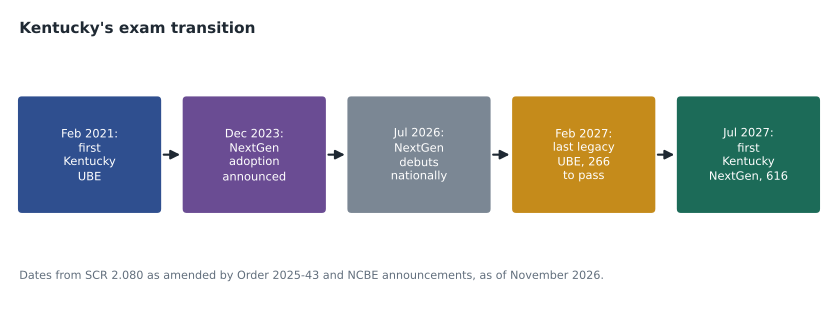
NCBE announced the structure of its new bar exam in 2023 and said that the current exam would be phased out. In December 2023, NCBE announced that Kentucky would adopt the new exam, known as the NextGen bar exam and formally as the NextGen UBE. Kentucky's rules now state the schedule. SCR 2.080, as rewritten by Order 2025-43, describes the legacy UBE as running from February 2021 through February 2027 and sets a separate passing score for NextGen.
So the dates are fixed in the rule. February 2027 is the last legacy UBE in Kentucky. July 2027 is the first NextGen administration. NCBE's first NextGen exams were given in July 2026 in the earliest-adopting jurisdictions, so Kentucky will not be among the first, and its candidates will benefit from a year of experience elsewhere with the new format.
What the NextGen exam looks like
The NextGen exam is shorter than the legacy UBE and organized differently. According to NCBE, it runs over a day and a half: two three-hour sessions on the first day and one three-hour session on the second, about nine hours of testing in all. Candidates take it on their own laptops at in-person, proctored locations, using a secure online platform.
The question formats change. NextGen uses three kinds of questions. Multiple-choice questions are still part of the exam, but they are mixed with integrated question sets, which present a single fact pattern and ask a series of related questions about it, some multiple-choice and some short written answers. Performance tasks ask the candidate to complete a practical piece of legal work using provided materials, much as the MPT does now, but integrated into the same sessions.
The structure of what is tested also changes. NextGen tests foundational concepts and principles together with foundational lawyering skills. The concepts are business associations and relationships, civil procedure, constitutional law, contract law, criminal law and constitutional protections of accused persons, evidence, real property and torts. The skills are legal research and legal writing, issue spotting and analysis, investigation and evaluation, client counseling and advising, negotiation and dispute resolution, and client relationship and management.
Three legacy subjects move. Conflict of laws and secured transactions are no longer separately tested. Family law and trusts and estates appear in performance tasks and may appear in integrated question sets; NCBE says that from July 2026 through February 2028 they are tested with legal resources provided, and family law becomes a standard tested subject in July 2028. For Kentucky's July 2027 and February 2028 candidates, then, those two subjects arrive with the law in hand.
| Feature | Legacy UBE | NextGen |
|---|---|---|
| Kentucky dates | February 2021 to February 2027 | From July 2027 |
| Length | Two full days | About nine hours over a day and a half |
| Formats | MBE, MEE essays, MPT tasks | Multiple choice, integrated question sets, performance tasks |
| Score scale | 400-point total | 500 to 750 |
| Kentucky passing score | 266 | 616 |
The new score scale
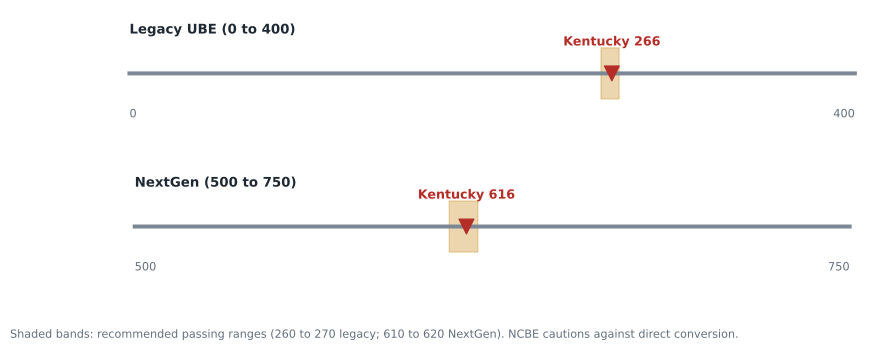
NextGen scores fall on a scale from 500 to 750. In November 2025, NCBE issued guidance recommending that jurisdictions consider passing scores between 610 and 620, and explained that this range corresponds to the legacy passing range of 260 to 270. Kentucky set its NextGen passing score at 616, within that range, in the same amended rule that keeps 266 for the legacy exam.
Candidates should resist the urge to convert. NCBE's own score portability guidance says that because the two formats differ, the numerical scores should not be compared directly. A 616 is not a 266 with a different label; it is a score on a different exam, set to reflect a similar level of minimum competence.
Planning near the line
Candidates sitting in February 2027 face a planning question that earlier candidates did not: what happens if they do not pass? Under the rule as written, the next Kentucky exam will be NextGen. A February candidate who misses must prepare for a different exam rather than simply repeating the same one.
Marchetti gives the group three pieces of advice. First, prepare for February as though there were no second chance in the same format, because there is not. Second, if a retake becomes necessary, change materials. Much of the substantive law carries over, but the integrated question sets and the skills-based tasks require practice in the new formats, and NCBE publishes sample questions and preparation materials for them. Third, count attempts. Under SCR 2.080, attempts on the UBE in any jurisdiction since February 2021 count toward Kentucky's five-attempt limit.
Candidates graduating in 2027 have the opposite question: whether to try to sit for the last legacy exam in February 2027. For most it is not available, because they will not have completed their degrees in time. Those who will graduate in May 2027 should simply plan for NextGen from the start, choose preparation materials written for it, and take the MPRE early, since it is unaffected by the transition and Kentucky requires it before the bar exam.
Worked problem
Which exam will Tomas take?
Tomas finishes his last law school courses in December 2026 and graduates in May 2027. His law school will certify in January that he has completed all degree requirements. He has a passing MPRE score.
Show solution
- Kentucky allows a candidate to sit once all degree requirements are completed, with the law school's certification.
- If Tomas files by October 1, 2026, he could sit for the February 2027 legacy UBE.
- It is now late November 2026, so the regular February deadline has passed; he would need a late filing window if the Office offers one.
- If no late window is available, his first Kentucky exam will be NextGen in July 2027, for which the deadline is February 1, 2027.
Answer: Tomas can take the February 2027 legacy exam only if a late filing window is open; otherwise he should prepare for NextGen in July 2027 and file by February 1.
Common mistakes
MistakeAssuming a failed February 2027 exam can be retaken in the same format.
InsteadJuly 2027 is NextGen; a retake means a new exam.
MistakeConverting a NextGen score into a UBE score.
InsteadNCBE says the two scores should not be compared directly.
MistakeStudying conflict of laws and secured transactions for NextGen.
InsteadThose subjects are not separately tested on NextGen.
MistakeIgnoring family law and trusts and estates on NextGen.
InsteadThey appear in performance tasks and integrated sets, with resources provided through February 2028.
MistakeForgetting the attempt limit.
InsteadUBE attempts in any jurisdiction since February 2021 count toward Kentucky's five-attempt limit.
Practice problems
Work each problem on paper first, then reveal the answer to check.
When is Kentucky's last legacy UBE?
Show answer
February 2027.
When does Kentucky first give NextGen?
Show answer
July 2027.
What is Kentucky's NextGen passing score?
Show answer
616 on the 500 to 750 scale.
What NextGen passing range did NCBE recommend?
Show answer
610 to 620, corresponding to the legacy range of 260 to 270.
Name the three NextGen question formats.
Show answer
Multiple choice, integrated question sets and performance tasks.
How an integrated question set works
The integrated question set is the format that feels most unfamiliar to candidates trained on the MBE, so Marchetti walked the group through an original example of the kind they should expect. A short fact pattern describes a small business owner who signs a lease for retail space, later learns that the landlord misstated the parking available, and now wants to leave. The first question asks which facts the lawyer should investigate before advising the client. The second asks the candidate to identify the strongest legal theory for ending the lease. The third asks for a short written explanation of the risks of simply moving out. The fourth asks which document from a provided set best supports the client's position.
Each question builds on the same facts, and together they test both law and skill: knowing the doctrine of misrepresentation and the landlord's duties, but also knowing what to ask, how to advise and how to read a document. A candidate who studies only rules will be comfortable with the second question and uneasy with the others. That is the design. NextGen asks candidates to do what a new lawyer does in the first months of practice, not only what a law student does in a doctrinal exam.
What carries over from legacy preparation
Much does. The doctrinal core of the MBE, such as contracts, torts, evidence, civil procedure, constitutional law, criminal law and real property, remains in NextGen's foundational concepts, and business associations moves from the essay subjects into the core list. A candidate who knows those subjects well has a large head start. MPT experience also carries over, because NextGen's performance tasks draw on the same skills of reading a file, applying provided law and writing for a stated audience.
What does not carry over well is format-specific practice. Timing strategies built for 100 standalone multiple-choice questions in three hours do not fit sessions that mix question types. Essay templates built for 30-minute MEE answers are not the same as the short constructed responses in integrated sets. And conflict of laws and secured transactions, which legacy candidates spend time on, are no longer separately tested.
Practicing on the platform
Because NextGen is delivered on the candidate's own laptop through a secure platform, technical familiarity becomes part of preparation. Candidates should use NCBE's published sample questions and tutorials in the format they will see on exam day, confirm that their laptops meet the platform's requirements well before the exam, and practice reading long fact patterns and resource materials on a screen. The part-time clerk, who will sit in July 2027, plans to do every full practice session on the same laptop he will use at the exam, so that the screen, keyboard and battery hold no surprises.
A study calendar for July 2027
Marchetti suggests a simple outline for candidates sitting for the first Kentucky NextGen exam. In the spring semester of the final year, take the MPRE if it is not already done and file the Kentucky application before February 1. In March and April, review the foundational concepts at a steady pace alongside coursework. From late May to the exam, follow a full-time plan that alternates doctrinal review with practice in all three NextGen formats, with at least one full simulated exam session each week from mid-June. In the final two weeks, shift to timed practice and rest.
Score transfers across the line
The transition also affects candidates who move between jurisdictions. A legacy UBE score earned elsewhere may still be transferable to Kentucky within the limits of SCR 2.090, and NCBE says that NextGen scores are designed to be portable to jurisdictions that accept them, with each receiving jurisdiction deciding whether to accept a score and whether it meets the local passing standard. Because the rules for scores from the other format are still settling across the country, a candidate who plans to transfer a score into or out of Kentucky during the transition should confirm with each jurisdiction how it will treat that particular score before relying on it. Lesson 11 covers Kentucky's transfer rule in detail.
A retake plan after February
For a February 2027 candidate who does not pass, Marchetti lays out the first month after results in some detail, because the calendar is tight. Read the score report and identify the weaker half. Settle the July filing question early. The regular July deadline of February 1 falls before the February exam is even given, so a cautious candidate should ask the Office of Bar Admissions well before February how a July application works for someone whose February result is still pending, and what late filing options, if any, will be offered after results. Spend the first two weeks after results working through NCBE's NextGen sample questions to learn the formats before buying new materials. Keep the doctrinal outlines from the legacy course, but replace the practice questions with NextGen-style sets. And protect the final six weeks for full-time preparation. The candidates who handle a format change best, she says, are the ones who treat it as a new exam with familiar law rather than as the old exam with a few new question types.
Summary and key terms
- SCR 2.080 sets the schedule: the legacy UBE runs through February 2027 and NextGen begins in July 2027.
- NextGen is about nine hours over a day and a half, on candidates' laptops at proctored locations.
- It tests foundational concepts and lawyering skills through multiple-choice questions, integrated question sets and performance tasks.
- Scores run from 500 to 750, and Kentucky's passing score is 616; NCBE cautions against comparing the scales directly.
- February 2027 candidates who need a retake will face NextGen, so they should plan accordingly.
- NextGen UBE
- NCBE's new bar exam, first given in July 2026 and in Kentucky from July 2027.
- Integrated question set
- A NextGen format in which one fact pattern supports several related questions.
- Foundational lawyering skills
- The practical skills NextGen tests alongside legal concepts.
- Legacy UBE
- The UBE in its original form, given in Kentucky through February 2027.
Lesson quiz · 5 questions
Score 60% or more to complete this lesson.
Create a free account to save your progress, take quizzes and earn a certificate.