
BAR-218 · Lesson 6 of 12 · 19 min
The Kentucky Law Component and how Kentucky law appears
▶ Video coming soon A video version of this lesson is on the way.
Sadie's first real assignment at the firm, months before the bar exam, was a short memo on whether a client's slip-and-fall claim was still timely. She wrote it from her bar review outline, which said that personal injury claims generally have a two- or three-year limitation period. The supervising partner returned it with a single line circled: 'Not in Kentucky.' The national exam had taught her the general rule; the client needed the Kentucky rule. Marchetti uses the story to introduce the part of admission that is about Kentucky law itself, and the habits a new Kentucky lawyer needs to find and use it. This lesson covers both.
Why Kentucky law is not on the exam
The UBE and NextGen are national exams. They test general principles, often the majority rule or the approach of the uniform and model acts, and they do not test any jurisdiction's local law. That is the price of portability: a score earned in one jurisdiction can be used in another only if the exam does not depend on either jurisdiction's rules.
Jurisdictions that adopt the UBE handle local law in one of two ways. Some add a local law exam or test. Others require a course. Kentucky uses a course, the Kentucky Law Component.
The Kentucky Law Component
The Kentucky Law Component is an online course on Kentucky law that applicants complete before admission. Bar review providers describe it as a requirement for Kentucky bar exam applicants and as an online course in the style of continuing legal education. Kentucky's materials when the UBE was introduced described it as covering areas of Kentucky law that differ from the general rules tested on the national exam. Applicants who transfer a UBE score from another jurisdiction must complete it as well.
Because the component is administered by the Office of Bar Admissions and its details are set outside the rules' text, candidates should confirm the current format, timing and any fee with the Office when they file. Sadie's plan is to complete it in the weeks after the February exam, so that it is finished well before her expected admission date.
The component is not graded the way the exam is, but it should not be treated as a formality. It is often a new lawyer's first organized look at the Kentucky rules that matter most in practice, and the topics it covers overlap heavily with the Kentucky law lessons in the second half of this course.
The sources of Kentucky law
A new Kentucky lawyer needs to know where Kentucky law lives and how the sources rank.
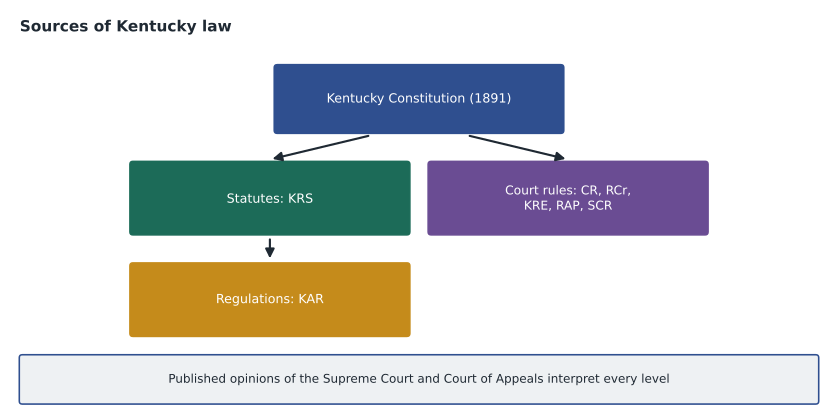
The Kentucky Constitution is the state's highest law. The current constitution dates from 1891, and it is longer and more detailed than the federal constitution. Several of its sections, including those that protect the right to sue for injuries, come up often in litigation, as Lesson 8 explains.
The Kentucky Revised Statutes, cited as KRS, are the state's codified statutes, organized into chapters. The Legislative Research Commission publishes them online. Agencies issue regulations under the statutes, published in the Kentucky Administrative Regulations, cited as KAR.
Court rules are a separate body of law. The Supreme Court of Kentucky adopts the Rules of Civil Procedure (CR), the Rules of Criminal Procedure (RCr), the Kentucky Rules of Evidence (KRE), the Rules of Appellate Procedure (RAP) and the family court rules, as well as the SCR rules on admission and practice that this course has already discussed.
Case law comes from the Supreme Court of Kentucky, the state's highest court, and the Kentucky Court of Appeals. Published opinions of the Supreme Court bind every Kentucky court. Kentucky's appellate rules distinguish published from unpublished opinions, and unpublished opinions have limited precedential value; a lawyer citing one should check the current appellate rule on when and how it may be cited.
| Source | Citation | Where to find it |
|---|---|---|
| Kentucky Constitution | Ky. Const. section number | Legislative Research Commission |
| Statutes | KRS chapter and section | Legislative Research Commission |
| Regulations | KAR title and chapter | Legislative Research Commission |
| Court rules | CR, RCr, KRE, RAP, SCR | Kentucky Court of Justice |
| Appellate opinions | Reporter or court opinion number | Kentucky Court of Justice and legal databases |
Where Kentucky departs from the national rules
The parts of Kentucky law that trip up new lawyers are the places where Kentucky departs from the rule the bar exam tests. Marchetti keeps a list, and the group adds to it each year. A few examples show the pattern, and later lessons develop them.
Limitation periods. Many jurisdictions give personal injury plaintiffs two years or more. Kentucky's general rule for personal injury is one year under KRS 413.140. Sadie's memo is a common mistake.
Comparative fault. The MBE tests the majority modified comparative fault approaches as well as pure comparative fault. Kentucky follows pure comparative fault, so a plaintiff who is mostly at fault may still recover a reduced amount.
Damages limits. Many states cap noneconomic or medical malpractice damages by statute. Kentucky's Constitution prohibits the General Assembly from limiting damages for injury or death, which has blocked caps of that kind.
Family property. Kentucky still has statutory dower and curtesy, giving a surviving spouse an interest in the deceased spouse's real property, a feature many states have abolished.
Custody. Kentucky law begins with a rebuttable presumption that joint custody and equal parenting time are in a child's best interests.
Professional conduct. Kentucky's Rules of Professional Conduct follow the ABA Model Rules closely but not perfectly, and the MPRE tests the ABA version.
Habits for finding Kentucky law
Marchetti teaches three habits. First, never rely on a national outline for a Kentucky answer; treat it as a list of issues and then look up the Kentucky rule. Second, read the current statute or rule, not a summary, and check whether it has been amended. Kentucky's General Assembly meets every year, and its sessions regularly change statutes that practitioners use. Third, check the case law interpreting the statute, because Kentucky courts have read some statutes narrowly or broadly in ways the text alone would not suggest.
Worked problem
Sadie's second draft
Sadie's supervising partner asked her to redo the slip-and-fall memo. The client fell in a store parking lot fourteen months ago and has not yet filed suit.
Show solution
- The general personal injury limitation period in Kentucky is one year under KRS 413.140.
- Fourteen months is longer than one year, so the claim appears untimely unless an exception applies.
- Sadie should check for any tolling or discovery rule that might apply on these facts and whether any other statute might govern.
- Her memo should state the one-year rule, explain the likely consequence, and identify the facts the partner needs to confirm.
Answer: Under Kentucky's one-year rule, the claim is probably barred unless an exception applies; the memo should flag that risk and the facts that might change it.
Common mistakes
MistakeUsing a national outline to answer a Kentucky question.
InsteadUse the outline to spot issues, then look up the Kentucky rule.
MistakeTreating the Kentucky Law Component as optional.
InsteadApplicants, including those transferring a UBE score, complete it before admission.
MistakeCiting an unpublished opinion as binding.
InsteadUnpublished opinions have limited precedential value; check the appellate rule before citing one.
MistakeAssuming Kentucky has a two-year personal injury limitation period.
InsteadThe general rule is one year under KRS 413.140.
Practice problems
Work each problem on paper first, then reveal the answer to check.
Why does the UBE not test Kentucky law?
Show answer
Because it is a national exam designed for score portability.
How does Kentucky address local law for UBE applicants?
Show answer
Through the Kentucky Law Component, an online course completed before admission.
What is the abbreviation for Kentucky's codified statutes?
Show answer
KRS, the Kentucky Revised Statutes.
Name two court rule sets adopted by the Supreme Court of Kentucky.
Show answer
Any two of CR, RCr, KRE, RAP and the SCR rules.
When a statute takes effect
New lawyers often find the right statute and then apply the wrong version of it. Kentucky's General Assembly meets every year, with a longer session in even-numbered years and a shorter one in odd-numbered years. Under the Kentucky Constitution, an ordinary act takes effect 90 days after the session adjourns, unless the act declares an emergency or sets a different effective date. So a bill passed in March may not take effect until the summer, and a question about events that happened in between may turn on the old text.
Marchetti's rule is to note three dates whenever a statute matters: the date of the events, the date the current version of the statute took effect, and the date of any amendment still waiting to take effect. If the events fall on one side of an amendment and the lawsuit on the other, a second look at which version applies is in order.
A research routine
For a Kentucky question, Marchetti teaches a routine in five steps. Start with a secondary source, such as a practice guide or a Kentucky treatise, to learn the vocabulary and find the governing statute or rule. Read the statute or rule itself in its current form. Check for amendments and effective dates. Read the leading Kentucky Supreme Court cases interpreting it, then the Court of Appeals cases on facts close to the client's. Finally, check whether those cases are still good law and whether any newer case has narrowed them.
The routine is slower than typing a question into a search engine, but it catches the errors that matter. A national practice guide may describe the majority rule without noting that Kentucky differs. A blog post may describe a statute as it read before the last session. A Court of Appeals opinion may have been reversed. Each step is a check on the one before.
Local rules and local practice
Kentucky's court rules apply statewide, but many circuits also have local rules on matters such as motion practice, scheduling and filing in family court. A new lawyer appearing in a circuit for the first time should read its local rules and ask a colleague who practices there about customs the rules do not mention. Sadie's firm keeps a one-page note on each circuit where it regularly appears, listing the judges' preferences on courtesy copies, motion days and proposed orders.
Using the Kentucky Law Component well
Candidates can get more from the Kentucky Law Component by treating it as the start of a practice notebook rather than as a box to check. Marchetti suggests keeping a short page for each topic the component covers, noting the Kentucky rule, the statute or case that states it, and the national rule it differs from. Those pages become a quick reference in the first year of practice, when the question is less often what the law is in general and more often what it is in Kentucky.
Sadie's notebook already has pages on limitation periods, comparative fault, damages caps, custody and the Board of Claims, drawn from her clerking work. She plans to add to it while she completes the component and to keep it next to her desk once she is admitted. The second half of this course follows a similar organization, so readers can build their own notebook as they go.
Asking for help
Kentucky's legal community is small enough that asking for help is normal. Local bar associations run mentoring programs, the Kentucky Bar Association offers practice resources to members, and law school libraries help alumni with research questions. A new lawyer who is unsure of a Kentucky rule should ask, and should also do the research, because the answer a colleague remembers may be the answer from before the last amendment.
Reading a Kentucky statute
Kentucky's statutes include their own rules of construction. KRS Chapter 446 sets out general rules for reading the Revised Statutes, including definitions of common terms and the instruction that statutes are to be liberally construed to carry out the General Assembly's intent. Those rules do not decide hard cases on their own, but they are the starting point, and Kentucky courts cite them. A new lawyer who reads a statute should read the definitions section of its chapter first, because a word such as person, owner or vehicle may carry a defined meaning that differs from ordinary usage.
Sadie learned this on her second assignment, which turned on whether a limited liability company counted as a person under a particular chapter. The answer was in a definitions section she had skipped. Marchetti's advice was simple: read the whole section, read the chapter's definitions, and then read the cases. The order matters, because cases often turn on a defined term the court assumes the reader already knows.
Summary and key terms
- The national exam does not test Kentucky law; Kentucky requires the Kentucky Law Component before admission instead.
- The component is an online course; candidates should confirm its current format and timing with the Office of Bar Admissions.
- Kentucky law comes from the 1891 Constitution, the KRS, the KAR, court rules and appellate opinions.
- Key departures from national rules include the one-year personal injury period, pure comparative fault, the constitutional bar on damages caps, dower and curtesy and the joint custody presumption.
- Good habits: check the Kentucky rule, read the current text and read the cases interpreting it.
- Kentucky Law Component
- An online course on Kentucky law that applicants complete before admission.
- KRS
- The Kentucky Revised Statutes.
- KAR
- The Kentucky Administrative Regulations.
- Unpublished opinion
- An appellate opinion not designated for publication, with limited precedential value.
Lesson quiz · 5 questions
Score 60% or more to complete this lesson.
Create a free account to save your progress, take quizzes and earn a certificate.