
BAR-218 · Lesson 9 of 12 · 20 min
Kentucky family law, wills and estates
▶ Video coming soon A video version of this lesson is on the way.
The partner Sadie works for most closely does a little of everything, and on any given week that means a divorce, a will and an estate. Sadie noticed early that the questions clients asked in those matters were rarely the ones her family law and trusts and estates outlines answered. A father wanted to know whether he would get equal time with his children. A widow wanted to know whether her late husband's will could leave her nothing. A retired farmer wanted to write his own will at the kitchen table. Each answer turned on a Kentucky rule. This lesson covers the Kentucky family law and estates rules a new lawyer is most likely to need.
Dissolution of marriage
Kentucky is a no-fault divorce state. Under KRS Chapter 403, the court enters a decree of dissolution if it finds that the marriage is irretrievably broken. One of the spouses must ordinarily have resided in Kentucky, or been stationed here as a member of the armed forces, for the period the statute requires before filing, and the decree generally cannot be entered until the spouses have lived apart for a statutory period. Fault is not a ground for divorce, though conduct can still matter in some decisions, such as maintenance.
Property is divided in two steps. The court first assigns each spouse his or her nonmarital property, which generally includes property owned before the marriage and property acquired by gift or inheritance. It then divides the marital property in just proportions under KRS 403.190, considering factors such as each spouse's contribution, the value of the property set apart to each spouse, the duration of the marriage and the economic circumstances of each spouse. Just proportions does not mean equal shares, though many divisions are close to equal in practice.
Tracing is often the hardest part. Property that began as nonmarital can become hard to identify after years of commingling, and the spouse claiming that property is nonmarital generally must trace it. New lawyers should begin gathering records, such as old account statements and closing documents, at the start of a case.
Custody and the equal parenting presumption
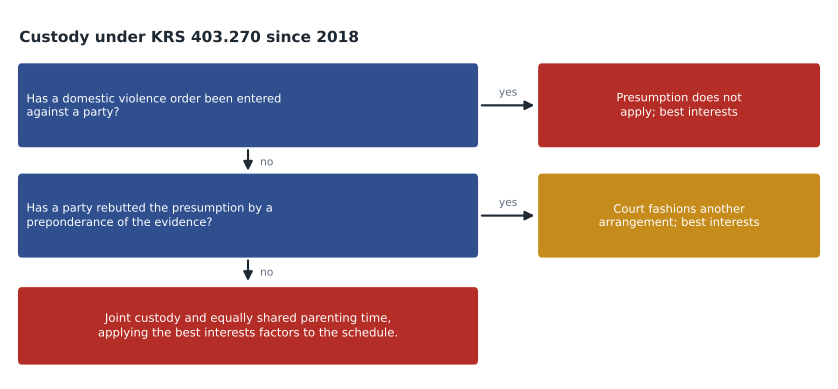
In 2018 the General Assembly enacted House Bill 528, which amended KRS 403.270 to create a rebuttable presumption that joint custody and equally shared parenting time are in the best interests of the child. Kentucky is widely described as the first state to adopt such a presumption for final custody orders. The presumption can be rebutted by a preponderance of the evidence, and it does not apply where a domestic violence order has been entered against a party.
The presumption shifts the starting point. Before 2018, the court applied the best interests factors without a statutory starting point. Now a parent who seeks more than equal time, or sole custody, carries the burden of showing that the presumption should not apply. The court still considers the statutory best interests factors, such as the wishes of the parents and child, the child's relationships, adjustment to home, school and community, and the mental and physical health of everyone involved.
Equal parenting time does not always mean an exact split of days. Courts have approved schedules that approximate equal time while accounting for school, work and distance. And a party seeking to modify an existing order faces its own statutory standards.
| Issue | Kentucky rule | Source |
|---|---|---|
| Ground for divorce | Marriage irretrievably broken | KRS Chapter 403 |
| Division of marital property | Just proportions after nonmarital property is assigned | KRS 403.190 |
| Custody starting point | Rebuttable presumption of joint custody and equal parenting time | KRS 403.270, as amended in 2018 |
| Rebutting the presumption | Preponderance of the evidence | KRS 403.270 |
| Domestic violence | Presumption does not apply where a DVO has been entered against a party | KRS 403.270 |
Wills
Kentucky recognizes two kinds of wills. An attested will must be in writing, signed by the testator, and signed by two witnesses in the testator's presence. A holographic will is valid in Kentucky without witnesses if it is wholly in the testator's handwriting and signed by the testator. Many jurisdictions do not recognize holographic wills at all, so this is a real difference.
A holographic will saves effort and creates risk. It must be proved after death, usually by people who can identify the handwriting, and it is often unclear or incomplete. A typed will that is signed but not witnessed is not a holographic will and is not valid. Sadie's retired farmer could write a valid will at his kitchen table, but the partner persuaded him to let the firm prepare an attested will with a self-proving affidavit, which allows the will to be admitted to probate without testimony from the witnesses.
Dower, curtesy and the surviving spouse
Kentucky is one of a small number of states that still has statutory dower and curtesy. Under KRS 392.020, a surviving spouse is entitled to an estate in fee simple in one half of the real property the deceased spouse owned in fee simple at death, and to a life estate in one third of real property the deceased spouse owned during the marriage but not at death, unless the surviving spouse relinquished that interest. The surviving spouse also takes a share of personal property under the same chapter.
Because a spouse's rights can survive a sale, Kentucky real estate practice routinely requires the seller's spouse to join in a deed to release dower or curtesy. A title examiner who sees a deed from a married seller without the spouse's signature will flag it.
A surviving spouse who is unhappy with the will may renounce it and take the statutory share instead, within the time and in the manner the statute requires. That is the answer to the widow's question: her husband's will cannot leave her with nothing if she makes a timely renunciation.
Worked problem
What does Mr. Ellis take?
Mrs. Ellis died owning a farm in her name alone. During the marriage she had also sold a rental house without Mr. Ellis joining in the deed. Her will leaves everything to her niece. Mr. Ellis consults the firm about his rights.
Show solution
- As surviving spouse, Mr. Ellis may renounce the will and claim his statutory share.
- Under KRS 392.020 he would take a fee simple interest in one half of the farm, which she owned at death.
- Because he did not relinquish his interest in the rental house, he may claim a life estate in one third of it, subject to the details of the statute.
- He must act within the time the renunciation statute allows.
Answer: Mr. Ellis can renounce the will and claim dower in both properties, but he must do so within the statutory time.
Common mistakes
MistakeAssuming a parent must prove entitlement to equal time.
InsteadSince 2018, joint custody and equal parenting time are presumed; the party seeking otherwise must rebut the presumption.
MistakeApplying the presumption despite a domestic violence order.
InsteadThe presumption does not apply where a DVO has been entered against a party.
MistakeTreating a signed, typed, unwitnessed will as valid.
InsteadOnly a will wholly in the testator's handwriting is valid without witnesses.
MistakeForgetting the spouse's signature on a deed.
InsteadDower and curtesy survive a sale unless the spouse relinquishes them.
MistakeDividing marital property equally by default.
InsteadKentucky divides marital property in just proportions.
Practice problems
Work each problem on paper first, then reveal the answer to check.
What is the ground for divorce in Kentucky?
Show answer
That the marriage is irretrievably broken.
What presumption did the 2018 custody amendment create?
Show answer
A rebuttable presumption of joint custody and equally shared parenting time.
By what standard may the presumption be rebutted?
Show answer
A preponderance of the evidence.
What makes a holographic will valid in Kentucky?
Show answer
It is wholly in the testator's handwriting and signed.
What does a surviving spouse take in real property owned at death under KRS 392.020?
Show answer
A fee simple interest in one half.
Maintenance and child support
Kentucky's maintenance statute, KRS 403.200, follows a two-step structure familiar from the Uniform Marriage and Divorce Act. The court first asks whether the spouse seeking maintenance lacks sufficient property, including marital property apportioned to that spouse, to provide for reasonable needs and is unable to support himself or herself through appropriate employment. Only if that threshold is met does the court decide the amount and duration, considering factors such as the standard of living during the marriage, the duration of the marriage, the age and condition of the spouse seeking maintenance and the other spouse's ability to pay.
Child support is set by statutory guidelines in KRS 403.212, based on the parents' combined income and the number of children, with adjustments for items such as health insurance and child care. The guidelines carry a rebuttable presumption of correctness, and a court that deviates from them must explain why. The equal parenting presumption does not eliminate child support; support is still calculated under the guidelines, which take parenting time into account in ways the statute specifies.
Protective orders
Family court lawyers see protective order proceedings often. Kentucky provides domestic violence orders for family members and members of an unmarried couple, and interpersonal protective orders under KRS Chapter 456 for victims of dating violence, sexual assault and stalking who do not have a qualifying family or household relationship with the respondent. Emergency relief is available quickly, with a hearing set promptly afterward. Because a domestic violence order removes the custody presumption discussed above, the outcome of a protective order hearing can shape a later custody case, and lawyers on both sides should prepare for it with that in mind.
Probate in district court
In Kentucky, probate matters are heard in district court. An executor named in a will, or an administrator for an estate without a will, applies to the district court in the county of the decedent's residence for appointment. The court may require a bond, though wills commonly waive it for the named executor. The personal representative then gathers assets, gives notice to creditors, pays valid claims and taxes, and distributes what remains under the will or the intestacy statutes. Kentucky also provides simplified procedures for small estates and for situations in which a surviving spouse takes most of the property.
Sadie's partner keeps a probate checklist with each step and the statutory deadline that applies to it. The items that new lawyers most often miss are the deadline for creditor claims, the inventory the representative must file, and the time limit for a surviving spouse to renounce the will.
Intestate succession
When a person dies without a valid will, Kentucky's descent and distribution statutes decide who takes. The rules are not the same as those in the Uniform Probate Code, which the bar exam often uses as its reference. In Kentucky, the surviving spouse's share of real property is generally the dower or curtesy interest described in this lesson, while the rest passes to descendants or, if there are none, to other relatives in the order the statute sets out. A new lawyer should not assume that a surviving spouse takes the entire estate when there are children, as some other systems provide.
Advising the client who wants to do it alone
Clients often ask whether they need a lawyer for a will or an uncontested divorce. The honest answer is that Kentucky law permits a holographic will and that some uncontested divorces proceed with little difficulty. But the mistakes that matter, such as a will that fails for lack of witnesses, a missed dower interest, an agreement that does not address retirement accounts, or a parenting schedule that cannot work, are expensive to fix later. Marchetti's group practices explaining that tradeoff in plain terms, because a client who understands the risks makes better decisions whatever they decide.
Separation agreements
Most Kentucky divorces end in a written separation agreement rather than a trial. KRS 403.180 allows the spouses to agree on property, maintenance, custody and support, and it makes the property and maintenance terms binding on the court unless the court finds them unconscionable. Terms about the children are different: the court keeps the responsibility to decide whether custody, parenting time and support arrangements serve the child's interests. A good agreement lists every asset and debt, assigns each one, and addresses items that are easy to forget, such as retirement accounts that need a separate court order to divide, tax filings for the final year and the treatment of the family home if it does not sell. Sadie's partner reads every draft agreement with one question in mind: what will these two people argue about in three years, and has the agreement already answered it?
Summary and key terms
- Kentucky divorce is no-fault; marital property is divided in just proportions after nonmarital property is assigned.
- Since 2018, KRS 403.270 presumes joint custody and equal parenting time, rebuttable by a preponderance and inapplicable where a DVO exists.
- Kentucky recognizes attested wills with two witnesses and holographic wills wholly in the testator's handwriting.
- KRS 392.020 preserves dower and curtesy: one half in fee of real property owned at death and a life estate in one third of certain property sold during marriage.
- A surviving spouse may renounce the will and take the statutory share.
- Just proportions
- Kentucky's standard for dividing marital property, which need not be equal.
- Holographic will
- A will wholly in the testator's handwriting and signed, valid in Kentucky without witnesses.
- Dower and curtesy
- A surviving spouse's statutory interest in the deceased spouse's real property.
- Renunciation
- A surviving spouse's election to take the statutory share instead of the will's provisions.
Lesson quiz · 5 questions
Score 60% or more to complete this lesson.
Create a free account to save your progress, take quizzes and earn a certificate.