
BAR-219 · Lesson 11 of 12 · 16 min
No reciprocity: admission routes, practice after admission and CLE
▶ Video coming soon A video version of this lesson is on the way.
Eddie's eleventh session began with a question from someone else. A lawyer at the Lafayette firm, admitted in Texas for eight years, had just moved back to Louisiana to be closer to family, and she had asked Eddie, half joking, whether she could ride his coattails into the Louisiana bar. 'I told her I thought she had to take the exam with me in February,' Eddie said. 'She did not believe me. In Texas, she said, someone with her experience would be admitted on motion.'
'She should believe you,' Marchetti said. 'Louisiana is one of the few jurisdictions with no admission on motion at all. Her eight years in Texas count for nothing toward a full Louisiana license, though they do open some limited doors. Today we cover those doors, then what happens after you are admitted: the oath, the bar, the annual obligations and continuing legal education. You will need the second half in about five months, if February goes well.'
No reciprocity
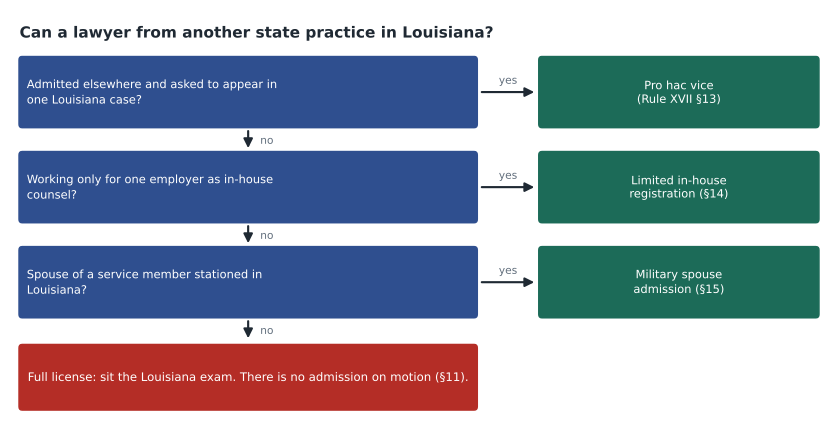
Rule XVII provides that Louisiana does not grant admission on motion or by reciprocity. A lawyer admitted in another state who wants a full Louisiana license must meet the same requirements as a new graduate: an ABA-approved J.D., character and fitness, a passing score on Part I and an MPRE score of 80. The rule does contain an MPRE exception for lawyers already admitted elsewhere, so an experienced lawyer may not need a fresh MPRE score if the conditions in the rule are met. But the nine-test Part I examination is unavoidable.
Louisiana's position is unusual. Most American jurisdictions admit lawyers from other states on motion after a period of active practice, typically five of the last seven years, and many accept transferred UBE scores. Louisiana's reasons tie back to the Code: a lawyer trained and experienced only in common law has not shown competence in the Civil Code subjects that govern most private disputes in Louisiana, and the examination is the Committee's way of testing it.
Pro hac vice
A lawyer admitted in another jurisdiction may appear in a particular Louisiana case by permission of the court, known as admission pro hac vice, under Rule XVII section 13. The out-of-state lawyer must associate with a Louisiana lawyer who is a member in good standing of the Louisiana bar, file a motion with the court with the information the rule requires, and pay the required fee. The Louisiana lawyer remains responsible to the court. Pro hac vice permission is case by case and at the court's discretion, and a lawyer who appears repeatedly risks being seen as practicing in Louisiana without a license, so it cannot serve as a substitute for one.
In-house counsel registration
Section 14 of Rule XVII allows a lawyer admitted in another jurisdiction who is employed in Louisiana by a single organization, as in-house counsel, to register with the court and provide legal services to that employer. The registered in-house lawyer may advise the employer and its organizational affiliates but may not, on that basis alone, represent other clients or appear in Louisiana courts. The registered lawyer must comply with the Louisiana Rules of Professional Conduct, is subject to Louisiana discipline and must meet continuing education and registration obligations set by the rule.
Military spouses and non-citizens
Section 15 of Rule XVII addresses lawyers who are spouses of members of the armed forces stationed in Louisiana. A qualifying military spouse admitted in another jurisdiction may obtain a limited admission to practice in Louisiana while the service member is stationed here, subject to conditions in the rule, including association with or supervision by a Louisiana lawyer where required and termination of the authority when the service member's assignment ends or the other conditions are no longer met. Section 16 addresses applicants who are not United States citizens or lawful permanent residents, setting out the conditions under which they may be admitted.
Federal practice
Admission to a federal court is separate from state admission. The federal district courts in Louisiana, the Eastern, Middle and Western Districts, and the United States Court of Appeals for the Fifth Circuit admit lawyers under their own rules. The Louisiana district courts generally require admission to the Louisiana bar for general admission, with pro hac vice provisions for lawyers admitted elsewhere. Federal practice before agencies, such as immigration courts or the Patent and Trademark Office, has its own rules. An out-of-state lawyer may be able to practice exclusively federal law in Louisiana in some settings, but should check both the federal rules and Louisiana's rules on unauthorized practice before relying on that.
| Route | Rule XVII section | Scope | Key condition |
|---|---|---|---|
| Full admission by examination | 3, 7 and 8 | All practice | Pass Part I and the MPRE; character and fitness |
| Pro hac vice | 13 | One case at a time | Association with Louisiana counsel; court permission |
| In-house registration | 14 | Advice to the employer only | Employment by a single organization in Louisiana |
| Military spouse | 15 | Limited practice | Service member stationed in Louisiana |
| Admission on motion | 11 | Not available | Louisiana grants no reciprocity |
The oath and admission
After the Committee reports that an applicant has passed both parts and satisfied character and fitness, the court admits the applicant. Rule XVII requires the applicant to take the oath of office in person before a justice of the Louisiana Supreme Court or the clerk of court. Admission ceremonies are held after each set of results, and new lawyers may also be sworn in individually under the rule. Admission is not complete until the oath is taken, and a person who has passed but not taken the oath may not practice.
The Louisiana State Bar Association
Every lawyer admitted in Louisiana becomes a member of the LSBA, the state's mandatory unified bar, and must pay annual dues and the disciplinary assessment. Members file annual registration information, including addresses and trust account information, and must keep it current. The LSBA offers ethics advisory services, practice management resources, a lawyer assistance program and sections for practice areas. For new lawyers, the most important LSBA program is Transition Into Practice.
Continuing legal education
Supreme Court Rule XXX sets the mandatory continuing legal education requirement, which the LSBA's Mandatory Continuing Legal Education Committee administers. Each active Louisiana lawyer must complete 12.5 hours of approved CLE each calendar year, including at least one hour of legal ethics and one hour of professionalism. Lawyers must report compliance by January 31 of the following year, and the rule allows a limited carryforward of excess hours to the next year.
New admittees have a special rule. A newly admitted lawyer must complete 12.5 hours over the year of admission and the following year combined, rather than 12.5 hours in each year, and at least eight of those hours must be in legal ethics, professionalism or law office management. Completing the LSBA's Transition Into Practice program satisfies the new admittee requirement. The rule also provides a reduced requirement for older lawyers: from January 1, 2026, lawyers aged 65 and older complete five hours a year until age 75, under the amended rule.
Transition Into Practice
Transition Into Practice pairs a newly admitted lawyer with an experienced mentor for a structured program of activities over the first year of practice. Mentors and new lawyers work through topics such as client relations, trust accounting, law office management, professionalism, court procedures and work-life balance, and meet to discuss real situations. Eddie's firm already has a mentor in mind for him, a successions and insurance lawyer who has practiced in Lafayette for thirty years.
Worked problem
The Texas lawyer's options
Lorraine, admitted in Texas for eight years, has moved to Lafayette and joined a firm that wants her to work on Louisiana and Texas cases. What can she do now, and what does a full Louisiana license require?
Show solution
- Admission on motion: not available in Louisiana under Rule XVII section 11.
- Pro hac vice: she may appear in individual Louisiana cases with a Louisiana lawyer associated and the court's permission, subject to the rule's limits.
- In-house registration: not applicable, because she works for a firm with clients rather than as counsel to a single employer.
- Federal and Texas work: she may continue Texas matters and federal work under her Texas license and federal admissions, taking care not to hold herself out as a Louisiana lawyer.
- Full license: she must apply to sit Part I, satisfy character and fitness and either submit an MPRE score of 80 or qualify for the rule's exception for lawyers admitted elsewhere.
Answer: Lorraine can work on Louisiana cases only pro hac vice for now; for a full license, she must pass the nine-test Louisiana examination like any new graduate.
Practice obligations in the first year
Beyond CLE, a new Louisiana lawyer has several obligations that come up in the first year. Trust accounts must be set up properly, with client funds kept separate from the lawyer's own funds. Malpractice insurance is not mandatory for all Louisiana lawyers, but most firms carry it and lawyers in private practice should consider it carefully. Lawyers must comply with the Louisiana Rules of Professional Conduct, including the differences from the Model Rules covered in Lesson 10, and with the advertising rules if they market their services.
Marchetti's advice for the first year is practical. Keep a calendar system that cannot fail, because missed deadlines are the most common source of malpractice claims and disciplinary complaints. Read the Louisiana rules on trust accounting before handling any client money. Use the LSBA's ethics resources when a question comes up. And take Transition Into Practice seriously, because it satisfies the new admittee CLE requirement and builds relationships that will help for years.
Common mistakes
MistakeAn experienced lawyer from another state can be admitted to Louisiana on motion.
InsteadLouisiana grants no admission on motion; a full license requires passing Part I.
MistakePro hac vice admission allows unlimited Louisiana practice.
InsteadPro hac vice is case by case, requires association with Louisiana counsel and is limited by the rule.
MistakeLouisiana lawyers need 12 CLE hours a year.
InsteadThe requirement is 12.5 hours a year, including one hour of ethics and one hour of professionalism.
MistakeNew lawyers must complete 12.5 hours in the year of admission and 12.5 the next year.
InsteadNew admittees complete 12.5 hours over the year of admission and the next year combined, with at least eight in ethics, professionalism or law office management.
MistakeThe oath can be taken by mail after passing.
InsteadRule XVII requires the oath to be taken in person before a justice or the clerk of court.
Planning the first two years of CLE
Eddie asked how he should plan his CLE if he is admitted in the spring of 2027. Marchetti walked through it. Under the new admittee rule, Eddie's compliance period would cover 2027, the year of admission, and 2028, the following year, combined. He would need 12.5 hours across those two years, at least eight of them in ethics, professionalism or law office management. If he completes Transition Into Practice with his mentor, that satisfies the requirement. From 2029, he would move to the regular cycle: 12.5 hours each calendar year, including at least one hour of ethics and one hour of professionalism, reported by January 31 of the next year.
Many Louisiana lawyers take more than the minimum, because CLE seminars are where they learn the year's legislative changes. Each summer, after the regular session, bar groups and law schools run programs on new legislation affecting the Civil Code, the Code of Civil Procedure and practice areas such as insurance, successions and family law. For a lawyer in a state whose codes change every year, those programs are less a chore than a necessity.
What happens if a lawyer falls behind
A lawyer who does not complete or report CLE on time faces consequences under Rule XXX, starting with notices and late fees and, if the deficiency is not cured, a declaration of ineligibility to practice until the lawyer complies. A lawyer who practices while ineligible risks discipline for unauthorized practice. The same is true of failing to pay bar dues or the disciplinary assessment, or failing to keep registration information current. These failures are easy to avoid with a calendar reminder and a habit of reporting hours as soon as a seminar ends.
Inactive status and returning to practice
Lawyers who stop practicing, temporarily or permanently, may change to inactive status, which reduces dues and suspends the CLE requirement, but an inactive lawyer may not practice law in Louisiana. A lawyer who wants to return to active status must meet the conditions set by the LSBA and the court, which can include completing CLE hours. A Louisiana lawyer who moves out of state may keep a Louisiana license active by continuing to pay dues and complete CLE, which can matter given Louisiana's lack of reciprocity: a lawyer who lets the license lapse may find it harder to return than one who kept it current.
Eddie wrote the CLE dates into the same planner he uses for bar study. 'If I can track nine tests across three days,' he said, 'I can track 12.5 hours across two years.' Marchetti suggested one more habit: keeping certificates of attendance in a single folder, so that if the MCLE Committee ever asks for proof, the answer takes a minute rather than an afternoon. Small systems like that, she said, are what separate lawyers who never think about compliance from lawyers who spend every January scrambling.
Summary and key terms
- Louisiana grants no admission on motion or reciprocity; a full license requires passing Part I, with an MPRE exception for some lawyers admitted elsewhere.
- Limited routes include pro hac vice under section 13, in-house registration under section 14 and military spouse admission under section 15.
- Admission requires the oath in person before a justice or the clerk of court, followed by mandatory LSBA membership and annual obligations.
- Rule XXX requires 12.5 CLE hours a year, including one hour each of ethics and professionalism, reported by January 31.
- New admittees complete 12.5 hours over the admission year and the next, with at least eight in ethics, professionalism or law office management; Transition Into Practice satisfies it.
- Admission on motion
- Admission of a lawyer licensed elsewhere without examination, not available in Louisiana.
- Pro hac vice
- Permission for an out-of-state lawyer to appear in a particular case.
- In-house registration
- Limited authority for an out-of-state lawyer to advise a single employer in Louisiana.
- Rule XXX
- The Louisiana Supreme Court rule setting the mandatory continuing legal education requirement.
- Transition Into Practice
- The LSBA's mentoring program for new lawyers, which satisfies the new admittee CLE requirement.
Lesson quiz · 5 questions
Score 60% or more to complete this lesson.
Create a free account to save your progress, take quizzes and earn a certificate.