
BAR-219 · Lesson 5 of 12 · 16 min
Louisiana's own exam and the NextGen decision
▶ Video coming soon A video version of this lesson is on the way.
A week after the scoring session, Eddie forwarded Marchetti a news article about the NextGen bar examination, NCBE's new test that first went live in July 2026. 'Half my friends in other states are talking about whether they will be the first NextGen class or the last UBE class,' he wrote. 'Does any of this touch Louisiana? And if Louisiana is staying on its own, does that hurt me if I ever want to practice in Texas?'
Marchetti answered at their next session. 'Short version: NextGen does not touch your exam, and Louisiana has said it is not adopting it. Your Louisiana pass will not transfer to Texas whether or not NextGen exists, because Louisiana has never given a portable score. That is a real cost of a Louisiana license, and it is worth understanding before you plan a career that crosses state lines. Let us look at how Louisiana's choice compares with the national model and what it means for you in practice.'
A state that writes its own test
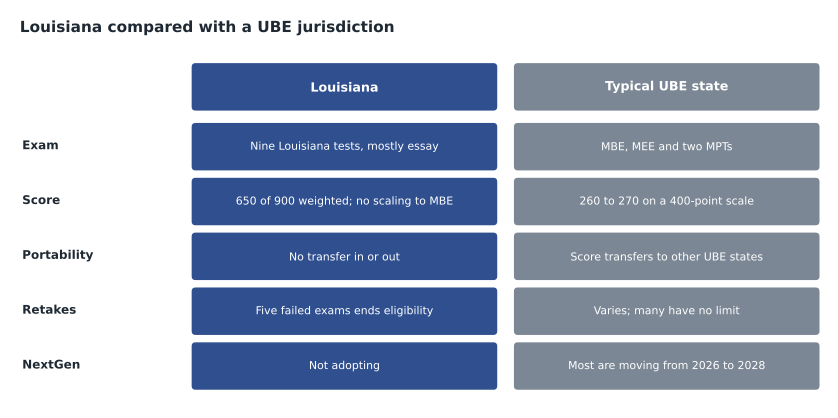
Most American jurisdictions now give the Uniform Bar Examination or are moving to NextGen. Under the UBE, NCBE writes the Multistate Bar Examination, a 200-question multiple-choice test; the Multistate Essay Examination, six essays on national law; and two Multistate Performance Test tasks, which test practical lawyering skills with a closed universe of materials. Jurisdictions grade the essays and performance tests, NCBE scales the scores to the MBE, and the result is a score on a 400-point scale that examinees can transfer to other UBE jurisdictions.
Louisiana has never joined that system. Its examination is written by the Committee on Bar Admissions, graded by Louisiana graders appointed by the Supreme Court and built around the Civil Code and Louisiana's other codes. NCBE's jurisdiction data for Louisiana lists no MBE, no MEE, no MPT and no UBE, and states that Louisiana does not accept transferred UBE scores. The reason is not stubbornness. A national examination built on common law subjects would not test the law that governs most private disputes in Louisiana: obligations, property, successions and matrimonial regimes under the Civil Code, delictual liability under article 2315 and procedure under the Code of Civil Procedure. An examinee could earn a high UBE score while knowing nothing about any of them.
What NextGen is
NCBE designed the NextGen bar examination to replace the UBE over several years. NextGen integrates knowledge and skills in a single examination, with question sets that combine multiple-choice, short-answer and longer written tasks, and it covers a narrower set of foundational subjects in more depth along with lawyering skills such as legal research, writing, issue spotting and client counseling. The first jurisdictions gave NextGen in July 2026, and NCBE has said the UBE will be phased out after a transition period, with the last UBE administrations expected around 2028.
For a UBE jurisdiction, adopting NextGen is mostly a question of timing. For Louisiana, it was a question of whether to join a national examination at all. NCBE's jurisdiction tracker lists Louisiana as not adopting NextGen. That fits Louisiana's history. The Committee has always tested Louisiana law directly, and nothing in NextGen changes the basic problem that a national test does not cover the Civil Code.
What Louisiana's choice means for candidates
For a candidate like Eddie, who intends to practice in Louisiana, the consequences are mostly good. He prepares for one examination, focused on the law he will use. He does not need to learn the national common law of property, contracts or wills in the depth the MBE demands, though some national material appears in the non-Code tests. His study materials come from Louisiana courses, Louisiana commercial providers and the Committee's own published questions and scope documents.
The consequences that cut the other way are portability and mobility. A Louisiana pass gives Eddie a Louisiana license and nothing more. If he wants to practice in Texas later, he cannot transfer a score, because he has none to transfer. He would need to sit the Texas examination or, once he has enough years of practice, apply for admission on motion under Texas's own rules, which many states allow for experienced lawyers from other jurisdictions. The door is not closed, but it is not the easy transfer that UBE examinees enjoy.
The rule cuts the other way as well. A lawyer licensed in Texas, Mississippi or any other state who wants a full Louisiana license cannot transfer a UBE score in and cannot be admitted on motion. Louisiana grants no reciprocity under Rule XVII. That lawyer must sit and pass Part I and satisfy the MPRE requirement like any new graduate. Lesson 11 covers the limited permissions that Louisiana does extend to out-of-state lawyers.
| Situation | UBE or NextGen jurisdiction | Louisiana |
|---|---|---|
| New graduate sits the bar | Takes the national examination; may transfer the score | Takes the nine-test Louisiana examination; score cannot be transferred |
| Examinee wants to move a score in | Usually allowed within a time limit | Not allowed |
| Experienced lawyer from another state | Often eligible for admission on motion | Must sit the Louisiana examination |
| Retake limits | Vary; many jurisdictions have none | Five failed attempts end eligibility |
| Switch to NextGen | Scheduled between 2026 and 2028 in most adopting jurisdictions | Not adopting |
Planning a career with a Louisiana license
Eddie's plan is to practice in Lafayette, and most Louisiana graduates stay in the state. For them, the lack of portability is a remote concern. But some Louisiana practices cross state lines regularly: maritime and energy work in the Gulf, insurance defense for national carriers, and federal practice in the Fifth Circuit. Lawyers in those fields often hold more than one license, and they plan for it.
Marchetti offered three practical points. First, federal court admission is separate from state admission. A Louisiana lawyer can be admitted to practice in the federal district courts in Louisiana and in the Fifth Circuit, and many federal courts in other states allow admission based on any state license or by pro hac vice motion. Second, many states admit experienced lawyers on motion after a set number of years of active practice, typically five of the last seven, so a Louisiana lawyer who later moves may not need to sit another examination, depending on that state's rules. Third, a candidate who already knows that a second license will be needed soon may want to sit a UBE jurisdiction's examination early in a career, while the material is fresh, rather than waiting.
Worked problem
A two-state career question
Eddie's friend Noémie, also a 2026 Louisiana graduate, has an offer from a Houston firm whose maritime group handles cases in both Texas and Louisiana courts. The firm wants her licensed in both states within two years. How should she think about it?
Show solution
- The Louisiana license requires the Louisiana examination; no Texas or UBE score can substitute.
- The Texas license requires the Texas examination, or admission on motion after enough years of practice under Texas rules; a Louisiana pass gives her no score to transfer.
- She cannot sit both examinations at the same sitting if their days overlap, so she should plan them for different sittings and check each jurisdiction's calendar.
- Federal court admission in both states may be available once she holds one state license, which covers much maritime work in federal court.
- Given Louisiana's five-attempt limit and the weight of the Code tests, she may decide to sit Louisiana first, while her civil law education is fresh, and Texas next.
Answer: Noémie needs two separate examinations; Louisiana first, then Texas at a later sitting, is a sensible plan, with federal admission covering much of her early maritime work.
Preparing for a test nobody else gives
Because the Louisiana examination is unique, candidates cannot rely on the enormous national market of practice questions that UBE candidates use. The best materials are Louisiana-specific: the Committee's published prior questions and topic lists for each subject, its sample multiple-choice questions, Louisiana bar review courses, and the candidate's own law school outlines from Louisiana courses. Marchetti tells candidates to treat the Committee's prior questions as a map of what the examiners care about, not as questions that will repeat. The examiners write new questions for each sitting, and recent questions are useful for practice precisely because they show the style and depth expected.
Candidates should also use the Code itself as a study tool. The Civil Code is a compact, organized text, and reading the key titles from beginning to end, with the official revision comments, gives a structure that no outline can match. Eddie has a dog-eared copy from law school, and Marchetti told him to keep it on the desk every day.
How graders read a Louisiana essay
Louisiana graders read many answers to the same question, and they reward a recognizable pattern: the issue stated clearly, the rule stated accurately with the key article where it matters, application that uses the specific facts, and a conclusion. In Code subjects, a grader looks for a civilian method: start from the legislation, read articles together as a system, and use court decisions as persuasive applications. Graders also notice answers that import common law concepts where the Code has its own: consideration instead of cause, adverse possession instead of acquisitive prescription, or a will instead of a testament. Those slips signal that the candidate is reasoning from outside the system.
'You do not need to sound like a treatise,' Marchetti told Eddie. 'You need to sound like a Louisiana lawyer who knows where the rule lives. If you write "under article 3473, a possessor in good faith with just title acquires ownership after ten years," a grader knows you understand the system. If you write "adverse possession requires open and notorious possession for the statutory period," a grader knows you learned property somewhere else.'
Why the independent examination persists
Some commentators have argued that Louisiana could join a national examination and add a Louisiana component for the Code subjects, as several UBE jurisdictions do with short local law courses or tests. Louisiana has so far kept its own examination in full. The volume of Code material, the weight Louisiana places on it and the importance of civil law method all make a short supplement a poor fit. For candidates, the practical lesson is to prepare for the examination that exists and to check the Committee's page for any announcements about future changes.
Common mistakes
MistakeLouisiana will move to NextGen on the national timetable.
InsteadNCBE lists Louisiana as not adopting NextGen; it keeps its own examination.
MistakeA Louisiana pass can be transferred to a UBE state.
InsteadLouisiana does not produce a UBE score, so there is nothing to transfer.
MistakeA high UBE score from another state lets an examinee skip Louisiana's exam.
InsteadLouisiana does not accept transferred UBE scores.
MistakeCalling it adverse possession is fine on a Louisiana essay.
InsteadUse the Code's concept and vocabulary: acquisitive prescription, and testament rather than will.
MistakePrior Committee questions will repeat.
InsteadPrior questions show style and coverage; the examiners write new questions for each sitting.
Coming from a common law education
Not every Louisiana candidate went to law school in Louisiana, and not every Louisiana law student took the civil law courses. A graduate of a law school in another state, or a Louisiana graduate who chose a common law track, faces a steeper climb, because the Code tests assume a working knowledge of a system the candidate may never have studied. Marchetti's advice for these candidates is to start earlier than they think they need to, to learn the structure of the Civil Code before memorizing rules, and to unlearn common law vocabulary deliberately.
A useful exercise is to make a two-column list of common law terms and their Louisiana counterparts: will and testament, adverse possession and acquisitive prescription, easement and servitude, life estate and usufruct, tort and delict or offense and quasi-offense, consideration and cause, statute of limitations and liberative prescription, and pleading by general allegation and fact pleading under the Code of Civil Procedure. The counterparts are not exact translations, and the differences are often what the essay tests. Usufruct, for example, is a real right of limited duration that can arise by law, as the surviving spouse's usufruct over community property does, which has no neat common law equivalent.
What carries over from national study
The independent examination does not mean a candidate's national knowledge is wasted. Constitutional law, federal jurisdiction and procedure, and much of evidence and criminal procedure rest on federal law that applies everywhere. Skills carry over too. The ability to read a fact pattern for issues, organize an answer under clear headings, state a rule accurately and apply it to specific facts is the same in Baton Rouge as in Boston. The MPRE is identical in every jurisdiction.
Eddie found that his evidence and constitutional law sessions with the group translated directly. 'The Friday tests feel like the national subjects with a Louisiana accent,' he said. 'Monday is a different language.' Marchetti agreed and added a warning: candidates who feel comfortable on Friday sometimes spend too much time there because it feels productive. The weighting says Monday and Wednesday are where the points are.
Staying current
Because Louisiana's examination is written in Louisiana, its content tracks Louisiana legislation and Louisiana Supreme Court decisions more closely than a national test can. That cuts both ways. Candidates need to know recent changes that are more than six months old by the sitting, and outlines from a few years ago may be out of date on points that matter, such as the 2024 change to delictual prescription and the 2025 change to comparative fault. Candidates should check the effective dates of any change they rely on.
Summary and key terms
- Louisiana writes and grades its own examination; it gives no MBE, MEE, MPT or UBE and does not accept transferred UBE scores.
- NCBE lists Louisiana as not adopting NextGen, which first went live in other jurisdictions in July 2026.
- A Louisiana pass is not portable; a second license elsewhere requires that state's examination or admission on motion under its rules.
- Lawyers licensed elsewhere must sit the Louisiana examination for a full license, because Louisiana grants no reciprocity.
- Prepare with Louisiana materials, the Committee's published questions and scope documents, and the Code itself, using civil law vocabulary and method.
- Uniform Bar Examination
- NCBE's combined MBE, MEE and MPT examination, scored on a 400-point scale and transferable among UBE jurisdictions.
- NextGen bar examination
- NCBE's new integrated examination, first given in July 2026, which Louisiana is not adopting.
- Score portability
- The ability to transfer a bar examination score from one jurisdiction to another.
- Reciprocity
- Admission of a lawyer licensed elsewhere without examination; Louisiana does not offer it.
- Civilian method
- Reasoning that starts from the code as a coherent system and treats decisions as persuasive applications.
Lesson quiz · 5 questions
Score 60% or more to complete this lesson.
Create a free account to save your progress, take quizzes and earn a certificate.