
BAR-219 · Lesson 2 of 12 · 16 min
Eligibility, law student registration, deadlines and fees
▶ Video coming soon A video version of this lesson is on the way.
Eddie's second session with Marchetti began with a question from a friend. A classmate who had left the civil law track for a clerkship in Houston was thinking about moving home and sitting the July 2027 Louisiana examination. 'She asked me whether she can still file, what it costs, and whether it matters that she never did law student registration,' Eddie said. 'I realized I filed my own application without really reading the rule. I just followed the checklist.'
'Following the checklist is fine when it works,' Marchetti said. 'But you should know why the checklist looks the way it does, because you will be the one people ask. Louisiana's filing system has a few features that catch people out: an early registration step for law students, a timely window and a late window for each sitting, a dean's certificate that you have to request well in advance, and a fee schedule that rewards applicants who registered early. Let us go through them in order.'
Who may apply
Rule XVII sets out the requisites for admission. An applicant must be at least eighteen years of age. An applicant must be a citizen of the United States, a lawful permanent resident, or otherwise authorized to work lawfully in the United States; the rule has a separate section addressing applicants who are not citizens. An applicant must hold a Juris Doctor degree from a law school approved by the American Bar Association, and the dean of the law school must certify the graduation to the Committee. An applicant must also pass both parts of the examination, satisfy the Committee and the court of good moral character and fitness, and take the oath in person.
The education requirement is the one that most often surprises applicants from outside the mainstream. Louisiana does not admit graduates of law schools that are not ABA-approved on the strength of practice experience, and there is no route through law office study. Applicants educated abroad must complete substantial study at an ABA-approved law school; commercial guides describe a minimum of fourteen semester hours, together with an equivalency showing, but the rule and the Committee's instructions control, and anyone in that position should contact the Committee before relying on a summary.
Law student registration
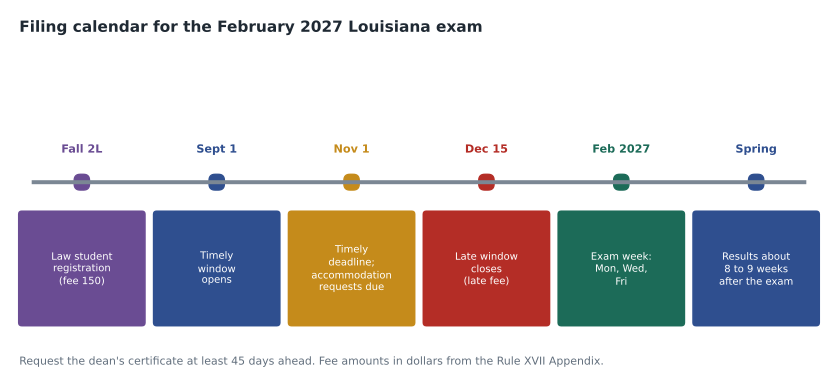
Louisiana asks law students who intend to practice in the state to register with the Committee while they are still in school, normally in the fall of the second year. Law student registration is not an application to sit the examination. It is an early filing that gathers background information, starts the character and fitness review and gives the Committee time to resolve any concerns before graduation. The Rule XVII appendix sets a law student registration fee of 150 dollars, with a higher late registration fee for students who file after the deadline.
Registration pays off in two ways. First, it spreads the character and fitness work over a longer period, so an applicant who has a past issue to explain has time to gather documents and answer questions. Second, the fee schedule rewards it: the appendix sets the bar application fee for first-time applicants who completed law student registration at 850 dollars, while other applicants pay 975 dollars. Eddie's Houston classmate, who never registered, will pay the higher fee and should expect a longer review because the Committee is starting her file from scratch.
The application windows
Louisiana gives the examination twice a year, in February and July, and each sitting has a timely filing window and a late filing window. For the February 2027 examination, commercial guides and NCBE's jurisdiction data describe a timely window from September 1 to November 1, 2026, and a late window from November 2 to December 15, 2026. An applicant who files in the late window pays a late fee in addition to the application fee. After the late window closes, the applicant must wait for the next sitting.
The July sitting follows the same pattern earlier in the year, and the Committee publishes the exact dates for each administration on its website. Because the windows open months before the examination, an applicant who decides late to sit in Louisiana may already be in the late window, or past it. Eddie's classmate, if she wants July 2027, should check the published dates now and plan to file within the timely window.
The dean's certificate
The Committee needs proof that each applicant graduated from an ABA-approved law school, and that proof comes from the dean, not the applicant. Law schools process these certificates in batches, and they need time to confirm that all degree requirements are complete. Commercial guides advise requesting the dean's certificate at least forty-five days before it is needed. An applicant who graduates in May and sits in July has very little slack; an applicant like Eddie, who graduated in May and sits in February, has plenty, but should still confirm that the certificate has arrived.
Testing accommodations
Applicants who need testing accommodations because of a disability must request them by the deadline the Committee sets for each sitting. For the February examination, the Committee's page gives November 1; for July, the deadline falls earlier in the year. A request needs supporting documentation from a qualified professional describing the condition, the functional limitation and the accommodation requested. Requests that arrive late or without adequate documentation may not be decided in time, so an applicant who might need accommodations should start gathering paperwork when filing the application, not after.
The laptop option
Louisiana allows applicants to type their essay answers on a laptop using approved examination software. Applicants who want to use a laptop must register for it, install the software and complete the practice test by the Committee's deadlines. NCBE's data for Louisiana lists a laptop fee of 136 dollars. Applicants who do not register, or whose laptops fail the setup, write by hand. Most candidates type, and Marchetti advises typing unless there is a specific reason not to: the essays are long, and typed answers are easier for graders to read.
The fee schedule
The Rule XVII appendix sets the fees for admission. The table below summarizes the main ones as stated in the appendix in late 2026; the appendix is amended from time to time, so applicants should check the current version.
| Item | Amount in dollars | Notes |
|---|---|---|
| Law student registration | 150 | Normally filed in the fall of the second year of law school |
| Late law student registration | 350 | For students who register after the deadline |
| Bar application, first-time applicant who completed law student registration | 850 | The lower rate rewards early registration |
| Bar application, all other applicants | 975 | Includes repeat applicants and those who did not register |
| Late filing fee | Additional amount set in the appendix | Charged for applications filed in the late window |
| Laptop registration | 136 | Per NCBE's jurisdiction data; paid to use examination software |
Eddie did the arithmetic for his classmate. 'She did not register, so she pays 975 for the application, plus the laptop fee if she types. If she files late, the late fee goes on top. That is real money for someone moving home on a clerk's salary.' Marchetti agreed. 'And it is avoidable. Filing early costs nothing extra.'
Worked problem
A late decision for the February sitting
Mireille, a 2025 graduate of an ABA-approved Texas law school who never registered as a Louisiana law student, decides on November 20, 2026 that she wants to sit the February 2027 Louisiana examination. What does she need to know?
Show solution
- The timely window for February 2027 closed on November 1, 2026, so she is in the late window, which runs to December 15, 2026.
- She must pay the application fee for applicants who did not complete law student registration, 975 dollars, plus the late filing fee in the appendix.
- She must arrange a dean's certificate from her Texas law school; she should request it immediately, because the forty-five day guidance runs past December 15.
- Her character and fitness review starts from the beginning, with the NCBE character report, Louisiana's supplemental questions and fingerprints.
- The accommodation deadline for February was November 1, so if she needs accommodations, she should ask the Committee whether a late request can be considered, or plan for July.
- She has about thirteen weeks to learn the Civil Code from scratch if she did not study it in law school, which is a serious challenge.
Answer: Mireille can still file in the late window with the higher fees, but she should consider whether July 2027 gives her a better chance, given the character review and the Code subjects she must learn.
Repeat applicants and the five-attempt limit
Rule XVII limits the number of times an applicant may fail the examination. An applicant who has failed the Louisiana examination five times may not apply again. Louisiana also gives no credit for individual subjects: an applicant who fails must sit all nine tests again at the next attempt, even those passed comfortably the first time. Rule XVII also requires applicants to sit all subjects in good faith, so a strategy of skipping a test to save effort is not an option.
The five-attempt limit makes each sitting count. Marchetti tells candidates to treat the first attempt as the one that matters, to sit only when they are ready, and to avoid sitting for practice. A failed attempt does not only cost time and fees; it uses one of a small number of chances.
How long a pass lasts
A passing score on Part I remains valid for five years. Within that time the applicant must satisfy the other requirements, including the MPRE and character and fitness, and be admitted. The MPRE score is likewise generally usable for five years, with an exception in the rule for lawyers admitted in other states. The practical effect is that an applicant who passes Part I but has an MPRE score below 80 can simply retake the MPRE, which NCBE offers several times a year, without repeating the nine tests.
Updating the application
An application is not a one-time document. Applicants have a continuing duty to update their disclosures if anything relevant changes before admission: a new address, a new job, an arrest, a lawsuit, a debt that goes to collection, a disciplinary action at work. Lesson 3 covers why this matters so much in the character and fitness review, but the short version is that failing to update is treated as a candor problem, and candor problems are more serious than most of the conduct people worry about disclosing.
Common mistakes
MistakeLaw student registration is the same as applying to sit the exam.
InsteadRegistration is an early character and fitness filing in law school; the bar application is filed separately for a specific sitting.
MistakeEvery applicant pays the same application fee.
InsteadFirst-time applicants who completed law student registration pay 850 dollars; other applicants pay 975 dollars.
MistakeMissing the timely deadline means waiting for the next sitting.
InsteadA late window follows the timely window, with an additional late fee.
MistakeAn applicant who fails can carry forward the subjects passed.
InsteadLouisiana gives no subject credit; a repeat applicant sits all nine tests.
MistakeThere is no limit on attempts.
InsteadAn applicant who has failed five times may not apply again.
A filing checklist that works
Marchetti keeps a one-page checklist for every Louisiana candidate, and she walked Eddie through it so that Eddie could pass it on to his classmate. The first item is the calendar: write down the timely deadline, the late deadline, the accommodation deadline and the laptop registration deadline for the sitting you want, taken from the Committee's own page, not from a forum post. The second item is the document list: the dean's certificate, any court records, employment records and explanations the application asks for, and the fingerprint materials. The third item is the money: the application fee at the rate that applies to you, the laptop fee, and the late fee if you are past the timely window.
The fourth item is the follow-up. Applicants should check the status of their file regularly and answer any request from the Committee promptly. A request for a missing document is routine; ignoring it is not. The fifth item is the update log: a short running note of anything that changes between filing and admission, so that the applicant can report it accurately and quickly. Candidates who keep this log rarely have trouble, because they never have to reconstruct months of changes from memory.
Choosing between February and July
Eddie's classmate asked whether February or July is the better sitting. There is no rule that one is easier, but the circumstances differ. July is the traditional sitting for new graduates, so most first-time takers sit then, and July results take longer because there are more papers to grade. February draws more repeat takers and graduates who finished in December or, like Eddie, chose to study through the fall. Provider-reported figures for recent sittings show higher overall pass rates in July than in February, largely because the July group has more first-time takers, who pass at higher rates everywhere.
For an individual, the better question is when you will be ready. A candidate who needs to learn the Civil Code from the beginning, as Eddie's classmate might after a common law education, should give herself the longer runway. A candidate who is already steeped in the Code and has a quiet fall, as Eddie did, can make February work well. Either way, the five-attempt limit means that sitting before you are ready is a poor bet.
Summary and key terms
- Applicants must be 18, meet the citizenship or work authorization requirement, hold an ABA-approved J.D. certified by the dean, pass both parts, show good character and take the oath in person.
- Law student registration in the second year starts the character file early and qualifies first-time applicants for the lower 850-dollar application fee.
- Each sitting has a timely and a late window; for February 2027 they ran from September 1 to November 1 and from November 2 to December 15, 2026.
- Request the dean's certificate at least 45 days ahead, and submit accommodation requests by the deadline for the sitting.
- There is no subject credit, applicants must sit all subjects in good faith, five failed attempts end eligibility, and a Part I pass lasts five years.
- Timely window
- The regular filing period for a given sitting of the Louisiana examination.
- Late window
- The filing period after the timely deadline, during which applications are accepted with an additional fee.
- Dean's certificate
- The law school dean's certification to the Committee that an applicant has graduated.
- Subject credit
- Carrying forward a passing score on one test to a later attempt; Louisiana does not allow it.
- Five-attempt limit
- The Rule XVII rule that an applicant who has failed five examinations may not reapply.
Lesson quiz · 5 questions
Score 60% or more to complete this lesson.
Create a free account to save your progress, take quizzes and earn a certificate.