
BAR-219 · Lesson 12 of 12 · 25 min
Capstone: Louisiana practice questions and an exam-day plan
▶ Video coming soon A video version of this lesson is on the way.
The last session in Eddie's course came on a gray Lafayette afternoon. His MPRE score had not arrived yet, his character and fitness file was quiet, and he had a desk covered in Code articles on index cards. 'I think I know the law,' he told Marchetti. 'What I do not know is whether I can produce it on demand, three tests a day, for three days, in the order the Committee picks.'
'That is exactly the right worry for this stage,' Marchetti said. 'Knowing the law and writing it under time pressure are different skills. Today we do three things. We build a study plan for the twelve weeks between now and February, weighted by the scoring. We work through original practice questions in the style of the Code tests, with the analysis a grader looks for. And we plan exam week down to the hour, including the parts nobody thinks about until the night before.'
A twelve-week plan weighted by the score
Lesson 4 showed that the five Code tests carry about 643 of the 900 weighted points. A study plan should reflect that. Marchetti's plan for Eddie gives roughly two thirds of the hours to the Code tests and one third to the non-Code tests, with the last weeks devoted to timed practice in the order of the examination days.
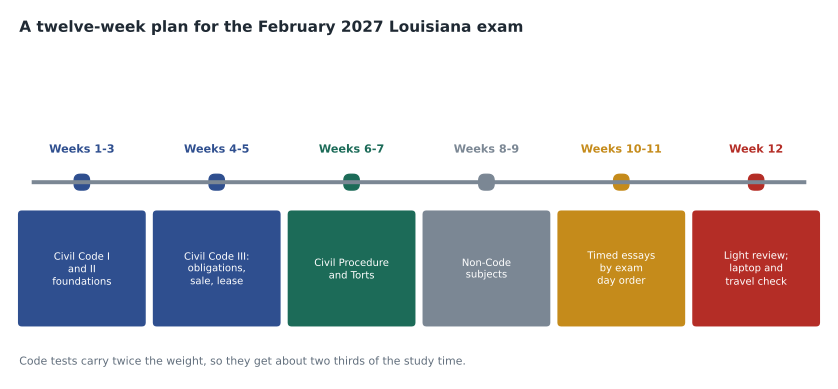
The plan is not rigid. Each week includes some practice on subjects already covered, so nothing goes cold, and the non-Code subjects get weekly short practice sets even during the Code weeks. Eddie's strengths shape it too: he starts the non-Code subjects with a base from the evidence and constitutional law sessions, so the plan gives him fewer hours there than a candidate starting from scratch.
| Weeks | Main focus | Daily practice | Checkpoint |
|---|---|---|---|
| 1 to 3 | Civil Code I and II: persons, property, successions, donations, matrimonial regimes | Two short Code essays; anchor article drill | Timed Civil Code II essay at the end of week 3 |
| 4 to 5 | Civil Code III: obligations, sale, lease, mandate, security rights, prescription | One long essay; multiple-choice set | Full timed Civil Code III test |
| 6 to 7 | Code of Civil Procedure and Torts, including the 2024 to 2026 reforms | One essay in each subject | Timed Wednesday morning pair |
| 8 to 9 | Business Entities, Constitutional Law, Criminal, Federal | Essay and multiple-choice rotation | Timed Friday set |
| 10 to 11 | Mixed review in exam-day order | Full timed tests on Monday, Wednesday, Friday pattern | Two full mock weeks |
| 12 | Light review and logistics | Anchor articles and outlines only | Rest before Monday |
How to practice Code essays
Practice essays work only if they are timed and reviewed. Marchetti asks candidates to write under real time limits, then compare their answers against a list of issues and rules prepared in advance, and only then read a model analysis. The comparison matters more than the score: a candidate who sees that he missed acquisitive prescription in two of three property essays has learned something specific.
For each essay, the routine is the same. Read the call of the question first, so you know what you are being asked. Read the facts once for the story and a second time for the issues, noting dates, relationships, forms of documents and amounts of money, because those are where Louisiana rules turn. Outline in a few minutes: the issues in order, the article or rule for each, and the facts that matter. Then write, issue by issue, under headings, with rule, application and conclusion for each. Leave a minute at the end to check that you answered every part of the call.
Practice question one: Civil Code II
The first practice question is an original succession problem. Odile, domiciled in Lafayette, dies in 2026, survived by her husband Gaston, to whom she was married under the legal regime, and three children: Aimée, 19; Bastien, 28 and in good health; and Céleste, 34, who has a severe intellectual disability that has made her permanently incapable of administering her estate since birth. Odile left a handwritten document, entirely in her own hand and signed, that reads: "I leave everything I own to Bastien." It bears no date. Odile's property consists of her half of the community home and a separate brokerage account she inherited from her mother. Advise the family.
A strong answer works through the issues in order. First, is the document a valid olographic testament? Article 1575 requires that it be entirely written, dated and signed in the testator's handwriting. The document has no date, and unless the date can be reasonably ascertained from information in the document, it fails as an olographic testament. If it fails, Odile died intestate. Second, intestacy: classify the property. Odile's half of the community home goes to her three children in equal shares, subject to Gaston's usufruct until his death or remarriage. The separate brokerage account goes to the three children in equal shares, with no usufruct.
Third, the alternative analysis if the testament were valid: forced heirship. Aimée, at 19, is a forced heir under article 1493, and Céleste, permanently incapable, is a forced heir regardless of age. Bastien, 28 and healthy, is not. With two forced heirs, the forced portion is one half of the estate, but not more than their intestate shares; each forced heir's legitime would be one fourth of the estate, which is less than the one third each would take by intestacy, so the forced portion is one half. A legacy of everything to Bastien would be reduced to the disposable portion, one half, and Aimée and Céleste could each claim one fourth. A good answer also notes Gaston's usufruct over the community share, which a testament could confirm or extend but which arises by law in intestacy.
Practice problems
Work each problem on paper first, then reveal the answer to check.
Odile's undated handwritten document says she leaves everything to Bastien. Is it a valid testament?
Show answer
Probably not. Article 1575 requires an olographic testament to be entirely written, dated and signed in the testator's hand; an undated document fails unless the date is reasonably ascertainable from its contents.
If Odile died intestate, who takes her half of the community home?
Show answer
Her three children in equal shares, subject to Gaston's usufruct over that half until he dies or remarries.
Which of Odile's children are forced heirs?
Show answer
Aimée, who is 23 or younger, and Céleste, who is permanently incapable; Bastien, 28 and healthy, is not.
If the testament were valid, how much could Aimée and Céleste claim together?
Show answer
The forced portion for two or more forced heirs, one half of the estate, shared between them, so one fourth each.
Practice question two: Torts and Civil Procedure
The second practice question combines Wednesday morning's tests. On February 10, 2026, Thibault slipped on a puddle of spilled detergent in an aisle of a hardware store in Breaux Bridge, St. Martin Parish. A store employee had walked past the puddle five minutes earlier without cleaning it. Thibault, who was looking at his phone, broke his wrist. He is domiciled in Lafayette Parish; the store is owned by a corporation whose registered office is in East Baton Rouge Parish. In January 2027, Thibault files suit in Lafayette Parish. The store's lawyer files an answer, and two months later files an exception of improper venue and an exception of prescription. A jury later finds Thibault 40 percent at fault and the store 60 percent at fault, with damages of 150,000 dollars. Discuss.
A strong answer takes the procedural issues first. Venue: the general rule sends a suit against a domestic corporation to the parish of its registered office, East Baton Rouge, and the supplementary rule for offenses allows suit where the wrongful conduct occurred or the damages were sustained, St. Martin. Lafayette Parish, Thibault's domicile, is not a proper venue on these facts. But improper venue is a declinatory exception, which must be pleaded before or in the answer; the store answered first, so the objection is waived. Prescription: the injury occurred after July 1, 2024, so the two-year delictual prescription applies. Suit filed in January 2027 is within two years of February 2026. Prescription is a peremptory exception that may be raised any time before submission, so it is timely raised but fails on the merits. Even if venue had been improper and timely raised, filing in an improper venue interrupts prescription only if the defendant is served within the prescriptive period, which candidates should mention.
On the merits, the merchant liability statute governs. Thibault must prove that the puddle presented an unreasonable risk of harm that was reasonably foreseeable, that the store created it or had actual or constructive notice, and that the store failed to exercise reasonable care. The employee walked past five minutes earlier, which supports actual notice. Fault allocation: under amended article 2323, effective January 1, 2026, and applicable to an accident in February 2026 subject to the act's own provisions, a plaintiff 40 percent at fault is not barred, because his fault is below 51 percent. He recovers 60 percent of 150,000 dollars, or 90,000 dollars. Because the action was filed after January 1, 2026, the medical expense limit in R.S. 9:2800.27 also affects the medical specials included in the award.
Practice problems
Work each problem on paper first, then reveal the answer to check.
Was Lafayette Parish a proper venue for Thibault's suit?
Show answer
No. The proper venues were East Baton Rouge, the corporation's registered office, and St. Martin, where the conduct occurred and the damage was sustained.
Can the store still object to venue?
Show answer
No. Improper venue is a declinatory exception that must be pleaded before or in the answer; by answering first, the store waived it.
Is Thibault's suit prescribed?
Show answer
No. The two-year delictual prescription applies to injuries after July 1, 2024, and he sued within two years.
How much does Thibault recover?
Show answer
Ninety thousand dollars: he is 40 percent at fault, below the 51 percent bar, so his 150,000-dollar award is reduced by 40 percent.
Practice question three: Civil Code III
The third practice question is shorter. Romain, a contractor in Houma, agreed orally with a homeowner to replace the homeowner's roof for an agreed price. Before work began, the homeowner told Romain she had found a cheaper roofer and would not go forward. Romain had already ordered custom materials that cannot be returned. Romain asks what he can recover.
The answer turns on the general law of obligations. A contract for work, unlike a sale of an immovable, does not require a writing, so the oral agreement can be proved by the means the Code and the Code of Evidence allow. If the contract is proved, the homeowner's refusal is a failure to perform, and Romain may recover damages under article 1994, measured for an obligor in good faith by the foreseeable loss under article 1996, which includes the cost of the custom materials and lost profit. Louisiana's rules on contracts to build also allow the owner to cancel the contract at will, but on condition of paying the contractor for labor and materials and the profit he would have made, which leads to a similar result. If the contract could not be proved, detrimental reliance under article 1967 might allow recovery of the cost of the materials, if Romain reasonably relied on the homeowner's promise.
Exam week, hour by hour
Exam week in Louisiana has its own rhythm. With tests on Monday, Wednesday and Friday, candidates have Tuesday and Thursday to recover and review, which is a gift if used well and a trap if used to cram. Marchetti's plan for Eddie covers the whole week.
Worked problem
Eddie's exam week plan
Plan the week of the February 2027 examination for Eddie, who will drive from Lafayette and stay near the test site.
Show solution
- Weekend before: travel on Saturday, check the route to the test site, confirm the laptop software and charger, lay out admission materials and permitted items, and stop new study by Sunday afternoon.
- Monday: arrive at check-in between 7:00 and 7:45; Civil Code I from 8:00 to 10:00; Civil Code II from 10:30 to 12:30; lunch away from other candidates' post-mortems; Civil Code III from 2:00 to 5:00. Evening: light dinner and early sleep; do not review Monday's answers.
- Tuesday: rest in the morning; in the afternoon, review anchor articles and outlines for Civil Procedure and Torts, and the main Business Entities rules; no full practice tests.
- Wednesday: Civil Procedure, Torts and Business Entities on the same schedule.
- Thursday: rest and light review of Constitutional Law, the criminal subjects and Federal Jurisdiction.
- Friday: Constitutional Law, Criminal Law, Procedure and Evidence, and Federal Jurisdiction and Procedure; then go home.
Answer: The week works best when Tuesday and Thursday are used for rest and light review of the next day's subjects, not for cramming or reliving finished tests.
Timing inside each test
Within each test, Marchetti's rule is to budget time in proportion to points and to stick to the budget. If a test has a multiple-choice block and three essays, the candidate should know before starting how many minutes each part gets, write the end times on scratch paper and move on when time is up. A partial answer to the last essay earns far more than a perfect answer to the first essay followed by nothing. In the three-hour afternoon tests, a short break to stretch and reset halfway can help, if the rules allow it.
Waiting for results and what comes next
February results usually arrive about eight to nine weeks after the examination. While waiting, Eddie plans to start work at the Lafayette firm as a law clerk, check his MPRE score and character and fitness file, and avoid reliving every essay. If he passes, the next steps are the oath in person, LSBA membership and Transition Into Practice. If he falls short, he will review the scores, identify the weak tests and plan for July, keeping in mind that he must sit all nine tests again and that each attempt counts toward the limit of five.
Marchetti closed the course with the same point she had made in the first session. 'You are not just passing a test,' he said. 'You are learning to think in the system you will practice in. The habits that will get you through February, starting from the article, reading the Code as a whole and applying it carefully to facts, are the habits that will make you a good Louisiana lawyer.'
Common mistakes
MistakeStudying all nine subjects equally is the fairest plan.
InsteadCode tests carry about 643 of 900 points; give them about two thirds of the time.
MistakeTuesday and Thursday are for cramming.
InsteadUse them for rest and light review of the next day's subjects.
MistakeA perfect first essay is worth the time it takes.
InsteadBudget time by points; a partial answer to every question beats a perfect answer to some.
MistakeAn undated handwritten testament is valid if signed.
InsteadAn olographic testament must be dated, unless the date is reasonably ascertainable from its contents.
MistakeFiling suit in an improper venue always preserves the claim.
InsteadFiling in an improper venue interrupts prescription only if the defendant is served within the prescriptive period.
Summary and key terms
- Weight study time by the score: about two thirds to the five Code tests, with weekly practice on non-Code subjects.
- Practice timed essays, compare answers to an issue list before reading a model, and use the same routine every time.
- Code essays should start from the article, classify property or obligations correctly and work issues in order.
- Plan exam week around Monday, Wednesday and Friday tests, using Tuesday and Thursday for rest and light review.
- Budget time inside each test by points, and after the examination, plan for admission or for a focused retake.
- Issue list
- A prepared list of the issues and rules a practice question raises, used to check an answer before reading a model.
- Time budget
- A plan dividing the time for a test among its parts in proportion to their value.
- Anchor article drill
- A short daily exercise restating and applying a key Code article.
- Mock week
- A practice week with full timed tests on the Monday, Wednesday and Friday pattern of the real examination.
- Post-mortem
- Discussing finished tests with other candidates, which Marchetti advises avoiding during exam week.
Lesson quiz · 5 questions
Score 60% or more to complete this lesson.
Create a free account to save your progress, take quizzes and earn a certificate.