
BAR-219 · Lesson 8 of 12 · 16 min
Successions, donations and matrimonial regimes
▶ Video coming soon A video version of this lesson is on the way.
Eddie told Marchetti at the start of the eighth session that Civil Code II was the test he feared most. 'Obligations I can reason through,' he said. 'Successions feel like memorizing a train timetable. Who inherits what, in what order, as owner or usufructuary, with fractions that change depending on how many children there are and how old they are. And then the community property rules sit on top of all of it.'
Marchetti had a different view. 'Civil Code II rewards memorization more than any other test, which is good news, because memorization is under your control. There are perhaps twenty rules that do most of the work. If you know them cold and practice applying them to family trees, you can score well on this test even when the facts look complicated. Today we cover intestate succession, forced heirship, testaments, donations and the core of the matrimonial regime, and we will finish with a family that has all of it.'
Community and separate property
Start with matrimonial regimes, because the classification of property as community or separate controls almost everything in an intestate succession. Under article 2327, the legal regime of community of acquets and gains applies to spouses domiciled in Louisiana, unless they have a matrimonial agreement that provides otherwise. Things in the possession of a spouse during the existence of the legal regime are presumed to be community, under article 2340, but either spouse may prove that they are separate property.
Community property, under article 2338, includes property acquired during the legal regime through the effort, skill or industry of either spouse, property acquired with community things or with community and separate things unless classified as separate, property donated to the spouses jointly, natural and civil fruits of community property, and damages awarded for loss or injury to community property. Separate property, under article 2341, includes property acquired by a spouse before the regime, property acquired with separate things, property acquired by inheritance or donation to that spouse individually, and damages for personal injuries to that spouse, except loss of earnings during the regime. The natural and civil fruits of separate property are community, unless the owning spouse reserves them as separate by a declaration made in an authentic act or act under private signature duly acknowledged and filed for registry.
Spouses may opt out of the legal regime by a matrimonial agreement. Under article 2329, spouses may enter into a matrimonial agreement before or during marriage as to all matters that are not prohibited by public policy. During marriage, however, spouses may enter into a matrimonial agreement that modifies or terminates a matrimonial regime only upon joint petition and a finding by the court that the agreement serves their best interests and that they understand the governing principles and rules. There are two important exceptions: spouses may subject themselves to the legal regime by matrimonial agreement at any time without court approval, and during the first year after moving into and acquiring a domicile in Louisiana, spouses may enter into a matrimonial agreement without court approval. A matrimonial agreement must be made by authentic act or by act under private signature duly acknowledged by the spouses.
The community terminates on the death or judgment of declaration of death of a spouse, a declaration of nullity of the marriage, a judgment of divorce or separation of property, or a matrimonial agreement that terminates the community. A judgment of divorce terminates the community retroactively to the date the petition was filed. After termination, each spouse owns an undivided one-half interest in the former community property, and either may seek partition and claims for reimbursement where one patrimony benefited the other.
Intestate succession
When a person dies without a valid testament, or with a testament that does not dispose of all the property, the property passes by intestacy according to the Code's order. The order differs for community and separate property, which is why classification comes first.
For the deceased's share of community property, the rule is short. If the deceased leaves descendants, they inherit his share of the community, subject to a usufruct in favor of the surviving spouse over that share, under article 890; the usufruct lasts until the surviving spouse dies or remarries, whichever occurs first, unless the deceased confirmed it for life or for a longer period by testament. If the deceased leaves no descendants, the surviving spouse inherits his share of the community in full ownership, under article 889.
For separate property, the order is longer. Descendants inherit first. If there are no descendants, the deceased's parents and siblings, or descendants of siblings, come next: the siblings inherit the separate property subject to a usufruct in favor of the surviving parents, and if there are no siblings, the parents inherit; if there are no parents, the siblings inherit. Only if there are no descendants, parents or siblings or descendants of siblings does the surviving spouse inherit separate property, under article 894. After that come other ascendants and collaterals.
Representation allows descendants of a predeceased heir to take the share that heir would have taken. In the direct line, representation takes place in favor of descendants without limit. In the collateral line, it takes place in favor of descendants of siblings.
| Situation | Deceased's share of community | Separate property |
|---|---|---|
| Descendants and a surviving spouse | Descendants own it, subject to the spouse's usufruct until death or remarriage | Descendants own it |
| No descendants; spouse, parents and siblings survive | Surviving spouse owns it | Siblings own it, subject to the parents' usufruct |
| No descendants or siblings; spouse and parents survive | Surviving spouse owns it | Parents own it |
| No descendants, parents or siblings or their descendants; spouse survives | Surviving spouse owns it | Surviving spouse owns it |
Forced heirship
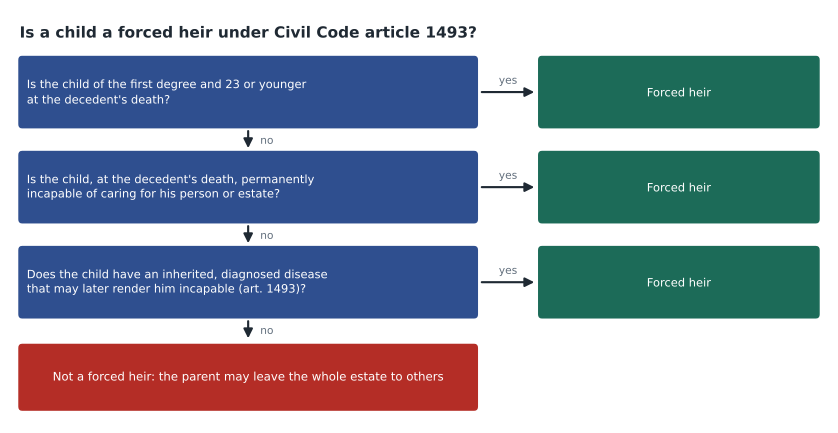
Louisiana is the only state with forced heirship, a rule that reserves a portion of a parent's estate for certain children, called the legitime or forced portion. Since constitutional and legislative changes in the 1990s, forced heirship is much narrower than it once was. Under article 1493, forced heirs are descendants of the first degree who, at the time of the decedent's death, are twenty-three years of age or younger, or descendants of the first degree of any age who, because of mental incapacity or physical infirmity, are permanently incapable of taking care of their persons or administering their estates. The article also treats as forced heirs children who have an inherited, incurable disease that may render them incapable in the future, if the condition is diagnosed. Grandchildren may represent a predeceased parent as forced heirs only in limited cases spelled out in the article, such as when the parent would have been twenty-three or younger at the decedent's death or when the grandchild is permanently incapable.
The size of the forced portion is set by article 1495. If there is one forced heir, the forced portion is one fourth of the decedent's property; if there are two or more forced heirs, it is one half. The forced portion can never exceed the amount the forced heirs would receive in intestacy, so a forced heir who would inherit less than one fourth by intestacy takes no more than that. The rest of the estate is the disposable portion, which the decedent may leave to anyone. The forced portion is calculated on a mass that includes the property at death, less debts, plus the value of certain donations the decedent made during the last three years of life.
A parent may disinherit a forced heir only for one of the just causes listed in the Code, such as striking the parent or attempting to take the parent's life, and only by stating the cause in the testament. A forced heir who is not lawfully disinherited may bring an action for reduction of excessive donations to recover the legitime. The Louisiana Trust Code allows the legitime to be placed in trust, subject to conditions.
Testaments
Louisiana recognizes two forms of testament: the olographic testament and the notarial testament. An olographic testament must be entirely written, dated and signed in the handwriting of the testator, under article 1575. The date is sufficiently indicated if the day, month and year are reasonably ascertainable from information in the testament. A typed testament signed by hand is not olographic.
A notarial testament must be made in writing and dated, and the testator must declare in the presence of a notary and two competent witnesses that the instrument is his testament and must sign it at the end and on each other separate page, under article 1577. The notary and witnesses must sign an attestation clause declaring that these formalities were followed. The Code provides special forms for testators who cannot read or cannot sign. A witness who is a legatee does not invalidate the testament, but the legacy to that witness is invalid, unless the witness would be an heir in intestacy, in which case the witness may receive the lesser of the legacy or the intestate share.
A testament may be revoked by the testator's physical destruction of it or by having it destroyed at his direction, by a subsequent testament in any of the required forms, or by a signed writing in the form of a testament. A legacy to a spouse is revoked by divorce after the testament is made unless the testator provides otherwise. Legacies are universal, general or particular, and the classification controls how the estate bears debts and how lapsed legacies are distributed.
Donations inter vivos
A donation inter vivos is a contract by which a person, the donor, gratuitously divests himself, at present and irrevocably, of the thing given in favor of another, the donee, who accepts it. A donation inter vivos must generally be made by authentic act. A donation of a corporeal movable, called a manual gift, may be made by delivery of the thing to the donee without any other formality. A donation inter vivos of all the donor's property is null if the donor does not reserve to himself enough for his subsistence. Donations count against the disposable portion and may be reduced if they impinge on the legitime.
Collation is the supposed or real return to the mass of the succession of property that a forced heir received from the decedent during life, so that the heirs share equally. Under the revised articles, collation is owed only by descendants who qualify as forced heirs, and the donor may expressly dispense with it.
Worked problem
A Lafayette family tree
Rémy dies intestate in 2026, domiciled in Lafayette and married under the legal regime to Annette. He leaves two children: Claire, age 21, and Luc, age 30 and in good health. His property consists of the family home, bought during the marriage with his salary, and a camp in Cameron Parish he inherited from his father. Who inherits what?
Show solution
- Classify the property: the home was acquired during the regime with community funds, so it is community property; Rémy owns an undivided one-half interest. The camp was inherited by Rémy alone, so it is his separate property.
- Annette keeps her own one-half interest in the community home; that is hers, not part of the succession.
- Rémy's one-half of the community home goes to his descendants, Claire and Luc, in equal shares, subject to Annette's usufruct over that half until she dies or remarries.
- The camp, as separate property, goes to the descendants, Claire and Luc, in equal shares, with no usufruct for Annette.
- Forced heirship matters only if there is a testament; here Claire, at 21, would be a forced heir and Luc would not, but intestacy gives both an equal share.
Answer: Annette keeps her half of the home and has a usufruct over Rémy's half; Claire and Luc own Rémy's half of the home and the camp equally.
Divorce in brief
Civil Code I covers divorce, and the core rules are short. A divorce may be granted under article 102 on motion after a period of living separate and apart following service of the petition, or under article 103 after the spouses have lived separate and apart continuously for the required period before the petition is filed, or on proof of adultery, a felony conviction with a sentence of death or imprisonment at hard labor, or abuse. The required periods are 180 days when there are no minor children of the marriage and 365 days when there are minor children, subject to exceptions for abuse. Final periodic support may be awarded to a spouse who is in need and free from fault in the breakup of the marriage, and it generally may not exceed one third of the obligor's net income. Covenant marriage, available by statute, has stricter grounds and waiting periods.
Common mistakes
MistakeThe surviving spouse inherits the deceased's share of the community when there are children.
InsteadThe children inherit it, subject to the surviving spouse's usufruct until death or remarriage.
MistakeEvery child is a forced heir.
InsteadOnly children 23 or younger at death, or permanently incapable, or with a qualifying inherited disease, are forced heirs.
MistakeA typed testament signed by hand is a valid olographic testament.
InsteadAn olographic testament must be entirely written, dated and signed in the testator's handwriting.
MistakeSpouses can change their regime during marriage by private agreement at any time.
InsteadDuring marriage, court approval is needed, except to adopt the legal regime or within a year after moving to Louisiana.
MistakeA witness who is a legatee voids the notarial testament.
InsteadThe testament stands; the legacy to the witness is invalid unless the witness is an intestate heir, who may take the lesser of the legacy or the intestate share.
Summary and key terms
- Under the legal regime, property acquired during marriage through either spouse's effort is community and presumed so; inherited or donated property is separate.
- Matrimonial agreements during marriage need court approval, except to adopt the legal regime or within the first year after moving to Louisiana.
- Descendants take the deceased's share of community subject to the spouse's usufruct; without descendants, the spouse takes it; separate property goes to descendants, then siblings and parents, then the spouse.
- Forced heirs are children 23 or younger or permanently incapable; the forced portion is one fourth for one forced heir and one half for two or more, never more than the intestate share.
- Testaments are olographic or notarial; donations inter vivos generally require an authentic act, except manual gifts of corporeal movables.
- Community of acquets and gains
- Louisiana's legal matrimonial regime, under which property acquired during marriage is generally owned equally by the spouses.
- Usufruct
- A personal servitude giving the right to use and enjoy property owned by another, the naked owner.
- Forced heir
- A child entitled to a reserved portion of a parent's estate under article 1493.
- Olographic testament
- A testament entirely written, dated and signed in the testator's handwriting.
- Notarial testament
- A testament signed before a notary and two witnesses with an attestation clause.
Lesson quiz · 5 questions
Score 60% or more to complete this lesson.
Create a free account to save your progress, take quizzes and earn a certificate.