
BAR-219 · Lesson 3 of 12 · 16 min
Character and fitness and the MPRE
▶ Video coming soon A video version of this lesson is on the way.
Eddie came to his third session with a confession he had been rehearsing. 'In my first year of college, I got a ticket for having an open container on Johnston Street during Mardi Gras,' he said. 'I paid it the next week. I disclosed it on my law student registration, and I disclosed it again on the bar application. But I keep wondering whether I should have written more, or whether the Committee is going to hold it against me.'
Marchetti had heard versions of this worry from almost every candidate she had coached. 'You did the most important thing, which is that you told them, twice, and the two answers match. A paid ticket from years ago, fully disclosed, is the kind of thing the Committee sees constantly. What it cares about is whether you are honest with it, whether your record shows a pattern that predicts harm to clients, and whether you have dealt with any problems responsibly. Let us go through how the process works, and then we will talk about the MPRE, since your score should arrive soon.'
The standard
Rule XVII requires every applicant to satisfy the Committee and the court of good moral character and fitness to practice law. The question is forward-looking: whether the applicant can be trusted to handle client funds, keep confidences, meet deadlines, deal honestly with courts and opponents, and comply with the Rules of Professional Conduct. Past conduct matters because it is the best available evidence of future conduct, not because the Committee is punishing anyone for it.
Like most jurisdictions, Louisiana looks at a familiar set of concerns: criminal conduct, academic or workplace dishonesty, neglect of financial obligations, mental health or substance use issues that currently impair functioning, prior discipline in another profession, and, above all, lack of candor in the application itself. The weight of any item depends on how recent it is, how serious it is, whether it was isolated or part of a pattern, and what the applicant has done since.
How the review works
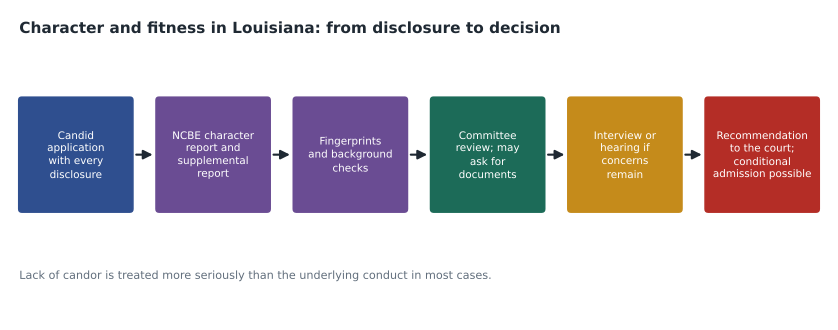
The Committee's review draws on several sources. NCBE prepares a character report on each applicant from the information the applicant provides, contacting references, employers, schools and courts to verify it. Louisiana adds its own supplemental questions and requires fingerprints for a criminal background check. The Committee compares what the applicant disclosed with what the investigation finds. When they match and nothing raises a concern, the file moves quietly toward approval.
When something does raise a concern, the Committee may ask for documents or a written explanation. If concerns remain, it may ask the applicant to meet with a member of the Committee or to appear at a more formal hearing. In some cases, the Committee may recommend conditional admission, which allows an applicant to be admitted subject to conditions such as monitoring, treatment or reporting for a set period. In the rare case of a denial, the applicant has the opportunity to seek review by the court.
Candor is the whole game
The most common way applicants create problems for themselves is by leaving things out. An applicant who omits a minor arrest, a dismissed lawsuit, a terminated job or an academic warning gives the Committee two issues instead of one: the underlying event and the omission. The omission is usually the more serious of the two, because it is direct evidence of how the applicant behaves when honesty is inconvenient, which is exactly what the Committee is trying to predict.
Marchetti's rule for candidates is simple: when in doubt, disclose and explain. If a question could reasonably be read to cover an event, answer it as if it does. Give dates, outcomes and a short, factual explanation. Attach documents when you have them. Do not argue, minimize or blame others. If the event reflects a lapse in judgment, say what you learned and what has changed. The same discipline applies to updates: if something happens after filing, report it promptly.
Consistency across documents matters too. The Committee will see your law school application, your law student registration, your bar application and the NCBE report side by side. Differences between them, even innocent ones, invite questions. Eddie's open container ticket appears the same way in his registration and his application, which is exactly what the Committee wants to see.
Common issues and how they are usually handled
| Issue | What the Committee looks for | Good practice |
|---|---|---|
| Minor traffic or alcohol citations | Pattern, recency, compliance with any sentence | Disclose every one; show payment or completion |
| Arrests without conviction | Underlying conduct and candor | Disclose even if dismissed or expunged if the question asks; explain briefly |
| Debts in default or collection | Responsibility, not the amount of debt | Show a payment plan or contact with creditors |
| Academic discipline | Honesty-related conduct weighs heavily | Disclose the full record from the school; explain what changed |
| Mental health or substance use | Current functioning, not diagnosis | Answer the questions actually asked; show treatment and stability where relevant |
| Employment terminations | Dishonesty or reliability problems | Disclose with dates and the employer's stated reason |
The table is a guide, not a promise. Each file is judged on its own facts, and the Committee looks at the whole person. But the pattern is consistent across jurisdictions: applicants who disclose fully and show responsibility are almost always admitted, while applicants who conceal are often delayed, conditioned or denied, even when the underlying conduct was minor.
Financial responsibility
Financial issues deserve a special word because new graduates carry large student loan balances and sometimes consumer debt. Having debt is not a character problem. Ignoring it can be. The Committee looks for evidence that the applicant meets obligations or, if that is not possible, communicates with creditors and makes arrangements. A loan in deferment or on an income-driven repayment plan is fine. A string of accounts in collection with no contact is not, because it suggests the kind of avoidance that harms clients when a lawyer is under pressure.
Worked problem
A disclosure that went well
An applicant was cited for shoplifting a phone charger at nineteen, completed a diversion program and had the record expunged. Seven years later, the Louisiana application asks about arrests and citations, including those that were expunged. How should the applicant handle it?
Show solution
- Read the question carefully: it expressly covers expunged matters, so the expungement does not remove the duty to disclose.
- Disclose the citation with the date, the court, the diversion program and the expungement.
- Attach the diversion completion certificate and the expungement order if available.
- Write two or three sentences acknowledging the conduct, noting the applicant's age at the time and describing what has changed since, without excuses.
- Make sure the law school application and law student registration said the same thing; if they did not, explain the discrepancy now.
Answer: Full, consistent disclosure with documents turns an old, minor matter into a routine file; concealment would have turned it into a candor problem.
The MPRE
Part II of the Louisiana bar examination is the Multistate Professional Responsibility Examination, written and administered by NCBE. The MPRE is a two-hour, sixty-question multiple-choice test on the law governing lawyers, based mainly on the ABA Model Rules of Professional Conduct and the ABA Model Code of Judicial Conduct, along with generally accepted principles from court decisions and procedural rules. Of the sixty questions, fifty are scored and ten are unscored pretest questions that look the same as the others. Scores are reported on a scale from 50 to 150.
Louisiana requires a scaled score of 80, the same as many other jurisdictions. NCBE offers the MPRE several times a year, generally in March, August and November, at test centers and in some cases by remote proctoring. Rule XVII treats an MPRE score as valid for five years, with an exception for lawyers admitted in other jurisdictions. Applicants may take the MPRE before or after Part I; they must have a qualifying score before admission.
The MPRE tests the Model Rules, not Louisiana's rules
A point that confuses Louisiana candidates every year is that the MPRE does not test the Louisiana Rules of Professional Conduct. It tests the ABA Model Rules. Louisiana's rules follow the Model Rules closely, but they differ in places. The best known example is Rule 1.8(e) on financial assistance to clients. The Model Rule permits a lawyer to advance court costs and litigation expenses and, since a 2020 amendment, to give modest gifts to indigent clients for basic living expenses in pro bono matters. The Louisiana rule has its own, longer text: it allows a lawyer to provide financial assistance to a client in necessitous circumstances for minimal living expenses and permits loans to a client, subject to conditions including a cap on interest tied to the prime rate. On the MPRE, answer under the Model Rule. In practice in Louisiana, follow the Louisiana rule. Lesson 10 returns to these differences.
Preparing for the MPRE alongside the bar
Most candidates prepare for the MPRE in two to four weeks of part-time study. The usual approach is to learn the major topics, which include conflicts of interest, client confidentiality, the client-lawyer relationship, competence and diligence, litigation and other forms of advocacy, communications about legal services and judicial conduct, and then work through many practice questions. Because the MPRE is a multiple-choice test of rules with fine distinctions, practice questions do most of the teaching.
Eddie studied for three weeks in October while also attending the evidence and constitutional law sessions. He finished the official NCBE practice tests, and he felt reasonably good walking out of the Baton Rouge test center. 'If I am short, I will retake it in March,' he said. 'The February results will not come out until spring anyway.' Marchetti agreed: a retake would not affect Part I, and the five-year validity gives plenty of room.
Common mistakes
MistakeAn expunged arrest never needs to be disclosed.
InsteadIf the application asks about expunged matters, the applicant must disclose them.
MistakeStudent debt counts against an applicant.
InsteadDebt itself is not a problem; neglecting obligations without contact or arrangements can be.
MistakeThe MPRE tests the Louisiana Rules of Professional Conduct.
InsteadThe MPRE tests the ABA Model Rules and Model Code of Judicial Conduct; Louisiana's rules differ in places.
MistakeThe MPRE must be passed before sitting Part I.
InsteadThe MPRE can be taken before or after Part I; a score of 80 is needed before admission.
MistakeMental health treatment is itself disqualifying.
InsteadThe focus is current fitness to practice; seeking treatment is generally viewed as responsible conduct.
When something happens after filing
The duty to update runs until the day of admission, and it is easy to forget during exam preparation. Marchetti gave Eddie a scenario she had seen with a former student. Two weeks before the February examination, the student was in a minor car accident in a parking lot in Metairie. Nobody was hurt, but the other driver claimed the student had backed into her, and a police officer issued a citation for improper backing. The student paid the citation online that afternoon and forgot about it until his admission ceremony was scheduled.
'He was lucky,' Marchetti said. 'A friend asked him whether he had updated his application, and he called the Committee the next morning. He sent a short letter with the citation, the payment receipt and two sentences of explanation. Nothing came of it. If he had said nothing and the citation had turned up in a later background check, he would have had to explain not only the accident but why he did not report it, and that is a much harder conversation.'
The lesson is that a small update, made promptly, is almost never a problem. Keeping a running log during the months between filing and admission, as Lesson 2 suggested, makes it easy. The log should include changes of address, new employment, any citation or arrest, any civil suit in which the applicant is a party, any significant financial event such as a judgment or a default, and any professional discipline.
What a hearing looks like
Most applicants never see a hearing, but knowing what one looks like takes away some of the fear. If the Committee has questions it cannot resolve on paper, it may ask the applicant to meet with a Committee member or a panel. The applicant may bring counsel. The panel asks about the issue in the file, looks at the documents and listens to the applicant's account of what happened and what has changed. Character references who know the applicant well, such as employers, professors or treatment providers where relevant, can be powerful.
The tone that works at a hearing is the same tone that works in a written disclosure: factual, accountable and forward-looking. Applicants who argue about whether the Committee should care, minimize a serious incident or blame others tend to do poorly. Applicants who acknowledge what happened, explain what they learned and show concrete evidence of change tend to do well, even when the underlying conduct was serious.
Reading an MPRE score report
NCBE reports MPRE scores several weeks after each administration, and the score is sent to the jurisdictions the examinee designates. The score report shows a scaled score between 50 and 150. Louisiana's requirement is 80, so an examinee who scores 80 or higher has satisfied Part II for five years. An examinee who scores below 80 can register for a later administration, and an MPRE retake does not count toward the five-attempt limit, which applies to the nine-test Louisiana examination. Eddie expects his November score in December, well before he sits the nine tests.
Summary and key terms
- Every applicant must satisfy the Committee and the court of good moral character and fitness; the question is whether the applicant can be trusted with clients and courts.
- The Committee uses the NCBE character report, Louisiana supplemental questions and fingerprints, and may ask for documents, an interview or a hearing.
- Lack of candor is usually more serious than the conduct not disclosed; disclose fully, consistently and with documents, and update promptly.
- Conditional admission is available in appropriate cases, and denials can be reviewed by the court.
- Part II is the MPRE with a scaled score of 80, valid for five years; it tests the ABA Model Rules, not the Louisiana rules.
- Character and fitness
- The review of whether an applicant has the honesty, reliability and judgment needed to practice law.
- Conditional admission
- Admission subject to conditions such as monitoring or reporting for a set period.
- MPRE
- NCBE's Multistate Professional Responsibility Examination, Part II of the Louisiana bar examination.
- Candor
- Complete and truthful disclosure to the Committee, including updates after filing.
- Rule 1.8(e)
- The conduct rule on financial assistance to clients; Louisiana's version differs from the ABA Model Rule.
Lesson quiz · 5 questions
Score 60% or more to complete this lesson.
Create a free account to save your progress, take quizzes and earn a certificate.