
BAR-221 · Lesson 11 of 12 · 22 min
Score transfer, admission without examination and practice after admission in Maryland
▶ Video coming soon A video version of this lesson is on the way.
Helen Szabo's firm sits ten miles from the Pennsylvania line and an hour from the District of Columbia. Two of its four lawyers are admitted in more than one jurisdiction. At the eleventh session Bridget said she had started wondering whether she would ever need a second license. 'Clients from York County come down to us,' she said. 'And half my classmates work in D.C.'
Hollis used the question to cover the other two routes into the Maryland bar, which Bridget's classmates and future colleagues might use, and the duties that begin on the day a Maryland lawyer takes the oath.
This lesson covers admission by transferred UBE score, admission without examination for experienced lawyers, the federal courts and what practice after admission requires, including the current position on continuing legal education.
Admission by transferred UBE score
A lawyer or graduate who sat the UBE in another jurisdiction may be able to use that score in Maryland instead of sitting again. Maryland accepts both legacy UBE scores and NextGen UBE scores. The transferred score must meet Maryland's passing score: 266 for a legacy score and 616 for a NextGen score. It must also be recent enough. NCBE's summary lists a maximum age of three years for transferred scores, and the Board's NextGen FAQ sets precise windows for legacy scores earned elsewhere during the transition, such as July 31, 2030 for a July 2027 legacy score.
The applicant asks NCBE to transfer the score and files with the Board through eBar. NCBE's summary lists a transfer fee of 750 dollars. Maryland does not accept a separately transferred MBE score; only a full UBE score qualifies.
Every other requirement still applies. The transfer applicant must establish character and fitness, meet the MPRE requirement of 85 and complete the Maryland Law Component. The Board advises transfer applicants to complete the MLC as soon as possible after filing, because it will not request the final Affirmation until the MLC is done, and the outside limit is two years from filing.
Worked problem
A transfer question
Hypothetical: Seun passed the NextGen UBE in another jurisdiction in July 2026 with a score of 631. In November 2026 he takes a job in Bethesda and wants Maryland admission. He took the MPRE in 2025 and scored 84. What must he do?
Show solution
- His NextGen score of 631 exceeds Maryland's 616 and is well within three years.
- His MPRE score of 84 is below Maryland's 85, so he must retake the MPRE.
- He must file through eBar, request NCBE's score transfer and pay the fee.
- He must pass character and fitness and complete the Maryland Law Component within two years of filing.
Answer: He can transfer his score but must first earn an MPRE score of 85 or higher, and he must complete the MLC and character review.
Admission without examination
Experienced lawyers admitted in other jurisdictions may petition for admission without examination under Maryland Rule 19-215. The core requirement is practice. The petitioner must have practiced law for at least three of the last five years, or for more than ten years in total. The Board's page explains that exceptions can be made for the type of practice but not for its duration. The petitioner must be admitted and in good standing elsewhere.
The petitioner must also meet the general requirements: an MPRE score of 85, character and fitness and the Maryland Law Component. The Board's page lists a petition fee of 700 dollars and an NCBE fee of 625 dollars for the character investigation that NCBE conducts for these applicants. The Board warns that NCBE's investigation typically takes two to six months.
Rule 19-215 was amended by a Supreme Court order of November 5, 2025, effective March 1, 2026. A lawyer considering this route should read the current text of the rule and the Board's page rather than relying on an older summary.
Maryland does not offer a separate shorter attorneys' exam for lawyers who do not meet the practice requirement. A lawyer with only two years of practice must use another route: transfer a UBE score if she has a recent one, or sit the NextGen exam in Maryland.
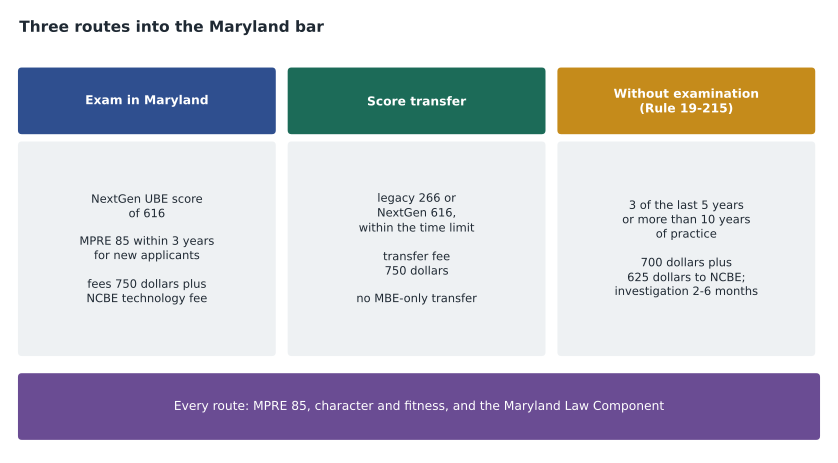
| Route | Score | Practice | Fees listed | Also required |
|---|---|---|---|---|
| Exam in Maryland | NextGen 616 | None | 750 dollars first time plus NCBE technology fee | MPRE 85, character, MLC |
| Score transfer | Legacy 266 or NextGen 616, within time limit | None | 750 dollars transfer | MPRE 85, character, MLC |
| Without examination (Rule 19-215) | None | Three of last five years or more than ten years | 700 dollars plus 625 dollars to NCBE | MPRE 85, character, MLC |
Worked problem
A practice question
Hypothetical: Margarethe was admitted in Pennsylvania in 2014 and practiced full time until 2021. She stayed home with her children from 2021 to 2024 and returned to practice part time in Pennsylvania in January 2025. In November 2026 she wants to be admitted in Maryland without examination. Does she meet the practice requirement?
Show solution
- From 2014 to 2021 she practiced about seven years, so she does not have more than ten years in total.
- In the last five years, from late 2021 to late 2026, she has practiced from January 2025 onward, less than two years.
- She meets neither the three-of-five test nor the more-than-ten test.
- Exceptions may be made for the type of practice but not for its duration.
Answer: No. She needs another route, such as sitting the NextGen exam in Maryland, unless she continues practicing long enough to meet the three-of-five test.
Federal courts
Admission to the Maryland bar does not by itself admit a lawyer to practice in the United States District Court for the District of Maryland or the federal courts of appeals. Each federal court has its own admission procedure, usually requiring membership in a state bar, a sponsor or certification and a fee. A Maryland lawyer whose work includes federal cases should apply for admission to the District of Maryland soon after state admission.
The oath and the first year
After the Board reports that an applicant is qualified, the applicant is admitted by the Supreme Court of Maryland and takes the oath, usually at an admission ceremony. The Board's guidance on the Maryland Law Component refers to November and May ceremonies after the July and February exams. The new lawyer's name is entered on the roll of attorneys, and the lawyer receives a client protection fund identification number that will appear on filings.
From that day the duties described in Lesson 10 apply. The lawyer pays annual assessments to the Client Protection Fund and the Disciplinary Fund, files annual reports on pro bono service and trust accounts, keeps contact information current with the Judiciary and follows the trust account rules. Failure to pay or report can lead to the lawyer being barred from practice until the problem is cured.
Continuing legal education
Maryland is one of the few states that does not require continuing legal education. That position has been under review. In 2023, a workgroup proposed a mandatory program of twelve hours a year, including hours in ethics and related subjects. The Supreme Court continued its consideration of the proposal in December 2024, and on April 28, 2025 it postponed the proposal until further notice. As of November 22, 2026 there is no mandatory CLE in Maryland.
A Maryland lawyer who is also admitted in a state that requires CLE must meet that state's requirement. Many Maryland lawyers attend CLE programs anyway, through the Maryland State Bar Association, local bar associations and law schools, because competence under Rule 19-301.1 requires keeping up with changes in the law. Bridget had just learned that contributory negligence, the noneconomic damages cap and the divorce grounds had all been the subject of recent legislative action, which made Hollis's point for her.
Practicing across borders
Maryland lawyers often need to work across state lines. A Maryland lawyer who appears in a single case in another state may seek admission pro hac vice there, with local counsel. A lawyer admitted elsewhere may seek to appear in a Maryland case pro hac vice under the Maryland Rules, sponsored by a Maryland lawyer. Model Rule 5.5 and its Maryland counterpart, Rule 19-305.5, limit practice in a jurisdiction where the lawyer is not admitted, with some safe harbors for temporary work.
Hollis suggested that Bridget keep her options open. A NextGen score of 616 or higher in Maryland would be a transferable score. If she later needed admission in another NextGen jurisdiction, she could transfer it within that jurisdiction's time limit and passing score. Pennsylvania and the District of Columbia have their own rules and transitions to NextGen, so she would need to check them when the time came.
Common mistakes
MistakeAn MBE score can be transferred to Maryland.
InsteadMaryland does not accept MBE transfers; only full UBE scores qualify.
MistakeTen years of practice at any time qualifies for admission without examination.
InsteadThe test is three of the last five years or more than ten years in total.
MistakeAdmission without examination skips the Maryland Law Component.
InsteadEvery route requires the MLC.
MistakeMaryland requires twelve hours of CLE a year.
InsteadThat was a 2023 proposal; the Court postponed it until further notice in April 2025.
MistakeState admission includes federal court admission.
InsteadThe District of Maryland and other federal courts have separate admission procedures.
Practice problems
Work each problem on paper first, then reveal the answer to check.
What scores qualify for transfer to Maryland?
Show answer
Legacy UBE scores of 266 or more and NextGen UBE scores of 616 or more, within the time limits.
What is the practice requirement under Rule 19-215?
Show answer
At least three of the last five years, or more than ten years in total.
What fees apply to admission without examination?
Show answer
A petition fee of 700 dollars and 625 dollars to NCBE for the character investigation.
How long does NCBE's investigation typically take?
Show answer
Two to six months.
What happened to mandatory CLE on April 28, 2025?
Show answer
The Supreme Court postponed the proposal until further notice.
A checklist for transferring a score into Maryland
Hollis wrote a checklist for Bridget's classmates who had sat the UBE elsewhere. Confirm the score meets Maryland's standard: 266 for a legacy score or 616 for a NextGen score. Confirm the score is within Maryland's time limit, using the Board's table for legacy scores earned during the transition. Confirm the MPRE score of 85 and its age. Create the eBar account and file the Character Questionnaire. File the transfer application and request NCBE's score transfer, paying the fee. Start the Maryland Law Component as soon as access arrives, because the final Affirmation will not be requested until it is complete. Keep the questionnaire current until admission.
Admission ceremonies
Maryland admits new lawyers at ceremonies in the spring and fall, after the February and July exams. The Board's guidance on the Maryland Law Component refers to the May and November ceremonies, and it encourages applicants to finish every requirement early so that they can be included. An applicant who misses a ceremony is not penalized, but she cannot practice until she is admitted and sworn.
The first-year duty list
Hollis gave Bridget a list for her first year after admission. Register with the Client Protection Fund and pay the annual assessment. File the annual pro bono and trust account reports on time. Keep contact information current with the Judiciary. Open and manage any trust account under the Chapter 400 rules if she ever holds client funds herself. Apply for admission to the United States District Court for the District of Maryland if her work requires it. Find a mentor for questions of practice and ethics. And, although Maryland does not require continuing legal education, attend programs that keep her current in the areas she practices.
Neighboring jurisdictions
For a lawyer in central Maryland, neighboring jurisdictions are part of daily life. Clients cross state lines, and so do cases. Hollis advised Bridget not to seek a second license before she needs one, but to keep records that would make one easy: her score report, her MPRE score, her Character Questionnaire and a list of her practice dates. A lawyer who later seeks admission elsewhere will be asked to reconstruct each of these, and a well-kept file saves weeks.
When rules change
Maryland's admission rules changed repeatedly between 2022 and 2026: new court names, a new exam, cap orders, an amended Rule 19-215 effective March 1, 2026, and a postponed CLE proposal. A lawyer who learned the rules in 2026 should expect more change. The habit Hollis wanted Bridget to keep was simple: check the Board's pages and the Court's orders before acting, and note the date of every fact she relies on.
Choosing between transfer and sitting again
Some applicants can choose between transferring a score and sitting the Maryland exam. Transfer is usually faster and cheaper if the score qualifies, since it avoids months of study. But a score near the end of its window may expire before the character review finishes, so an applicant whose score is close to the limit should file at once and keep track of the deadline. An applicant whose score falls just short of Maryland's standard cannot combine it with anything else and must sit the NextGen exam in Maryland or elsewhere.
Summary and key terms
- Maryland accepts transferred legacy UBE scores of 266 and NextGen scores of 616 within time limits; the transfer fee is 750 dollars.
- Maryland does not accept MBE-only transfers.
- Rule 19-215 admits experienced lawyers without examination: three of the last five years or more than ten years of practice.
- Admission without examination costs 700 dollars plus 625 dollars to NCBE; NCBE's investigation takes two to six months.
- Every route requires the MPRE score of 85, character and fitness and the Maryland Law Component.
- After admission, annual assessments and reports apply; mandatory CLE was postponed until further notice in April 2025.
- score transfer
- Admission using a UBE score earned in another jurisdiction.
- admission without examination
- Admission of experienced out-of-state lawyers under Rule 19-215.
- Rule 19-215
- The Maryland Rule on admission of out-of-state attorneys without examination, amended effective March 1, 2026.
- pro hac vice
- Permission for a lawyer not admitted in a jurisdiction to appear in a single case there.
- mandatory CLE
- Required continuing legal education; not currently required in Maryland.
Lesson quiz · 5 questions
Score 60% or more to complete this lesson.
Create a free account to save your progress, take quizzes and earn a certificate.