
BAR-221 · Lesson 8 of 12 · 22 min
Maryland torts: contributory negligence and the noneconomic damages cap
▶ Video coming soon A video version of this lesson is on the way.
One of Helen Szabo's clients, Mr. Oduya, had been hit by a car while crossing York Road in Towson. He was in a crosswalk, but the walk signal had started flashing when he stepped off the curb. The driver's insurer wrote back to Helen's demand letter in two sentences: its insured had a green light, and Mr. Oduya had entered the crosswalk against a flashing signal, so his own negligence barred any recovery. Bridget read the letter twice. 'Is that really the law?' she asked. Helen said it was, in Maryland, and that it was the single most important thing she wanted Bridget to understand about Maryland tort practice.
At the eighth session Hollis made the same point from the exam side. 'On the NextGen exam, if a question asks about a plaintiff who was partly at fault, the answer will almost always use comparative negligence, because that is the general rule. In Maryland practice the answer is different. You have to hold both in your head and never mix them up.'
This lesson covers the two features of Maryland tort law that most often surprise lawyers trained elsewhere: contributory negligence as a complete bar and the statutory cap on noneconomic damages. It also notes the limits on claims against local governments.
Contributory negligence
Under the general rule followed by almost every state, a plaintiff whose own negligence contributed to her injury can still recover, but her damages are reduced in proportion to her share of fault. That is comparative negligence. Some states use pure comparative negligence; most use a modified form that bars recovery if the plaintiff's fault reaches 50 or 51 percent.
Maryland follows the older common law rule of contributory negligence. If the plaintiff's own negligence was a proximate cause of her injury, she recovers nothing, however small her share of fault. Maryland is one of a handful of jurisdictions that keep the rule, along with Alabama, North Carolina, Virginia and the District of Columbia, although the District has modified it for pedestrians and cyclists by statute.
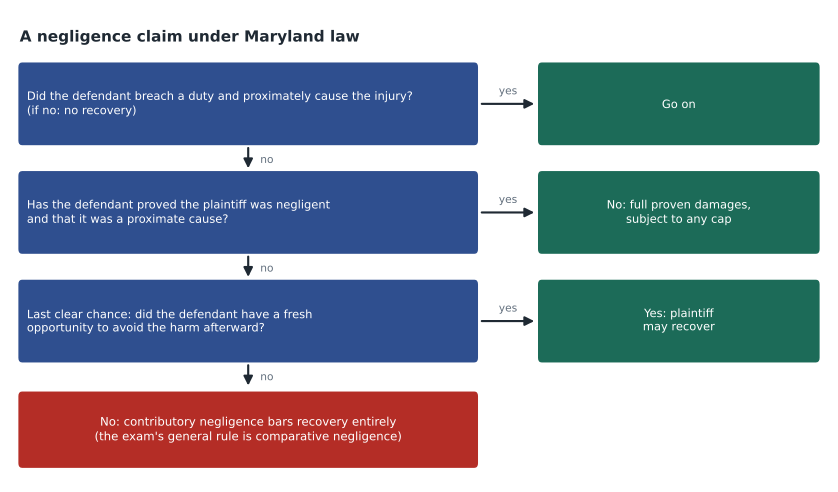
Contributory negligence is an affirmative defense. The defendant bears the burden of proving that the plaintiff was negligent and that the plaintiff's negligence was a proximate cause of the injury. The question is usually one for the jury, and courts will take it from the jury only when the plaintiff's negligence is clear and no reasonable person could find otherwise.
Coleman v. Soccer Association of Columbia
The Supreme Court of Maryland, then the Court of Appeals, has declined to abandon contributory negligence more than once. The leading recent case is Coleman v. Soccer Association of Columbia, 432 Md. 679 (2013). James Coleman, a volunteer soccer coach, was injured when he jumped up and grabbed the crossbar of a soccer goal that was not anchored, and the goal fell on him. The jury found the association negligent but also found Coleman contributorily negligent, so he recovered nothing. On appeal he asked the court to replace contributory negligence with comparative negligence.
The court declined. It reasoned that the General Assembly had repeatedly considered and refused to adopt comparative negligence, and that a change with such wide effects on insurance, joint liability and the law of contribution was a matter for the legislature. The court had reached the same conclusion three decades earlier in Harrison v. Montgomery County Board of Education, 295 Md. 442 (1983). Coleman drew a vigorous dissent, but the rule remains.
The rule today
The General Assembly has continued to debate the question. In 2026, a bill introduced by Delegate Elizabeth Embry to move Maryland to comparative negligence did not pass, and the legislature chose to study the issue further. On a Tuesday in October 2026 the House Judiciary Committee held a briefing on the issue in Annapolis, hearing from supporters, including a cycling advocate, and from the Maryland Municipal League, which warned that local governments have substantial exposure to negligence claims. The next session begins on January 13. As of November 22, 2026, contributory negligence remains Maryland law.
Last clear chance and related doctrines
Because contributory negligence is so harsh, Maryland recognizes the doctrine of last clear chance. If, after the plaintiff's negligence put her in danger, the defendant had a fresh opportunity to avoid the harm and failed to use it, the plaintiff may recover despite her own negligence. Maryland courts require something new or independent: the defendant's chance to avoid the accident must arise after the plaintiff's negligence, not simply be the same negligence that caused the collision.
Assumption of the risk is a separate complete defense. A plaintiff who knew of a risk, appreciated it and voluntarily encountered it cannot recover for injuries caused by that risk. In practice defendants often plead both defenses.
Contributory negligence also shapes the law of multiple defendants. Maryland retains joint and several liability among defendants and uses the Uniform Contribution Among Joint Tort-Feasors Act to allocate payments between them. Courts in Coleman and Harrison noted that changing to comparative negligence would require rethinking these rules as well.
Worked problem
Mr. Oduya's case
Mr. Oduya stepped into the crosswalk on York Road after the walk signal began flashing. The driver turned right on a green light without looking toward the crosswalk and struck him when he was halfway across. The insurer says contributory negligence bars recovery. Analyze the claim under Maryland law.
Show solution
- The driver arguably breached the duty to yield to a pedestrian lawfully in the crosswalk and to keep a proper lookout.
- The insurer must prove Mr. Oduya was negligent and that his negligence was a proximate cause. Entering on a flashing signal may be negligent, but a jury could find it was not a proximate cause if he was already well into the crosswalk when the driver turned.
- Last clear chance may apply if the driver, after Mr. Oduya was in the crosswalk, had a fresh opportunity to see and avoid him.
- On the general rule tested on the exam, his damages would simply be reduced by his share of fault.
Answer: The claim is not hopeless. Contributory negligence is a jury question with the burden on the defendant, and last clear chance offers a second route. But the risk of a total bar is real, which affects settlement value.
The noneconomic damages cap
Maryland limits the amount a plaintiff may recover for noneconomic damages in personal injury and wrongful death actions. Section 11-108 of the Courts and Judicial Proceedings Article sets the cap. Noneconomic damages are damages for pain, suffering, inconvenience, physical impairment, disfigurement, loss of consortium and other nonpecuniary injury. Economic damages, such as medical expenses and lost wages, are not capped by this section.
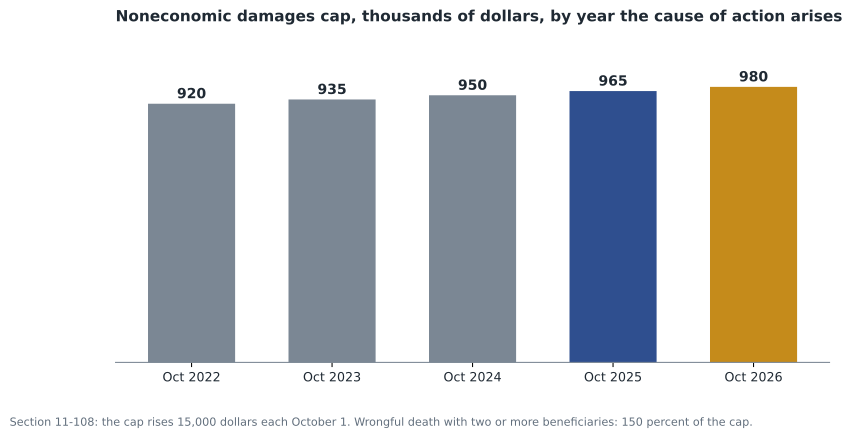
The cap rises by 15,000 dollars every October 1, and the cap that applies is the one in effect when the cause of action arises. For causes of action arising from October 1, 2025 through September 30, 2026, the cap is 965,000 dollars. For causes of action arising from October 1, 2026 through September 30, 2027, it is 980,000 dollars.
Wrongful death claims have a higher combined limit when there are two or more beneficiaries. In that case total noneconomic damages for all beneficiaries may not exceed 150 percent of the cap. For a cause of action arising in the year beginning October 1, 2026, that limit is 1,470,000 dollars.
The jury is not told about the cap. It returns its verdict, and the court then reduces any noneconomic award that exceeds the limit. Medical malpractice claims have their own separate cap under a different statute, and claims against local governments are subject to the Local Government Tort Claims Act, discussed below.
| Cause of action arises | Cap for personal injury | Wrongful death, two or more beneficiaries |
|---|---|---|
| October 1, 2025 to September 30, 2026 | 965,000 dollars | 1,447,500 dollars |
| October 1, 2026 to September 30, 2027 | 980,000 dollars | 1,470,000 dollars |
Mr. Oduya was hit in August 2026, so the cap that applies to his claim is 965,000 dollars, even if the case is tried in 2028. A client injured on October 15, 2026 would be under the 980,000-dollar cap.
The cap is also a live legislative question. In the 2026 session, House Bill 476 would have repealed the limits on noneconomic damages in personal injury and wrongful death actions. The House Judiciary Committee referred it to interim study on March 21, 2026, and in October 2026 lawmakers again discussed eliminating the cap. As of November 22, 2026 the cap remains in force.
Claims against local governments
Claims against Maryland counties, municipalities and certain other local entities fall under the Local Government Tort Claims Act. It limits a local government's liability to 400,000 dollars per individual claim and 800,000 dollars for all claims arising from the same occurrence, with higher limits for some claims involving law enforcement officers and for sexual abuse claims by minors. The Act also requires the claimant to give notice of the claim within a set period, generally one year after the injury. Claims against the State itself fall under the Maryland Tort Claims Act, which has its own limits and procedures. A lawyer who learns that a county bus or a municipal pothole was involved should calendar the notice deadline on the first day.
Worked problem
Applying the cap
Hypothetical: A jury in Baltimore County awards Ms. Pham 300,000 dollars for medical expenses and lost wages and 1,200,000 dollars for pain and suffering after a crash on November 2, 2026. She was not contributorily negligent. What judgment should be entered?
Show solution
- Economic damages of 300,000 dollars are not limited by section 11-108.
- The cause of action arose on November 2, 2026, so the applicable cap is 980,000 dollars.
- The noneconomic award of 1,200,000 dollars exceeds the cap and is reduced to 980,000 dollars.
- The jury was not told of the cap; the court applies it after the verdict.
Answer: Judgment of 1,280,000 dollars: 300,000 in economic damages and 980,000 in noneconomic damages.
Common mistakes
MistakeMaryland uses modified comparative negligence.
InsteadMaryland retains contributory negligence as a complete bar; Coleman (2013) declined to change it.
MistakeThe plaintiff must prove she was not negligent.
InsteadContributory negligence is an affirmative defense; the defendant bears the burden.
MistakeThe cap is fixed at 1 million dollars.
InsteadIt rises by 15,000 dollars every October 1; 980,000 dollars for causes arising October 1, 2026 to September 30, 2027.
MistakeThe cap depends on the trial date.
InsteadIt depends on when the cause of action arises.
MistakeThe cap limits medical bills and lost wages.
InsteadSection 11-108 limits only noneconomic damages.
Practice problems
Work each problem on paper first, then reveal the answer to check.
What did Coleman v. Soccer Association of Columbia hold?
Show answer
The Court of Appeals, now the Supreme Court of Maryland, declined to replace contributory negligence with comparative negligence, leaving the change to the General Assembly.
What is last clear chance?
Show answer
A doctrine allowing a negligent plaintiff to recover if the defendant had a fresh opportunity to avoid the harm after the plaintiff's negligence and failed to use it.
What is the cap for a cause of action arising on December 1, 2026?
Show answer
980,000 dollars.
What is the wrongful death limit for two or more beneficiaries in that year?
Show answer
150 percent of the cap, 1,470,000 dollars.
What did House Bill 476 of 2026 propose and what happened?
Show answer
Repealing the noneconomic damages limits; it was referred to interim study on March 21, 2026.
Exam rule and Maryland rule side by side
Hollis asked Bridget to write the two rules next to each other and keep the page by her desk until February. On the exam, a negligent plaintiff's damages are reduced in proportion to fault under comparative negligence, unless the question supplies a different rule. In Maryland practice, a negligent plaintiff whose negligence was a proximate cause recovers nothing, unless last clear chance applies. On the exam, damages caps appear only if the materials provide one. In Maryland practice, section 11-108 caps noneconomic damages in every personal injury and wrongful death case.
How contributory negligence shapes practice
The total bar changes the way Maryland injury cases are investigated, valued and settled. Plaintiffs' lawyers look harder at the client's own conduct at intake, because one bad fact can end the case. Defense lawyers plead contributory negligence routinely, and insurers raise it early, as the letter to Mr. Oduya's lawyer did. Settlement values reflect the risk that a jury will find even slight fault. Hollis noted that the same rule explains why some Maryland lawyers decline cases that would be routine in a comparative negligence state.
Where the cap matters
Most injury claims settle far below the cap, so the cap shapes only the most serious cases: catastrophic injuries, deaths and cases with large pain-and-suffering claims. In those cases it can be decisive. A lawyer valuing such a case must identify the date the cause of action arose, apply the right cap, consider whether a wrongful death claim has two or more beneficiaries, and remember that economic damages are uncapped. Careful proof of medical expenses, future care and lost earning capacity becomes more important, because those damages are not limited.
Summary and key terms
- Maryland keeps contributory negligence: a plaintiff whose negligence was a proximate cause recovers nothing.
- Coleman v. Soccer Association of Columbia, 432 Md. 679 (2013), left any change to the General Assembly; 2026 bills did not pass.
- Contributory negligence is an affirmative defense; last clear chance can avoid it.
- Section 11-108 caps noneconomic damages; the cap rises 15,000 dollars each October 1 and is 980,000 dollars for causes arising from October 1, 2026.
- Wrongful death with two or more beneficiaries is limited to 150 percent of the cap.
- Local government claims are limited to 400,000 dollars per claim and 800,000 per occurrence, with a notice requirement.
- contributory negligence
- The rule that a plaintiff's own negligence, if a proximate cause, bars recovery entirely.
- last clear chance
- A doctrine letting a negligent plaintiff recover when the defendant had a fresh chance to avoid the harm.
- noneconomic damages
- Damages for pain, suffering, impairment, disfigurement and similar nonpecuniary harm.
- section 11-108
- The Courts and Judicial Proceedings Article provision capping noneconomic damages.
- Local Government Tort Claims Act
- The Maryland statute limiting local government liability and requiring notice of claims.
Lesson quiz · 5 questions
Score 60% or more to complete this lesson.
Create a free account to save your progress, take quizzes and earn a certificate.