
BAR-221 · Lesson 6 of 12 · 21 min
The Maryland Law Component
▶ Video coming soon A video version of this lesson is on the way.
On the Monday after Bridget filed her Notice of Intent, an email arrived from the Board with a username, which was her NCBE number, and a temporary password for the Maryland Law Component. She logged in that evening, created a permanent password and downloaded the outlines. Then she closed the file. 'I thought I should leave it until after the exam,' she told Hollis at the sixth session. 'Is that wrong?'
'It is not wrong,' Hollis said. 'It is one choice. Let us look at what the Maryland Law Component is, what it tests and when it makes sense to do it, and then you can decide.'
This lesson describes Maryland's jurisdiction-specific requirement: who must complete it, what the outlines cover, how the online test works, what score is needed and the deadlines that apply.
What it is
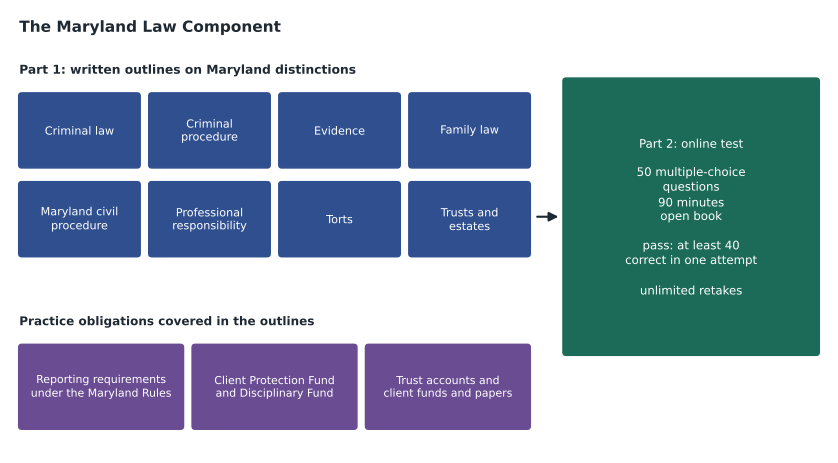
The Maryland Law Component, often shortened to MLC, is Maryland's way of making sure new lawyers know the Maryland rules that the Uniform Bar Examination does not test. It has two parts. Part 1 is a set of written outlines on Maryland law. Part 2 is an online multiple-choice exam based entirely on those outlines. Under the Maryland Rules and Board Rule 4, no applicant can be cleared for admission until the Maryland Law Component is complete.
Every applicant must complete it, whatever the route: applicants sitting the UBE in Maryland, applicants transferring a qualifying UBE score from another jurisdiction and lawyers petitioning for admission without examination. A lawyer who has practiced in Virginia for twenty years and qualifies for admission without examination still has to pass the Maryland Law Component.
What the outlines cover
The outlines focus on how Maryland law differs from the general law tested on the UBE. According to the Board, they cover substantive Maryland distinctions in eight subjects: criminal law, criminal procedure, evidence, family law, Maryland civil procedure, professional responsibility including the Maryland Attorneys' Rules of Professional Conduct, torts, and trusts and estates. They also cover reporting requirements under the Maryland Rules, a lawyer's obligations to the Client Protection Fund and the Disciplinary Fund, and Maryland's rules on attorney trust accounts and the handling of client funds and papers.
The choice of subjects reflects where Maryland departs from the general rules a new lawyer learned in law school. Torts includes contributory negligence, which Maryland retains while most states use comparative negligence, and the cap on noneconomic damages. Family law includes Maryland's grounds for divorce, which changed substantially in 2023. Civil procedure covers Maryland's court structure and rules that differ from the federal rules. Professional responsibility covers the Maryland Attorneys' Rules and the duties that come with a Maryland license. Lessons 7 through 10 of this course take up several of these topics in more depth.
The practice obligations at the end of the outlines may be the most useful part for a new lawyer. A first-year associate who does not know how a Maryland trust account must be handled, or that she must report certain information to the Judiciary each year, can get into trouble without any dishonest intent.
The online test
The test has 50 multiple-choice questions and a time limit of 90 minutes, shown on a countdown timer. It is open-book. All answers come from the outlines, so no other resources are needed. Each attempt draws a new set of 50 questions. Before each attempt the applicant certifies her identity and status and that she has neither given nor received help. The session submits automatically when time runs out. The applicant may submit early only after answering all 50 questions.
To pass, the applicant must answer at least 40 of the 50 questions correctly in a single 90-minute attempt. She does not have to answer every question, as long as 40 are correct when time expires. Attempts are unlimited, and an applicant who does not pass may start a new attempt right away.
| Feature | Rule |
|---|---|
| Questions | 50 multiple choice, a new set each attempt |
| Time | 90 minutes, with a countdown timer; auto-submits at zero |
| Materials | Open book; all answers come from the MLC outlines |
| Passing | At least 40 correct in a single attempt |
| Retakes | Unlimited; a new attempt may start immediately |
| Reporting | Passing is reported to the Board automatically; status shows in eBar the following Monday |
Access and reporting
Access is emailed on the Monday after the applicant's Notice of Intent or petition is filed, or on the next business day if that Monday is a court holiday. A filing marked filed on a Monday gets access the following Monday. The welcome email gives the username, which is the applicant's NCBE number, and a temporary password, and it may land in a spam folder. On first login the applicant creates a permanent password and must download the outlines.
When an applicant passes, the result is reported automatically to the Board. The applicant receives a confirmation email and can print a Certificate of Successful Completion. The Board asks applicants to keep these records and not send them in unless asked. Passing status appears in eBar on the Monday, or next business day, after the successful attempt.
Deadlines
There is no single deadline for the Maryland Law Component, but there are two practical limits and one outer limit.
For applicants who sit the UBE in Maryland, the MLC may be completed after the exam. The Board recommends finishing by mid-October after a July exam and by mid-April after a February exam, to give the best chance of being included in the November or May admission ceremonies. The outside limit is two years from the notice of exam results stating that the applicant passed.
For applicants transferring a UBE score or seeking admission without examination, the Board advises completing the MLC as soon as possible after filing. The Board will not request the final Affirmation until the MLC is complete. The outside limit is two years from the filing of the notice or petition.
Failing to complete the MLC is not a ground for extending the two-year deadline under Rule 19-214. An applicant who lets two years pass risks having to start the admission process over.
When to do it
Hollis laid out the options. Bridget could complete the MLC now, in November or December, before her bar study became intense. She could leave it until after the exam, in March, when she would have time before results. Or she could do it after results in April, which the Board allows but which risks missing the May ceremony if anything goes wrong.
Doing it early has two advantages. It takes the requirement off the list for good. And reading Maryland law before the exam has a small benefit for practice. The disadvantage is a risk of confusion: the NextGen exam tests general law, and a candidate who has just read that Maryland retains contributory negligence may be tempted to apply it on the exam. Hollis thought that risk was manageable for most candidates if they kept the two bodies of law clearly separated.
Doing it in March avoids the confusion risk and still finishes well before the recommended mid-April date. Bridget chose March. She put two evenings on her calendar, one for reading the outlines and one for the test, with a backup evening if she did not pass on the first attempt.
How to prepare
Because the test is open book and drawn entirely from the outlines, preparation is about knowing the outlines well enough to find answers quickly. Ninety minutes for 50 questions is just under two minutes per question. A candidate who has to search the outlines from scratch for every question will run out of time. A candidate who has read them once, carefully, and knows where each topic sits will finish comfortably.
Hollis suggested a method. Read the outlines through once with a highlighter, marking every place where Maryland differs from the general rule. Make a one-page index of topics and page numbers. Then take the test with the index and the outlines open. Answer the questions you know first, mark the others and return to them. Watch the timer: 40 correct is enough, and an unanswered question is better than running out of time with an answer you cannot submit.
Worked problem
Planning around the deadline
Hypothetical: Rhiannon passed the July 2026 Maryland exam and received her results notice on October 9, 2026. She has not started the MLC. She wants to be sworn in at the November ceremony. What should she do?
Show solution
- The Board recommends completing the MLC by mid-October after a July exam for the November ceremonies.
- She has only days before mid-October, but the test can be taken at once and retaken immediately if needed.
- Her passing status will appear in eBar on the Monday after she passes.
- She must also file her Affirmation within seven days of the results notice.
Answer: She should file her Affirmation and take the MLC immediately. If she passes quickly, she may still make November; if not, she remains within the two-year outer limit but may have to wait for a later ceremony.
Why Maryland uses this approach
Jurisdictions on the UBE face a choice about local law. Some add a local essay or test on exam day. Others require a separate course or test. Maryland chose the separate route, open book and repeatable, which keeps the exam uniform and portable while ensuring that every new Maryland lawyer has read the local rules once. The approach reflects a judgment that knowing where to find the Maryland rule is the essential skill. A lawyer in practice looks things up; the MLC tests whether she can.
Common mistakes
MistakeThe MLC is given on exam day.
InsteadIt is a separate online test that can be taken any time after filing.
MistakeOnly exam takers need the MLC.
InsteadScore transfer applicants and lawyers seeking admission without examination need it too.
MistakeThe MLC requires a perfect score.
InsteadAt least 40 of 50 correct in a single 90-minute attempt.
MistakeA failed MLC attempt means waiting months to retry.
InsteadAttempts are unlimited and a new one can begin immediately.
MistakeThe two-year limit can be extended if the MLC is not done.
InsteadFailure to complete the MLC is not a ground for extending the deadline under Rule 19-214.
Practice problems
Work each problem on paper first, then reveal the answer to check.
How many questions, how much time and how many correct?
Show answer
50 questions, 90 minutes, at least 40 correct in one attempt.
When does access arrive?
Show answer
By email on the Monday after the Notice of Intent or petition is filed.
Name four subjects in the MLC outlines.
Show answer
Any four of criminal law, criminal procedure, evidence, family law, Maryland civil procedure, professional responsibility, torts, and trusts and estates.
When does the Board recommend finishing after a February exam?
Show answer
By mid-April, to maximize the chance of a May ceremony.
What is the outer limit for an applicant who passed the exam in Maryland?
Show answer
Two years from the notice of exam results stating that she passed.
Building an index
Hollis showed Bridget how she would build an index for the outlines. One page, two columns. On the left, short topic labels in the order a question might use them: contributory negligence, last clear chance, damages cap, local government notice, divorce grounds, marital property, alimony, child support, elective share, Orphans' Court, trust accounts, Client Protection Fund, reporting duties, criminal procedure differences, evidence differences. On the right, the page numbers in the outlines. The index takes an hour to make and saves far more than an hour during the test.
Practice in the style of the test
Bridget wrote three original practice questions of her own to test the method. In one, a lawyer receives settlement funds for a client and asks where they must go; the answer is an attorney trust account at an approved institution. In another, a plaintiff injured on October 10, 2026 asks what limit applies to her pain and suffering award; the answer is 980,000 dollars. In the third, a couple who separated under one roof six months ago asks whether they can file on that ground; the answer is yes, if they have pursued separate lives. She found each answer in the outlines in under a minute using her index. Her questions were not the Board's questions, which she never saw in advance and which change with every attempt, but they showed her the method worked.
A completion checklist
Before starting an attempt, Bridget planned to check four things: a quiet room and a stable internet connection, the outlines and the index open on a second screen or printed, ninety uninterrupted minutes with her phone in another room, and the certification she would make about identity and independent work. After passing, she would save the confirmation email and print the certificate, then confirm the next Monday that eBar showed her status as passed.
Keeping the outlines
The outlines are useful after admission too. They summarize the trust account rules and reporting duties a new lawyer must meet, and they point to the Maryland rules and statutes behind each distinction. Hollis suggested Bridget keep her annotated copy on her office computer for her first year of practice.
A note on honesty
The Maryland Law Component relies on the applicant's certification that she worked alone. An applicant who shares questions, takes the test with a friend or uses someone else's notes breaks that certification, and the breach is itself a character and fitness problem. Hollis put it simply: the MLC is the first sworn test of a Maryland lawyer's integrity, and it is an easy one to pass honestly.
Summary and key terms
- The Maryland Law Component has written outlines on Maryland law and an online open-book test.
- Every applicant on every route must complete it before being cleared for admission.
- The outlines cover eight subjects plus reporting, Client Protection Fund and trust account obligations.
- The test has 50 questions in 90 minutes; passing requires 40 correct in a single attempt; retakes are unlimited.
- Access arrives the Monday after filing; passing is reported automatically.
- Finish by mid-April after a February exam; the outer limit is two years.
- MLC
- The Maryland Law Component, Maryland's required outlines and open-book test on Maryland law.
- MLC outlines
- The written materials on Maryland law that contain every answer on the MLC test.
- Certificate of Successful Completion
- The record an applicant may print after passing the MLC.
- Client Protection Fund
- The fund, supported by lawyers' annual payments, that reimburses clients for losses caused by lawyer dishonesty.
- Rule 19-214
- The Maryland Rule whose two-year time limit is not extended because the MLC is incomplete.
Lesson quiz · 5 questions
Score 60% or more to complete this lesson.
Create a free account to save your progress, take quizzes and earn a certificate.