
BAR-221 · Lesson 5 of 12 · 20 min
Exam changes: from the legacy UBE to NextGen in July 2026
▶ Video coming soon A video version of this lesson is on the way.
Bridget's law school classmates had split into two camps in the spring of 2026. Some had rushed to sit Maryland's last legacy exam in February 2026, before graduating, so they could take a test with years of practice materials behind it. Others had waited for July and the new exam. Bridget had been in the second group before her father's surgery changed her plans. 'Did I miss the easy one?' she asked Hollis at the fifth session.
'There is no easy one,' Hollis said. 'There is the one you are sitting. But you should understand how Maryland got here, because the transition still affects you: it decides which scores Maryland will accept, which materials you should study from and how crowded the exam is.'
This lesson traces Maryland's move from its own exam to the legacy UBE and then to the NextGen UBE, explains what changed in July 2026, and covers the transition rules that still matter for candidates and for lawyers transferring scores.
Before the UBE
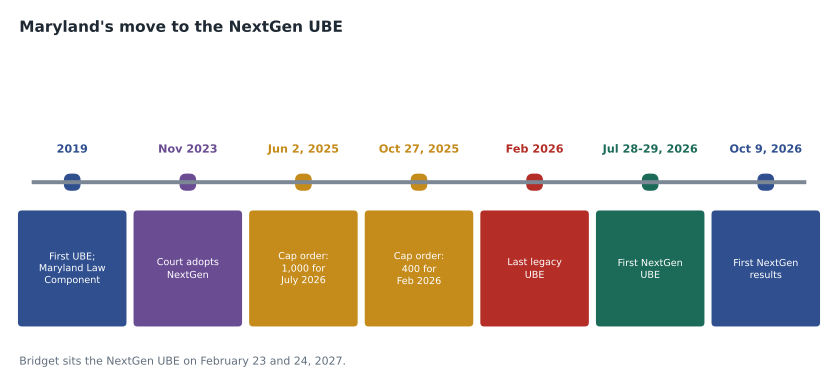
For decades Maryland wrote its own bar exam. It combined the MBE with essay questions on Maryland law drafted by the Board. Candidates studied Maryland civil procedure, Maryland family law and other Maryland subjects for the exam itself. That changed when Maryland adopted the Uniform Bar Examination, which it first gave in 2019. From then on, the exam tested general law, and Maryland introduced the Maryland Law Component to teach and test the local rules that the exam no longer covered.
The UBE brought a major advantage: portability. A Maryland UBE score could be transferred to other UBE jurisdictions, and scores from other jurisdictions could be transferred into Maryland. For a state that borders the District of Columbia, Virginia, Delaware, Pennsylvania and West Virginia, and whose lawyers often practice across state lines, portability mattered.
The decision to adopt NextGen
NCBE designed the NextGen bar exam over several years to test lawyering skills alongside doctrine and to replace the legacy UBE. The Supreme Court of Maryland issued an order in November 2023 adopting the NextGen bar exam. Maryland chose to be among the first jurisdictions to give it, in July 2026. When the first administration took place, ten jurisdictions gave the NextGen exam to 2,630 examinees.
The Board's last legacy UBE was the February 2026 exam. NCBE's jurisdiction summary confirms that Maryland's final legacy administration was February 2026. From July 2026 every examinee in Maryland sits the NextGen UBE, including repeat takers who failed a legacy exam.
What changed in July 2026
The changes were not only in the questions. The legacy UBE had three components: the MBE, with 200 multiple-choice questions over a full day; the MEE, with six essays; and the MPT, with two performance tests. It took twelve hours over two days and was scored on a 400-point scale. The NextGen UBE has three sections of three hours each over one and a half days, mixes question types within each section, and is scored on a 500 to 750 scale.
| Feature | Legacy UBE in Maryland | NextGen UBE in Maryland |
|---|---|---|
| Last or first administration | Last: February 2026 | First: July 2026 |
| Length | Twelve hours over two days | Nine hours over one and a half days |
| Components | MBE, MEE and MPT | Standalone multiple choice, integrated sets, performance tasks |
| Weights | MBE 50, MEE 30, MPT 20 percent | Multiple choice 49, integrated sets 21, performance tasks 30 percent |
| Scale | 0 to 400 | 500 to 750 |
| Maryland passing score | 266 | 616 |
| Format | Laptop or handwriting options for written parts | Computer-based on examinee laptops |
The format of testing changed too. The NextGen exam is entirely computer-based, using NCBE's software on examinees' laptops. For July 2026, Maryland gave it at the Baltimore Convention Center, in Halls A through C. A single large site with secure software and stable power and networking is a substantial logistical undertaking, and that is part of why the Supreme Court limited the number of applications for the first administration.
The cap orders
The June 2, 2025 order capped the July 2026 exam at 1,000 applications and processed them in priority stages across April 2026: April 1 to 10, April 11 to 20, and April 21 to May 1. The October 27, 2025 order capped the February 2026 legacy exam at 400 applications, gave repeat Maryland examinees priority from November 1 to 10, 2025, and opened processing to everyone from November 12. In both orders one justice did not approve.
These orders had real effects. Some candidates who wanted the last legacy exam could not get a place and had to wait for NextGen. Others filed earlier than they otherwise would have. Candidates for later exams should check the Judiciary's administrative orders page before each filing period. Bridget found no cap order for February 2027 when she checked in November 2026, but she had filed on November 3 anyway.
Legacy scores after the change
Maryland stopped giving the legacy exam, but legacy scores still matter. Many jurisdictions continue to give the legacy UBE into 2027 and 2028, and some examinees will earn legacy scores there and want to transfer them to Maryland. Maryland accepts transferred legacy UBE scores as well as NextGen scores, subject to time limits and to Maryland's legacy passing score of 266.
The Board's NextGen FAQ sets out how long legacy UBE scores earned elsewhere after Maryland's change remain usable under Board Rule 5(b). A legacy score from the July 2026 exam is usable through July 31, 2029. A score from February 2027 is usable through February 28, 2030. A score from July 2027 is usable through July 31, 2030. A score from February 2028 is usable through February 29, 2031. In each case the window is about three years from the exam.
| Legacy UBE taken elsewhere | Usable in Maryland through |
|---|---|
| July 2026 | July 31, 2029 |
| February 2027 | February 28, 2030 |
| July 2027 | July 31, 2030 |
| February 2028 | February 29, 2031 |
NextGen scores are transferable too. NCBE's summary says Maryland accepts NextGen transfers from July 2026, with a maximum age of three years, and that Maryland does not accept a separately transferred MBE score. Lesson 11 covers the transfer procedure.
What Bridget should study from
The most practical consequence of the change is in study materials. Bridget's older classmates had MBE books and released MEE essays from years of legacy exams. Those materials are still useful for doctrine, because the NextGen concepts overlap heavily with legacy subjects, but they do not train the new question formats. Hollis set three rules.
First, use NCBE's NextGen sample questions and practice materials as the core, because they show the actual item types and interface. Second, use legacy MBE questions for doctrine drilling in moderation, recognizing that NextGen multiple-choice questions are often shorter and include multiple-select items. Third, practice performance tasks under NextGen timing, because the tasks are shorter than the old MPT and sometimes include research choices.
Hollis also warned about subjects. The NextGen concepts list is narrower in some ways than the legacy MBE and MEE combined. Conflict of laws and secured transactions, for example, are not tested. NCBE's materials indicate that family law and trusts and estates are being phased into the NextGen exam during the transition period, and bar review providers report that family law becomes part of the standard scope from July 2028. Bridget should check NCBE's current content scope for her administration rather than rely on a list from a classmate.
Worked problem
A repeat taker after the change
Hypothetical: Leonard sat Maryland's February 2026 legacy UBE and scored 259. He wants to try again. Can he sit the legacy exam again in Maryland, and what score does he need?
Show solution
- Maryland's last legacy UBE was February 2026.
- From July 2026 every examinee in Maryland sits the NextGen UBE.
- His legacy score of 259 does not carry over; the two exams are scored on different scales.
- He must sit the NextGen exam and score at least 616.
Answer: He cannot sit the legacy exam in Maryland again. He files a new Notice of Intent for a NextGen administration and needs 616.
Why the change matters beyond the exam
NCBE designed NextGen to measure skills new lawyers use: reading and applying unfamiliar materials, counseling clients, negotiating, researching and writing. Maryland's choice to adopt it early signals that its admitting authority values those skills. For Bridget, the change meant that her clerkship work at Helen Szabo's firm, drafting demand letters and summarizing client interviews, was more relevant to the exam than it would have been under the legacy format.
Common mistakes
MistakeMaryland's last legacy UBE was July 2026.
InsteadThe last legacy UBE in Maryland was February 2026; NextGen began in July 2026.
MistakeLegacy scores cannot be used in Maryland any more.
InsteadMaryland accepts transferred legacy UBE scores within its time limits and its legacy passing score of 266.
MistakeA failed legacy score can be combined with a NextGen attempt.
InsteadThe exams use different scales; a repeat taker sits NextGen and needs 616.
MistakeOld MEE essays are the best practice for NextGen.
InsteadNCBE's NextGen materials train the new formats; legacy materials help with doctrine only.
MistakeThe cap orders apply to every future exam.
InsteadEach order applied to a particular administration; check for any new order before filing.
Practice problems
Work each problem on paper first, then reveal the answer to check.
When did Maryland first give the UBE?
Show answer
In 2019, when it also introduced the Maryland Law Component.
When was Maryland's first NextGen exam?
Show answer
July 28 and 29, 2026, at the Baltimore Convention Center.
How long is a July 2027 legacy score from another jurisdiction usable in Maryland?
Show answer
Through July 31, 2030, under Board Rule 5(b) as described in the Board's FAQ.
What does Maryland require for a transferred legacy score?
Show answer
At least 266 and a score within the time limit.
Does Maryland accept a separately transferred MBE score?
Show answer
No; NCBE's summary says Maryland does not accept MBE transfers.
Maryland among the first jurisdictions
Being early had costs and benefits. The cost was uncertainty. In 2025 and early 2026, Maryland candidates had fewer practice materials for NextGen than for the legacy exam, and bar review courses were still building their programs. The capacity limits of a new computer-based format led to the cap orders. The benefit was a cleaner break. Maryland candidates do not have to wonder when the change will come, and Maryland examiners have already graded a NextGen administration.
Other jurisdictions are moving on their own timetables. NCBE has said that the legacy UBE will be phased out after February 2028. A Maryland lawyer who wants admission in a neighboring jurisdiction should check whether that jurisdiction gives the legacy UBE, the NextGen UBE or its own exam, and whether it accepts NextGen transfers from Maryland.
Older materials and Maryland-specific content
Bridget's father had kept a box of a family friend's bar study books from the 1990s, complete with Maryland essay questions. Hollis told her to leave them in the box. Before 2019 Maryland tested its own law on the essays, and some of that law has since changed. Divorce grounds are the clearest example: a book that teaches limited divorce and a twelve-month separation is teaching rules Maryland abolished in 2023. Even the names of the courts changed in 2022. Old books are useful only as a reminder of how much changes.
More recent legacy materials are a different matter. A legacy MBE question on hearsay or the parol evidence rule tests the same doctrine NextGen tests, though in a different format. Bridget used a limited set of legacy MBE questions for doctrine drills in December and switched to NextGen materials for most of her practice from January.
Research tasks
One genuinely new element of NextGen is legal research inside the performance tasks. Some tasks give a set of authorities and ask the examinee to decide which are relevant before writing, or to choose search terms that would locate the right materials. Legacy MPT practice does not train this skill, because the MPT library contained only the materials needed. Bridget practiced by skimming a set of authorities, sorting them into relevant, possibly relevant and irrelevant, and checking her sorting against the model answer before writing.
A decision matrix for repeat takers
For candidates who failed a legacy exam, Hollis suggested asking three questions. Do I have a legacy score close to passing that I could improve on in another jurisdiction still giving the legacy exam? Do I want to practice in Maryland specifically, which now requires NextGen? And how much time do I have to learn the new formats? Most Maryland-focused repeat takers, she said, should simply prepare for NextGen and treat their legacy preparation as a doctrinal foundation.
What did not change
Some things stayed the same through the transition. Maryland still requires the MPRE score of 85, character and fitness approval and the Maryland Law Component. Its filing deadlines, December 1 for February and May 1 for July, did not move, and the exam still falls on the last Wednesday of February and July and the Tuesday before. The Board still grades the written components and NCBE still scales the scores. A candidate who understood the legacy admission process already understands most of the NextGen process; what changed is the exam itself.
Summary and key terms
- Maryland gave its own exam until it adopted the UBE in 2019 and introduced the Maryland Law Component.
- The Supreme Court adopted NextGen in November 2023; the last legacy UBE in Maryland was February 2026.
- The first NextGen exam was July 28 and 29, 2026, at the Baltimore Convention Center, computer-based.
- Cap orders limited July 2026 to 1,000 and February 2026 to 400 applications.
- Maryland still accepts legacy UBE transfers within Board Rule 5(b) windows, at 266, and NextGen transfers at 616.
- Study from NCBE's NextGen materials; use legacy materials for doctrine only.
- legacy UBE
- The Uniform Bar Examination of MBE, MEE and MPT, scored out of 400, last given in Maryland in February 2026.
- Board Rule 5(b)
- The Board rule setting how long transferred legacy UBE scores remain usable in Maryland.
- transition period
- The years in which some jurisdictions give the legacy UBE while others give NextGen.
- content scope
- NCBE's published list of concepts and skills tested on the NextGen exam.
- portability
- The ability to transfer a UBE score from one jurisdiction to another.
Lesson quiz · 5 questions
Score 60% or more to complete this lesson.
Create a free account to save your progress, take quizzes and earn a certificate.