
BAR-221 · Lesson 3 of 12 · 21 min
Character and fitness and the MPRE
▶ Video coming soon A video version of this lesson is on the way.
Bridget admitted at the third session that the Character Questionnaire had taken her longer than any law school paper. Two items had stopped her. In the summer of 2021, between her second and third years of college, she had been cited in Ocean City for possessing alcohol under the age of 21. She paid the fine and completed an alcohol education class. And in 2023, during her first year of law school, a store credit card she had forgotten about went to a collection agency. She paid it in full in early 2024 once a credit report showed it. 'I almost did not list the citation,' she said. 'It was five years ago and it was a fine.'
'Then I am glad you are here,' Hollis said. 'Because the citation is not the problem. Leaving it off would have been.'
This lesson covers the character and fitness requirement in Maryland, how the Character Questionnaire and the review work, how to handle disclosures, the duty to keep the questionnaire current and the MPRE requirement of 85.
What the requirement asks
Every applicant for admission to the Maryland bar must establish good moral character and fitness to practice law. The burden is on the applicant. The question is not whether the applicant has ever made a mistake but whether the applicant can be trusted with the responsibilities a lawyer carries: handling client money, keeping confidences, meeting deadlines, telling the truth to courts and following rules. Past conduct matters because it predicts future conduct, and the review looks at the whole person, including what the applicant has done since.
Factors that typically raise questions include criminal charges and convictions, academic or employment discipline, dishonesty in any setting, unpaid debts and neglected financial obligations, a pattern of traffic offenses, untreated substance problems that affect conduct, and misconduct in other professions. Factors that reduce concern include the age at which the conduct happened, how long ago it was, whether it was isolated, whether the applicant took responsibility, and evidence of rehabilitation.
Candor is the core of the review
In almost every jurisdiction the most serious character problem an applicant can create is a false or incomplete answer on the application. Maryland is no exception. An old citation, honestly disclosed and explained, is usually a small matter. The same citation, discovered by a background check after the applicant left it off, becomes a question about honesty in a sworn filing to a court's admitting authority, which goes directly to fitness to practice law.
Hollis gave Bridget three rules for disclosure. First, read each question literally and answer what it asks, including matters that were dismissed, expunged or handled as a diversion if the question reaches them. Second, when in doubt, disclose and explain. Third, attach documents: a court record showing the fine was paid, a certificate from the alcohol class, a letter or statement showing the collection account was paid in full.
Bridget had followed all three. Her explanation of the citation was four sentences long: what happened, how old she was, what she did about it and that nothing similar had happened since. Her explanation of the collection account said she had not known about it, paid it when she found it, and now checks her credit report every year.
How the review works
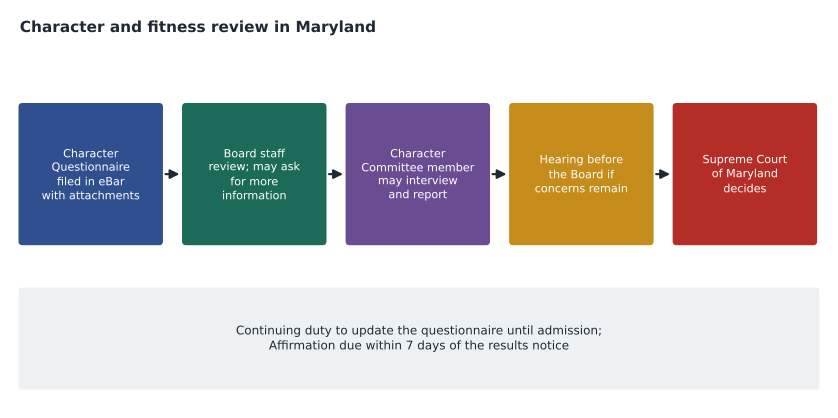
The Character Questionnaire is the starting point. The Board's staff reviews it with its attachments, including the certified driving histories and the credit report. The Board may ask for more information or documents.
Maryland also uses Character Committees appointed by the Supreme Court. A member of a committee, a practicing lawyer, may interview an applicant and report on the applicant's character. The interview is not an exam. It is a conversation in which the committee member checks that the applicant understands the questionnaire answers and can discuss any matter disclosed. An applicant should prepare by rereading the questionnaire, bringing copies of documents and being ready to explain any disclosure calmly and briefly.
If concerns remain after review, the Board can hold a hearing, and the final decision on admission rests with the Supreme Court of Maryland. Most applicants never reach that stage. Applicants who do should consider getting advice from a lawyer who handles admission matters.
The continuing duty to update
The Character Questionnaire speaks as of the date it was filed, but the duty to keep it accurate continues until admission. If something new happens, such as a new address, a new job, a traffic ticket, a lawsuit or a change in a matter already disclosed, the applicant must update the questionnaire promptly. Maryland formalizes this at the end. After an applicant passes the exam, the applicant must file an Affirmation within seven days of the results notice, confirming that the questionnaire is complete and updating any information.
Bridget asked whether her move to an apartment in Towson in September counted. It did. She had already listed her Towson address, because she filed after the move. Her new job as a law clerk was also listed. Hollis told her to keep a short running file of anything that changed between November and April, so the Affirmation would take ten minutes rather than an anxious evening.
Old questionnaires
A Character Questionnaire does not last forever. If an applicant's CQ is three or more years old, the Board charges a 100-dollar update fee, and the applicant must bring the questionnaire current. An applicant who sits the exam, does not pass and returns two or three exams later should expect to update.
Worked problem
A disclosure problem
Hypothetical: Garrett filed his Character Questionnaire in October. In January he received a speeding ticket on Interstate 95 and paid it online. He passed the exam and received his results notice in April. What should he do?
Show solution
- The duty to update the questionnaire continues until admission.
- A new traffic citation is the kind of event the questionnaire asks about.
- He should have updated the questionnaire promptly in January.
- At the latest, he must disclose it in the Affirmation due within seven days of the results notice, with a copy of the paid citation.
Answer: He should update now and in the Affirmation, explain the delay honestly and attach proof of payment. A paid speeding ticket is minor; an undisclosed one is a candor problem.
The MPRE requirement
Maryland requires a scaled score of 85 or higher on the Multistate Professional Responsibility Examination. The MPRE is a two-hour, sixty-question multiple-choice exam written by NCBE and given at Pearson VUE test centers. It tests the law governing lawyers, based mainly on the ABA Model Rules of Professional Conduct and related law, not the Maryland Attorneys' Rules specifically. Scores are reported on a scale of 50 to 150. NCBE offers the MPRE several times a year.
The timing rule depends on whether the applicant is already admitted elsewhere. An applicant not currently admitted in another jurisdiction must have an MPRE score of 85 or higher from an administration within three years before filing the Notice of Intent. An applicant currently admitted elsewhere may use a score of 85 or higher earned at any time, if NCBE can officially report it. The applicant asks NCBE to report the score to Maryland once the eBar account exists.
Bridget's score of 97 from March 2026 was well within three years of her November 2026 Notice of Intent. Hollis asked her to imagine that she had taken the MPRE in March 2023, in her first year of law school, and was filing her NOI in May 2026. 'Three years and two months,' Bridget said. 'Too old. I would need to retake it.'
| Applicant | MPRE rule in Maryland | Example |
|---|---|---|
| Not admitted in any other jurisdiction | Scaled score of 85 or higher within three years before filing the NOI | March 2026 score of 97, NOI filed November 2026: valid |
| Currently admitted elsewhere | Scaled score of 85 or higher earned at any time, if officially reportable | Score of 90 from 2012, admitted in Virginia: valid |
| Score below 85 | Retake until a score of 85 or higher | Score of 82 in August: retake in November or later |
How Maryland's MPRE score compares
Maryland's 85 is in the middle of the range among jurisdictions. Many require 85, some require 80 or 86, and California requires 86. A candidate who expects to seek admission in several states should aim well above 85 so that one score works everywhere. The MPRE is scaled, so a score of 85 in one administration reflects the same level of performance as 85 in another.
Preparing for the MPRE
Most candidates prepare for the MPRE in two to four weeks. The core subjects are conflicts of interest, client confidentiality, the client-lawyer relationship, competence and diligence, communications with clients and others, duties to the court, fees and client property, advertising and solicitation, and the regulation of the profession. The questions often turn on a precise distinction: a lawyer may reveal confidential information to prevent reasonably certain death or substantial bodily harm, but the rule permits disclosure rather than requiring it; a conflict may be consentable with informed consent confirmed in writing, or it may not be consentable at all.
Hollis's advice was practical. Work timed sets of sixty questions in two hours. Read the call of the question first: the MPRE often asks whether a lawyer is subject to discipline, which is a narrower question than whether the conduct was wise. And learn the difference between must, may and must not.
The MPRE and the NextGen exam
The NextGen exam also tests some professional responsibility. NCBE's materials say certain Model Rules are tested within client counseling, negotiation and client relationship skills, including rules on competence, scope of representation, diligence, communication, confidentiality, conflicts, candor to the tribunal, truthfulness to others and communications with represented and unrepresented persons. That does not replace the MPRE. Maryland still requires the MPRE score of 85.
The Maryland Attorneys' Rules
After admission, Bridget will practice under the Maryland Attorneys' Rules of Professional Conduct, in Title 19, Chapter 300 of the Maryland Rules. Those rules follow the structure of the ABA Model Rules closely but are numbered as Maryland rules, so the confidentiality rule appears as Rule 19-301.6 rather than Rule 1.6. The Maryland Law Component outlines cover the Maryland rules and their differences from the Model Rules, and Lesson 10 discusses them.
Common mistakes
MistakeA dismissed charge or a paid fine does not need to be disclosed.
InsteadAnswer each question literally; disclose what it asks about, including matters that were dismissed or resolved if the question reaches them.
MistakeOnce the CQ is filed, nothing more needs to be reported.
InsteadThe duty to update continues until admission, and the Affirmation is due within seven days of the results notice.
MistakeAny MPRE score of 85 works for a new graduate.
InsteadAn applicant not admitted elsewhere needs a score within three years before filing the NOI.
MistakeThe MPRE tests the Maryland Attorneys' Rules.
InsteadThe MPRE tests the ABA Model Rules and general law governing lawyers.
MistakeThe character interview is an oral exam on legal ethics.
InsteadIt is a conversation with a Character Committee member about the applicant's history and disclosures.
Practice problems
Work each problem on paper first, then reveal the answer to check.
What MPRE score does Maryland require?
Show answer
A scaled score of 85 or higher.
How old may the MPRE score be for an applicant not admitted elsewhere?
Show answer
It must come from an administration within three years before the Notice of Intent is filed.
When is the Affirmation due?
Show answer
Within seven days of the notice of exam results stating that the applicant passed.
Who may interview a Maryland applicant about character?
Show answer
A member of a Character Committee appointed by the Supreme Court of Maryland.
What is usually worse than an old minor offense on a character application?
Show answer
Failing to disclose it, which raises a question of candor.
Preparing for the interview
Bridget asked how to prepare if a Character Committee member contacted her. Hollis gave her four steps. Reread the whole questionnaire the night before, not just the disclosures, because the interviewer may ask about an employer or an address. Bring copies of the documents attached to each disclosure. Prepare a short, honest account of each matter in two or three sentences: what happened, what you did about it and what has changed. And answer the question asked. An applicant who volunteers a long story about an unfair police officer turns a paid citation into a discussion of judgment.
What rehabilitation looks like
Where an applicant has a more serious history, the review looks for evidence of rehabilitation. Useful evidence includes the passage of time without further incidents, completion of any sentence or program, restitution where money was owed, treatment where a health or substance problem contributed, stable employment, and letters from people who know the applicant well and know about the matter. The strongest evidence is consistent conduct over years. A statement of remorse helps only when the record supports it.
Debts and finances
Financial matters are among the most common disclosures. The concern is not that an applicant owes money; most new lawyers carry student loans. The concern is neglect: unpaid judgments, accounts in collection that the applicant ignored, unfiled tax returns or defaults on agreements. An applicant with an old collection account, like Bridget, should show that it is resolved and explain what she does now to stay on top of her finances. An applicant with a current problem should show a realistic plan, such as a written payment agreement, and evidence that she is following it.
Driving records
Maryland's requirement of a certified driving history from every state where the applicant held a license in the last three years means traffic matters will surface whether or not the applicant remembers them. A single speeding ticket is unremarkable. A pattern of unpaid tickets, a suspended license or an alcohol-related driving offense draws attention. As with everything else, disclosure and documentation are the answer.
Summary and key terms
- Applicants must prove good moral character and fitness; the burden is on the applicant.
- Candor is the core of the review: disclose, explain briefly and attach documents.
- The Board reviews the CQ, a Character Committee member may interview the applicant, and the Supreme Court decides.
- The duty to update continues until admission; the Affirmation is due within seven days of the results notice.
- Maryland requires an MPRE score of 85; new applicants need a score within three years before filing the NOI.
- Applicants already admitted elsewhere may use a reportable score of 85 or higher from any time.
- good moral character
- The trustworthiness and fitness an applicant must prove to be admitted.
- Character Committee
- A committee of lawyers appointed by the Supreme Court of Maryland whose members interview applicants about character.
- Affirmation
- The filing due within seven days of the results notice confirming and updating the Character Questionnaire.
- MPRE
- NCBE's professional responsibility exam; Maryland requires a scaled score of 85.
- candor
- Complete honesty in filings with the Board, the central value in character review.
Lesson quiz · 5 questions
Score 60% or more to complete this lesson.
Create a free account to save your progress, take quizzes and earn a certificate.