
BAR-221 · Lesson 2 of 12 · 21 min
Eligibility, education, filing deadlines and fees
▶ Video coming soon A video version of this lesson is on the way.
At the second session Hollis asked Bridget to share her eBar dashboard. Two filings sat there, both marked approved: the Character Questionnaire and the Notice of Intent for the February 2027 exam. Below them were two paid invoices. 'Good,' Hollis said. 'Now pretend you have not done any of this and explain to me why you did it in that order and what would have happened if you had waited until December 2.'
This lesson covers who may sit the Maryland bar exam, the education requirement and its waivers, the filings in eBar and their order, the deadlines for February and July exams, the fees and the limits the Supreme Court has placed on the number of applications for recent exams. These are the rules that decide whether an applicant is allowed into the exam room, so they deserve the same care as any substantive topic.
The education requirement
Maryland's standard requirement has two parts. First, the applicant must have completed the pre-legal education needed to enter an ABA-approved law school, which in practice means a bachelor's degree. The applicant arranges for the undergraduate institution to send an official transcript showing the degree. Second, the applicant must hold a JD, or an equivalent degree, from a law school approved by the American Bar Association.
Applicants whose education does not fit that pattern are not automatically excluded. The Board's rules allow waivers for some applicants, and NCBE's summary of Maryland's requirements notes that eligibility is not limited to graduates of ABA-approved schools. NCBE also describes additional conditions for graduates of foreign law schools, including study at an ABA-approved law school and admission in another United States jurisdiction. The decisive point is timing: a waiver must be obtained before the applicant files the Notice of Intent. An applicant who files first and asks for a waiver later is asking the Board to approve a filing it cannot yet accept.
Hollis gave a hypothetical. Teodor earned his law degree in Romania, practiced there for six years and completed an LLM at a United States law school in 2026. 'Can he just file a Notice of Intent for February?' she asked. Bridget shook her head. 'He needs to look at the waiver rules and get a decision first, and he has to check whether Maryland requires him to be admitted somewhere else before it will let him sit.' Hollis agreed. 'And he needs to start months before December, not weeks.'
The final law school transcript
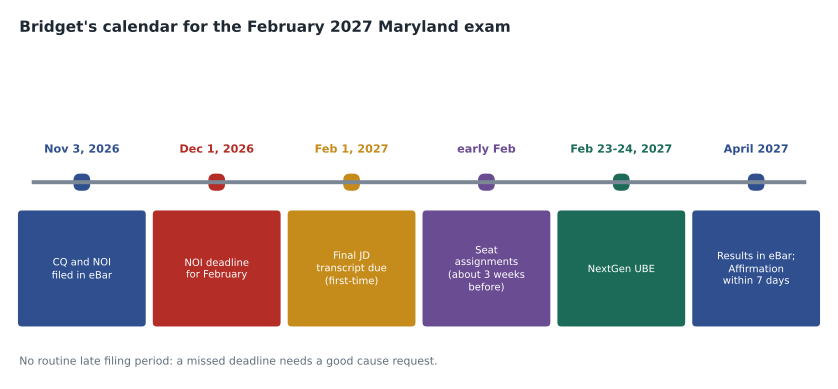
An applicant may file before graduating, but the Board must receive the official JD transcript before the applicant can be qualified. For first-time applicants, the official transcript showing the degree is due by February 1 for a February exam and by July 1 for a July exam. Bridget graduated in May 2026, so her transcript was already available, and she had asked her law school to send it in October.
The filings in eBar
Maryland's application has two main filings, and their order matters. The Character Questionnaire, usually called the CQ, collects the applicant's history: addresses, employment, education, finances, driving record, court involvement, discipline and more. The Notice of Intent, the NOI, tells the Board which exam the applicant will sit and records law school information. The Board's instructions say the CQ must be submitted before the NOI or at the same time, never after it.
The CQ requires attachments. Applicants must provide a certified driving history from each United States jurisdiction where they held a driver's license in the last three years, and a credit report, or an explanation if a credit report is unavailable. Gathering these takes time. A driving record from another state may take a week or more to arrive, and a credit report may reveal an old account the applicant had forgotten. Lesson 3 discusses why that matters.
Once each filing is submitted, the Board reviews it. Only after the Board approves a filing does eBar issue an invoice for its fee, which the applicant pays electronically. An applicant who submits the CQ and NOI on the last day and waits for invoices is not late, because the filing date is what counts, but an applicant who submits an incomplete CQ may have to supplement it, and approval may be delayed.
Deadlines
Maryland gives the bar exam twice a year, on the last Wednesday of February and July and the Tuesday before. The Notice of Intent for a February exam is due December 1 of the preceding year. For a July exam it is due May 1 of the same year. For the February 23 and 24, 2027 exam, that meant December 1, 2026.
Maryland does not have a routine late filing period with a late fee, as some states do. NCBE's summary of Maryland lists no late filing. The Board's own page says an applicant who misses the deadline may make a good cause request, with a letter explaining the grounds. A candidate should treat December 1 and May 1 as hard deadlines and should not plan on persuading the Board that a missed deadline was justified.
The Board publishes a dates document for each exam showing the filing period, the deadline, the exam site and other key dates. For the July 2026 exam, for example, the filing period ran from April 1 to May 1, 2026, and the exam was given on July 28 and 29, 2026, at the Baltimore Convention Center. Seat assignments are released about three weeks before the exam.
Fees
Maryland's fees are charged per filing. The Board's NextGen FAQ lists the Notice of Intent fee as 400 dollars and the Character Questionnaire fee as 350 dollars, so a first-time applicant pays 750 dollars to the Board. A repeat applicant who already has a current CQ on file pays the 400-dollar NOI fee. If the applicant's CQ is three or more years old, the Board charges 100 dollars for a CQ update. NCBE separately charges a technology fee for the computer-based NextGen exam, which the Board's FAQ described as about 149 dollars. Fees are invoiced only after approval and paid through eBar.
| Fee | Amount | Who pays it |
|---|---|---|
| Notice of Intent | 400 dollars | Every applicant sitting an exam |
| Character Questionnaire | 350 dollars | First-time applicants |
| CQ update | 100 dollars | Repeat applicants whose CQ is three or more years old |
| NCBE technology fee | About 149 dollars | NextGen examinees, paid to NCBE |
| Score transfer (Lesson 11) | 750 dollars | Applicants transferring a UBE score |
| Admission without examination (Lesson 11) | 700 dollars plus 625 dollars to NCBE | Out-of-state lawyers under Rule 19-215 |
Fees change. Hollis reminded Bridget that the fee table on the Board's Fees page is the source to check on the day of filing, and that NCBE's technology fee belongs to NCBE, not the Board.
Caps on applications
Maryland has a feature most states do not: for some recent exams, the Supreme Court limited how many applications the Board would process. The June 2, 2025 order for the July 2026 exam, Maryland's first NextGen administration, capped processing at 1,000 applications and set priority stages within the filing period: April 1 to 10, April 11 to 20 and April 21 to May 1, 2026. The October 27, 2025 order for the February 2026 exam, the last legacy UBE in Maryland, capped processing at 400 applications. During November 1 to 10, 2025, only repeat applicants in Maryland were processed, first come, first served, and from November 12 all applicants were processed in order of filing.
The reason for the caps was capacity. Maryland moved to a computer-based exam at a single large site, and the orders limited numbers to what the Board could administer. A cap changes the strategy for filing. When a cap is in place, filing on the first day of an open stage matters, and filing on the deadline day may be too late even though the deadline has not passed.
Hollis asked whether a cap applied to February 2027. Bridget had checked the Judiciary's administrative orders page and found none for February 2027 as of mid-November. 'So I could have filed on November 30?' she asked. 'You could have,' Hollis said, 'but you would have been betting there would be no order and no problem with your CQ. You filed on November 3. That is the habit I want.'
Worked problem
Reading a cap order
Suppose a future order caps an exam at 500 applications, gives repeat applicants priority from November 1 to 10 and opens processing to everyone from November 12. Paolo, a first-time applicant, files on November 5. Marta, who failed the previous Maryland exam, files on November 12. Who is processed first?
Show solution
- During November 1 to 10, only repeat applicants are processed.
- Paolo filed during the priority period but is not a repeat applicant, so his filing waits until general processing begins.
- Marta is a repeat applicant, but she filed on November 12, when everyone is processed in filing order.
- From November 12, filings are processed first come, first served, and Paolo's earlier filing date puts him ahead of Marta's.
Answer: Under these hypothetical terms, Paolo is processed first in the general period because he filed earlier. Marta lost her priority by filing after November 10. The actual terms of any order govern, so read it.
Accommodations
Applicants with disabilities may request testing accommodations. Requests go through the Board with supporting documentation and must be made on the schedule the Board sets for each exam, which can be earlier than the general deadline. A candidate who expects to request accommodations should begin gathering documentation as soon as she decides which exam to sit. Approved accommodations for the MPRE do not carry over automatically to the bar exam, because the two exams are administered separately.
Retakes
NCBE's summary of Maryland lists no limit on the number of times an applicant may sit the exam. A repeat applicant files a new Notice of Intent for each exam and pays the NOI fee. Repeat applicants also have to keep their CQ current. Maryland's priority for repeat applicants in the February 2026 cap order shows that the Board sometimes treats repeat applicants differently when capacity is tight.
Laptop and computer-based testing
The NextGen exam is computer-based. Examinees bring their own laptops and use NCBE's secure testing software. When filing the NOI, the applicant indicates how she will take the exam, and the Board's instructions explain laptop requirements and software registration. Bridget's laptop was four years old. Hollis told her to check it against NCBE's technical requirements in December, not in February, because a failed software check two days before the exam is a crisis that a December check turns into an errand.
Common filing errors
Most filing problems are avoidable. Applicants submit the NOI before the CQ, which eBar should block but which causes confusion when the CQ is incomplete. They forget a driving record from a state where they held a license two years ago. They assume a late filing period exists. They wait until the last day and then discover a cap order. They forget that the final transcript is due February 1. Each of these errors can cost an exam season.
Common mistakes
MistakeThe Notice of Intent can be filed first and the CQ later.
InsteadThe CQ must be filed before the NOI or at the same time, never after.
MistakeMaryland has a late filing period with a late fee.
InsteadThere is no routine late filing period; a missed deadline requires a good cause request.
MistakeThe February deadline is January 1.
InsteadThe NOI for a February exam is due December 1 of the preceding year; for July, May 1.
MistakeFees are paid when the filing is submitted.
InsteadThe Board approves each filing first; eBar then issues an invoice for payment.
MistakeA waiver can be requested after the NOI is filed.
InsteadAny education waiver must be obtained before filing the NOI.
Practice problems
Work each problem on paper first, then reveal the answer to check.
What two attachments must accompany the Character Questionnaire?
Show answer
A certified driving history from each United States jurisdiction where the applicant held a license in the last three years, and a credit report or an explanation if none is available.
When is the final JD transcript due for a first-time February applicant?
Show answer
By February 1 of the exam year.
What does a first-time applicant pay the Board?
Show answer
750 dollars: 400 for the Notice of Intent and 350 for the Character Questionnaire, plus NCBE's technology fee.
What cap applied to the July 2026 exam?
Show answer
The Supreme Court's June 2, 2025 order capped processing at 1,000 applications, with priority stages in April 2026.
Does Maryland limit the number of attempts?
Show answer
NCBE lists no limit on attempts in Maryland.
A filing checklist
Hollis asked Bridget to turn the lesson into a checklist she could hand to a classmate. It had eight lines. Confirm the bachelor's degree transcript has been sent. Confirm the law school will send the final JD transcript by February 1 or July 1. Create the NCBE account and the eBar account. Order certified driving histories from every state where a license was held in the last three years. Pull a credit report and read it line by line. File the Character Questionnaire. File the Notice of Intent with it or after it, choosing the exam and the laptop option. Pay each invoice as soon as eBar issues it, and check the judiciary's administrative orders page for any cap order before the filing period opens.
The checklist has one more use. It keeps a record of dates. If a question later arises about when something was filed or paid, the applicant who wrote down the date and kept the eBar confirmation can answer it in a minute. Bridget had saved a screenshot of each confirmation in a folder named for the exam, a habit Hollis said she should keep for the rest of her career, because a Maryland lawyer files almost everything in MDEC and the same discipline applies there.
Hollis added a last point about money. The Board's fees are paid after approval, but NCBE's technology fee and any score transfer or MPRE fees are paid to NCBE through its own account. A candidate who budgets only for the Board's 750 dollars will be surprised. Bridget's total for February 2027, including NCBE's fee, came to about 900 dollars, before bar review costs.
Summary and key terms
- The standard requirement is a bachelor's degree and a JD from an ABA-approved law school; any waiver must be obtained before filing the NOI.
- The Character Questionnaire must be filed before or with the Notice of Intent, with a certified driving history and a credit report.
- The NOI is due December 1 for a February exam and May 1 for a July exam; there is no routine late filing period.
- First-time applicants pay 750 dollars to the Board, repeat applicants 400 dollars, plus NCBE's technology fee.
- The Supreme Court capped applications at 1,000 for July 2026 and 400 for February 2026; read any cap order before planning to file late.
- The exam is computer-based on the examinee's laptop; check the laptop early.
- Character Questionnaire
- The detailed eBar filing on the applicant's history, submitted before or with the Notice of Intent.
- Notice of Intent
- The eBar filing that registers an applicant for a particular Maryland exam.
- good cause request
- A letter asking the Board to accept a filing after the deadline; not a routine late filing period.
- cap order
- A Supreme Court of Maryland order limiting the number of applications processed for an exam.
- CQ update
- A 100-dollar filing that refreshes a Character Questionnaire three or more years old.
Lesson quiz · 5 questions
Score 60% or more to complete this lesson.
Create a free account to save your progress, take quizzes and earn a certificate.