
BAR-227 · Lesson 10 of 12 · 22 min
Montana water law and the Wrongful Discharge from Employment Act
▶ Video coming soon A video version of this lesson is on the way.
Two files sat side by side on Brynn's desk at Thorsen & Kittle. The first belonged to a ranch family east of Lewistown who wanted to move the point where they took water from a creek, about half a mile upstream, because the old headgate had washed out. Their right dated to 1898. The second belonged to an assistant manager at a Lewistown hardware store who had been fired in September 2026 after three years on the job, without, he said, any explanation. 'One is about a creek and the other is about a job,' Brynn told Marchetti. 'But both depend on Montana statutes that do not look like anything I studied for the bar.'
Marchetti agreed. 'Water law and employment law are two places where Montana is unlike most states. Montana follows prior appropriation, administered under a 1973 statute and a statewide adjudication that has been running for decades. And Montana is the only state that has replaced at-will employment with a statute requiring good cause for discharge. A Montana lawyer who represents ranchers or employers, which in a town like Lewistown is almost everyone, needs both.'
This lesson covers the constitutional and statutory framework for Montana water rights, permits and changes of use, the statewide adjudication and the Water Court, exempt wells, stream access, and then the Wrongful Discharge from Employment Act: what makes a discharge wrongful, the probationary period, remedies and procedure.
Water: the constitutional framework
Article IX, Section 3 of the Montana Constitution recognizes and confirms all existing rights to the use of water for any useful or beneficial purpose. It declares that all surface, underground, flood and atmospheric waters within the state are the property of the state for the use of its people, subject to appropriation for beneficial uses as provided by law. It directs the Legislature to provide for the administration, control and regulation of water rights and to establish a centralized record system.
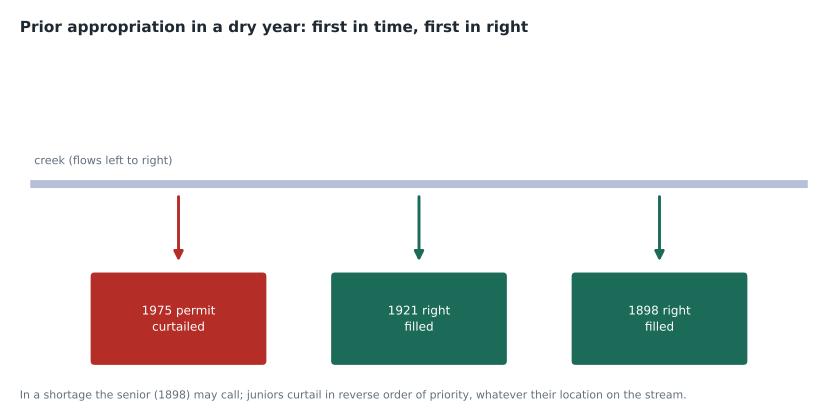
Montana follows the doctrine of prior appropriation, as do most western states. A water right is a right to use a quantity of water for a beneficial use, not ownership of the water itself. Rights are ranked by priority date: first in time is first in right. When there is not enough water for everyone, a senior appropriator may call for the water, and junior users must stop diverting until the senior's right is satisfied. Beneficial use is the basis, the measure and the limit of the right, so a user who stops using water for a long period may lose the right through abandonment.
The Montana Water Use Act of 1973
The Montana Water Use Act, in Title 85, Chapter 2 of the Montana Code Annotated, took effect July 1, 1973. It divides Montana water rights into two groups. Rights in existence before July 1, 1973, are existing rights, recognized and confirmed by the Constitution and adjudicated through the statewide general adjudication. Rights acquired on or after that date generally require a permit from the Department of Natural Resources and Conservation.
To obtain a new permit, an applicant must show, among other things, that water is physically and legally available, that the proposed use will not adversely affect the water rights of prior appropriators, that the means of diversion is adequate, that the use is beneficial and that the applicant has a possessory interest in the place of use. The Department's decisions are reviewable in court.
An existing right can also be changed. Moving the point of diversion, the place of use, the purpose of use or the place of storage requires authorization from the Department under Section 85-2-402. The central test is that the change must not adversely affect other water users, whether senior or junior. A change cannot enlarge the right: the historic use, measured by the amount actually and beneficially used, limits what may be changed.
Worked problem
Moving the headgate
The ranch family's 1898 irrigation right diverts from a creek at a headgate that washed out. They want to divert half a mile upstream. Between the old and new points, a neighbor with a 1950 right diverts from the same creek. What must they show?
Show solution
- A change in point of diversion requires Department authorization under Section 85-2-402.
- They must show no adverse effect to other appropriators. Moving upstream past the 1950 user could reduce flow at the neighbor's headgate if the family takes more water upstream than it historically took at the old point.
- The change is limited to historic beneficial use: the family must document how much water was actually used, often with records, aerial photographs and testimony.
- If the right has been decreed by the Water Court, the change application relies on the decreed elements; if not, the historic use must be shown.
Answer: The family can move the diversion if they prove historic use and no adverse effect, possibly with conditions such as measuring devices or limits on the flow rate.
The statewide adjudication and the Water Court
Before 1973, Montana had no centralized record of water rights. Many rights existed only by use, some had been decreed by local courts and some were recorded in county records of varying quality. The Legislature responded by ordering a statewide general adjudication of all pre-1973 rights. Claimants had to file statements of claim by a deadline in 1982, and the Montana Water Court, created in 1979, has been examining and decreeing those claims basin by basin ever since. The Department examines claims and reports issues to the court; the court issues temporary preliminary, preliminary and final decrees.
Failure to file a claim by the deadline created a conclusive presumption that the right had been abandoned, a result the Montana Supreme Court upheld. A Montana lawyer handling a ranch sale or a water dispute will therefore start by checking the claim file and decree status for every right involved. Federal and tribal reserved water rights are addressed through compacts negotiated with the United States and the tribes. The compact with the Confederated Salish and Kootenai Tribes, for example, was approved by Congress in December 2020.
Exempt wells
Not every groundwater use needs a permit. Under Section 85-2-306, a well or developed spring that appropriates no more than 35 gallons a minute and no more than 10 acre-feet a year may be developed without a permit, with a notice of completion filed afterward. These exempt wells serve most rural homes. Their cumulative effect on streams has long been controversial. In Clark Fork Coalition v. Tubbs (2016), the Montana Supreme Court held invalid a Department rule that had allowed many wells in a single development to qualify as separate exempt appropriations, and new litigation over exempt wells was filed in late 2025. A lawyer advising a subdivision developer must check the current rules.
Stream access
Water law includes public rights as well as private ones. In Montana Coalition for Stream Access v. Curran (1984), the Montana Supreme Court held that under the Montana Constitution and the public trust doctrine, the public may use rivers and streams that are capable of recreational use, regardless of who owns the streambed. The Legislature codified the rule in the Stream Access Law of 1985. The public may use such waters up to the ordinary high-water mark, but the law does not allow crossing private land to reach a stream. Questions about access at bridges and about portage around obstructions arise regularly.
| Question | Montana rule |
|---|---|
| Who owns water? | The state, for the use of its people; users hold rights to use (Article IX, Section 3) |
| How are rights ranked? | By priority date; first in time is first in right |
| New use after July 1, 1973? | Generally a Department permit |
| Change of an existing right? | Department authorization under Section 85-2-402; no adverse effect; limited to historic use |
| Pre-1973 rights? | Statewide adjudication; Water Court decrees |
| Small groundwater wells? | Exempt up to 35 gallons a minute and 10 acre-feet a year (Section 85-2-306) |
| Public recreation on streams? | Allowed up to the ordinary high-water mark (Curran; Stream Access Law) |
Employment: the Wrongful Discharge from Employment Act
The second file raised a different question. In nearly every state, an employee without a contract can be fired for any reason or no reason, as long as the reason is not illegal. Montana changed that in 1987 with the Wrongful Discharge from Employment Act, Sections 39-2-901 through 39-2-915. It remains the only state statute of its kind. The Act sets the rules for discharge claims and is the exclusive remedy for wrongful discharge, displacing common-law claims such as breach of the covenant of good faith in the employment relationship.
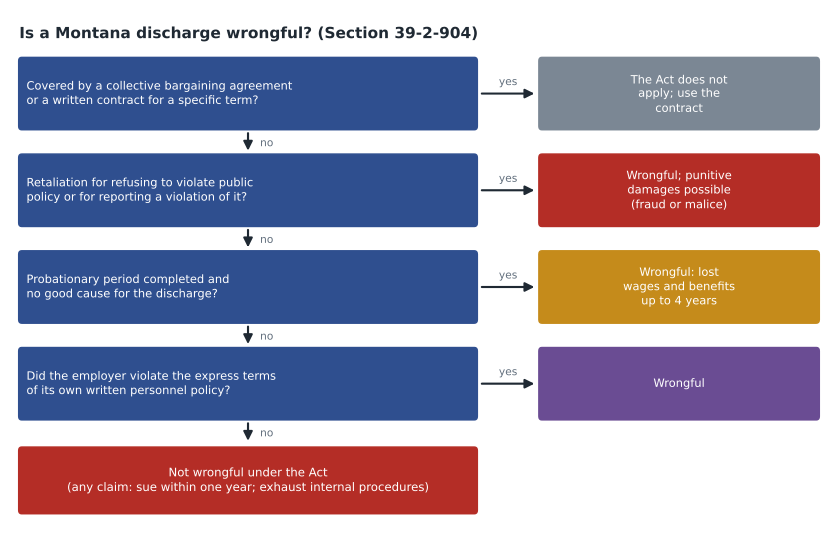
Under Section 39-2-904, a discharge is wrongful in three situations: when it was in retaliation for the employee's refusal to violate public policy or for reporting a violation of public policy; when it was not for good cause and the employee had completed the employer's probationary period; or when the employer violated the express provisions of its own written personnel policy.
Good cause is defined in Section 39-2-903 as reasonable job-related grounds for dismissal based on a failure to satisfactorily perform job duties, disruption of the employer's operation, or other legitimate business reason. Montana courts give employers latitude in business judgments, particularly for managers and employees in positions of trust, but a reason that is false, whimsical or pretextual is not good cause.
The probationary period matters because the good-cause requirement does not protect an employee who has not completed it. The employer may set a probationary period, and the statute supplies a default when the employer does not. The Legislature revised the Act in 2021, including the rules on probationary periods and on the employer's internal procedures, so a lawyer must read the current text rather than older cases describing the earlier version.
Remedies and limits
The Act limits damages. Under Section 39-2-905, a wrongfully discharged employee may recover lost wages and fringe benefits for up to four years from the date of discharge, with interest, reduced by interim earnings and by what the employee could have earned with reasonable diligence. Damages for pain and suffering, emotional distress and similar harms are not available. Punitive damages are available only if the employee proves by clear and convincing evidence that the employer engaged in actual fraud or actual malice in a discharge in retaliation for refusing to violate or reporting a violation of public policy.
The Act does not apply to a discharge subject to a collective bargaining agreement or to an employee covered by a written contract for a specific term, and it does not displace other statutes that provide their own remedies, such as discrimination claims under the Montana Human Rights Act.
Procedure is strict. An action must be filed within one year after the discharge. If the employer has written internal procedures under which an employee may appeal a discharge, and has told the employee about them as the statute requires, the employee must first exhaust them, and the limitations period is tolled while the employee does so, subject to statutory limits. The Act also encourages arbitration: a party who makes a valid written offer to arbitrate that the other side rejects, and who then prevails, may recover attorney fees.
Worked problem
The hardware store manager
The assistant manager worked three years at the store and received good reviews. In September 2026 the owner fired him, saying only that it was time for a change. The store has a written grievance procedure, which the owner mentioned at the time of discharge. What should the firm do?
Show solution
- Coverage: no union contract and no fixed-term written contract, so the Act applies.
- Probation: three years of employment means the probationary period was completed under any likely policy.
- Good cause: time for a change is not a job-related ground based on performance, disruption or a legitimate business reason, unless the employer can show one, such as a documented restructuring.
- Procedure: the firm sent a grievance letter in October 2026 to exhaust the internal procedure; the one-year limitations period runs from the September 2026 discharge, tolled while the procedure is pending under the statute.
- Remedies: lost wages and benefits up to four years, less interim earnings; no emotional distress damages; consider a written offer to arbitrate for fee leverage.
Answer: The client has a strong claim if the employer cannot articulate a legitimate business reason. The firm must track the limitations period carefully.
Why both matter for a new lawyer
Brynn noticed that the two statutes shared a feature: both replaced a common-law system with a statutory one that has its own procedures, its own agency or forum and its own limits. A lawyer who tries to handle a water change by thinking about ownership of land, or a firing by thinking about at-will employment, will get the analysis wrong from the start. 'Read the statute first,' Marchetti said, 'then the cases.'
Common mistakes
MistakeLandowners own the water flowing across their land.
InsteadWater belongs to the state for the use of its people; users hold rights of use ranked by priority.
MistakeAny well on rural land needs a Department permit.
InsteadWells within the 35 gallons a minute and 10 acre-feet limits are exempt, subject to the rules on combined appropriations.
MistakeMontana employers may fire employees at will after any probationary period.
InsteadAfter the probationary period, the Wrongful Discharge from Employment Act requires good cause.
MistakeA wrongfully discharged Montana employee can recover emotional distress damages.
InsteadThe Act limits recovery to lost wages and benefits for up to four years, plus punitive damages only in narrow cases.
Summary and key terms
- Article IX, Section 3 makes water state property subject to appropriation; Montana follows prior appropriation by priority date.
- The Water Use Act (effective July 1, 1973) requires permits for new uses and Department authorization for changes under Section 85-2-402.
- Pre-1973 rights are adjudicated statewide by the Water Court; exempt wells are limited to 35 gallons a minute and 10 acre-feet a year.
- Curran (1984) and the 1985 Stream Access Law allow public recreational use up to the ordinary high-water mark.
- The Wrongful Discharge from Employment Act (1987) makes discharge wrongful for public-policy retaliation, lack of good cause after probation or violation of written policy; damages are capped at four years of lost wages and benefits.
- 0
- prior appropriation
- 1
- priority date
- 2
- beneficial use
- 3
- change of appropriation
- 4
- Water Court
- 5
- exempt well
- 6
- good cause
- 7
- probationary period
Practice problems
Work each problem on paper first, then reveal the answer to check.
What must an applicant show to change the point of diversion of a Montana water right?
Show answer
Department authorization under Section 85-2-402, showing no adverse effect on other appropriators, limited to historic beneficial use.
What are the limits for an exempt well under Section 85-2-306?
Show answer
No more than 35 gallons a minute and no more than 10 acre-feet a year.
What are the three grounds for a wrongful discharge under Section 39-2-904?
Show answer
Retaliation for refusing to violate or reporting a violation of public policy; discharge without good cause after the probationary period; violation of the employer's written personnel policy.
What is the limitations period for a claim under the Wrongful Discharge from Employment Act?
Show answer
One year after the discharge, tolled while the employee exhausts required internal procedures.
Lesson quiz · 5 questions
Score 60% or more to complete this lesson.
Create a free account to save your progress, take quizzes and earn a certificate.