
BAR-227 · Lesson 4 of 12 · 19 min
The Montana UBE: format, scoring and the 266 passing score
▶ Video coming soon A video version of this lesson is on the way.
Brynn brought a page of numbers to her fourth session. Her classmate in Idaho had said a 270 was safe. A friend who sat in Washington had mentioned 266. A bar review ad promised to raise her MBE score by fifteen points. 'I know Montana is 266,' she said. 'What I do not know is how the MBE score and the essays turn into that number, and where my study hours do the most good.'
Hollis Marchetti drew a long horizontal line and marked it 0 at one end and 400 at the other. 'Everything on the UBE ends up on this line. Your MBE score, your essays and your performance tests are each converted to a common scale, weighted and added. In Montana, 266 or more passes. If you know how the weights work, you can decide where an extra hour of study is worth the most.'
This lesson explains the two days of the Montana exam, the three components and their weights, how written answers become scaled scores, what 266 means, how results are reported and what the numbers mean for study planning.
Two days in Helena
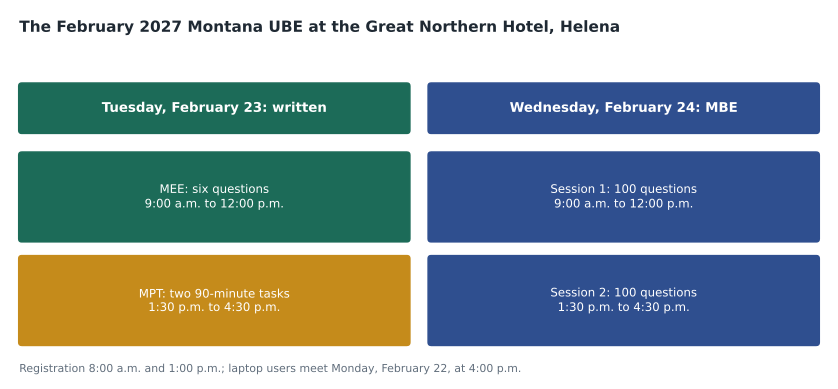
Montana gives the UBE twice a year, in late February and late July, in Helena. For February 2027, the Board's notice sets the exam at the Great Northern Hotel in Helena on Tuesday, February 23, and Wednesday, February 24. Laptop users attend a short meeting at 4:00 p.m. on Monday, February 22, to review the exam software and internet access.
Day one is the written day. Registration opens at 8:00 a.m., instructions begin at 8:30 and the Multistate Essay Examination starts at 9:00 and runs until noon. After lunch, registration reopens at 1:00, instructions begin at 1:15 and the Multistate Performance Test runs from 1:30 to 4:30. Day two is the Multistate Bar Examination, on the same timetable: session one from 9:00 to noon and session two from 1:30 to 4:30. Applicants with approved accommodations receive an individual schedule.
The three components
The Multistate Essay Examination gives six questions in three hours, so about thirty minutes per question. Since July 2026 the MEE covers business associations (agency and partnership, corporations and limited liability companies), civil procedure, constitutional law, contracts including Article 2 of the Uniform Commercial Code, criminal law and procedure, evidence, real property and torts. NCBE removed conflict of laws, family law, trusts and estates and secured transactions from the MEE starting with the July 2026 exam; NCBE says family law and trusts and estates may still appear on the MPT, with the law supplied, until the legacy exam ends.
The Multistate Performance Test gives two ninety-minute tasks in three hours. Each task supplies a file of facts and a library of law and asks for a practical document, such as an objective memo, a persuasive brief, a client letter or a contract provision. The law in the library may come from a fictional jurisdiction. The MPT tests lawyering skills rather than memorized rules.
The Multistate Bar Examination gives 200 multiple-choice questions in two three-hour sessions. Of the 200, 175 are scored and 25 are unscored pretest questions mixed in at random. The seven subjects are civil procedure, constitutional law, contracts, criminal law and procedure, evidence, real property and torts. The MBE is graded by NCBE.
| Component | Format | Time | Weight in UBE score |
|---|---|---|---|
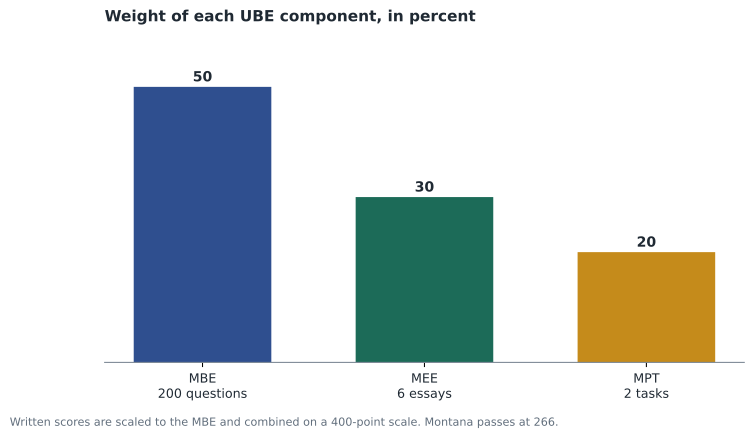
| MEE | Six essay questions | Three hours, morning of day one | 30 percent |
| MPT | Two performance tasks with file and library | Three hours, afternoon of day one | 20 percent |
| MBE | 200 multiple-choice questions (175 scored) | Six hours, day two | 50 percent |
From raw answers to a 400-point score
The MBE produces a scaled score directly from NCBE. Raw correct answers are converted through equating, a statistical process that adjusts for differences in difficulty between exam forms, so that a given scaled score represents the same level of performance whatever form a candidate took. MBE scaled scores are reported on a 200-point scale, and most fall between about 100 and 180.
The written components are graded by Montana graders, using NCBE's grading materials. Each MEE and MPT answer receives a raw grade. The raw written scores are then scaled to the MBE: the distribution of the group's written scores is lined up with the distribution of the same group's MBE scores. A candidate who writes well relative to the others who sat in Montana that session earns a high scaled written score.
Finally the components are weighted and combined onto the 400-point UBE scale. In effect, the MBE scaled score supplies half of the total, the scaled MEE supplies 30 percent and the scaled MPT supplies 20 percent. A useful shortcut: the UBE total is roughly the MBE scaled score plus the scaled written score, where the written score blends the MEE and MPT in a three-to-two ratio.
Worked problem
Computing a UBE score
A candidate earns an MBE scaled score of 131. Her written components, scaled to the 200-point MBE scale, are 138 on the MEE and 134 on the MPT. Does she pass in Montana?
Show solution
- Written score on the 200-point scale: (0.6 times 138) plus (0.4 times 134) = 82.8 + 53.6 = 136.4.
- UBE total on the 400-point scale: MBE 131 plus written 136.4 = 267.4.
- Equivalently: 0.5 times 131 times 2 (65.5 times 2 = 131), plus 0.3 times 138 times 2 (82.8), plus 0.2 times 134 times 2 (53.6) = 267.4.
- Compare with Montana's minimum of 266.
Answer: She passes with about 267, even though her MBE score alone was below the halfway mark of 133, because her written work was above average.
What 266 means
Montana's passing score is a combined scaled score of 266 on the 400-point scale. A candidate who scored exactly the same on every component would need about 133 on each, measured on the 200-point scale. National MBE means for July exams have generally been in the low 140s in recent years, and February means, with more repeat takers, run several points lower. In plain terms, a candidate who performs at about the national average for first-time takers should pass in Montana.
UBE passing scores range from 260 to 270 across jurisdictions. Montana's 266 sits in the middle. That matters for portability: a Montana score of 266 to 269 transfers to states with a 266 or lower cut score but not to those that require 270. A candidate who expects to move after a year or two should keep that in mind, because a score earned in Montana carries its number with it.
One administration, all components
Under the Rules, all components must be passed in a single administration, and component scores cannot be carried forward or transferred separately. A candidate who does well on the MBE in February but fails overall cannot keep the MBE score and retake only the written portion in July. Montana also does not accept a transferred MBE score from another jurisdiction by itself. A candidate who sat for the MBE elsewhere and wants to use it must either transfer a full UBE score that meets Montana's rules or take the whole exam again in Montana.
Montana does allow a concurrent application for admission by transferred score, which helps candidates who sit for the UBE in another state and want to be admitted in Montana as well. That route is covered in Lesson 11.
Results and the swearing-in
Under the Board's February 2027 notice, results are sent by email and by mail within eight weeks of the exam. They are not released early, and they become public only five days after the Board approves final grades, when the Administrator files the report with the Clerk of the Supreme Court. Pass and fail decisions are final and not subject to substantive review, though an unsuccessful candidate may review his or her own results for reexamination purposes within sixty days of the mailed notice.
A candidate who passes, has certified an MPRE score of 80, has completed the Montana Law Seminar and has been certified by the Commission is admitted at a ceremony set by the Supreme Court. For the February exam that is usually in early May in Helena. An applicant may petition to take the oath elsewhere, before a judge in another jurisdiction or before the Clerk or a Montana district judge. An applicant must be admitted within one year after meeting all the requirements, or the application terminates.
| Stage | February 2027 timing | Source |
|---|---|---|
| Exam | February 23 and 24, 2027 | Board notice |
| Montana Law Seminar | Distributed February 25; view by March 5, 2027 | Board notice |
| Results | Within eight weeks, by email and mail | Board notice |
| Results public | Five days after the Board approves grades | Rules and notice |
| Swearing-in | Usually early May 2027, in Helena | Board notice |
Exam-day rules worth knowing now
The Board's notice lists what may come into the exam room, and violations can be treated as cheating. Permitted items go in a one-quart clear plastic bag: the signed Montana Bar Examination Code of Conduct form, the government photo identification matching the copy submitted with the application, earplugs, a wallet, keys, tissues, medication, a non-digital watch and one clear plastic bottle of water, juice or soda per session. The Board supplies pens, pencils and erasers for the MBE, highlighters and scratch paper. Bags, mechanical pencils, hats and hoods, notes, phones, smartwatches and any device with an on-off switch are prohibited. Weapons are prohibited even with a permit.
Laptops are optional for the MEE and MPT and must be registered with ExamSoft in advance. A laptop user may switch to handwriting during the exam but may not switch to a laptop after registration closes, and every laptop user should be ready to handwrite if power or software fails.
What the numbers mean for study
Marchetti turned the weights into hours. 'Half your score is the MBE, so it gets the largest share of your time, but not all of it. The MPT is 20 percent and is the fastest component to improve: two tasks in one afternoon, and technique carries most of the score. The MEE is 30 percent and overlaps with the MBE subjects you already study.' For a candidate with about 400 study hours, she suggested roughly half for the MBE, a third for the MEE and the rest for the MPT, with at least six full timed MPT tasks before February.
Brynn rearranged her calendar. She kept MBE practice daily, moved two MPT tasks into each of the next six weeks and scheduled one full timed essay morning each week. 'I was treating the MPT as something to look at in the last week,' she said. 'It is a fifth of the score.'
Common mistakes
MistakeMontana adds Montana essay questions to the UBE.
InsteadMontana gives the UBE without added questions; the Montana Law Seminar is separate from the exam.
MistakeA candidate needs 133 on the MBE to pass.
InsteadThe 266 is a combined score; strong written work can offset a lower MBE score.
MistakeA good MBE score from a failed attempt can be kept for the next exam.
InsteadAll components must be passed in a single administration.
MistakeMontana accepts a transferred MBE score.
InsteadMontana accepts transferred UBE scores, not MBE scores alone.
What graders reward on the MEE
Because written scores are scaled within the group, a candidate gains most by doing what separates a good answer from an average one. Graders consistently reward answers organized by issue, with headings or clear paragraph breaks; answers that state the rule accurately before applying it; answers that use the facts in the question rather than restating rules in the abstract; and answers that reach a conclusion on each issue. They penalize answers that wander, bury the analysis under long rule statements or miss an obvious issue.
The call of the question controls. Each MEE question ends with one or more specific questions, and the best answers follow them in order. A candidate who writes a general essay about a subject, rather than answering each call, often loses credit even when the law is correct.
MPT technique in two tasks
With two ninety-minute tasks in one afternoon, pacing matters. A reliable approach is to read the task memo first and note exactly what document is requested, for whom and in what format. Then read the library, extracting the rules and how the cases applied them. Then read the file, looking for facts that fit those rules. Spend roughly the first forty minutes reading and organizing and the remaining fifty writing. Then stop and move to the second task, even if the first feels unfinished; an incomplete second task costs far more than a slightly rough first one.
Use only the law in the library. If the library is from a fictional jurisdiction, apply it even when Montana or federal law would differ, and cite it the way the task memo asks.
MBE pacing and review
The MBE gives 100 questions in each three-hour session, about 1.8 minutes per question. Because 25 of the 200 questions are unscored pretest items that cannot be identified, every question deserves full effort. Strong MBE preparation comes from working many realistic questions under time and reviewing every miss, including the ones answered correctly by luck. A miss log that records the rule behind each error, by subject, shows where the next week of study should go.
Summary and key terms
- Day one: the MEE (six questions, three hours) and the MPT (two tasks, three hours). Day two: the 200-question MBE.
- Weights: MBE 50 percent, MEE 30 percent, MPT 20 percent; written scores are scaled to the MBE.
- Montana's passing score is 266 on the 400-point scale.
- All components must be passed in one administration; Montana does not accept transferred MBE scores alone.
- Results come within eight weeks; the February swearing-in is usually in early May in Helena.
- 0
- MEE
- 1
- MPT
- 2
- MBE
- 3
- pretest question
- 4
- equating
- 5
- scaling
- 6
- UBE total score
- 7
- single administration
Practice problems
Work each problem on paper first, then reveal the answer to check.
What weight does the MPT carry in a Montana UBE score?
Show answer
20 percent.
A candidate has an MBE scaled score of 128 and a scaled written score of 139. Does the candidate pass?
Show answer
Yes: 128 plus 139 equals 267, which is at least 266.
Can a Montana candidate keep a strong MBE score from a failed exam?
Show answer
No. All components must be passed in a single administration.
When are February results usually released?
Show answer
Within eight weeks of the exam, by email and mail.
Lesson quiz · 5 questions
Score 60% or more to complete this lesson.
Create a free account to save your progress, take quizzes and earn a certificate.