
BAR-227 · Lesson 12 of 12 · 23 min
Capstone: Montana practice questions and an exam-day plan
▶ Video coming soon A video version of this lesson is on the way.
The final session of the course came in mid-November. Hollis Marchetti had planned it in two halves. In the first, Brynn would work three original problems on Montana law, the kind of fact patterns she would meet in the Montana Law Seminar and in her first year at Thorsen & Kittle. In the second, they would build her plan for the last twelve weeks before February 23 and for the two days in Helena. 'Two kinds of readiness,' Marchetti said. 'The exam tests general law, so that is where the hours go. But I want you to walk out of the seminar in March already knowing where Montana differs.'
This lesson works through three original Montana problems with model analysis in IRAC form, a set of short-answer drills on Montana admission rules and Montana law, a twelve-week study plan for the February 2027 UBE and a practical plan for each exam day. The problems are original and written for this course; they are not released bar exam questions, and they test Montana law, which the UBE itself does not.
Problem 1: The Judith Basin creek
Facts (hypothetical): The Pryor family owns a ranch in Judith Basin County with an irrigation right from a creek with a priority date of 1902, claimed in the statewide adjudication and decreed by the Water Court in a temporary preliminary decree. Upstream, a hay farmer holds a 1979 permit from the Department for the same creek. In July 2026, a dry month, the Pryors' headgate received a trickle while the farmer kept diverting. The Pryors also want to change their right from flood irrigation to sprinkler irrigation on a larger acreage, using the same amount of water. And their new neighbor drilled a domestic well producing 20 gallons a minute without a permit. Discuss the Pryors' rights and options.
Issue: whether the Pryors can stop the upstream diversion, whether they can expand their irrigated acreage and whether the neighbor's well is lawful.
Rule and analysis on the call: Montana follows prior appropriation under Article IX, Section 3 and the Water Use Act. The Pryors' 1902 right is senior to the farmer's 1979 permit. In a shortage, the senior may call for the water, and the junior must curtail diversions to the extent needed to satisfy the senior right. The Pryors can request enforcement through the district court, often with the help of a water commissioner appointed to distribute water under a decree, or through other enforcement procedures available under the Act. The temporary preliminary decree supports their claimed priority and flow rate.
Rule and analysis on the change: A change in place or purpose of use requires Department authorization under Section 85-2-402, with no adverse effect to other users. Converting from flood to sprinkler irrigation can increase consumptive use, because less water returns to the creek as return flow, even if the diversion stays the same. Expanding the acreage would enlarge the right beyond its historic consumptive use, which a change cannot do. The Pryors may change the method and place of use only within their historic consumptive use, and only if downstream users relying on return flows are not harmed.
Rule and analysis on the well: Under Section 85-2-306, a groundwater appropriation of no more than 35 gallons a minute and 10 acre-feet a year is exempt from the permit requirement, with a notice of completion filed after the well is completed. A 20-gallon-a-minute domestic well qualifies, provided the annual volume stays within the limit and it is not part of a combined appropriation that exceeds the limits.
Conclusion: The Pryors can call for water against the junior farmer. They can seek a change to sprinkler irrigation, but not an expansion of the acreage beyond their historic use, and the change must protect other users. The neighbor's well appears lawful if the notice of completion is filed.
Worked problem
Grading checklist for problem 1
What would a Montana practitioner look for in an answer to the Judith Basin problem?
Show solution
- Prior appropriation and seniority: 1902 is senior to 1979; the junior must curtail.
- Enforcement through the decree and water commissioner or other procedures under the Act.
- Change of use under Section 85-2-402: no adverse effect; historic consumptive use limits the change; return flow analysis.
- Exempt well limits: 35 gallons a minute and 10 acre-feet a year; notice of completion; combined appropriation caveat.
Answer: An answer that ranks the rights in its first paragraph and explains why a change cannot enlarge a right earns most of the credit.
Problem 2: The Great Falls warehouse
Facts (hypothetical): Cora Benteen managed a warehouse in Great Falls for a regional distributor for four years. Her reviews were strong. In 2026 she reported to the state that her employer was storing chemicals in violation of safety regulations. Two weeks later she was fired for what the employer called a poor attitude. The employer's handbook lists a progressive discipline procedure of verbal warning, written warning and suspension before termination for attitude problems; none was used. The handbook also has a written appeal procedure, which the employer described to Cora in her termination letter. Cora wants damages for lost wages and emotional distress, and she wants to sue in eighteen months, after she finishes a training program.
Issue: whether Cora's discharge was wrongful under the Wrongful Discharge from Employment Act, what remedies are available and whether her timing works.
Rule and analysis: Under Section 39-2-904, a discharge is wrongful if it was in retaliation for reporting a violation of public policy, if it was not for good cause after the employee completed the probationary period, or if the employer violated the express provisions of its written personnel policy. Cora's facts support all three. Reporting a safety violation to the state is reporting a violation of public policy, and the two-week gap suggests retaliation. After four years she has completed any probationary period, and a vague poor attitude without documentation is weak as good cause, which requires reasonable job-related grounds such as failure to perform duties, disruption or a legitimate business reason. And the employer skipped its own written progressive discipline procedure.
Remedies: Under Section 39-2-905, Cora may recover lost wages and fringe benefits for up to four years from the date of discharge, with interest, less interim earnings and what she could have earned with reasonable diligence. Emotional distress damages are not available. Punitive damages are available only if she proves by clear and convincing evidence that the employer acted with actual fraud or actual malice in a retaliatory discharge, which may be arguable on these facts.
Procedure: The action must be filed within one year after the discharge. Because the employer has a written appeal procedure and told her about it, she must first exhaust it, and the limitations period is tolled while she does so within the statute's limits. Waiting eighteen months to sue would almost certainly be too late. Either party may make a written offer to arbitrate, which affects attorney fees.
Conclusion: Cora has a strong claim on all three grounds, but she must exhaust the internal procedure and file within one year, as tolled. She cannot recover emotional distress damages under the Act.
Problem 3: The Missoula intersection and the county plow
Facts (hypothetical): In January 2026, a Missoula County snowplow backed out of a side road into the path of a car driven by Tom Aldous, who was driving slightly too fast for icy conditions. A pickup following Tom too closely then struck his car. A jury could find Tom 30 percent at fault, the county 45 percent and the pickup driver 25 percent. Tom's damages are 1,200,000 dollars, including 500,000 dollars in noneconomic damages. The pickup driver has a 100,000-dollar policy and few assets. The county's adjuster has not paid any of Tom's medical bills, though the county's fault seems clear. Discuss.
Analysis on fault: Under Section 27-1-702, Tom's 30 percent is not greater than the combined 70 percent of the defendants, so he recovers, reduced by 30 percent, to 840,000 dollars. Under Section 27-1-703, neither defendant is more than 50 percent at fault, so each is severally liable only for its own share: the county for 45 percent of 1,200,000, or 540,000 dollars, and the pickup driver for 25 percent, or 300,000 dollars. Tom bears the risk that the pickup driver cannot pay beyond his policy.
Analysis on the county: The county is a governmental entity. Under Article II, Section 18 and Section 2-9-108, its liability is limited to 750,000 dollars per claim and 1.5 million dollars per occurrence, and it is immune from punitive damages. The 540,000-dollar share is within the cap. Tom must present his claim as the statutes require. The noneconomic damages are not capped, because the medical malpractice limit in Section 25-9-411 applies only to claims against health care providers.
Analysis on insurance: If the county's liability is reasonably clear, its liability carrier may owe Ridley payments of Tom's reasonably related medical expenses as they are incurred, before settlement. The Unfair Trade Practices Act lists unreasonable claim handling, and Section 33-18-242 gives third-party claimants an action for certain violations, generally after the underlying claim is resolved.
Worked problem
Grading checklist for problem 3
What would a grader look for in the Missoula problem?
Show solution
- Modified comparative negligence: 30 percent is not greater than 70 percent; recovery reduced to 840,000 dollars.
- Several liability for defendants at 50 percent or less: 540,000 and 300,000 dollars.
- Governmental limits of 750,000 and 1.5 million dollars; no punitive damages; claim presentation.
- No medical malpractice cap; Ridley payments and the UTPA third-party action.
Answer: The key move is recognizing that the 45 percent county share does not trigger joint and several liability, so the uninsured share stays with the pickup driver.
Short-answer drills
Marchetti ended the first half with rapid questions on the admission rules and Montana law. Brynn answered each in a sentence.
| Question | Answer |
|---|---|
| Passing UBE score in Montana? | 266 |
| MPRE score required? | 80, earned no earlier than three years before the first day of the exam |
| February filing deadline? | October 1 |
| How long is a transferred UBE score valid? | Three years from the first day of the administration, earned within three attempts |
| Montana Law Seminar for February 2027? | Online, distributed February 25, viewed by March 5 |
| First NextGen exam in Montana? | February 2028 |
| Civil jury verdict? | Two-thirds of the jury |
| Joint and several liability threshold? | More than 50 percent of fault |
| Governmental limits? | 750,000 dollars per claim, 1.5 million dollars per occurrence |
| Exempt well limits? | 35 gallons a minute and 10 acre-feet a year |
| WDEA lost wages limit? | Up to four years from discharge |
| CLE requirement? | 15 hours a year, including 2 Professional Fitness and Integrity hours |
The last twelve weeks
The second half of the session was about February. Because Montana gives the plain UBE, the plan was a standard UBE plan, adjusted for Brynn's strengths and her clerking hours, which she would reduce in January.
| Weeks | Focus | Milestones |
|---|---|---|
| 1 to 4 (late November to mid-December) | MBE subjects in rotation; one MEE essay a day; one MPT task a week | Miss log started; first full MBE practice set of 100 |
| 5 to 8 (mid-December to mid-January) | MBE weak subjects; two MPT tasks a week; full timed MEE mornings | Full simulated MBE day; laptop decision made (she will handwrite) |
| 9 to 11 (mid-January to early February) | Mixed MBE sets; MEE subjects that overlap with MBE; MPT timing | Fees paid by February 1; certification letter received; hotel confirmed |
| 12 (the last week) | Light review; sleep; logistics | Clear bag packed; route to the Great Northern Hotel checked |
The exam-day plan
Marchetti walked through both days hour by hour, using the Board's February 2027 schedule.
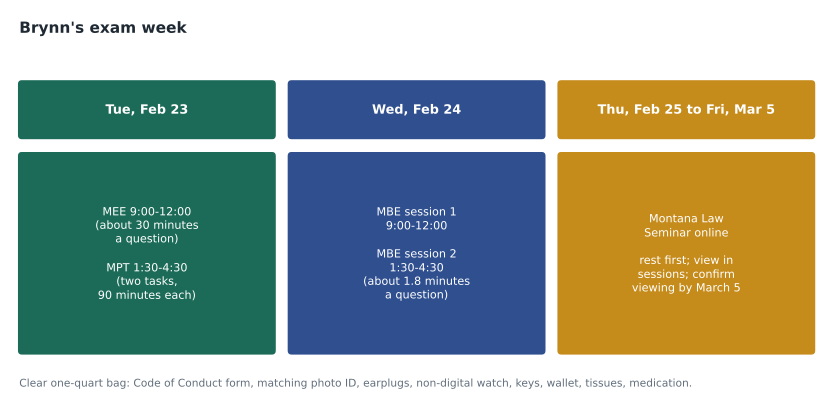
The night before, Brynn would stay in Helena, lay out her clear one-quart bag with the signed Code of Conduct form, her photo identification matching the copy she submitted, earplugs, a non-digital watch, keys, wallet, tissues and any medication, and set two alarms. No phone, smartwatch, mechanical pencil, hat or hood would go into the room.
On Tuesday, February 23, she would arrive before the 8:00 a.m. registration, take her assigned seat and listen to the instructions at 8:30. For the MEE from 9:00 to noon, she would read all six calls first, then spend about thirty minutes on each question, outlining briefly and writing in clear issue-by-issue paragraphs. At lunch she would eat outside the exam room, since food is not allowed inside, and not discuss the essays with anyone. For the MPT from 1:30 to 4:30, she would split the time roughly evenly between the two tasks, reading the task memo first, then the library, then the file, and following the format instructions exactly.
On Wednesday, February 24, the MBE: 100 questions from 9:00 to noon and 100 from 1:30 to 4:30, about 1.8 minutes per question. She would mark difficult questions, keep moving and leave no answer blank, since there is no penalty for wrong answers.
On Thursday, February 25, the Montana Law Seminar would be distributed online. She would rest that day and watch the seminar over the following week, well before the March 5 deadline, and confirm her viewing as the Board requires.
After the exam
Results would arrive by email and mail within eight weeks. If she passed, the swearing-in would likely be in early May in Helena. If she did not, she would review her results within sixty days, file a reexamination addendum at least twenty days before the July exam and sit again on the legacy format, the last legacy administration in Montana. Either way, her MPRE score of 88 was already on file, and she would not need to repeat the seminar.
Brynn closed her notebook. 'Twelve weeks of general law, two days in Helena, one week of Montana law on a screen,' she said. 'And then the real Montana law starts.' Marchetti agreed. 'That is the right order. You have done the hard part of understanding the system. Now go practice questions.'
Common mistakes
MistakeMontana capstone problems are what the UBE tests.
InsteadThe UBE tests general principles; these Montana problems prepare for the seminar and practice.
MistakeA change in irrigation method never needs Department approval.
InsteadChanges in place or purpose of use need authorization under Section 85-2-402, and increased consumptive use is a central issue.
MistakeA retaliatory discharge allows emotional distress damages under the Act.
InsteadThe Act limits damages to lost wages and benefits for up to four years, with punitive damages only in narrow cases.
MistakeThe county is jointly and severally liable whenever it is at fault.
InsteadJoint and several liability applies only to a defendant more than 50 percent at fault.
Summary and key terms
- Prior appropriation ranks water rights by priority; changes are limited to historic consumptive use and must not harm other users.
- The Wrongful Discharge from Employment Act offers three grounds, limited remedies and a one-year limitations period with exhaustion of internal procedures.
- Modified comparative negligence, several liability at 50 percent or less and governmental limits combine in multi-party crash cases.
- A twelve-week UBE plan balances MBE, MEE and MPT practice and handles fees, certification and logistics.
- Exam week: MEE and MPT on February 23, MBE on February 24, Montana Law Seminar online from February 25 to March 5.
- 0
- IRAC
- 1
- call for water
- 2
- consumptive use
- 3
- return flow
- 4
- exhaustion
- 5
- several liability
- 6
- miss log
- 7
- exam-day plan
Practice problems
Work each problem on paper first, then reveal the answer to check.
Can a senior appropriator require a junior to stop diverting in a shortage?
Show answer
Yes. In a shortage, the junior must curtail diversions to the extent needed to satisfy the senior right.
Why can converting flood irrigation to sprinklers be an adverse effect?
Show answer
It can increase consumptive use and reduce return flows that downstream users rely on.
A plaintiff is 30 percent at fault, defendants are 45 and 25 percent at fault. Is either defendant jointly and severally liable?
Show answer
No. Neither is more than 50 percent at fault, so each is severally liable for its own share.
When must Brynn finish viewing the Montana Law Seminar for the February 2027 exam?
Show answer
By Friday, March 5, 2027.
Lesson quiz · 5 questions
Score 60% or more to complete this lesson.
Create a free account to save your progress, take quizzes and earn a certificate.