
BAR-227 · Lesson 9 of 12 · 21 min
Montana's Constitution: privacy, a clean and healthful environment and the right to know
▶ Video coming soon A video version of this lesson is on the way.
Brynn had studied the federal Constitution for three years and the Montana Constitution for part of one seminar. At Thorsen & Kittle she discovered that the state document came up constantly. A client wanted to know whether a county commission could discuss a road closure behind closed doors. A ranch family asked whether a proposed mine upstream could be challenged on environmental grounds. And a criminal defense lawyer down the hall asked her to research whether a recording made by a police informant could be used at trial. 'Every one of those turned on the Montana Constitution, not the federal one,' she told Marchetti.
Marchetti was not surprised. 'Montana's 1972 Constitution is one of the most rights-protective state constitutions in the country. It protects privacy expressly, it guarantees a clean and healthful environment, and it gives the public a right to know what government is doing. Montana lawyers argue it first and the federal Constitution second.'
This lesson covers the 1972 Constitution and how Montana courts read its Declaration of Rights, the right of privacy and its application to searches and personal decisions, the 2024 amendment on pregnancy decisions, the right to a clean and healthful environment from MEIC to Held v. State, and the rights to know and to participate.
The 1972 Constitution
Montana's current constitution was written by a constitutional convention of 100 elected delegates in 1972 and ratified by the voters later that year by a narrow margin. It replaced the 1889 constitution adopted at statehood. The delegates wrote a long Declaration of Rights in Article II, adding rights that appear in no federal text, and they wrote environmental and natural resource provisions in Article IX. The convention transcripts are a major source for interpreting the document, and Montana courts cite them regularly.
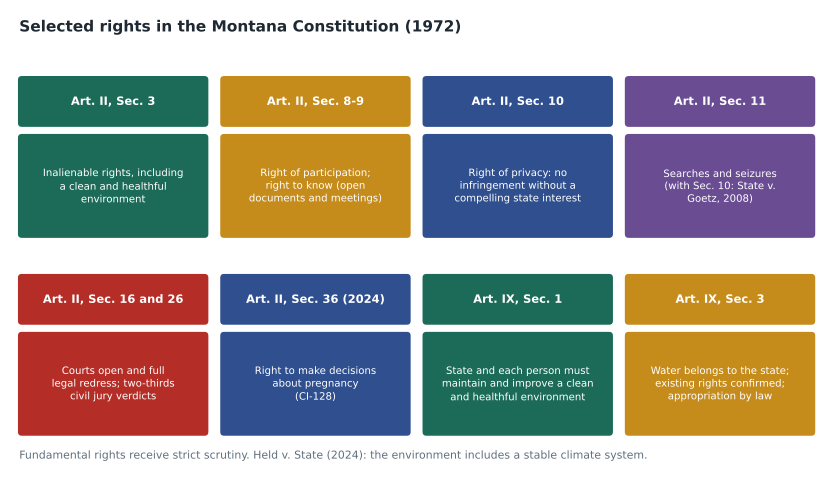
Montana courts treat the rights in Article II as fundamental. A law that infringes a fundamental right is reviewed under strict scrutiny: the state must show a compelling interest and that the law is narrowly tailored to serve it, using the least onerous path available. Montana courts interpret their constitution independently of federal decisions and have often found that it gives more protection than the United States Constitution in parallel areas.
The right of privacy
Article II, Section 10 states that the right of individual privacy is essential to the well-being of a free society and shall not be infringed without the showing of a compelling state interest. The federal Constitution has no comparable express clause; federal privacy doctrine is built from several amendments and the Due Process Clause. Montana's text makes privacy a fundamental right in its own words.
The Montana Supreme Court has applied Section 10 to personal decisions. In Gryczan v. State (1997), it struck down a statute criminalizing consensual sexual conduct between adults of the same sex, holding that it violated the right of privacy, years before the United States Supreme Court reached a similar result under the federal Constitution in 2003. In Armstrong v. State (1999 MT 261), the Court held that the right of privacy protects a person's right to obtain a lawful medical procedure, including a pre-viability abortion, from a qualified health care provider of the patient's choosing, and struck down a law limiting who could perform abortions.
Privacy and searches
Section 10 also works with Section 11, Montana's search and seizure clause, to give broader protection than the Fourth Amendment in some settings. The leading example is State v. Goetz (2008 MT 296). Under federal law, a conversation recorded by police with the consent of one participant, such as an informant wearing a wire, generally raises no Fourth Amendment problem. The Montana Supreme Court held that under Sections 10 and 11, the warrantless electronic monitoring and recording of a face-to-face conversation in the defendant's home, with only the informant's consent, violated the defendant's rights. Absent an established exception, police need a warrant for that kind of recording in Montana.
Worked problem
The informant's recording
Hypothetical: A police informant wears a recording device into Nils Ekberg's apartment in Bozeman and records a conversation about a drug sale, with the informant's consent but without a warrant. Nils's lawyer moves to suppress the recording. How would a Montana court analyze the motion?
Show solution
- Federal law: under the Fourth Amendment, one-party consent recordings generally are not searches, so the federal claim is weak.
- Montana law: under Article II, Sections 10 and 11, as applied in State v. Goetz, Nils had a reasonable expectation that a private conversation in his home would not be electronically recorded and transmitted without a warrant.
- Strict scrutiny: the state must show a warrant exception; absent one, the recording is the product of an unlawful search.
- Remedy: suppression of the recording, though the informant may still testify to what he heard.
Answer: The recording is likely suppressed under the Montana Constitution even though it would be admissible under federal law.
The 2024 amendment on pregnancy decisions
In November 2024, Montana voters approved Constitutional Initiative 128, which added Section 36 to Article II, titled the right to make decisions about pregnancy. It protects a right to make and carry out decisions about one's own pregnancy, including the right to abortion, and limits the government's ability to burden that right before fetal viability, with exceptions to protect the patient's life or health. The amendment wrote into the text a protection that the Court had already found within the right of privacy in Armstrong. Lawsuits over its meaning and application have followed, and a lawyer should check current decisions before advising on it.
A clean and healthful environment
The 1972 delegates wrote environmental protection into the Constitution twice. Article II, Section 3 lists among the inalienable rights of all persons the right to a clean and healthful environment. Article IX, Section 1 provides that the state and each person shall maintain and improve a clean and healthful environment in Montana for present and future generations, and directs the Legislature to provide for administration, enforcement and adequate remedies.
In Montana Environmental Information Center v. Department of Environmental Quality (1999 MT 248), the Montana Supreme Court held that the right to a clean and healthful environment is a fundamental right and that it is anticipatory and preventive. A plaintiff need not wait for actual harm to people or the environment before invoking it. The Court held that a statute exempting certain discharges from the state's nondegradation review was subject to strict scrutiny, because it allowed degradation without any review.
Held v. State (2024)
The right drew national attention in Held v. State. Sixteen young Montanans sued the state, arguing that a provision of the Montana Environmental Policy Act that barred agencies from considering greenhouse gas emissions and their climate effects in environmental reviews violated their right to a clean and healthful environment. After a trial in 2023, the district court ruled for the plaintiffs. On December 18, 2024, the Montana Supreme Court affirmed.
The Court held that a stable climate system is included in the clean and healthful environment the Constitution protects, that the plaintiffs had standing, and that the MEPA limitation was subject to strict scrutiny and failed it, because preventing agencies from even considering greenhouse gas emissions did not serve a compelling interest in a narrowly tailored way. The decision did not order the state to adopt any particular energy policy. Its practical effect was to require agencies to consider greenhouse gas emissions and climate impacts when MEPA review applies. The ruling has prompted continuing debate in the Legislature over MEPA, and a lawyer handling a permit challenge should check the current statute and any litigation over later amendments.
The right to know and the right of participation
Article II, Section 9 gives every person the right to examine documents and to observe the deliberations of all public bodies and agencies of state government and its subdivisions, except where the demand of individual privacy clearly exceeds the merits of public disclosure. Section 8 guarantees the public a reasonable opportunity to participate in the operation of government agencies before final decisions, as provided by law. Montana's open meeting and public participation statutes implement both provisions.
Section 9 requires balancing when privacy is at stake. Personnel records, medical information and similar materials may be protected, but only when the individual's privacy interest clearly exceeds the public interest in disclosure. Courts weigh whether the person had a subjective expectation of privacy that society recognizes as reasonable and then compare it with the merits of disclosure. Public officials performing official duties have a reduced expectation of privacy in that conduct.
Worked problem
The closed county meeting
A county commission plans to meet privately to discuss closing a county road used by a ranch client. The commissioners say the topic is sensitive and they want to talk frankly. Can they close the meeting?
Show solution
- Start with Article II, Section 9: deliberations of public bodies are open unless individual privacy clearly exceeds the merits of disclosure.
- A road closure is a public policy question; no individual privacy interest is at stake.
- Section 8 also guarantees the public a reasonable opportunity to participate before the commission decides.
- A decision made in an improperly closed meeting may be challenged under Montana's open meeting statutes, which provide remedies including voiding the decision.
Answer: The commission cannot close the meeting for this purpose. The client should attend, comment and preserve any objection.
Using the Montana Constitution in practice
Marchetti's practical advice was to raise state constitutional claims separately and clearly. Montana courts decide state constitutional questions independently, but they expect a lawyer to argue the Montana text, the convention record and Montana precedent rather than simply cite federal cases. A brief that says only that the Montana Constitution provides the same protection as the federal one invites the court to treat the claims as identical. A brief that explains why Montana's text and history call for more protection gives the court a reason to reach a different result.
Brynn's three questions now had answers. The county commission must deliberate in the open. The ranch family's challenge to the upstream mine would be framed around the right to a clean and healthful environment and the state's environmental review statutes. And the defense lawyer down the hall had a strong suppression motion under Goetz. 'I thought the Montana Constitution was a seminar topic,' Brynn said. 'It is half the practice.'
Common mistakes
MistakeMontana privacy protections are the same as federal ones.
InsteadArticle II, Section 10 expressly protects privacy and requires a compelling state interest; Montana courts have given broader protection, as in Goetz.
MistakeThe environmental right applies only after harm occurs.
InsteadMEIC held it anticipatory and preventive.
MistakeHeld v. State ordered Montana to adopt a climate policy.
InsteadHeld struck a MEPA provision barring consideration of greenhouse gas emissions; it did not order a specific policy.
MistakePublic bodies may close meetings whenever topics are sensitive.
InsteadSection 9 allows closure only when individual privacy clearly exceeds the merits of disclosure.
How Montana courts interpret the Constitution
Montana courts begin with the text, read in light of the intent of the framers. Because the 1972 convention kept a verbatim record of its debates, the transcripts are often decisive. In MEIC, for example, the Court relied on delegates' statements that they intended the environmental provisions to be the strongest in the nation and to protect against harm before it occurs. A lawyer making a state constitutional argument should cite the relevant convention debates as well as the case law.
Montana courts also decide state constitutional questions independently of federal law. When a Montana decision rests on the Montana Constitution and says so clearly, the United States Supreme Court will not review it, because it rests on an adequate and independent state ground. That is why Montana opinions in search and seizure and privacy cases often state expressly that they rely on Article II.
Preserving a state constitutional claim
A state constitutional argument must be raised and developed in the trial court. A brief that cites Article II only in passing, or argues only the federal Constitution, may lead the court to treat the state claim as waived or as no broader than the federal one. The practical rule is to give each state claim its own heading, quote the Montana text, explain the convention history if it helps and cite Montana precedent applying the provision.
Rights that bind private parties
Some Montana constitutional rights reach beyond the government. Article IX, Section 1 places the duty to maintain and improve a clean and healthful environment on each person as well as on the state, and Article II, Section 3 frames the environmental right as one of the inalienable rights of all persons. Whether and how those provisions apply directly to private conduct has been litigated, and a lawyer for a private developer or a neighboring landowner should research the current decisions rather than assume that only state action is covered.
Summary and key terms
- Montana's 1972 Constitution has an expansive Declaration of Rights; infringements of fundamental rights receive strict scrutiny.
- Article II, Section 10 protects privacy expressly; Gryczan and Armstrong applied it to personal decisions, and Goetz applied it with Section 11 to warrantless recordings.
- Constitutional Initiative 128 (2024) added Article II, Section 36 on pregnancy decisions.
- The right to a clean and healthful environment is fundamental and anticipatory (MEIC, 1999); Held v. State (December 18, 2024) held it includes a stable climate system.
- Sections 8 and 9 guarantee public participation and the right to know, subject to privacy that clearly exceeds the merits of disclosure.
- 0
- Declaration of Rights
- 1
- strict scrutiny
- 2
- right of privacy
- 3
- clean and healthful environment
- 4
- anticipatory and preventive
- 5
- stable climate system
- 6
- right to know
- 7
- right of participation
Practice problems
Work each problem on paper first, then reveal the answer to check.
What standard applies to a law infringing the Montana right of privacy?
Show answer
Strict scrutiny: a compelling state interest, with the law narrowly tailored to serve it.
What did State v. Goetz hold?
Show answer
Warrantless electronic monitoring and recording of a face-to-face conversation in the defendant's home, with only the informant's consent, violated Article II, Sections 10 and 11.
What did Held v. State decide?
Show answer
A stable climate system is part of the protected clean and healthful environment, and a MEPA provision barring consideration of greenhouse gas emissions was unconstitutional.
When may a Montana public body withhold documents or close a meeting under Section 9?
Show answer
Only when the demand of individual privacy clearly exceeds the merits of public disclosure.
Lesson quiz · 5 questions
Score 60% or more to complete this lesson.
Create a free account to save your progress, take quizzes and earn a certificate.