
BAR-227 · Lesson 5 of 12 · 19 min
Exam changes ahead: Montana and the NextGen bar exam
▶ Video coming soon A video version of this lesson is on the way.
Joanne Kittle, the younger partner at Thorsen & Kittle, stopped by Brynn's desk one afternoon with a printout. 'You saw that the Supreme Court approved NextGen?' she asked. 'Our summer clerk next year will be taking a completely different exam. Should we be worried about you?' Brynn was not sure, so she brought the printout to her next session.
Hollis Marchetti had been following the change for two years, and her answer was reassuring. 'You will take the exam Montana has given since 2013. Montana's first NextGen exam is in February 2028. Your February 2027 exam, and the July 2027 exam if you needed it, are legacy UBE administrations. But you should understand NextGen anyway, for two reasons. If you ever retake after July 2027, it will be NextGen. And as a lawyer you will supervise clerks and hire associates who took it.'
This lesson explains why the bar exam is changing, what NextGen looks like, how Montana adopted it and on what timetable, how scores will work during the transition and what the change means for candidates at different points in the process.
Why the exam is changing
NCBE designed the NextGen bar exam after a multi-year study of what newly licensed lawyers actually do. The study found that the existing exam put heavy weight on memorized rules across many subjects, while new lawyers spend much of their time on skills: legal research, writing, issue spotting, counseling clients and negotiating. NextGen tests fewer subjects in less depth and more skills, using integrated questions that mix knowledge and lawyering tasks.
The legacy UBE has been narrowing in the same direction. Starting with the July 2026 exam, NCBE removed conflict of laws, family law, trusts and estates and secured transactions from the MEE, bringing its subject list closer to NextGen's. Candidates sitting the legacy exam in Montana in February or July 2027 take that narrower MEE.
What NextGen looks like
NextGen is a single integrated exam given over a day and a half. Day one has six hours of testing and day two has three. The exam is organized in three sections of about three hours each. Each section contains multiple-choice questions, integrated question sets built around a common fact pattern and a performance task. The three kinds of questions are weighted in NCBE's published blueprint at roughly 49 percent for the stand-alone multiple-choice questions, 21 percent for the integrated sets and 30 percent for performance tasks.
The exam tests eight foundational concepts during the transition: business associations, civil procedure, constitutional law, contracts, criminal law, evidence, real property and torts. NCBE has announced that family law will be added as a foundational concept starting July 2028. It also tests seven foundational skills, including legal research, legal writing, issue spotting and analysis, investigation and evaluation, client counseling and advising, negotiation and dispute resolution, and client relationship and management. Some of the professional responsibility rules most often used in practice appear within the skills questions.
NextGen produces a single score on a new scale from 500 to 750, rather than the 400-point UBE scale. Each jurisdiction sets its own passing score on that scale, just as each sets its own UBE cut score today.
| Feature | Legacy UBE (Montana through July 2027) | NextGen (Montana from February 2028) |
|---|---|---|
| Length | Two full days (12 hours) | A day and a half (9 hours) |
| Structure | MEE, MPT and MBE as separate components | Three integrated sections with multiple choice, integrated sets and a performance task |
| Subjects | Seven MBE subjects plus business associations on the MEE | Eight foundational concepts; family law added July 2028 |
| Skills | Mostly through the MPT | Seven foundational skills throughout |
| Score scale | 400 points; Montana passes at 266 | 500 to 750; jurisdictions set passing scores |
| Delivery | Paper MBE; laptop optional for written work | Computer-based at the jurisdiction's site |
How Montana adopted NextGen
Montana adopted NextGen through the normal rulemaking process. The Montana Board of Bar Examiners and the State Bar of Montana jointly petitioned the Supreme Court to amend the Rules for Admission to require the NextGen Uniform Bar Examination, and asked that the change take effect with the February 2028 exam. On March 16, 2026, in its standing rules docket on admission, the Court issued an order giving the bench, the bar and the public sixty days to comment on the petition and directing that it be posted on the State Law Library and State Bar websites.
After the comment period, the Court approved the adoption. The State Bar announced that Montana will begin administering NextGen with the February 2028 bar exam as the current exam is phased out, and that the change preserves score portability for future lawyers. NCBE announced Montana's plans on July 17, 2026, in the same release as California's, which plans to begin with NextGen in July 2028.
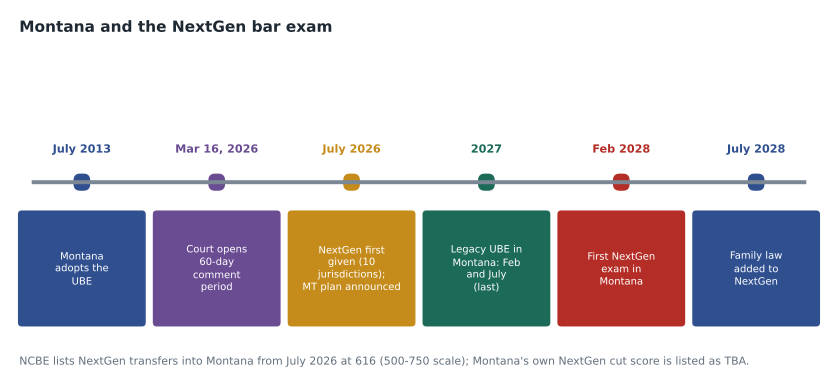
Montana's transition dates
NCBE's summary of Montana's rules lists the final legacy UBE administration in Montana as July 2027 and the first NextGen administration as February 2028. That means a Montana candidate has three legacy chances in the period after Brynn's graduation: July 2026 (already past), February 2027 and July 2027. A candidate who has not passed by July 2027 will take NextGen at the next Montana administration.
Other states are moving on different schedules. NextGen was first given in July 2026 in ten jurisdictions. Some states keep the legacy exam through February 2028, and NCBE reports that fifty-two jurisdictions have announced plans to adopt NextGen by July 2028. A Montana candidate who wants one more legacy attempt after July 2027 could, in principle, sit in another jurisdiction that still gives it and transfer the score, subject to Montana's transfer rules and that jurisdiction's eligibility rules.
Scores during the transition
Score portability is the main practical question during the change. Montana continues to accept transferred legacy UBE scores of 266 or more under the usual three-year and three-attempt rules. NCBE's summary of Montana's score portability rules also lists NextGen scores as accepted for transfer starting July 2026, with a minimum of 616 on the NextGen scale. The same summary lists Montana's own NextGen passing score as to be announced, so a candidate should check the Rules and the Board's announcements for the final figure before relying on it.
Worked problem
Who takes which exam?
Four candidates ask which exam applies: (1) Brynn, sitting in Montana in February 2027; (2) a candidate who fails in Montana in July 2027 and wants to retake in Montana; (3) a candidate who passed NextGen in Washington in July 2026 with a 640 and wants to transfer to Montana in 2027; (4) a 2027 law graduate planning to sit in Montana in February 2028.
Show solution
- Brynn: legacy UBE; 266 passes.
- July 2027 failure: the next Montana administration, February 2028, is NextGen.
- Washington NextGen score: NCBE lists Montana as accepting NextGen scores from July 2026 with a minimum of 616; 640 meets that figure, subject to the three-year limit and the other transfer requirements.
- February 2028 graduate: NextGen in Montana.
Answer: The date of the exam decides the format. Score transfers turn on Montana's portability rules for each kind of score.
What changes and what stays the same
Much of Montana's admission system will not change with the exam. The education rule, the character and fitness process, the MPRE score of 80 and the Montana Law Seminar are all separate from the exam format. The deadlines of October 1 and March 15 come from the Rules and do not depend on which exam is given, though the Rules may be amended in other ways as part of the transition, and candidates should watch for amendments.
What will change is how candidates study. NextGen rewards practice with integrated sets and performance tasks, timed reading of materials and fluency in lawyering tasks, more than memorizing long rule outlines. NCBE has published sample questions, a content scope outline and a tutorial for its computer-based testing software, and bar preparation companies have built NextGen courses around them.
What it means for Brynn and her firm
For Brynn, the practical advice was short. 'Study for the exam you are taking,' Marchetti said. 'February 2027 is the legacy UBE with the narrower MEE. If you pass, NextGen will never matter to your license. If you do not, you still have July 2027 on the legacy format, and that gives you time to adjust.' Brynn wrote it at the top of her plan: February 2027, legacy; July 2027, legacy backup; February 2028 and later, NextGen.
For Thorsen & Kittle, the change matters for hiring. A clerk who graduates in 2027 and sits in February 2028 will take NextGen, and an associate who moves to Montana from a NextGen state will arrive with a score on the 500 to 750 scale. Joanne Kittle asked Brynn to write a one-page summary for the partners, which became the table in this lesson.
Common mistakes
MistakeMontana began NextGen in July 2026.
InsteadMontana was not among the first jurisdictions; its first NextGen exam is February 2028.
MistakeNextGen scores are on the same 400-point scale as the UBE.
InsteadNextGen uses a single score from 500 to 750.
MistakeThe MPRE requirement ends with NextGen.
InsteadThe MPRE score of 80 is a separate requirement under the Rules.
MistakeA candidate who fails in July 2027 can retake the legacy exam in Montana in February 2028.
InsteadMontana's February 2028 exam is NextGen.
Inside a NextGen section
NCBE's published blueprint describes each of the three sections in similar terms. A section contains about 40 stand-alone multiple-choice questions, two integrated question sets and one performance task. The stand-alone questions are paced at roughly the same speed as MBE questions. An integrated set gives a single fact pattern, sometimes with documents, followed by several questions that may be multiple choice or short written answers, and the set may move from analysis to counseling to drafting. A performance task gives a file and a library and asks for a written work product, much like the MPT, though NextGen includes longer research-focused tasks that weigh the use of legal sources more heavily.
Some questions on each exam are unscored pretest questions, as on the MBE. Within a section, candidates may generally work in any order, so pacing across the three kinds of questions becomes part of the skill.
Studying for NextGen if you need to
A candidate who expects to sit in Montana in February 2028 or later should start with NCBE's materials: the content scope outline, which lists the topics tested under each foundational concept and marks some as tested only with legal resources supplied; the sample questions and performance tasks; and the tutorial for the testing software. Bar preparation courses for NextGen build around the same materials.
The biggest change in study habits is practice with mixed question types. A candidate who has studied only by reading outlines and answering stand-alone multiple-choice questions will find integrated sets unfamiliar. Regular practice with sets and performance tasks under time builds the skill of moving quickly from reading to analysis to writing.
What does not change
Several things carry over from the legacy UBE. The core legal subjects are still civil procedure, constitutional law, contracts, criminal law, evidence, real property, torts and business associations. Performance tasks still reward reading the task memo carefully, using only the library and following the requested format. And the habits of good exam preparation, such as a study calendar, a miss log and full timed practice, remain the best predictors of success.
Watching for announcements
Because Montana's NextGen passing score is listed as to be announced in NCBE's summary, and because rule amendments may accompany the transition, candidates planning for 2028 should check the State Bar's admissions page and the Court's orders regularly. The Montana Supreme Court publishes orders on admission rules in its rules docket, and the State Bar posts news items and exam information sheets for each administration. A candidate who relies on a classmate's memory of a rule from an earlier year risks missing a change.
Marchetti suggests that Montana firms hiring 2027 and 2028 graduates ask candidates which exam they will take and plan for the timing of results. A NextGen candidate in February 2028 will receive results on the Board's schedule for that exam, and the firm's start date and supervision plan should allow for it.
Two scales, two numbers
During the transition, Montana lawyers and employers will see two kinds of scores. A legacy UBE score is a number on the 400-point scale, and in Montana it passes at 266. A NextGen score is a number on the 500 to 750 scale, and NCBE lists Montana's minimum for transferred NextGen scores as 616. The two numbers measure different exams on different scales, so they cannot be compared by simple arithmetic. A hiring partner reading a resume should ask which exam a candidate took and check the number against the right standard, and a candidate should report the exam and the scale along with the score.
The same care applies to score reports from other jurisdictions. A candidate who took NextGen in another state receives a score report from that state's admitting authority and NCBE. When transferring the score, the candidate should request that NCBE send it to Montana and confirm that the score, the exam date and the number of attempts appear correctly in the file.
Summary and key terms
- NextGen tests eight foundational concepts and seven skills in about nine hours over a day and a half, scored from 500 to 750.
- The Court sought comment on the Board and State Bar petition on March 16, 2026, then approved NextGen; NCBE announced Montana's plans on July 17, 2026.
- Montana's last legacy UBE is July 2027 and its first NextGen exam is February 2028.
- Montana keeps accepting legacy UBE scores of 266; NCBE lists NextGen transfers from July 2026 at a minimum of 616, with Montana's own NextGen cut score listed as to be announced.
- The education rule, character and fitness, the MPRE score of 80 and the Montana Law Seminar remain.
- 0
- NextGen bar exam
- 1
- foundational concepts
- 2
- foundational skills
- 3
- integrated question set
- 4
- performance task
- 5
- legacy UBE
- 6
- score portability
- 7
- transition period
Practice problems
Work each problem on paper first, then reveal the answer to check.
When is Montana's first NextGen exam?
Show answer
February 2028.
What is the last legacy UBE administration in Montana?
Show answer
July 2027, according to NCBE's summary.
On what scale are NextGen scores reported?
Show answer
A single score from 500 to 750.
Which Montana requirements are unaffected by the change of exam?
Show answer
The education rule, character and fitness, the MPRE score of 80 and the Montana Law Seminar.
Lesson quiz · 5 questions
Score 60% or more to complete this lesson.
Create a free account to save your progress, take quizzes and earn a certificate.