
BAR-227 · Lesson 7 of 12 · 20 min
Montana courts, civil procedure and tribal jurisdiction
▶ Video coming soon A video version of this lesson is on the way.
The bar exam was behind her in this part of the course; Marchetti had told Brynn to read Lessons 7 to 10 after February 24, when the Montana Law Seminar and her first months of practice would bring the same topics. But Brynn read ahead during a slow week at the firm, because a file on her desk raised a question she could not answer from law school. A client of Thorsen & Kittle, a feed supplier in Lewistown, had sold hay to a rancher who lived on the Fort Belknap Reservation and had not been paid. Joanne Kittle wanted to know where the supplier could sue. 'District court in Blaine County?' Brynn guessed. 'Tribal court? Federal court? I honestly do not know.'
Marchetti used the question to frame the session. 'A Montana lawyer works with more court systems than most lawyers in other states: state courts, a single appellate court, specialized water and workers' compensation courts, federal court and the courts of the tribal nations. Before you can answer where to sue, you need the map.'
This lesson covers the structure of the Montana courts, the Montana Rules of Civil Procedure and the main ways they differ from federal practice, limitations periods a new lawyer needs early, appeals, and the basic rules on civil jurisdiction in Indian country.
The Montana Supreme Court
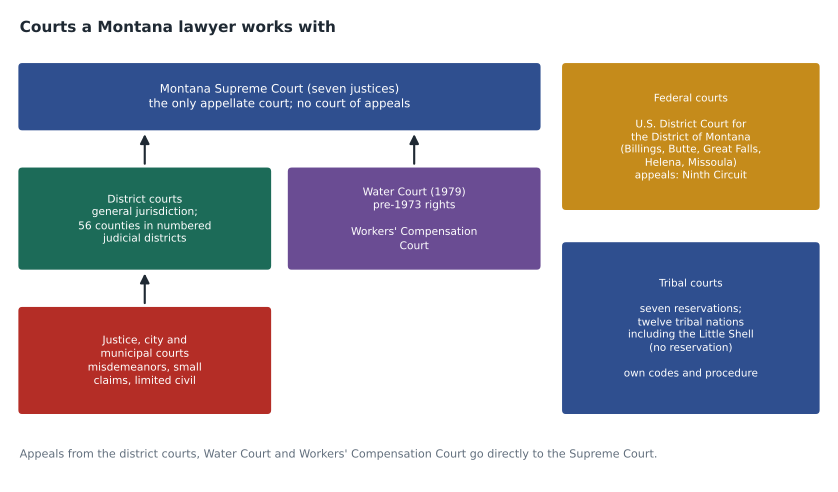
The Montana Supreme Court is the state's highest court and its only appellate court. Montana has no intermediate court of appeals, so appeals from the district courts go directly to the Supreme Court. The Court has seven members, a chief justice and six justices, elected statewide in nonpartisan elections for eight-year terms. When a vacancy occurs between elections, the governor appoints a replacement, subject to confirmation by the state Senate. In 2021 the Legislature abolished the Judicial Nomination Commission that had screened candidates, and the Court upheld that change in Brown v. Gianforte, 2021 MT 149.
Because every appeal goes to the Supreme Court, it hears a large and varied docket, from criminal appeals to water cases to family law. It also exercises original jurisdiction, for example through writs of supervisory control over district courts in urgent cases where the normal appeal process is inadequate. And it governs the legal profession: it adopts the rules of admission, professional conduct, civil and appellate procedure and evidence.
The district courts
The district courts are Montana's courts of general jurisdiction. Montana's 56 counties are grouped into numbered judicial districts, and each district has one or more district judges, elected in nonpartisan elections for six-year terms. District courts hear felony criminal cases, civil cases above the limits of the lower courts, family law, probate, juvenile cases and appeals from courts of limited jurisdiction. Their judges travel among the counties in their districts, so in rural Montana a judge may hold court in several county seats in a week.
A distinctive Montana feature is the right to substitute a district judge. By statute, a party may move to substitute the assigned district judge without stating a reason, subject to time limits and to a limit on the number of substitutions per side. The right is easy to lose by waiting, so a new lawyer should calendar the deadline as soon as a case is filed or served.
Courts of limited jurisdiction and specialized courts
Below the district courts are courts of limited jurisdiction: justice courts organized by county, city courts and municipal courts. They handle misdemeanors, traffic cases, small claims and civil cases up to statutory limits. Judges of some of these courts need not be lawyers. Appeals from them generally go to the district court.
Montana also has two specialized courts. The Montana Water Court, created in 1979, adjudicates claims to water rights that existed before July 1, 1973, as part of the statewide general adjudication discussed in Lesson 10. The Workers' Compensation Court decides disputes over benefits under the Workers' Compensation Act. Appeals from both go to the Supreme Court.
Federal court in Montana
The United States District Court for the District of Montana sits in divisions in Billings, Butte, Great Falls, Helena and Missoula. Appeals go to the Ninth Circuit. Federal jurisdiction follows the usual rules: federal questions, diversity of citizenship with more than 75,000 dollars in controversy, and the other categories set by Congress. Many Montana cases with an out-of-state party end up in federal court through removal.
The Montana Rules of Civil Procedure
Montana's Rules of Civil Procedure were comprehensively revised effective in 2011 to track the Federal Rules of Civil Procedure in numbering and much of their content. A lawyer trained in federal procedure will recognize the structure: pleadings under Rules 7 to 15, joinder under Rules 18 to 25, discovery under Rules 26 to 37, trial under Rules 38 to 53 and judgment under Rules 54 to 63. The overlap is deliberate, and Montana courts often look to federal decisions interpreting a similar federal rule.
The differences matter in practice. Several come from the Montana Constitution or statutes rather than the rules themselves. The most important is the civil jury: under Article II, Section 26 of the Montana Constitution, two-thirds of a jury may render a verdict in a civil action. Unanimity is not required. Montana's service of process rules in Rule 4 also differ in detail from federal Rule 4, and a new lawyer should read the Montana rule rather than assume the federal version applies.
| Topic | Federal practice | Montana practice |
|---|---|---|
| Rule numbering | Federal Rules of Civil Procedure | Montana Rules revised in 2011 to follow the federal numbering |
| Civil jury verdict | Unanimous unless the parties stipulate otherwise | Two-thirds of the jury may render a verdict (Article II, Section 26) |
| Changing the judge | Recusal only for cause | Statutory substitution of a district judge without cause, within time limits |
| Appeals | To the circuit court of appeals | Directly to the Montana Supreme Court; no intermediate court |
| Service of process | Federal Rule 4 | Montana Rule 4, which differs in detail |
Limitations periods a new lawyer meets early
Limitations periods are statutory and are found mainly in Title 27, Chapter 2 of the Montana Code Annotated. The ones a new lawyer meets most often include three years for most tort actions, including personal injury and property damage based on negligence; eight years for actions on a written contract; five years for actions on an oral contract; and two years for libel and slander. Medical malpractice claims must generally be brought within three years after the injury or its discovery, with an outside limit of five years from the act, subject to exceptions. Claims against government entities also require timely presentation of the claim, discussed in Lesson 8. Because the periods turn on the specific claim and on discovery and tolling rules, a lawyer should read the current statute for each claim rather than rely on memory.
Appeals to the Supreme Court
Appeals are governed by the Montana Rules of Appellate Procedure. An appeal from a final judgment is taken by filing a notice of appeal in the district court within the time set by the rules, generally 30 days after notice of entry of judgment, with a longer period in some cases involving the state. The appellant then orders transcripts, and the parties file briefs on the schedule the rules set. The Court decides many cases on the briefs and issues some decisions as noncitable memorandum opinions, marked with an N after the citation, such as 2024 MT 310N.
Montana uses a public-domain citation form: the year, MT and a sequential number, as in Brown v. Gianforte, 2021 MT 149. Montana courts expect that form in briefs, with a parallel citation to the Montana Reports or the Pacific Reporter where required.
Civil jurisdiction in Indian country
Montana is home to seven Indian reservations and twelve tribal nations, including the Little Shell Tribe of Chippewa Indians, which gained federal recognition in 2019 and does not have a reservation. Each reservation has its own government and court system. A Montana lawyer will regularly meet questions about which court has jurisdiction over a dispute involving tribal members or events on a reservation.
The basic framework comes from federal law and United States Supreme Court decisions. In Williams v. Lee (1959), the Court held that a state court could not hear a suit by a non-Indian trader against tribal members over a debt arising on the reservation, because doing so would infringe on the right of reservation Indians to make their own laws and be ruled by them. In Montana v. United States (1981), a case from the Crow Reservation, the Court held that tribes generally lack civil regulatory authority over nonmembers on land within the reservation owned in fee by non-Indians, with two exceptions: activities of nonmembers who enter consensual relationships with the tribe or its members, such as commercial dealings, contracts or leases, and conduct that threatens or has a direct effect on the political integrity, economic security, or health or welfare of the tribe. In United States v. Cooley (2021), another Crow Reservation case, the Court held that a tribal police officer could temporarily detain and search a non-Indian on a public highway running through the reservation, relying on the second Montana exception.
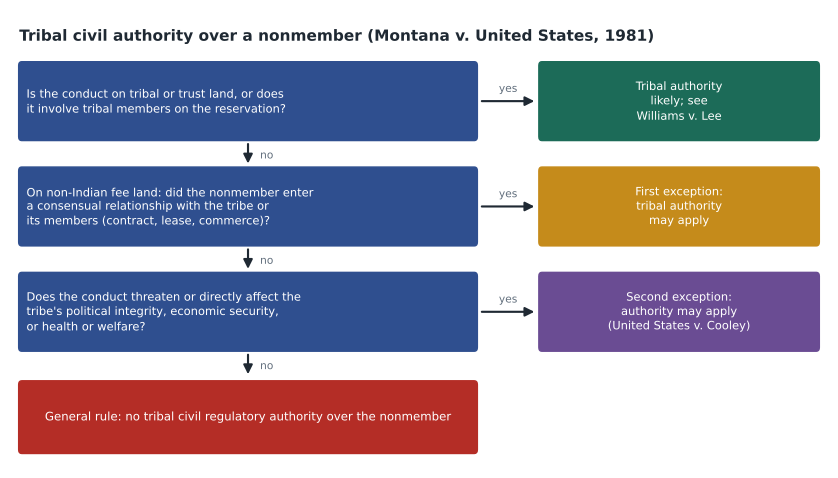
Applying the framework to the hay sale: the rancher is a tribal member living on the reservation, and the transaction, a sale and delivery of hay, took place at least partly there. Under Williams v. Lee, a state court suit against a tribal member over a reservation transaction may infringe on tribal self-government, and the tribal court is likely the proper forum, at least in the first instance. Federal courts have also developed a doctrine requiring parties to exhaust tribal court remedies before asking a federal court to decide whether a tribal court has jurisdiction. The supplier's lawyer must also read the tribe's own code, which governs filing, service and procedure in its court.
Worked problem
Where can the feed supplier sue?
A Lewistown feed supplier, not a tribal member, delivered hay to a ranch on the Fort Belknap Reservation owned by a tribal member. The member has not paid 18,000 dollars. Where should the supplier sue?
Show solution
- Identify the parties and the location: a nonmember plaintiff, a tribal member defendant, a transaction performed on the reservation.
- State court: under Williams v. Lee, a state court suit against a member over a reservation transaction risks infringing on tribal self-government; the defendant would likely challenge state jurisdiction.
- Tribal court: the tribe has authority over its members, and the supplier entered a consensual commercial relationship with a member; the tribal court is the likely forum.
- Federal court: there is no federal question, and the amount is below the 75,000-dollar diversity threshold, so federal court is not available for the claim itself.
- Practical steps: read the tribal code on civil actions, filing fees and service; consider whether the contract had a forum selection clause.
Answer: The tribal court is the most likely forum. A Montana lawyer should be ready to appear there and should learn its rules, including any requirements for advocates admitted before that court.
Why this matters for new lawyers
Brynn took the analysis back to Joanne Kittle, who smiled. 'That is why we keep the tribal codes on the shelf,' she said. A Montana lawyer in a small town may in a single week appear in justice court on a traffic case, district court on a divorce, the Water Court on a claim to an old irrigation right and a tribal court on a collection case. The Rules for Admission recognize part of that variety: they exempt certain Indian Child Welfare Act cases from the usual limits on pro hac vice appearances, and they exempt federal government lawyers appearing in Water Court matters.
Common mistakes
MistakeMontana has an intermediate court of appeals.
InsteadAppeals from the district courts go directly to the Montana Supreme Court.
MistakeCivil jury verdicts in Montana must be unanimous.
InsteadTwo-thirds of the jury may render a civil verdict under Article II, Section 26.
MistakeA party in Montana can change the district judge only by showing bias.
InsteadA statute allows substitution of a district judge without cause, within time limits.
MistakeState courts can always hear a contract suit against a tribal member.
InsteadUnder Williams v. Lee, state jurisdiction over reservation transactions with members may infringe tribal self-government.
Practice habits for Montana courts
Three habits help a new Montana litigator. First, read the local rules and standing orders of each district court and of the federal court before filing, because practices differ across judicial districts and judges. Second, calendar every deadline that can be lost by waiting, including the deadline to substitute a district judge, the time to answer, the time to appeal and claim presentation deadlines for governmental defendants. Third, check whether a matter involves a tribal member, tribal land or a reservation transaction at the intake stage, so that jurisdiction is analyzed before a complaint is filed in the wrong court.
Summary and key terms
- The seven-member Montana Supreme Court is the only appellate court; justices serve eight-year terms after nonpartisan elections.
- District courts are courts of general jurisdiction covering the 56 counties; justice, city and municipal courts handle limited matters; the Water Court and Workers' Compensation Court are specialized.
- The Montana Rules of Civil Procedure were revised in 2011 to track the federal rules; two-thirds civil verdicts and judge substitution are key differences.
- Common limitations periods: three years for most torts, eight years for written contracts, five years for oral contracts, two years for defamation.
- Williams v. Lee and Montana v. United States frame civil jurisdiction in Indian country; United States v. Cooley applied the second Montana exception.
- 0
- Montana Supreme Court
- 1
- district court
- 2
- Water Court
- 3
- substitution of judge
- 4
- two-thirds verdict
- 5
- supervisory control
- 6
- Montana exceptions
- 7
- tribal court exhaustion
Practice problems
Work each problem on paper first, then reveal the answer to check.
Where does an appeal from a Montana district court go?
Show answer
Directly to the Montana Supreme Court.
How many jurors must agree on a civil verdict in Montana?
Show answer
Two-thirds of the jury.
What are the two exceptions in Montana v. United States?
Show answer
Consensual relationships with the tribe or its members, and conduct that threatens or directly affects the tribe's political integrity, economic security, or health or welfare.
What is the general limitations period for a written contract claim in Montana?
Show answer
Eight years.
Lesson quiz · 5 questions
Score 60% or more to complete this lesson.
Create a free account to save your progress, take quizzes and earn a certificate.